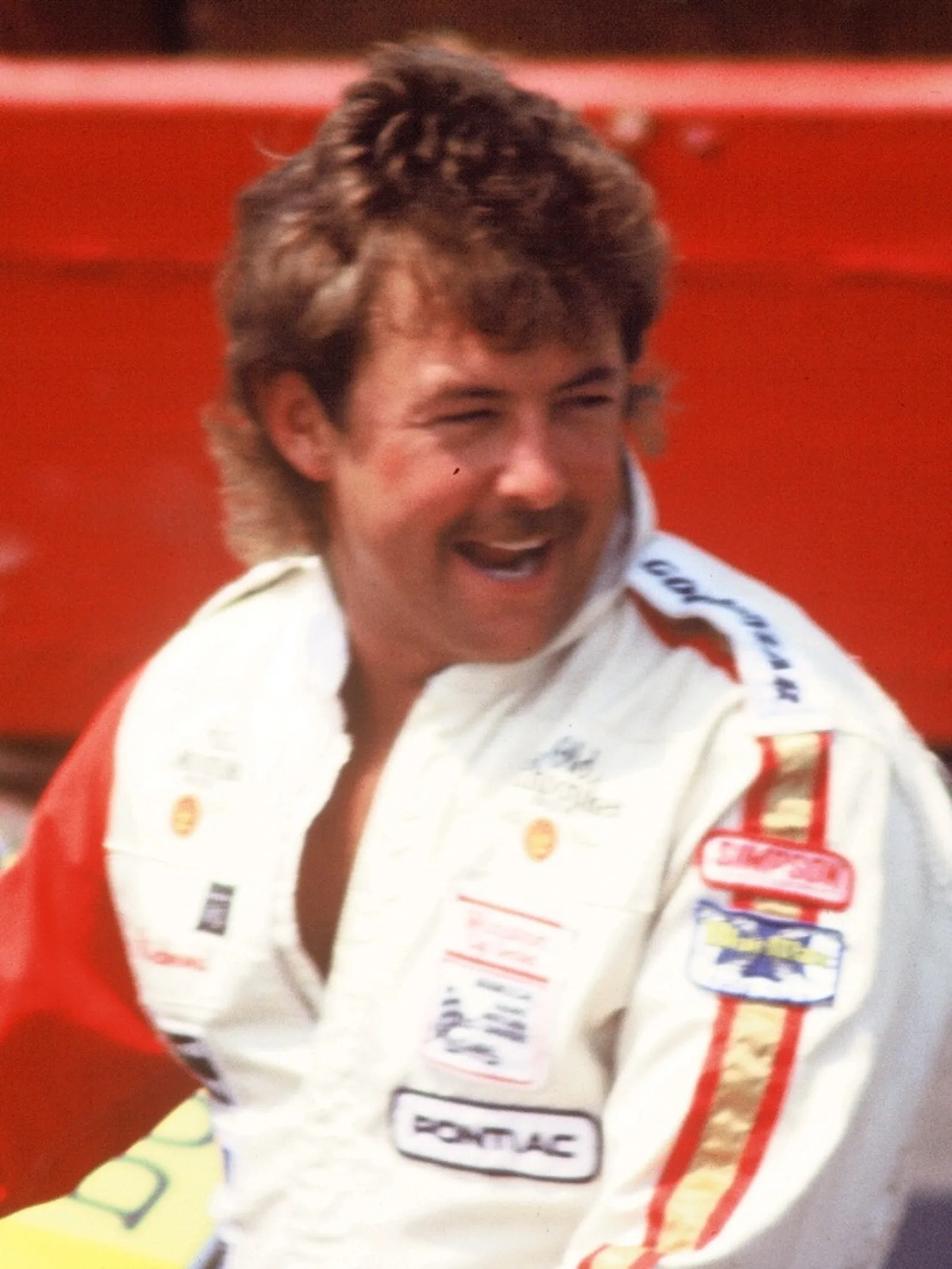
From Ashland, Ohio to the 1980 Indianapolis 500 and a 1986 season of seven wins, Tim Richmond's career was fast, brief and cut short by illness and a dispute with NASCAR.
Tim Richmond, born in Ashland, Ohio, competed in IndyCar before becoming one of the first drivers to switch full-time to NASCAR stock cars. He won 13 races in eight NASCAR seasons, including seven in 1986, before illness and a dispute with NASCAR ended his career.
Richmond's career was brief at the top level but unusually fast in its best years. He moved from open-wheel racing into NASCAR, took a third-place points finish in 1986, and then saw his career cut short by illness and a dispute with the sanctioning body.
Where did Tim Richmond grow up?
Richmond was born on 7 June 1955 and grew up in Ashland, Ohio. He had a go-kart as a toddler and attended Miami Military Academy in Miami, Florida, as a teenager. He earned a private pilot licence at 16.
His father founded a manufacturing company that exported machines around the world. Outside cars he was a conference-record hurdler, and in 1970 the academy chose him as its Athlete of the Year. He attended Ashland University for about a year before leaving.
At Miami Military Academy his football career was strong enough that the school retired his jersey once his playing days were over.
Seven wins and a third-place points finish in 1986, before a career that ended far earlier than its speed promised.
How did Richmond start racing?
Before taking the wheel himself, Richmond crewed for Dave Shoemaker on a sprint car team. In 1976, at the age of 21, he took a car onto Lakeville Speedway for practice laps and was quicker than the team's regular driver. His first race in the car ended with a broken axle. A crash at Eldora Speedway later that season cost him the ride when his father dismissed him.
The next year his father bought him a SuperModified better suited to his style. That 1977 season brought a Rookie of the Year award at Sandusky Speedway and a SuperModified class title. In 1978 he ran the USAC national sprint car tour, finishing 30th in points and also taking the series' rookie honour.
That year he also attended Jim Russell's road school at Willow Springs and posted a record lap as a student. A win in a Formula Super Vee support race at Phoenix International Raceway, in a Lola T620, attracted sponsors and interest from major team owners, including Roger Penske.
What did Richmond achieve in IndyCar-era racing?
Richmond's open-wheel highlights came in 1979 and 1980. He qualified 15th and finished eighth at Watkins Glen in 1979, the best result of his open-wheel career. In the 1980 Indianapolis 500 he started nineteenth, worked into the top ten and finished ninth, which earned him Rookie of the Year honours.
His earlier 1979 race at Michigan International Speedway was less successful. He qualified 21st with a speed of 175.768 mph (282.871 km/h), against a pole speed of 203.879 mph (328.111 km/h) set by Bobby Unser. His engine failed on lap four, and he finished last.
That same year he tested Kenny Reece's unusual 3-to-1 Supermodified, which ran three wheels on its right side. The car was outlawed before it could race.
In the build-up to the 1980 Indianapolis 500 he posted the month's quickest unofficial practice lap, ahead of favourite Johnny Rutherford. A morning crash on the first qualifying day ended his pole hopes, and after repairs he lined up nineteenth.
Why did Richmond switch to NASCAR?
Richmond switched to NASCAR after Pocono Raceway president Joseph Mattioli III convinced him to try stock cars. His Cup debut came at Pocono's Coca-Cola 500 on 27 July 1980, where he was twelfth in a D. K. Ulrich Chevrolet, two months after the Indianapolis award.
He was among the first drivers to make the full-time jump from single-seaters to stock cars, a path that later became common. He stated that he had worried his open-wheel career might end after a series of crashes, and that the stock car offer seemed the safer route to keep racing.
How did Richmond's early NASCAR seasons go?
In 1980 Richmond competed in five events and finished 41st in the points. In 1981 he drove for three teams and recorded six top-ten finishes, a tenth at Bristol among them, to place 16th in the standings. The season ended with a run for Bob Rogers at Dover International Speedway.
His breakthrough came in 1982. Driving for J.D. Stacy, he placed fifth at Darlington on his first run for the team, finished second at Pocono and then won both races at Riverside. He also took his first career pole at Bristol, and he finished the season 26th in points with twelve top-ten finishes.
In 1983 he drove for Raymond Beadle with sponsorship from Old Milwaukee beer. He won at Pocono, his first oval victory, and took four poles at Darlington, Pocono, Charlotte and Atlanta. He finished tenth in the points, and in 1984 he won at North Wilkesboro and finished 12th.
Esquire magazine picked him as a standout of the new generation of stock car drivers in 1984. In 1985 he drove in two Busch Series races, qualifying on pole for both and winning the Charlotte race.
What does Richmond's NASCAR record look like season by season?
| Season | Team | Main result |
|---|---|---|
| 1980 | D. K. Ulrich | Debut at Pocono, twelfth; 41st in points |
| 1981 | Three teams | Six top-ten finishes; 16th in points |
| 1982 | J.D. Stacy | Two wins at Riverside; one pole; 26th in points |
| 1983 | Raymond Beadle | One win at Pocono; tenth in points |
| 1984 | Raymond Beadle | One win at North Wilkesboro; 12th in points |
| 1985 | Raymond Beadle | Second at Bristol, his best; eleventh in points |
| 1986 | Hendrick Motorsports | Seven wins; third in points |
| 1987 | Hendrick Motorsports | Two wins and one pole in eight starts |
What made the 1986 season his best?
Richmond joined Hendrick Motorsports in 1986 with crew chief Harry Hyde, driving the number 25 Folgers car. The team needed until mid-season to find its rhythm, and in June he broke a 64-race winless run at Pocono. He led 97 laps there, including the final thirty, and it was his first win in a Rick Hendrick car.
A rain stoppage before the halfway point meant the drivers circled under caution for 26 minutes while the track dried. Richmond resumed in third, and after his car was adjusted to remove the push he was more competitive. A month later he won a fog-shortened event at Pocono, crossing the line ahead of Ricky Rudd by 0.05 seconds.
He closed 1986 with seven wins, the most on tour, and third in the points, the best of his NASCAR career. The press association gave him its co-driver award alongside Dale Earnhardt.
How did illness affect Richmond's career?
He fell ill in 1986, around the time of a New York City promotional trip. He missed the 1987 Daytona 500, when his condition was reported as double pneumonia, and media later reported that he had AIDS. He returned to Pocono in mid-1987 and won the Miller High Life 500.
He had been hospitalised for an extended period in Cleveland and then rested at home before that race. The Miller High Life 500 win came from third on the grid. He led 82 laps, including the final 46, and won by eight car-lengths over Bill Elliott, even though a gearbox problem left him with only fourth gear in the pits.
He won again at Riverside later that year. His last start came at Michigan International Speedway in August, a 29th place after an engine blew. He left Hendrick in September 1987, and that season he started eight races, winning twice and taking one pole.
Why was Richmond suspended in 1988?
NASCAR suspended Richmond in 1988 after a drug test came back positive. The substances were later identified as an over-the-counter allergy medication and a pain reliever. He sued NASCAR in April 1988, and the suit was settled out of court with its terms sealed.
He was retested and reinstated later in 1988, but no team would give him a car. NASCAR had also asked for his full medical records, which he refused to release. A 2010 ESPN documentary recorded Bill France Jr., then NASCAR's president, calling the drug screen a flawed test.
At a Daytona press conference in February 1988, Richmond denied drug abuse and argued that the test had gone wrong. He then withdrew to his family's condominium in Florida, where he was later hospitalised in West Palm Beach.
How did Richmond's life end?
Richmond died on 13 August 1989, aged 34, roughly two years after his last NASCAR start. On 23 August his family said he had died from complications of AIDS. He was buried in Ashland, Ohio, the town where he had grown up.
The circumstances of his death drew speculation for several days. Earlier, one of his friends had said he was in hospital after a motorcycle accident, an account that was unlikely given his health.
Dr. Jerry Punch later said that more than 90 drivers and personnel were tested for HIV in the wake of his death.
What is Richmond's legacy?
Richmond is remembered for his speed, his 13 NASCAR victories and an early switch from single-seaters to full-time stock cars. He was inducted into the Ashland County Sports Hall of Fame in 1996 and the International Motorsports Hall of Fame in 2002.
In 1990 Washington station WJLA-TV and reporter Roberta Baskin alleged that a former NFL drug adviser had falsified tests that helped end his career early. The New York Times published the findings, and NASCAR confirmed it was seeking to replace that adviser.
NASCAR named him one of its 50 greatest drivers in 1998. A 2009 ARCA race at Mansfield Motorsports Park was renamed the Tim Richmond Memorial ARCA Re/Max 250, and ESPN's 30 for 30 series produced the documentary Tim Richmond: To The Limit, which premiered on 19 October 2010.
The character Cole Trickle in the film Days of Thunder was loosely based on Richmond. Later drivers have also paid tribute: in 2018 Dalton Sargeant drove a No. 25 truck for GMS Racing in his honour, and Alex Bowman and Tyler Reddick ran Richmond throwback schemes at Darlington in 2019 and 2024.