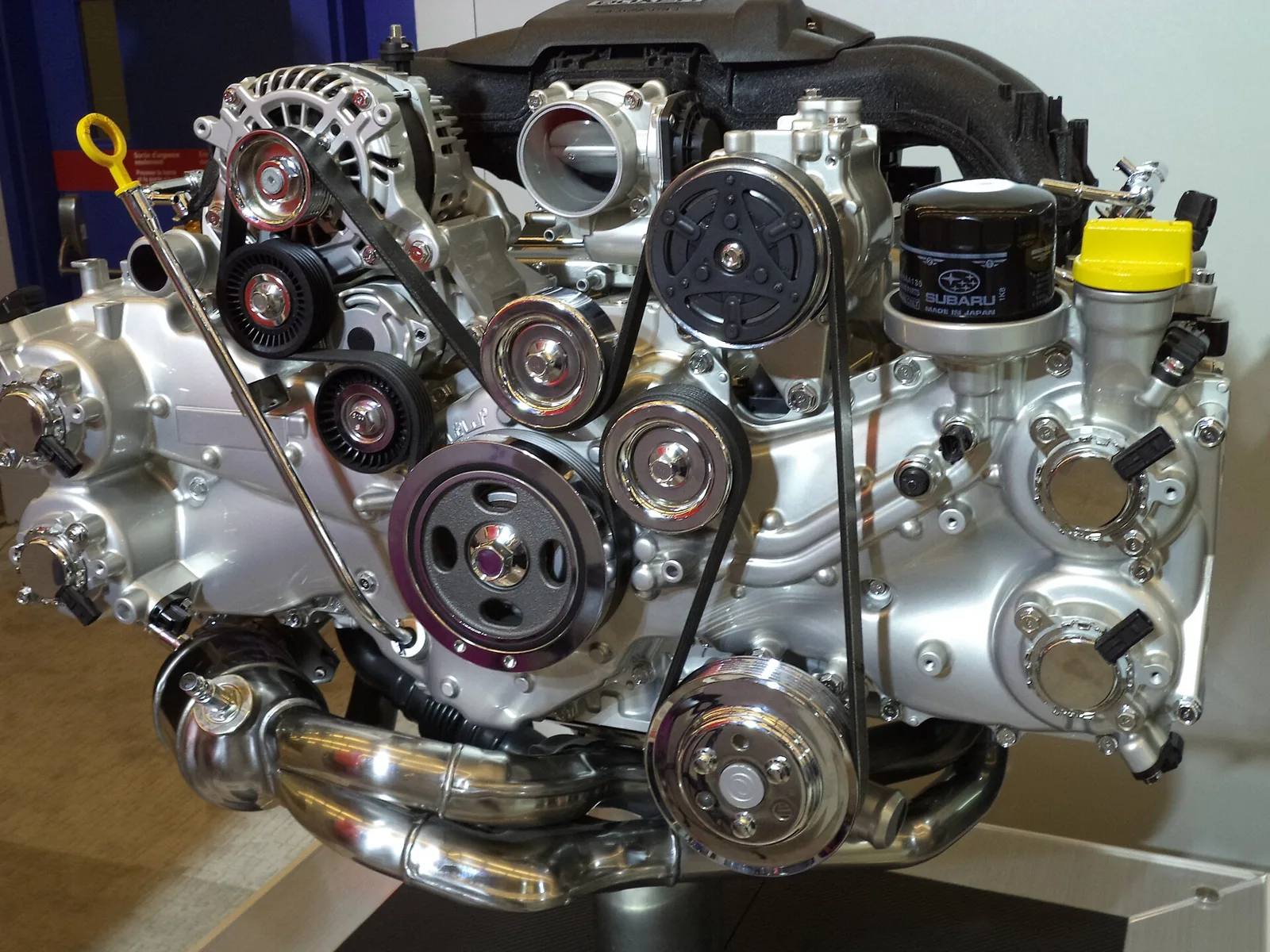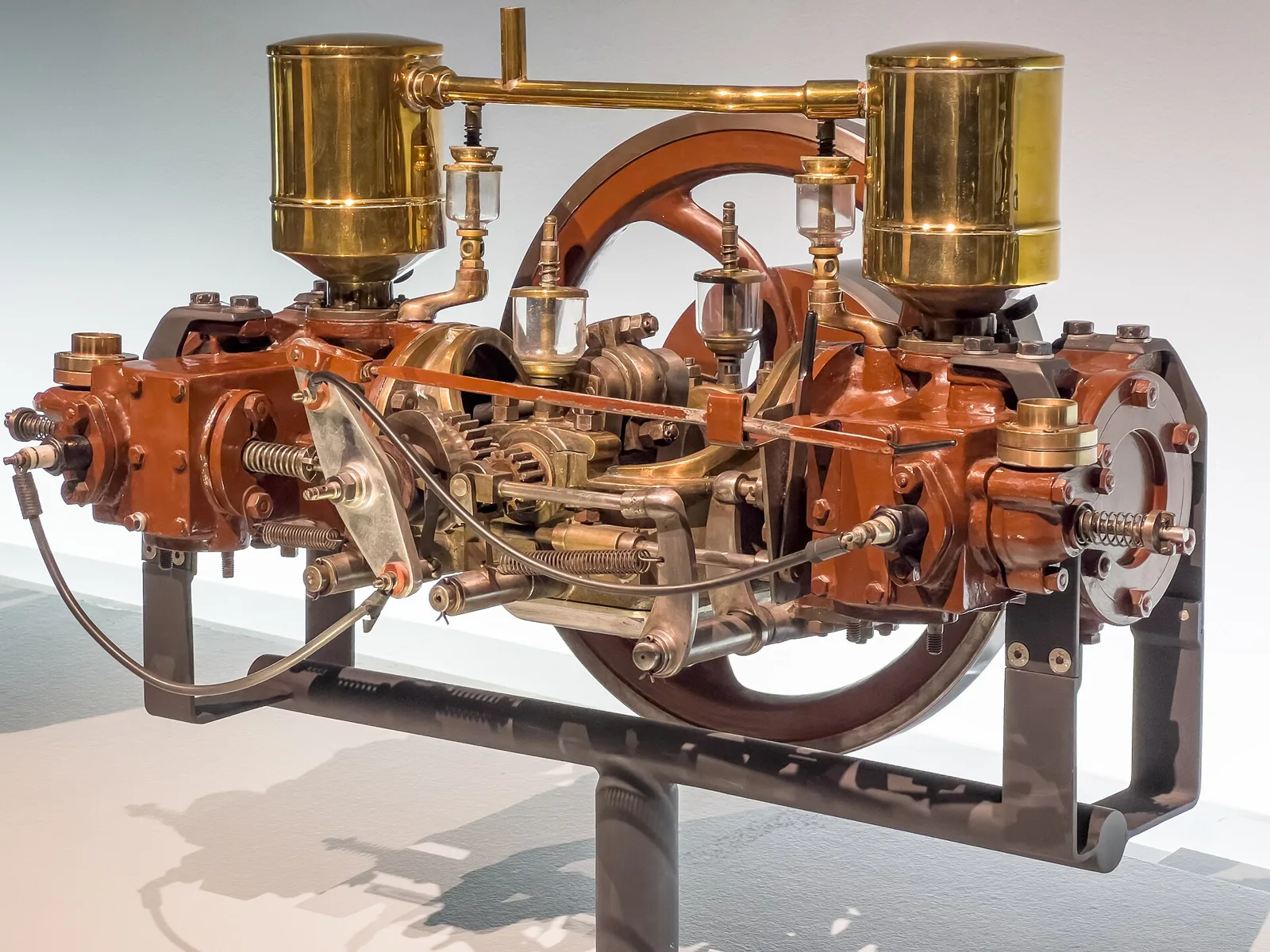
Opposed pistons that cancel each other's shake, a centre of gravity near the floor and an engine that needs a lot of width. The case for the flat engine.
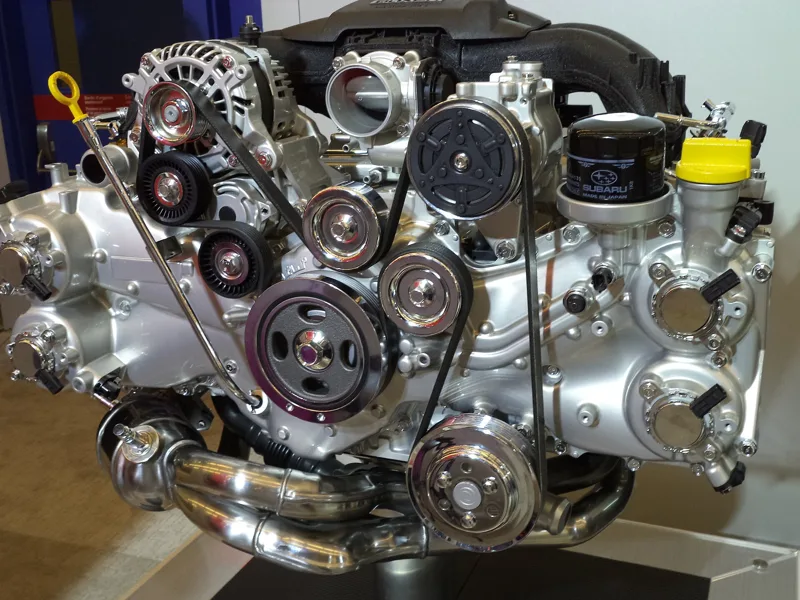
A boxer engine is a flat engine whose opposed pistons move in and out together, cancelling vibration. It sits short and low, which lowers a car's centre of gravity, but it is wide and needs two cylinder heads. Since the late 1990s only Subaru and Porsche have stayed significant makers.
The Ferrari Berlinetta Boxer carried the word in its name, yet its flat-twelve used the 180-degree V12 arrangement, which is not the boxer layout.
What is a boxer engine?
A flat engine is a piston engine whose cylinders lie on opposite sides of a central crankshaft. It is also called a horizontally opposed engine, which is not to be confused with the opposed-piston design, in which each cylinder holds two pistons that share a central combustion chamber.
Most flat engines use the boxer arrangement. Each pair of opposed pistons moves inwards and outwards at the same moment, like boxers touching gloves before a fight. The only alternative is effectively a V engine with the banks laid out 180 degrees apart. Here a pair of cylinders shares one crankpin, so as one piston travels in, its partner travels out. That arrangement is simpler than the boxer, where every piston has its own crankpin, and it was used on most twelve-cylinder flat engines.
The first flat engine was built in 1897 by Karl Benz. He called it the Contramotor, or kontra engine, and it was a boxer-twin. Flat engines went on to appear in aircraft, motorcycles and cars. In cars they now trail straight engines, which dominate below six cylinders, and V engines, which dominate from six upwards. In aircraft, where straight engines are rare and V engines have nearly vanished outside historical machines, flat engines are more at home, and they have even replaced radials in many smaller installations.
The boxer is the only common layout with no unbalanced forces, however many pairs of cylinders it has.
Why is a boxer engine so well balanced?
Think of two people sawing a log from opposite ends, pulling and pushing in step. Because the two pistons of a boxer pair move in and out together, their pushes and pulls cancel along the line of the cylinders. A boxer is the only common engine layout with no unbalanced forces, whatever the number of cylinder pairs. As a result, a boxer needs neither a balance shaft nor counterweights on the crankshaft to offset the weight of the reciprocating parts.
The balance is not perfect. A rocking couple remains, because the two cylinders of a pair sit slightly apart, separated by the spacing of the crankpins along the crankshaft.
Compare it with other layouts. Against the more common straight engine, a flat engine has better primary balance, which means less vibration. Set against a V engine, the usual choice from six cylinders up, the flat engine sits lower and, with six cylinders, balances better in the primary sense.
Why is the boxer engine centre of gravity so low?
The shape explains it. A flat engine spreads its cylinders sideways on either side of the crankshaft instead of stacking them upwards, so the engine sits low and short. The gains are a short engine, a low centre of mass and a good fit with air cooling, since the cylinders and heads are exposed and have plenty of surface. In a car, the low centre of mass helps handling.
| Layout | Strengths | Drawbacks |
|---|---|---|
| Flat or boxer | Short, low centre of mass, better primary balance than a straight engine, suits air cooling | Wide, needs two cylinder heads |
| Straight | Common for engines with fewer than six cylinders | Worse primary balance than a flat engine |
| V | Common for six cylinders or more | Higher centre of mass than a flat engine; for six cylinders, worse primary balance |
What does a boxer engine cost in packaging?
Width. Next to inline and V engines, a flat engine takes up more width, and that hurts most when it sits between the steered wheels. It also needs two cylinder heads, where a straight engine needs one.
Designers have worked around the width by placing the engine where it does not matter. Because a flat engine is short, mounting it outside the car's wheelbase leaves minimal overhang, so many flat-engined cars have been rear-engined and rear-driven. The list runs from the BMW 600 and 700 to the Tatra 97, the Volkswagen Beetle (1938-2003), the Porsche 356, the Chevrolet Corvair, the Tucker 48 and the Porsche 911.
The opposite arrangement, with the engine up front driving the front wheels, was also common. Examples include the Citroen 2CV, the Lancia Flavia, the Citroen GS and the Alfa Romeo Alfasud, along with the Subaru Leone. A conventional front-engine, rear-wheel-drive car is rare among flat engines, but the Toyota 86 and Subaru BRZ, on sale since 2012, are modern examples.
Why did most makers stop building boxers?
They did not stop all at once. Various manufacturers used flat engines, mostly boxer-fours, up to the end of the 1990s. After that, Porsche and Subaru were the only significant makers left.
The range of flat engines built over the years is wider than most people expect. Flat-twins are mostly found in motorcycles. Flat-fours turn up in cars, notably the early Volkswagens and most Subarus, and in smaller single-engine aircraft, for which they are still made. Flat-sixes are used mostly in aircraft and cars, particularly the Porsche 911 and Subaru. Flat-eights appeared in several racing cars, mostly Porsche's in the 1960s. A flat-ten was built as a prototype road car engine by Chevrolet in the 1960s, but never reached production. Flat-twelves powered racing cars, notably the Porsche 917K, and Ferrari road cars from 1973 to 1996. Flat-sixteen prototypes were built by Coventry Climax and Porsche.
The earliest car makers tried the layout almost at once. A Lanchester boxer-twin appeared in 1900, a Wilson-Pilcher boxer-four in 1901 and a Wilson-Pilcher boxer-six in 1904, while Ford's 1903 Model A, 1904 Model C and 1905 Model F also used it. The air-cooled flat-six that Chevrolet built for the Corvair from 1960 to 1969 included one of the first turbocharger installations in a mass-produced car. Volkswagen's water-cooled Wasserboxer, introduced in 1982, eventually replaced its air-cooled flat-fours.
Beyond cars, boxer-twins have a long motorcycle history. BMW Motorrad has built them since the R32 of 1923, and the Honda Gold Wing used a flat-four from 1974 to 1987 before switching to a flat-six.
How the Subaru boxer engine took over a niche
Subaru's boxer-four line began with the EA engine, introduced in 1966, and it remains in production in developed form. Most Subarus use a boxer-four, either naturally aspirated or turbocharged. A print advertisement for the 1973 Subaru GL coupe coined its own word for the layout, quadrozontal. The company also built boxer-sixes from 1988 to 1996 and from 2001 to 2019.
Subaru has combined the layout with four-wheel drive since 1971, with the engine at the front. Cars like the Leone, Legacy and Impreza pair a boxer-four with a front differential built into the gearbox and a driveshaft running to the rear half-shafts.
The EJ series, introduced in 1989 to succeed the EA, was the mainstay of the range. Every EJ is a 16-valve horizontal flat-four with single or double overhead camshafts, naturally aspirated or turbocharged, with outputs from 94 hp up to 341 hp (70 to 254 kW; 95 to 346 PS). Fuji Heavy Industries, Subaru's parent company, did the main engineering, led by Masayuki Kodama, Takemasa Yamada and Shuji Sawafuji. The engines are also commonly used in light aircraft and kit cars, and as swaps into air-cooled Volkswagens.
The EJ20 had a clear end date. Subaru used the 46th Tokyo Motor Show in October 2019 to announce that EJ20 production would finish by the end of March 2020. Only the Japanese market still sold it, in the WRX STI, and a one-off WRX STI EJ20 Final Edition marked the end.
Subaru also built the world's first passenger car diesel boxer. That was the Subaru EE of 2008, a turbocharged boxer-four with common rail injection. And the Toyota 86 and Subaru BRZ share a boxer-four that Toyota designates 4U-GSE but that Subaru designed and builds as the FA20.
How the Porsche flat-six defined the 911
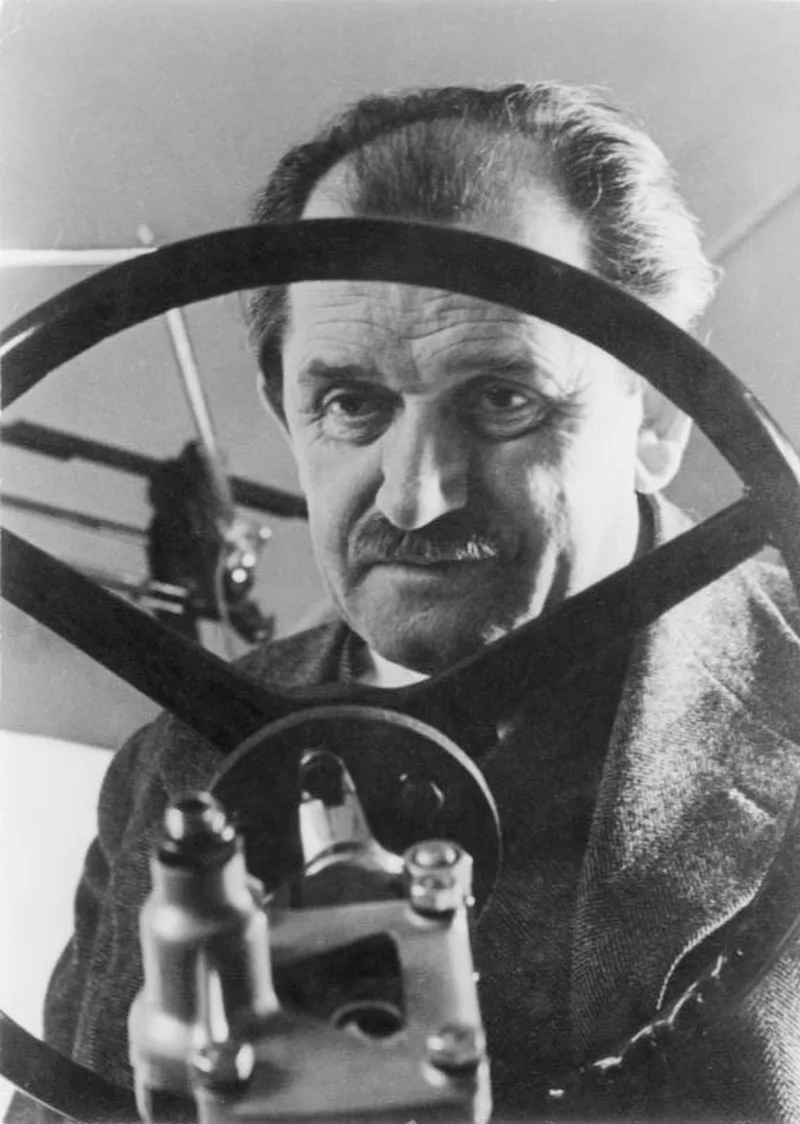
Porsche has made its flat-six for more than sixty consecutive years. It began with the rear-engine 911 of 1963 and the mid-rear-engine racing Porsche 906 Carrera 6 of 1966, each with 2000 cc. The family grew out of Ferdinand Porsche's air-cooled flat-four designs, which powered the first Volkswagen Beetle and then the Porsche 356. Porsche's first car, the 356, ran an air-cooled boxer-four from 1948 to 1965, and the 911 has used flat-sixes exclusively since it appeared, which is why the 911-bodied cars sold with the old 356 engine were called 912s.
All the Porsche flat-sixes stayed air-cooled with extra oil cooling until the late 1970s, when some turbocharged endurance racers were built partly or fully water-cooled, mainly for the 956 and 962C of the 1980s. The regular 911 stayed air-cooled until the 993 of the 1990s. Starting with the 996, it moved to water-cooled engines that are simpler and cheaper but less suited to racing, and the change came in 1997. Related designs live on in the GT3 and GT2 models.
The largest street-legal 911 engine so far is the one in the 2011 997 GT3 RS 4.0. Its 4.0-litre flat-six uses the crankshaft from the RSR with the stroke increased from 76.4 mm to 80.4 mm, which raised the peak to 500 PS (368 kW; 493 hp), reached at 8,250 rpm, with 460 N-m (339 lbf-ft) arriving at 5,750 rpm. Only 600 were built. At 123.25 hp per litre, it is one of the most powerful naturally aspirated six-cylinder engines in any production car.
Porsche has used the layout well beyond the 911. The 914/6 of 1970 to 1972, the 959 of 1986 to 1993 and the Boxster and Cayman of 1996 to 2021 all used flat-sixes. Boxer-fours powered the 912, the 914, and the current 982-generation Boxster and Cayman. In racing, Porsche's flat-eights ran in the 1962 Porsche 804 Formula One car and the 908 sports car, and its flat-twelve powered the 917.