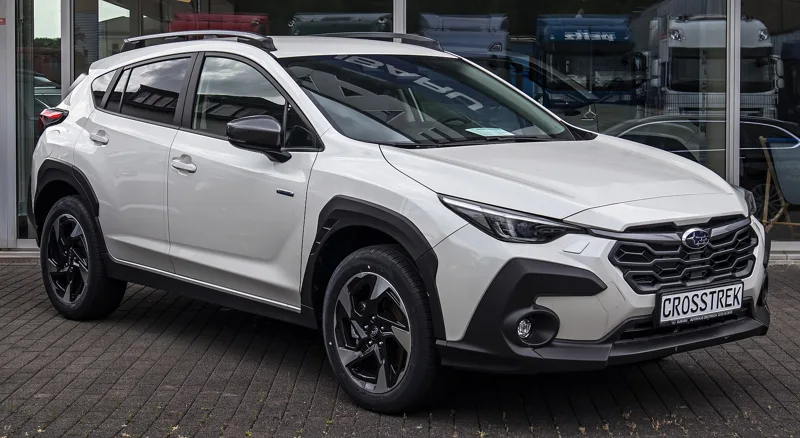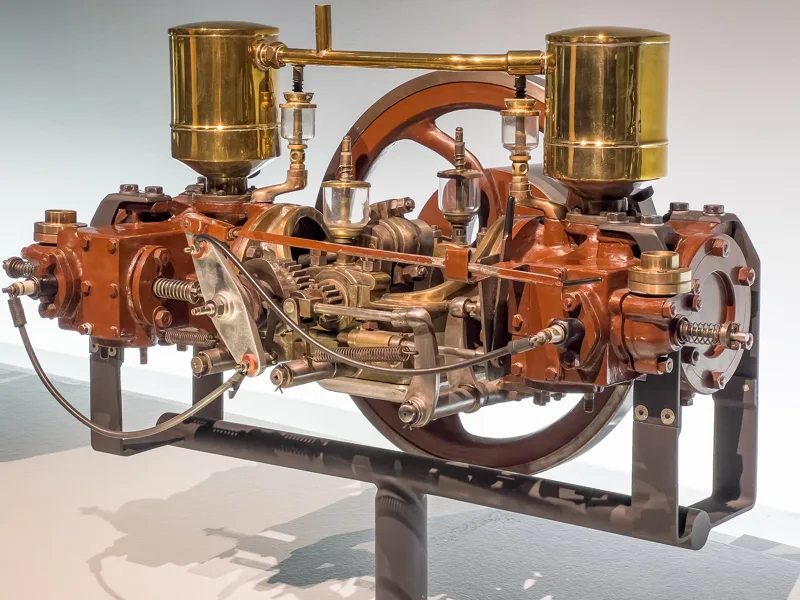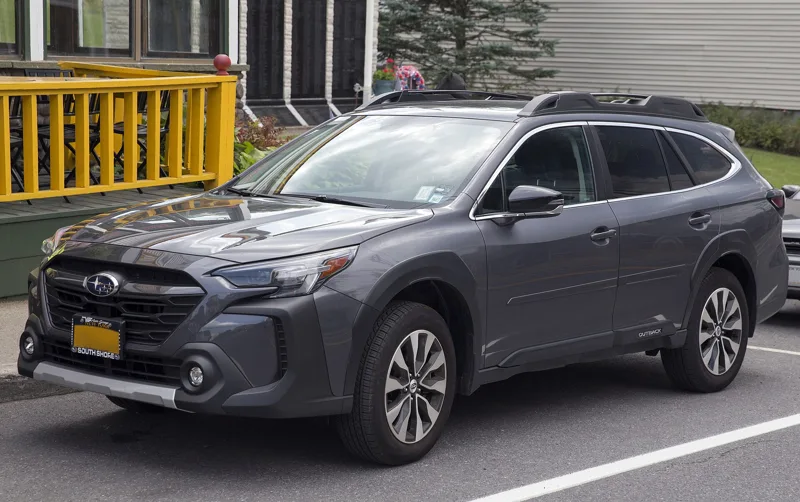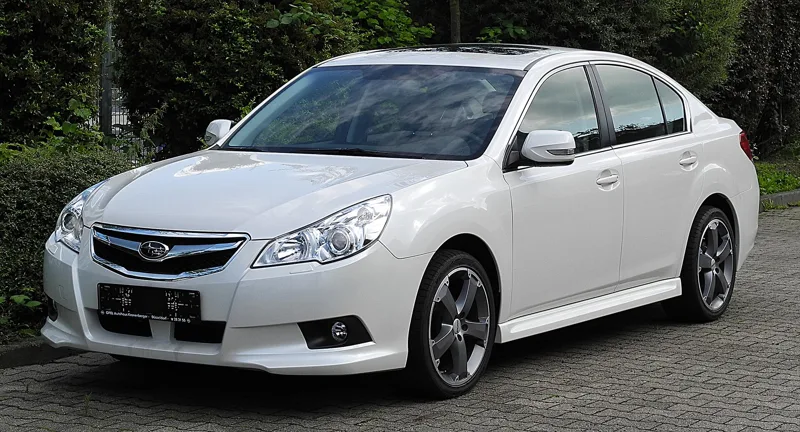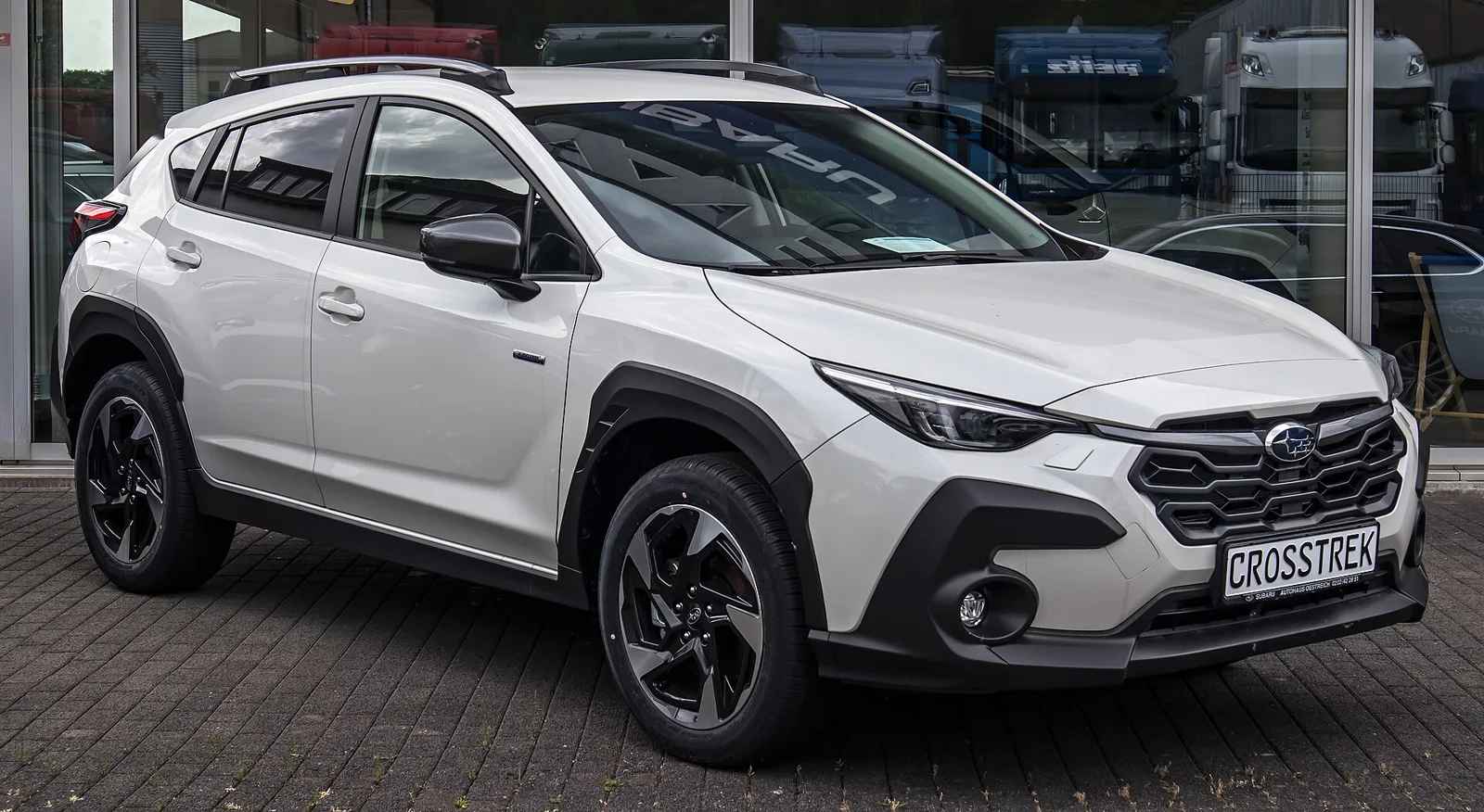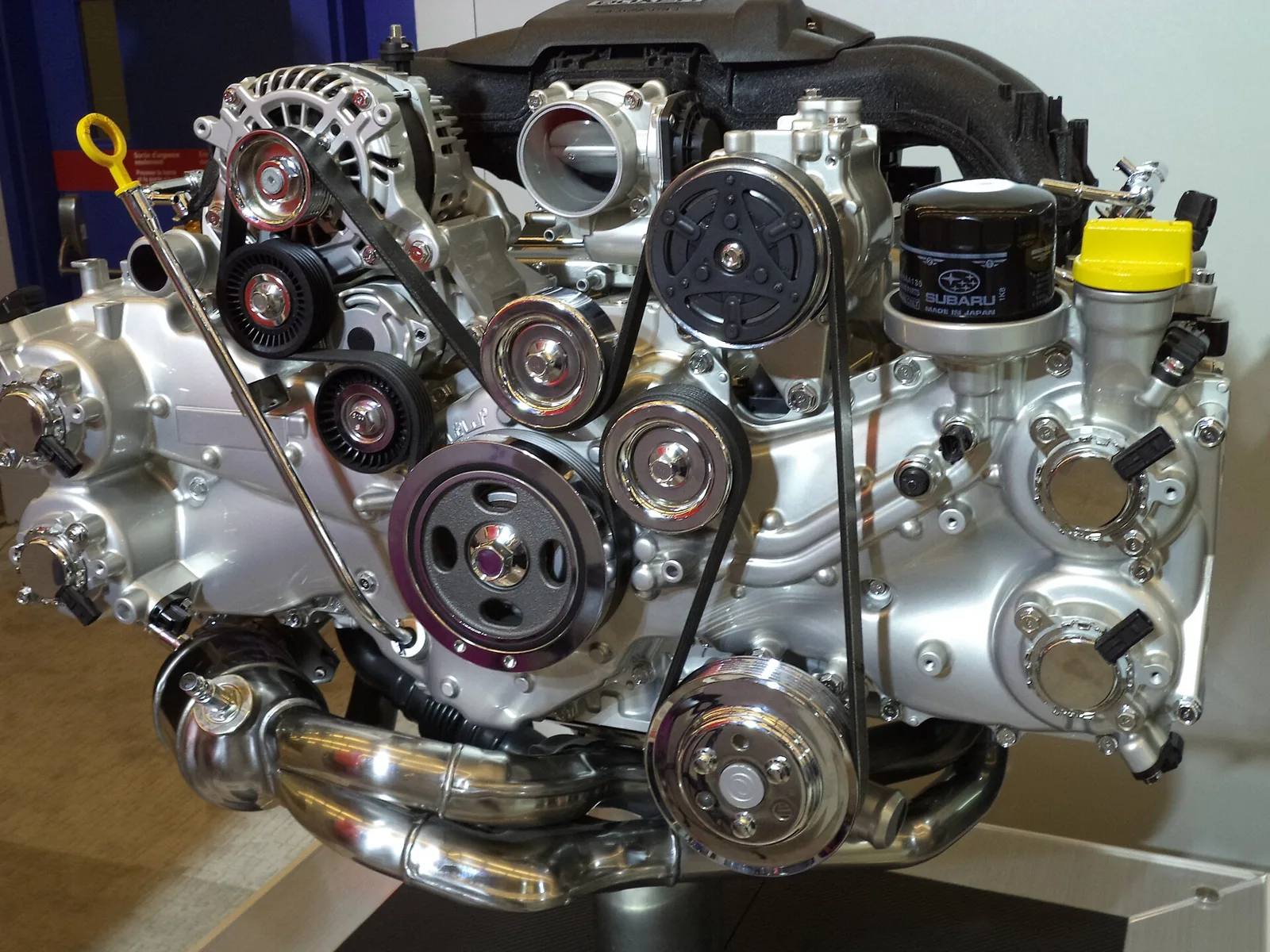
A 400 mm long flat-four that started the story, a flat-six that was the only one of its kind, and a Formula One flat-twelve that never made a grid.
Subaru built its EA flat-four from 1966 to 1994, then the EJ, then the FB from 2010 and the lower-slung FA derived from it. Flat-six engines ran from the ER27 and EG33 to the EZ30 and EZ36, until a turbo FA24F replaced the six in the Legacy and Outback.
Subaru once put its name on a 3.5 litre flat-12 for Formula One. The Subaru 1235, designed by Carlo Chiti and Motori Moderni in the 1990s, was heavy, underpowered and fragile, and it never qualified for a single Grand Prix. It makes an odd footnote to a family of horizontally opposed engines that has otherwise been the most dependable thing about the company: first the EA fours of the 1960s, then flat-sixes, then the FB and FA fours that power its cars today.
Subaru EA engine: the 1966 starting point
Until 1966 Subaru was known for kei cars. For its first four-passenger model the firm had started on an air-cooled boxer engine in 1960 for a prototype Subaru 1500, but Fuji Heavy Industries ran short of money and development stopped. A new front-wheel-drive prototype used a 923 cc water-cooled boxer instead, and that became the Subaru 1000 and the EA-52 engine. Sales began in 1966.
The EA series was always a water-cooled flat-four with aluminium heads and blocks, two valves per cylinder and either pushrod or single-overhead-cam valve gear. It was remarkably short, roughly 400 mm (15.7 in) from end to end, and the crankshaft ran on three main bearings. Production ran from 1966 to 1994, in cars that included the FF-1 Star, the Leone, the Brat (sold as the Brumby in some markets), the Loyale, the Omega, the Vortex, the RX and the XT, also called the Alcyone.
Subaru once lent its name to a 3.5 litre flat-12 for Formula One, and it never qualified for a race.
A tour of the EA family
The early EA-52 ran from 1966 to 1970 in the Subaru 1000 and FF-1 Star. The twin-carburettor EA-53 powered the 1967 Subaru 1000 Sports Sedan, which won the 1000cc class in the Japan Alpine Rally of September 1968. The EA-61 ran from 1969 to 1972, and the EA-62 of 1971 to 1972 is the only EA engine with rear-facing exhaust ports.
The EA-63 and EA-64 both ran from 1973 to 1979. The EA-64 left the sedan range in September 1975 because new emissions rules would have made the car too slow, though it stayed in the Van 1200 Standard until the first-generation Leone ended in 1979. The EA-65 followed from 1975 to 1985.
The EA-71, produced from 1976 to 1994, came as a Narrow Case and then a redesigned Fat Case, which in turn led to the stroked EA-81 of 1980 to 1994. A twin-carburettor EA-71S became the de facto standard engine of Japan's FJ1600 single-seater class for decades. The EA-81S, a special version, used twin downdraft Weber carburettors on its 1983 Safari Rally car, with the unusual reverse-valve layout. An informal EA-81T added a turbocharger at 7 psi (0.48 bar) and multi-point injection in 1983 and 1984.
The EA-82 of 1984 to 1994 was meant to be a 2.0 litre engine and was destroked to 1.8 for production. Its SOHC valvetrain and multi-point injection carried over to the next-generation EJ. A turbocharged EA-82T arrived in 1984 with lower-compression pistons and 7 psi of boost, and a revised "Spider" intake looks like an early step toward the EJ manifold. An EA-72 of 1989 was planned for Japan, with a 1,595 cc capacity, but never came out because the EJ15 and EJ16 were already in development.
The Subaru six-cylinder engines
Subaru's flat-sixes arrived in three generations. The ER27, derived from the EA, was the sole engine in the 1988 to 1991 Alcyone VX, known in the United States as the XT6. It was introduced in November 1985 on the ACX-II concept at the Tokyo Motor Show, and the production Alcyone VX followed in August 1987. When it appeared it was the only water-cooled flat-six in a car. It was also the first Subaru engine to carry its displacement in its name, 2.7 litres, a habit the company kept.
The ER27 resembled the EA82 but many parts were unique, including higher-flow oil and water pumps. Its two-piece intake had no central plenum, and it used two timing belts, one with a spring tensioner like the EA82 and one hydraulic like the EJ22. North American cars were slightly derated, to 145 hp (108 kW; 147 PS), peaking at 5,200 rpm, with 212 N-m (156 ft-lb) arriving at 4,000 rpm.
The EG33 stood in the same relation to the EJ, sharing bore and stroke with the EJ22. It was the only engine in the 1991 to 96 Alcyone SVX, mated to the 4EAT automatic, front- or all-wheel drive. Unlike the SOHC EJ22 it had twin overhead cams with four valves per cylinder, run by a single toothed belt that drove the exhaust cams, which drove the intake cams through helical gears. It was the biggest naturally aspirated engine Subaru had then built for regular production. After the SVX ended, Subaru offered no six until the EZ30.
In the 2026 Super GT season the BRZ GT300 racecar carries a heavily reworked EG33, which Subaru calls the "EG33 kai". The displacement is cut to 3.0 litres and it has twin turbochargers.
EZ30 and EZ36: the compact sixes
The EZ30 reached Japan first, in the Lancaster 6 wagon in May 2000, and the US followed that November in the 2001 Outback H6-3.0. Designed by Noriaki Sekine, it was far narrower than earlier sixes: its bore pitch, the spacing between neighbouring cylinders, was 98.4 mm (3.87 in) against 113 mm (4.4 in) on the EJ fours, and a chain drove the camshafts instead of a belt. The result was a block with outside dimensions similar to the EJ25, only about 2.5 cm longer. A butterfly valve in the intake gave a resonance effect at high revs, and North American cars made 212 hp.
The 2004 EZ30 mark II added active valve lift on the intake cam, three exhaust ports per head, a new block casting and 8.91 kg (19.6 lb) less mass through hollow camshafts, fewer timing cover bolts and a plastic intake. A twin-turbo version was shown on the B11S concept at Geneva in 2003. The EZ30 was the sole engine in the Tribeca from 2006 to 2014.
The EZ36 arrived in the restyled Tribeca for 2008 and replaced the 3.0 in the Legacy and Outback from the 2010 model year. It had thinner iron sleeves for more bore and asymmetric connecting rods for more stroke, was 21 mm (0.83 in) longer than the EZ30 and ran on regular unleaded thanks to a new cooling system and variable timing on both camshafts. By the 2020 model year the six no longer headed the Legacy and Outback range. The turbocharged FA24F took over as the premium choice.
Subaru FB engine: the third generation
Subaru announced the FB on 23 September 2010, as the third generation after the EA of 1966 and the EJ of 1989. The company said unofficially that the letters mean FHI, Future and Brand New, Boxer. Sizes were 1.6, 2.0 and 2.5 litres, with naturally aspirated and turbocharged versions, with a new block and head, dual overhead cams, variable valve timing on intake and exhaust (Subaru's AVCS) and a timing chain in place of a belt.
The aims were lower emissions, better economy and a broader torque band than the EJ. Subaru made the stroke longer and the bore smaller; the 2.5's cylinders narrowed from 99.5 mm to 94 mm (3.92 in to 3.70 in). A chain lets the valves sit at a narrower angle, allowing the smaller bore and less unburned fuel at cold start. Smaller cylinder heads kept the external dimensions almost unchanged, and the FB is only slightly heavier than an equivalent EJ.
Subaru claims a 28 percent cut in friction losses, helped by roller rockers, lighter pistons and rods, a polymer coating on the skirts, lighter 0W-20 oil and a compact oil pump. The engine holds about 1 litre more oil because the chain needs a supply. Fuel economy improved by 10 percent. It is built at the Gunma Oizumi Plant, and the 2.5 came first, in the Forester.
FB16, FB20 and FB25 variants
The 1.6 litre FB16 has a bore and stroke of 78.8 by 82 mm and 11.0:1 compression, making 84 kW (114 PS) in European-market cars. Its turbocharged sibling, the FB16 DIT, was the first turbo FB, with direct injection and stop-start, and was the base engine of the 2014 to 2020 Levorg. Designer Rei Sasaki aimed to match the naturally aspirated FB25 on regular petrol. It shares only the crankshaft with the FB16. On the Japanese JC08 cycle the heavier Levorg reached 16.0 km/L (38 mpg-US), against 15.6 km/L for an FB16 Impreza G4. It makes 125 kW (170 PS) and 250 N-m.
The FB20 is undersquare at 84 by 90 mm, where the EJ20 was oversquare at 92 by 75 mm, for 1,995 cc. The base FB20B has 10.5:1 compression and 110 kW (150 PS). The FB20X, in the 2014 to 2016 XV/Crosstrek Hybrid, has reduced friction and a motor built into the CVT, for a stated 160 hp combined. The direct-injection FB20D, used from 2017 in the fifth-generation Impreza and from 2018 in the XV, raises compression to 12.5:1 and 113 kW (154 PS). The 2019 plug-in Crosstrek uses a detuned FB20V with a hybrid system sourced from Toyota, and a mild-hybrid e-Boxer version of the FB20D went to Forester and XV buyers in Japan in 2018, then Europe in 2019 and Australia in 2020.
The 2.5 litre FB25 measures 94 by 90 mm, against the EJ25's 99.5 by 79 mm. The FB25B had 10.0:1 compression and 170 hp (127 kW) in North American cars. Direct injection arrived in the revised FB25D with the 2019 Forester, introduced at the 2018 New York show, and in the 2020 Legacy and Outback, with 182 hp (136 kW). Later cars list 180 hp (134 kW), and Strong Hybrid applications pair a 162 hp engine with a 118 hp motor for 194 hp combined.
Subaru FA engine: lower, lighter, shared with Toyota
The FA is a derivative of the FB used in Subaru and Toyota cars, designed to cut weight while staying durable. The two share a platform, yet almost nothing else: the FA has its own block, cylinder head, rods and pistons. The first FA, the FA20D, was developed for the BRZ and mounted as low as possible to reduce the chassis's polar moment. A less deep sump and a shorter inlet manifold keep the whole engine lower.
The FA20 is perfectly square, 86 by 86 mm for 1,998 cc, and the figure is also a reminder of the Toyota AE86. The FA20D uses Toyota's D-4S system, which combines direct and port injection, plus AVCS and 12.5:1 compression, and it produces 197 hp (147 kW) at 7,000 rpm in 2012 to 2016 cars. Toyota calls it the 4U-GSE. Wards Auto listed it among its 10 Best Engines for 2013.
The turbo FA20F came in late 2012 with Subaru's own direct injection and a twin-scroll turbocharger. Compression falls to 10.6:1. It was named to the Wards 10 Best list in 2015 and 2016, and powers the Legacy 2.0GT DIT at 300 PS (221 kW), the Forester XT and the WRX, rated at 268 hp in the United States. A revised version for the 2015 WRX changed the camshafts, rocker arms, boost, intercooler and exhaust.
The 2.4 litre FA24 has a 94 mm bore and 86 mm stroke. The turbocharged FA24F appeared for the 2019 Ascent, is aluminium throughout, burns regular 87 AKI fuel and was pitched as matching a naturally aspirated six. It makes 260 hp (194 kW) in the Ascent, Legacy XT and Outback XT and 271 hp (202 kW) in the 2022 global WRX. The Legacy sedan was shown with the engine at the 2019 Chicago show. Tuners report about 265 hp at the wheels from a WRX on a dyno.
The naturally aspirated FA24D has 12.5:1 compression and direct plus port injection. A turbocharged FA24F would have raised the price and centre of gravity of the second-generation BRZ and Toyota 86, so it was not used. The 2022 BRZ and GR86 make 170 to 174 kW (228 to 234 hp) at 7,000 rpm and 250 N-m at 3,700 rpm. The torque curve was revised, without the dip between 3,000 and 5,000 rpm that the FA20D showed from fuel economy tuning, and an oil cooler was added. Oil rules vary: the 2022 GR86 needs ILSAC GF-5 and the 2023 car GF-6A.
The Subaru engine families compared
| Family | Layout | Introduced | Sizes | Notable use |
|---|---|---|---|---|
| EA | Flat-four | 1966 | 923 cc and 1.8 litre among others | Subaru 1000, Leone, XT |
| ER27 | Flat-six | 1985 concept, 1987 production | 2.7 litres | Alcyone VX |
| EG33 | Flat-six | 1991 | Bore and stroke shared with the EJ22 | Alcyone SVX |
| EZ30 and EZ36 | Flat-six | 2000 and 2008 | 3.0 litres for the EZ30 | Outback, Legacy, Tribeca |
| FB | Flat-four | 2010 | 1.6, 2.0 and 2.5 litres | Forester, Impreza, Levorg |
| FA | Flat-four | 2012 | 2.0 and 2.4 litres | BRZ, GR86, WRX |
What is replacing the FB engine?
Subaru brought in a more efficient engine, the CB18, in 2020, with the job of replacing the FB in several models. The FB25D is listed in the 2027 Impreza, and hybrid versions are listed for the 2025 Forester and 2026 Crosstrek.