From the 1971 Leone that took 30 per cent of Israel's car market to the Levorg Layback and the Crosstrek that lost its XV name.
The Subaru Leone was a compact car sold from 1971 to 1994 that brought mass-produced four-wheel drive to passenger cars, the Levorg is a mid-size sports wagon built since 2014, and the Crosstrek, called XV for two generations, is a lifted Impreza hatchback built since 2012.
For almost two decades, a Subaru was the only Japanese car an Israeli buyer could get. The Arab League boycott kept other Japanese makes out between 1973 and 1991, and the Subaru Leone took roughly 30% of the whole local passenger car market in those years, between about 220,000 and 250,000 cars. It is a startling footnote for a model that began as a modest compact from a company whose other cars were kei cars.
The Leone, the Levorg and the Crosstrek are three Subaru nameplates that share a thread: each took a conventional body and added something Subaru does best, usually four-wheel drive and a flat-four engine. One is a 1970s compact, one a sports wagon and one a raised hatchback, and they trace the company's range from the 1970s to today.
Subaru Leone history: the compact that mass-produced four-wheel drive
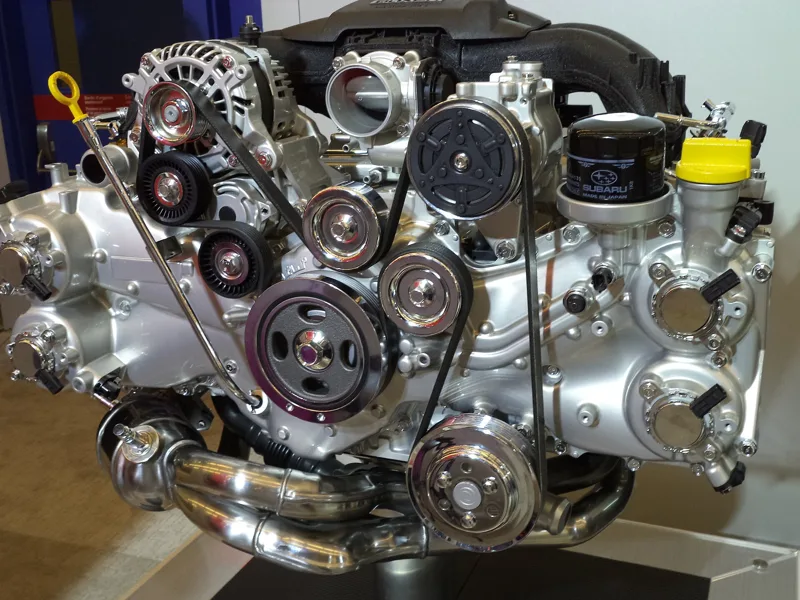
The Leone was produced from 1971 to 1994, and its name is the Italian word for lion. It replaced the Subaru 1000 and went on to become the forerunner of the Impreza. Every Leone had a Subaru EA flat-four engine, and most were sold with optional four-wheel drive. Until the larger Legacy arrived in 1989 it was the top model in the range.
For years the Leone was practically the only Subaru sold outside Japan, because the company's smaller kei cars did not travel. In Australia, Europe and North America buyers therefore knew it by a trim name, such as DL, GL, GLF, GL-10 or RX, rather than as a Leone. That is why the car is often called simply the Subaru GL or the L series. By 1990 only Japan still used the Leone name. Chile, the United States and Canada knew the car as the Loyale, Europe and Australia as the L-Series, and New Zealand as the Omega.
First generation: coupe, sedans and a 4WD wagon
The first Leone appeared on 7 October 1971 as a front-wheel-drive coupe in DL, GL and GSR trims. Sedans with two and four doors followed in April 1972. At that point it was the largest car Subaru made, sitting above the Rex kei car. The design leaned on an alliance with Nissan, formed in August 1968, and the long bonnet and short boot reflect Nissan's styling of the time.
The biggest step came in September 1972 with the four-wheel-drive station wagon, which reached the United States in 1974 as a 1975 model. Subaru launched the Leone ahead of the 1972 Winter Olympics in Sapporo, to underline how it coped with bad weather. Four-wheel drive had until then belonged largely to off-roaders, with the very expensive Jensen FF as a rare exception, so a four-wheel-drive passenger car built in volume was a break with the pattern. Subaru had tested the idea in 1971 with a limited run of FF-1 1300G wagons. The feature made the cars especially popular in places like Switzerland and Colorado, and its rivals included the Honda Civic, Toyota's Corolla, Nissan's Sunny, the Mazda Familia, the Isuzu Gemini and Mitsubishi's Lancer.
The 1400 RX coupe stood out for its four-wheel disc brakes, sport-tuned suspension and five-speed manual gearbox, which made it one of the first Japanese cars with four-wheel discs. A two-door hardtop followed in June 1973, with F-prefixed model names for Formal, and a four-wheel-drive sedan arrived in 1975. Early engines were 1.2- and 1.4-litre carburetted flat-fours. After emissions rules tightened, the 1.2 left the sedans in September 1975, a 1.6-litre engine was added for 1976 and reached Europe in 1977, where it made a claimed 83 PS DIN (61 kW) at 5,600 rpm. Buyers could pick four- and five-speed manuals and, from 1975, a three-speed automatic. One quirk: the handbrake worked on the front wheels. A refreshed range in March 1977 widened the rear track by 40 mm (1.6 in), and the Grand Am-T topped the line in November 1977.
The American Leone and the BRAT
The Leone reached the United States in 1972. The 1.6-litre EA71 engine, using Subaru's SEEC-T technology, needed no catalytic converter and could run on leaded fuel. Power in 49-state trim was 67 hp (50 kW) at 5200 rpm, and driveability and mileage suffered. A 1973 advert called the engine "quadrozontal". Late 1977 brought the BRAT, a two-seat pickup with two extra seats welded into the bed, which kept it clear of the US import duty known as the chicken tax on light commercial vehicles. It was updated in 1981 with a dual-range four-wheel-drive transmission and the 1.8-litre EA81 engine, and ran alongside the second-generation Leone until the 1982 model year.
Second and third generations
The second generation arrived in June 1979 in four body styles: a two-door hardtop, a sedan, a wagon and the three-door hatchback that Japan called the Swingback. It added a dual-range four-speed four-wheel-drive gearbox with manual ride-height adjustment. November 1981 brought Japan's first automatic all-wheel-drive car, built around a wet, hydraulic, multi-plate clutch that let the driver engage four-wheel drive with a push of a button. The 1800 GTS was the first Subaru with air conditioning, power windows and power steering, and a turbocharger arrived in November 1983, chosen for efficiency rather than speed because of Japan's tax on emissions.
The third generation, released on 16 July 1984 with "folded paper" styling, offered a three-door hatchback, a four-door sedan and a wagon, and reached the United States in 1985. A 1.8-litre SOHC EA82 engine arrived, and from 1988 buyers could have full-time four-wheel drive with a manual or electronically controlled four-speed automatic. Options included a digital dashboard, a trip computer, cruise control and air suspension whose ride height the driver could select.
The performance RX sedan came in 1985 with the turbocharged EA82T, a five-speed dual-range gearbox, a manually locking centre differential, a limited-slip rear differential, rally-tuned suspension, four-wheel discs and a weight of 1,070 kg (2,359 lb). RX stands for Rally-X, and it is the predecessor of the Subaru WRX. Only 2,600 RX coupes were made, and the sedan found 1,500 buyers in its first year. The Leone wagon lost ground to the larger Legacy wagon in 1989, and the Impreza replaced the range in 1994.
A Subaru was the only Japanese car Israelis could buy from 1973 to 1991, and the Leone took about 30% of the market.
Subaru Levorg: the sports wagon from Legacy, revolution and touring
Subaru says the name Levorg is stitched together from LEgacy, reVOlution and touRinG. It is a mid-size car built since 2014. The first generation shares its platform with the Impreza, the WRX and the Legacy, while the second rides on the Subaru Global Platform that underpins most of its family cars.
Subaru showed a pre-production concept when the 43rd Tokyo Motor Show opened in November 2013, took orders in Japan from 4 January 2014, and began sales in May. In February 2015 it announced the European launch, and the car premiered there at the Geneva show in March. About 11,000 advance orders came in over three months, 2,000 short of the company's forecast.
First generation (VM)
Japanese buyers could choose two turbocharged, intercooled, direct-injected flat-four engines: a 1.6-litre FB16 with 170 PS (125 kW) and 250 Nm (184 lb ft), or a 2.0-litre FA20 with 300 PS (221 kW) and 400 Nm (295 lb ft). Both used a Lineartronic CVT, a continuously variable transmission that has no fixed gears, and four-wheel drive. A facelift in June 2017 reworked the grille, bumper and LED lamps on every grade except the STI Sport. In 2019 the European market lost the turbo 1.6 in favour of a naturally aspirated 2.0-litre FB20B. On 20 November 2019 Subaru launched the V-Sport, with front sports seats, Bilstein dampers, ventilated discs and 225/45 R18 tyres, at JPY 3,150,000.
Levorg in the British Touring Car Championship
On 12 January 2016 Subaru announced a manufacturer entry in the British Touring Car Championship with Team BMR. For 2016 the team prepared four Levorg Sports Tourers to Next Generation Touring Car specification. They ran rear-wheel drive, because the championship does not allow four-wheel drive, and the drivers were Jason Plato and Colin Turkington, both previous champions twice over, plus team owner Warren Scott. Mountune Racing prepared the FA20 2.0-litre boxer engines. Ashley Sutton joined from MG Racing for 2017 and went on to win the championship for the team, while Plato struggled for pace that season. For 2018 BMR switched engine suppliers from Mountune to Swindon.
Second generation (VN) and WRX Sportswagon
The second generation appeared as a prototype at the Tokyo show on 23 October 2019, with the Subaru Global Platform and a newly developed 1.8-litre CB18 engine. It went on sale in Japan on 21 August 2020, with GT, GT-H and STI Sport grades. More than 90% of Japanese buyers chose the EyeSight driver-assist package, and Subaru planned to build 2,200 a month. Like the first generation, it was not sold in North America.
Subaru's engine designer Tsuneaki Numamiyauchi said the CB18's displacement balanced a rise in torque to 300 Nm (220 lb ft) with better fuel economy from lean-burn technology, a way of running with more air than fuel. Fuel economy rose from 16.0 to 16.6 km/L (38 to 39 mpg-US) against the FB16, and the engine is 44 mm (1.7 in) shorter, leaving a larger crush zone.
In Australia the car is the WRX Sportswagon, on sale from 7 April 2022 in Standard, GT and tS trims, and in New Zealand it is the WRX GT, from 24 May 2022. Both get the 2.4-litre FA24F turbo engine and the Subaru Performance CVT only. In March 2026 the Standard trim was discontinued in Australia. The STI Sport R brought the FA24F to Japan in November 2021. The WRX Wagon also reached Chile in July 2022, Colombia in August 2022 and Mexico on 13 April 2024. In Asia it launched in the Philippines on 8 June 2022, Thailand on 24 August 2022, Malaysia on 7 December 2022, Singapore on 17 January 2023, Indonesia on 16 February 2023 and Taiwan on 20 March 2023.
Levorg Layback
The Layback, a crossover-inspired Levorg, went on sale in September 2023 in Limited EX trim only, with the CB18 engine. Against the regular Levorg it grows by 15 mm (0.6 in) in length, 25 mm (1.0 in) in width and 70 mm (2.8 in) in height, with 200 mm (7.9 in) of ground clearance, and its tyres and bumpers allow a steeper approach angle for rough roads. A hybrid S:HEV version has been on sale since July 2026 with a 2.5-litre FB25D e-Boxer engine, a slightly redesigned front end, new headlights and 18-inch wheels.
Subaru Crosstrek generations: from XV to a worldwide name
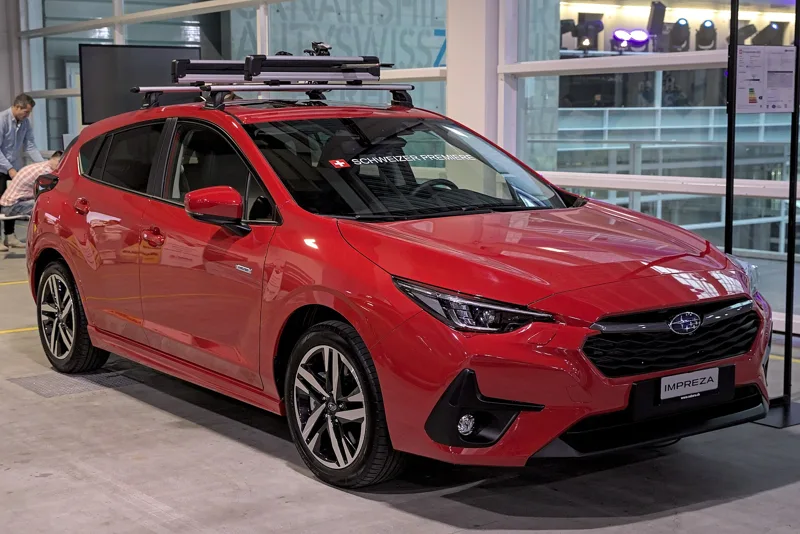
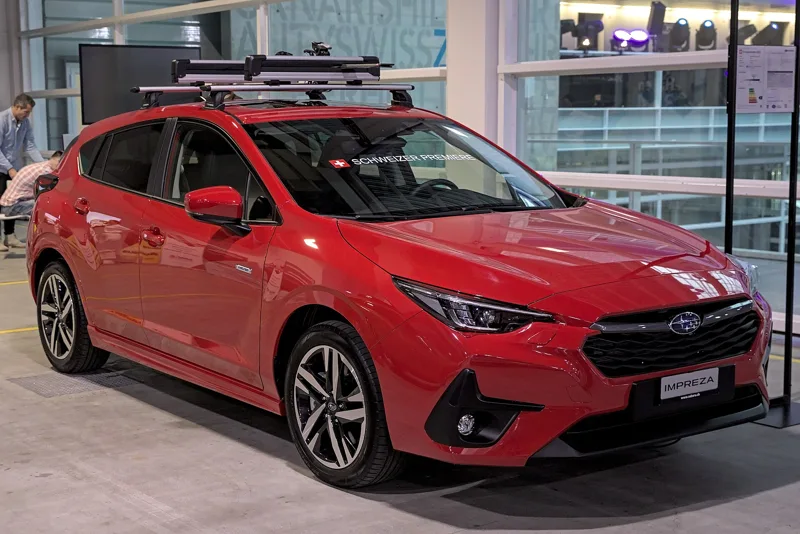
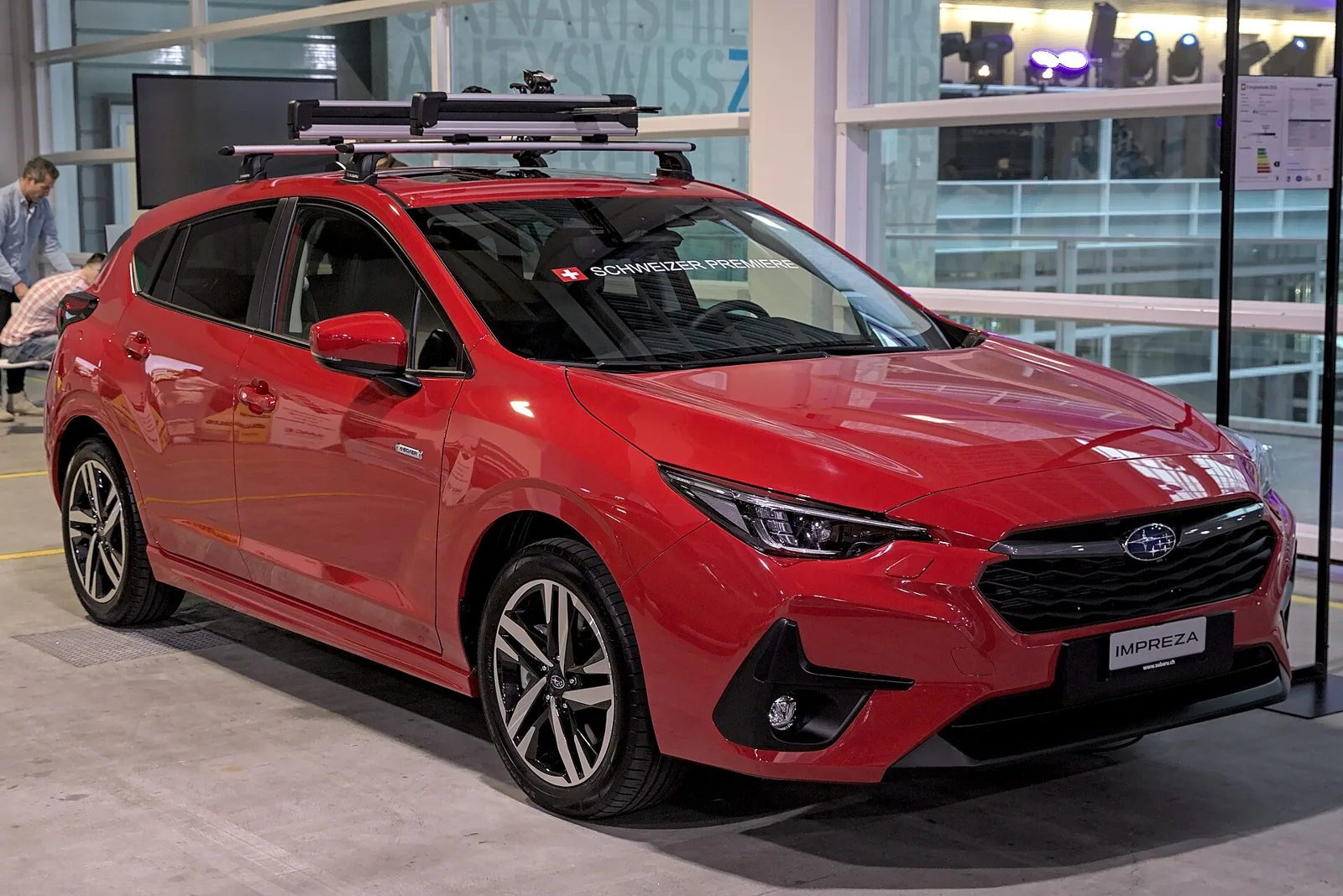
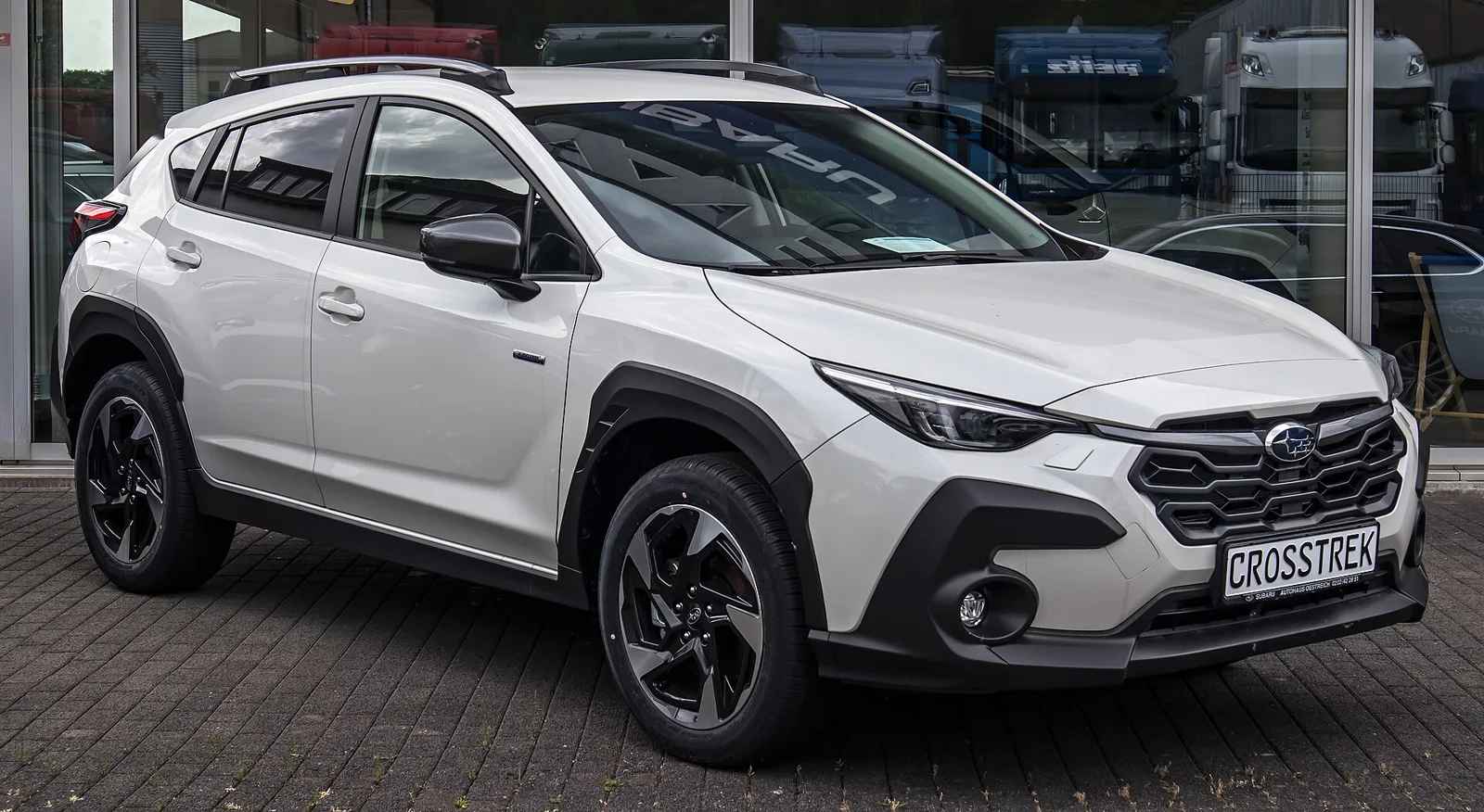
The Subaru Crosstrek has been built since 2012. In North America it follows the Outback Sport, and elsewhere the Impreza XV, and like both it is a lifted Impreza hatchback, though the lift is bigger than the Outback Sport's. Globally it was called the XV for its first two generations, and in North America the XV Crosstrek until Subaru dropped the XV for the 2016 model year. The third generation, introduced in 2022, brought the Crosstrek name to every market for the first time. Every Crosstrek has been a raised version of the Impreza hatchback.
First generation (GP)
Subaru showed an XV concept at Auto Shanghai in 2011, and the production car was unveiled at the Frankfurt show that year. It went on sale in Japan on 25 September 2012 and arrived in America, as the XV Crosstrek, for the 2013 model year after a debut at the 2012 New York show. The US car had the 148 hp (110 kW) FB20B engine, 17-inch wheels, roof rails and Symmetrical All-Wheel Drive. With the CVT, the system can send all its torque to the wheels with the most grip.
Production at Tan Chong in Malaysia, from complete knock-down kits, began in January 2013, at 5,000 units a year for Malaysia, Thailand and Indonesia. Europe's early models offered a 1.6-litre petrol, a 2.0-litre petrol and a 2.0-litre diesel with stop-start.
Sales were much stronger in the United States, helped by slowing sedan and hatchback sales there. Updates through 2017 included reversing cameras, bigger infotainment screens, a limited run of 1,000 Sunrise Yellow special editions in 2015 and a Platinum Special Edition for 2017. A new car on the fifth-generation Impreza followed in 2018.
Crosstrek Hybrid, then and now
Subaru unveiled the first XV Crosstrek Hybrid at the 2013 New York show. It was the company's first production hybrid, following a line of concepts that goes back to the 2003 B9 Scrambler. A 10 kW (14 PS; 13 hp) motor producing 65 Nm (48 lb ft) was built into the Lineartronic CVT and used mainly for acceleration help and regenerative braking. The nickel hydride battery, at 0.6 kWh, sat in the spare tyre's space, and the car weighed about 300 pounds (140 kg) more. On battery alone it could cover about 1 mile (1.6 km) at 25 mph (40 km/h), and combined consumption improved by around 11%, from 28 to 31 mpg-US (8.4 to 7.6 L/100 km). The 2014 model year brought a Hybrid and a Hybrid Touring, with up to 160 hp (119 kW). The last Hybrid was the 2016 model, and Japan sold a Hybrid tS tuned by STI in the second half of that year.
A plug-in hybrid came back for 2019, announced in May 2018 as a compliance car sold only in states that follow California's emissions rules. It has three modes: full electric, parallel hybrid and series hybrid. The FB20 petrol engine is detuned to 137 hp (139 PS; 102 kW), and two electric motors bring combined output to 148 hp (150 PS; 110 kW). With a 13.2 US gallon (50 L) tank and an 8.8 kWh battery it has a range of 480 miles (770 km), and it can run 17 miles (27 km) on electricity at up to 65 mph (105 km/h). The motors and battery add about 455 pounds (206 kg).
Second generation (GT) and e-BOXER
Subaru unveiled the second-generation XV, called Crosstrek in North America, at Geneva in March 2017. It moved to the Subaru Global Platform, with ground clearance of at least 220 mm (8.7 in) and matte black cladding down the sides. In its first full month of sales it sold 11,085 cars in Japan. The North American version used the direct-injection FB20D engine with 152 hp (154 PS; 113 kW) and 196 Nm (145 lb ft), with a six-speed manual as the base transmission, and a 6.5-inch Starlink screen with Apple CarPlay and Android Auto. X-MODE off-road assist was added. For 2019 EyeSight became standard on CVT models, and 2020 brought SI-Drive, start-stop and lane centring.
At Geneva in March 2019 Subaru launched e-BOXER, a hybrid system for the European Forester and XV. It places a single 12.3 kW (16 hp; 17 PS) electric motor inside the CVT, with the battery above the rear axle to improve front-to-rear balance, and an altered FB20 engine making 110 kW (148 hp; 150 PS). A facelift for the 2021 model year began in the middle of 2020.
Subaru Leone, Levorg and Crosstrek compared
| Model | Years | Class | Related to | Distinguishing feature |
|---|---|---|---|---|
| Leone | 1971-1994 | Compact car | Predecessor of the Impreza | Mass-produced four-wheel-drive passenger car |
| Levorg | Since 2014 | Mid-size sports wagon | Impreza/WRX/Legacy, then Subaru Global Platform | Sold as WRX Sportswagon in Australia |
| Crosstrek | Since 2012 | Compact crossover SUV | Lifted Impreza hatchback | Called XV for its first two generations |
The Levorg Layback hybrid and the one global Crosstrek name
The S:HEV variant of the Levorg Layback has been on sale since July 2026, and the Australian Standard trim was dropped in March 2026. For the Crosstrek, the third generation has carried the one global name since 2022.