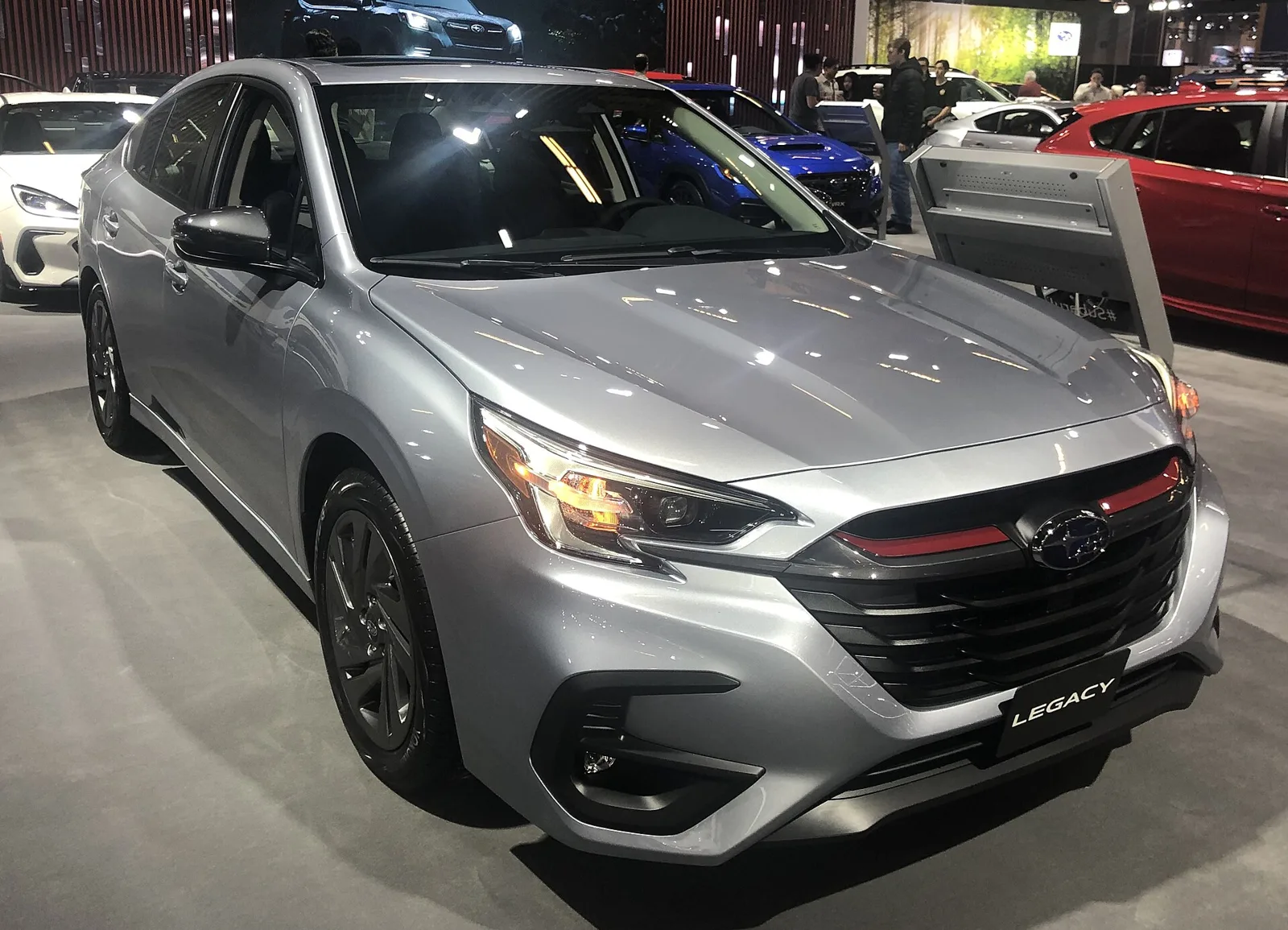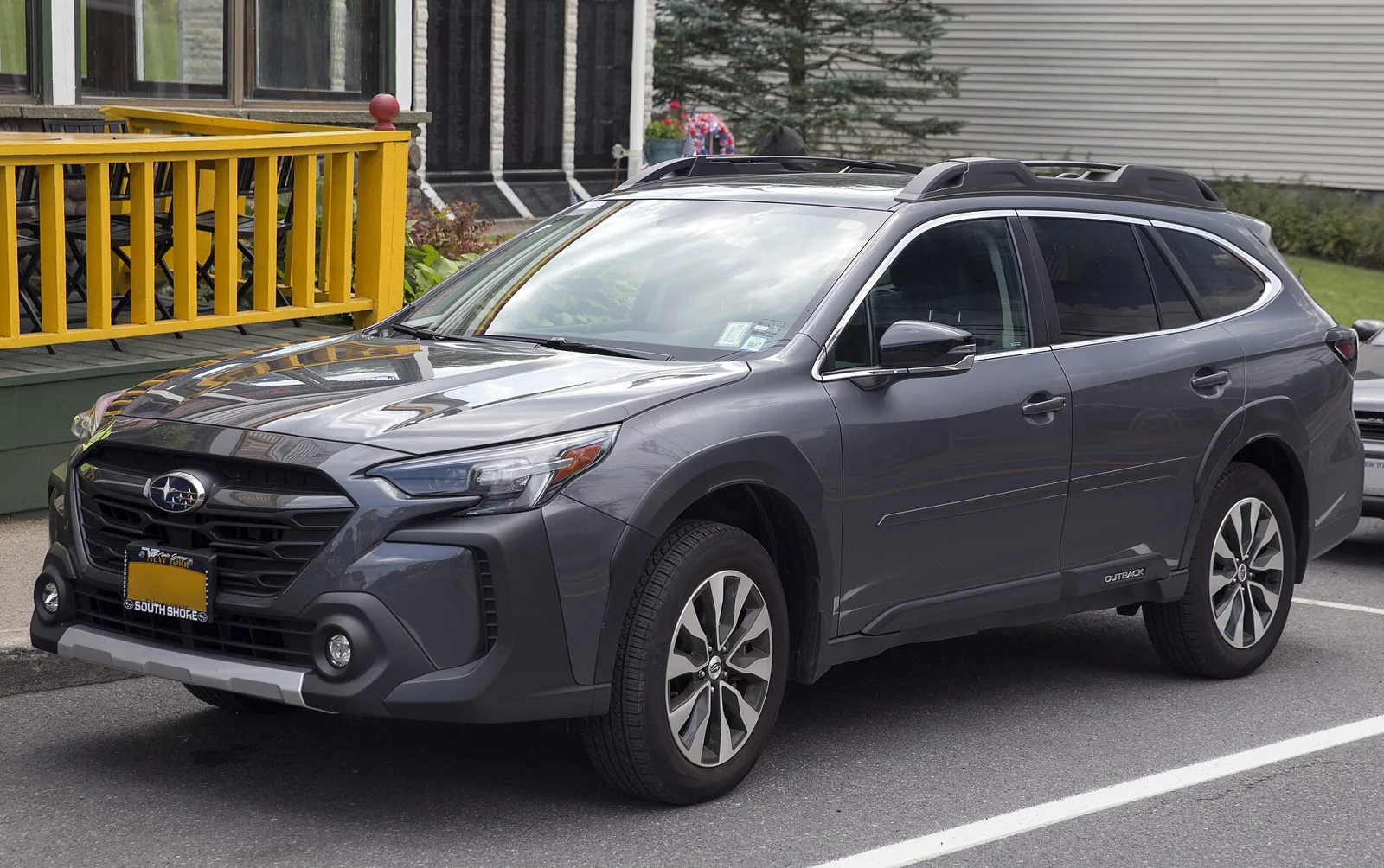
From a 1995 Legacy with cladding and a lift to a seventh generation crossover, all-wheel drive and boxer engines throughout.
The Subaru Outback began in 1994 as a Legacy wagon with added cladding and a raised suspension. It grew into a seven generation family of all-wheel drive models, and the seventh generation, revealed in 2025, is a crossover SUV.
The Outback started life in 1994 as a Legacy wagon fitted with cladding and a lift, and it grew into a family of all-wheel drive models spanning seven generations. Most versions have had all-wheel drive as standard, and the same boxer engines have carried the name through its long life. The Impreza-based Outback Sport ran alongside it for years.
Where did the Outback come from?
The Outback concept came from Subaru of America in the mid-1990s, when the company's sales were slumping. It had no entry in the sport utility market, which was then booming. Lacking the money to design an all-new vehicle, Subaru added body cladding and a suspension lift to its Legacy wagon.
The car was named after the Australian outback. Actor Paul Hogan became the spokesman in North America, casting it as a sturdier, more economical rival to big truck-style SUVs. Sales beat expectations, and Tim Mahoney, Subaru of America's senior vice president, credited the model with saving the company.
It was formally introduced at the 1994 New York Auto Show for the 1995 model year. In Japan it was sold from August 1995 as the Legacy Grand Wagon, a name meant to signal a grander, more luxurious car than the standard Japanese Legacy Touring Wagon. In Australia it launched in 1996 as the Outback, and the Legacy prefix was dropped there.
A Legacy wagon with cladding and a lift that grew into a seven generation family of all-wheel drive crossovers.
What did the first Outback look like?
The Outback retained the ground clearance of the standard Legacy wagon at first, but it used a two-tone paint scheme and fog lights to suggest a rugged character. Olivier Boulay styled the exterior on a short-term contract. Initially it was a trim package on the base Legacy L wagon, with a heavy cloth interior, Berber carpet mats and a luggage rack as standard.
For the 1996 model year the front bumper covers became more aggressive, the fog lights gave way to larger rallye-inspired driving lamps, and the tyres grew taller with deeper tread. Ground clearance rose to 198 mm (7.8 in), or 200 mm (7.87 in) in Japan. The inspiration came from the Legacy's rallying, including a 1990 Safari Rally win in Group N.
The previous Legacy wagon had offered an optional air suspension that temporarily raised the car, but the permanently raised ride height of the Outback proved more practical. Subaru's North American sales had been falling before the Outback arrived, and the model offered a fuel-efficient alternative to the SUVs that were outselling Subaru's traditional wagons.
How did the first Outback's engines and drive work?
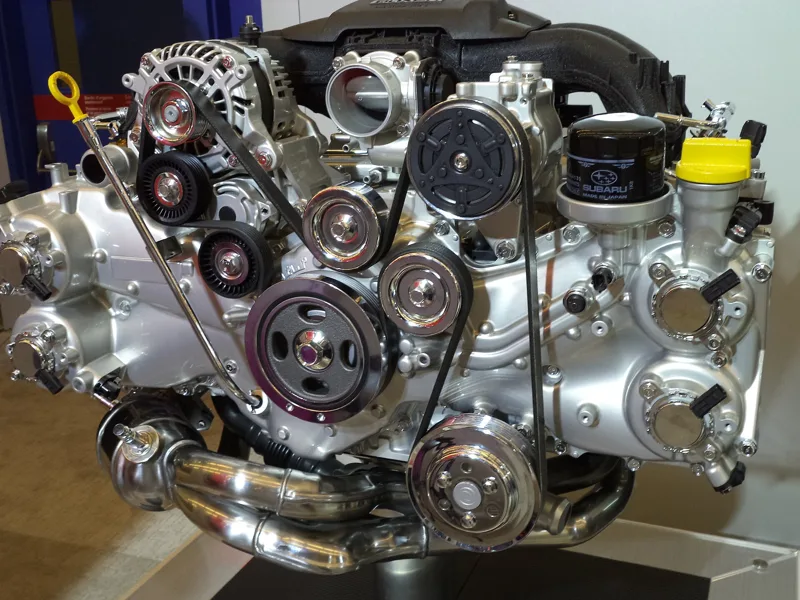
The only engine at first was a 2.2-litre flat-four producing 135 hp (101 kW). For model year 1996 it was replaced by a 2.5-litre twin-cam engine with 155 hp (116 kW), and in the following year power rose to 165 hp (123 kW). Early Outbacks kept the EJ22 four-cylinder, while later generations moved to the larger, DOHC EJ25.
The Japanese Grand Wagon and Lancaster used only the DOHC 2.5-litre flat-four, which gained 10 hp (7.5 kW) in 1998. Some Japanese-spec cars came with digital climate control, plaid upholstery, a dual-range manual transmission and a Momo black leather steering wheel. In September 1997 the Japanese Grand Wagon was renamed the Legacy Lancaster.
All-wheel drive depended on the gearbox. Manual cars had a mechanical Continuous AWD system, normally split 50/50 front and rear, which relied on limited-slip differentials to move power between the axles. Automatic cars used an electronically controlled system normally split 90/10 front and rear, sending more torque rearward under acceleration and forward under braking. In reverse or first gear the automatic split the torque 50/50.
What was the Legacy SUS?
The Legacy SUS, short for Sport Utility Sedan, was a sedan version of the Outback that was tested in the United States in 1998 and then rolled out in North America the following year. It took the Outback's Limited trim as standard, with a hood scoop and a trunk-mounted rear wing added.
Despite the scoop, the SUS did not have a turbocharged engine. The only engine it used was the naturally aspirated EJ25D. The SUS name was dropped when the second-generation Outback sedan arrived.
What changed with the second generation?
With the third-generation Legacy, the second-generation Outback wagon became its own model. The new body was smoother and rounder, about 3 inches longer, and it had a slightly longer wheelbase. The raised roof was kept, and the Japanese version went on sale in September 1998 as the Lancaster. The US-spec Outback arrived in 2000.
A new version of the flat-four boxer became standard, with more low-end torque and smoother performance. The rear suspension was redesigned to take up less space, which added room in the trunk and cargo floor. The 165 hp (123 kW) SAE four-cylinder produced 166 lb ft (225 N m) of torque at a lower rpm than the previous generation.
Ground clearance was 7.3 in (190 mm), and the engine met California's LEV emissions standard. The Outback received a good rating from the Insurance Institute for Highway Safety in 2000 after a 40 mph crash test. Its front seat belts were repositioned, and front and rear airbags were fitted.
Which engines and trims did the second generation offer?
The four-cylinder had a timing belt that needed replacing at about 100,000 miles (160,000 km). The 3.0-litre six used a timing chain that did not need replacement under normal conditions. The base six was sold as the H6-3.0 and shared its interior and options with the Limited, apart from the manual transmission.
The H6-3.0 L.L. Bean edition added a six-disc CD changer, automatic climate control, leather upholstery and dual moonroofs. OnStar was an option on the US L.L. Bean and VDC trims. In Japan, satellite navigation was offered on the upper wagons from 1998.
The H6-3.0 VDC combined the six with the Vehicle Dynamics Control system, which brought stability control and traction control together. A 200 W McIntosh stereo was standard from 2001 to 2004, and the car used a Japanese AWD system called VTD, which normally split power 45/55 front to rear. The VDC version also had extra sound insulation, and it was only slightly heavier than the standard H6-3.0 L.L. Bean.
How did the Outback differ in Australia and Japan?
Australian cars followed the Japanese models in their headlights, indicators, taillights and bumpers, and the Outback badge sat higher on the front doors. The early Australian style had gold cladding and all-in-one headlights, while the 2002 to 2004 cars had silver cladding and multi-unit headlights.
The Lancaster, sold in Japan from September 1998, came with the 2.5-litre engine and either a five-speed manual or an automatic. In May 2000 the Lancaster 6 arrived with Subaru's flat-six. The Lancaster ADA system, introduced in September 1999, used two CCD cameras mounted either side of the rear-view mirror to assist the driver.
What did the third generation add?
The third-generation Outback crossover debuted on 22 October 2003 at the Frankfurt Auto Show, alongside the new Legacy. It was first used in export markets, and by then the name was used in every market. Models with the 3.0-litre EZ30D six appeared at the 2004 Chicago Auto Show.
Ground clearance was 8.5 in (220 mm) in the United States, a figure set to help the car get around fuel economy rules, and 7.8 in (200 mm) elsewhere. The US top trim was the L.L. Bean Edition, with a wood and leather steering wheel, perforated leather seats, GPS navigation and a one-piece glass moonroof.
A new Outback XT for 2005 used the turbocharged 2.5-litre EJ255 from the Impreza WRX, producing 243 hp (181 kW). The naturally aspirated 2.5 made 175 hp (130 kW). Top Gear's 2007 Car of the Year went jointly to the Outback and the Ford Mondeo.
From the 2008 model year the Legacy wagon and Outback sedan were dropped in the United States, leaving the Legacy sedan and the Outback crossover. The 2.5i was certified PZEV, which meant it could be sold in all 50 states, while other models met LEV2 standards.
What was the fourth generation?
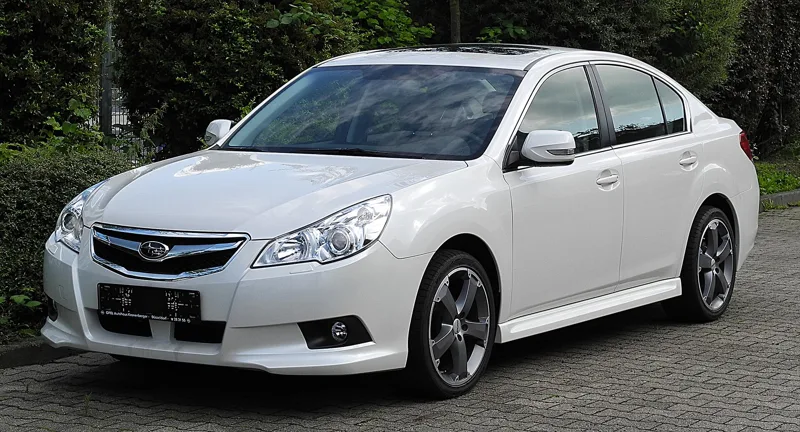
The fourth generation debuted at the New York show in April 2009, fifteen years after the original Outback first appeared there. It was based on the fifth-generation Legacy, and the Outback reached Japan on 20 May 2009. Ground clearance rose to 220 mm (8.7 in), and the car became the ninth Subaru to offer a continuously variable transmission.
Air bags covered the front seats and the sides, and a knee bolster airbag was fitted for the driver. The turbocharged engine was dropped from most international versions, and the double-sized moonroof was reduced to a conventional size. The chassis used Dynamic Chassis Control concepts, with high-tensile steel and a double wishbone rear suspension mounted on large rubber bushes.
In North America the fourth generation won Motor Trend's Sport/Utility of the Year award for 2010. The EyeSight camera system returned to Japan in 2008, and it later came to the fourth-generation car there on its first anniversary.
How did the fifth generation change the Outback?
The fifth-generation Outback arrived for the 2015 model year, with the sixth-generation Legacy sedan that was previewed at the Los Angeles Auto Show in November 2013. It stood alone as a model line apart from the Legacy, which sharpened the gap between them. In Japan it was still badged the Legacy Outback.
Subaru framed the new styling as more Outback, combining the strengths of passenger cars and SUVs. EyeSight was offered for the first time in Europe on the new car, and the mirrors were moved onto the front door sheet metal to cut drag. The body and wheelbase grew, and the car was classed as a crossover, with its larger 256 hp (191 kW) 3.6-litre EZ36 engine.
The IIHS gave the car its Top Safety Pick, JNCAP awarded ASV+, and NHTSA gave five stars. From 2018 some markets offered Subaru Adaptive Driving Beam, which adjusts shutters in the high beam to avoid dazzling oncoming drivers. In China the uplevel engine was a turbocharged 2.0-litre FA20F.
What did the sixth generation bring?
The revised Outback premiered at the New York International Auto Show on 17 April 2019 and went on sale in the United States for the 2020 model year, alongside the Legacy sedan. The raised suspension gave a minimum ground clearance of 8.7 in (220 mm). Subaru said that the Outback accounted for more than 80 per cent of the new station wagons sold in the US that year.
In North America the base unit was the 2.5-litre FB25D, rated 182 hp (185 PS; 136 kW) at 5,800 rpm, while XT models used the 2.4-litre FA24F turbo, rated 260 hp (194 kW; 264 PS) at 5,600 rpm. In the US the range was Base, Premium, Onyx Edition, Limited and Touring. The sixth generation went on sale in Australia on 18 February 2021, followed by Europe in April 2021, Taiwan that April, and South Africa in May 2021.
In Japan the sixth generation was sold as the Legacy Outback from 7 October 2021, with the 1.8-litre CB18 turbo engine. It was the last model in the Legacy series to be sold in Japan, and orders were scheduled to end in March 2025. Subaru said the car had fulfilled its role in the domestic market. In October 2024 a 30th Anniversary model with STi tuned dampers was built in a run of 500 units.
What is the Outback Wilderness?
The Outback Wilderness was released in May 2021 as a 2022 model, and it was the first vehicle sold under Subaru's Wilderness brand. Its suspension was raised to 9.5 inches (240 mm), 20 mm more than the standard car's 8.7 inches (220 mm). It rode on all-terrain tyres on black 17-inch wheels, with more plastic cladding and integrated tow hooks.
The Wilderness roof rack is rated for up to 700 pounds (320 kg), and its final drive ratio is shorter, at 4.44:1 against the standard 4.11:1. The only engine option is the turbocharged 2.4-litre FA24F. Interior details include orange stitching and water-resistant StarTex seats.
What is the seventh-generation Outback like?
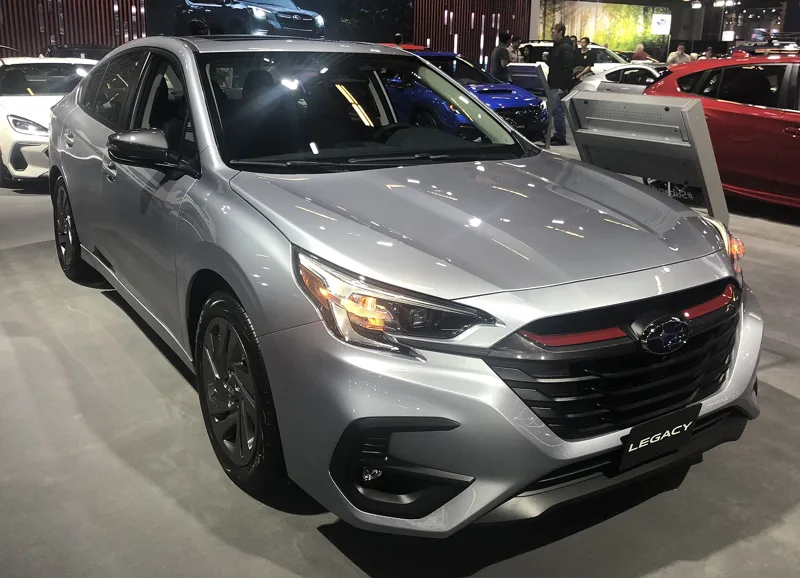
The seventh-generation Outback was revealed on 16 April 2025 and went on sale in North America in August 2025 for the 2026 model year. It moved to a crossover SUV shape, with a boxier body, a taller roofline and more cladding. Subaru said the boxy design emphasised the car's height and durability. 19-inch alloy wheels were offered for the first time on an Outback.
Inside, a 12.1-inch touchscreen sits alongside a 12.3-inch digital instrument cluster, and the infotainment system runs Google's Android Automotive operating system. Wind noise is 10 per cent lower than before. Cargo space grows to 970 L (34.3 cu ft), and the load floor was raised by 51 mm (2 inches).
The base engine is a naturally aspirated 2.5-litre boxer four making 180 hp (134 kW; 182 PS) and 241 N m (178 lb ft). The XT and Wilderness use a turbocharged 2.4-litre boxer four with 260 hp (194 kW; 264 PS) and 376 N m (277 lb ft). Both are paired with a continuously variable automatic and standard symmetrical all-wheel drive.
The Wilderness has 9.5 inches (24 cm) of ground clearance and a 3,500 lb (1,600 kg) towing capacity. EyeSight allows hands-free driving on highways up to 85 mph (137 km/h). The car went on sale in Australia on 27 November 2025, Mexico in February 2026 and New Zealand in the same month, and Indonesia in July 2026.
What was the Outback Sport?
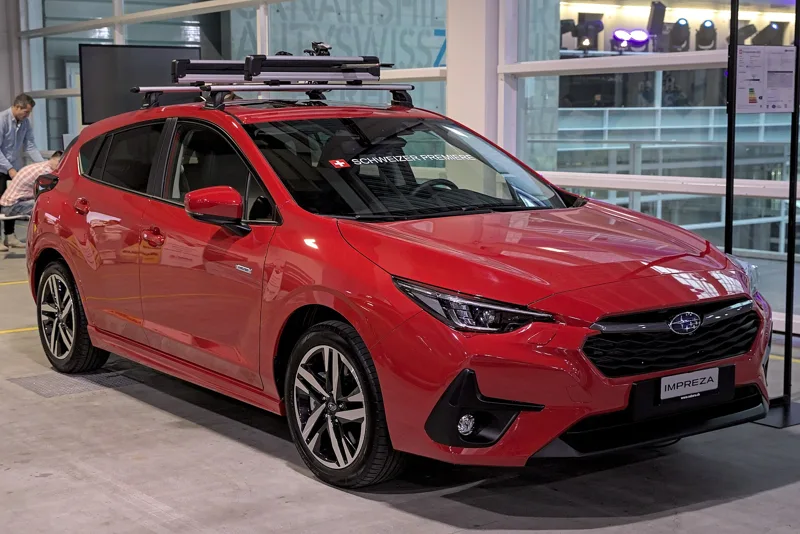
Subaru released the first Impreza-based Outback Sport in North America for the 1995 model year, with an off-road look and two-tone paint. The Impreza hatchback underpinnings were unchanged. The first Outback Sport was based on the L Active Safety Group, with all-wheel drive and front and rear disc anti-lock brakes.
It used a 1.8-litre EJ18 or 2.2-litre EJ22 engine, with a roof rack and mud flaps. Ground clearance stayed at 160 mm (6.3 in), and it rose to 160 to 170 mm (6.4 to 6.5 in) in 1997. The Outback Sport was priced below the Legacy-based Outback and aimed at younger buyers. Later generations followed the Impreza, with a second generation for 2002 and a third from 2008.
| Specification | Detail |
|---|---|
| Launch | 1994 New York Auto Show, for the 1995 model year |
| First generation engine | 2.2-litre flat-four, 135 hp (101 kW); 2.5-litre twin cam, 155 hp (116 kW) from 1996; 165 hp (123 kW) from 1997 |
| Ground clearance, first generation | 198 mm (7.8 in) for 1996; 200 mm (7.87 in) in Japan |
| Second generation | Body about 3 inches longer; ground clearance 190 mm (7.3 in) |
| Third generation | Ground clearance 220 mm (8.5 in) in the US, 200 mm (7.8 in) elsewhere; XT 243 hp (181 kW) |
| Fourth generation | Ground clearance 220 mm (8.7 in); CVT; 3.6-litre flat-six from the Tribeca |
| Fifth generation | 3.6-litre EZ36, 256 hp (191 kW) |
| Sixth generation | 2.5-litre FB25D, 182 hp (136 kW); 2.4-litre FA24F turbo, 260 hp (194 kW) |
| Wilderness | Ground clearance 240 mm (9.5 in); towing 1,600 kg (3,500 lb) |
| Seventh generation | 2.5-litre boxer, 180 hp (134 kW; 182 PS); 2.4-litre turbo, 260 hp; cargo 970 L (34.3 cu ft) |