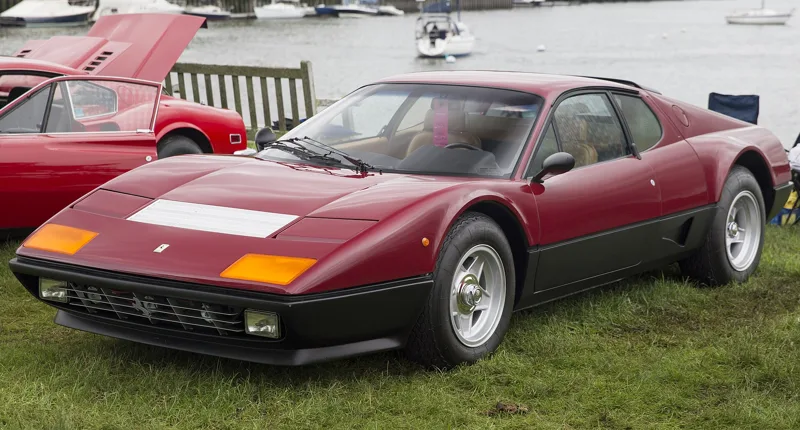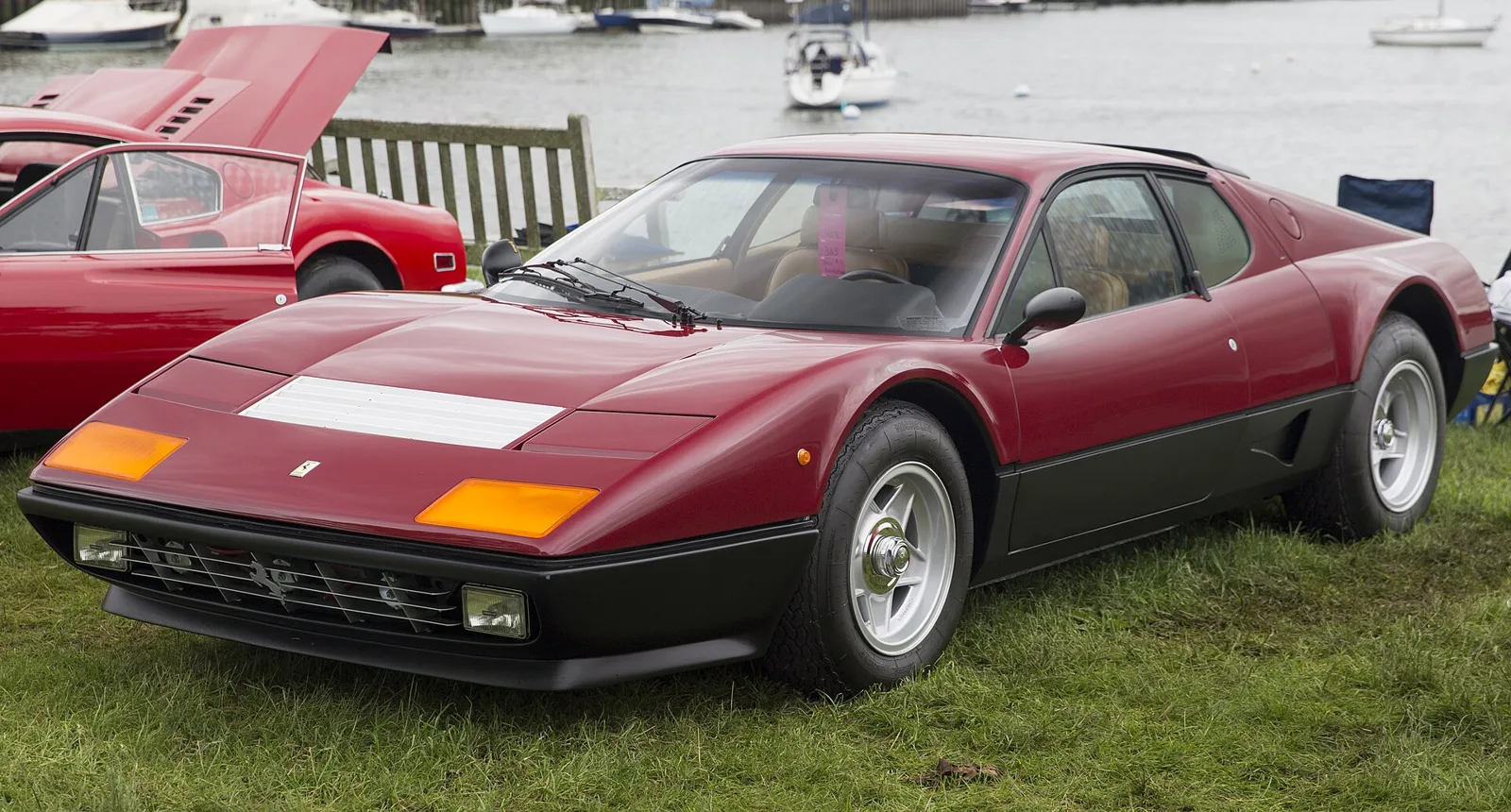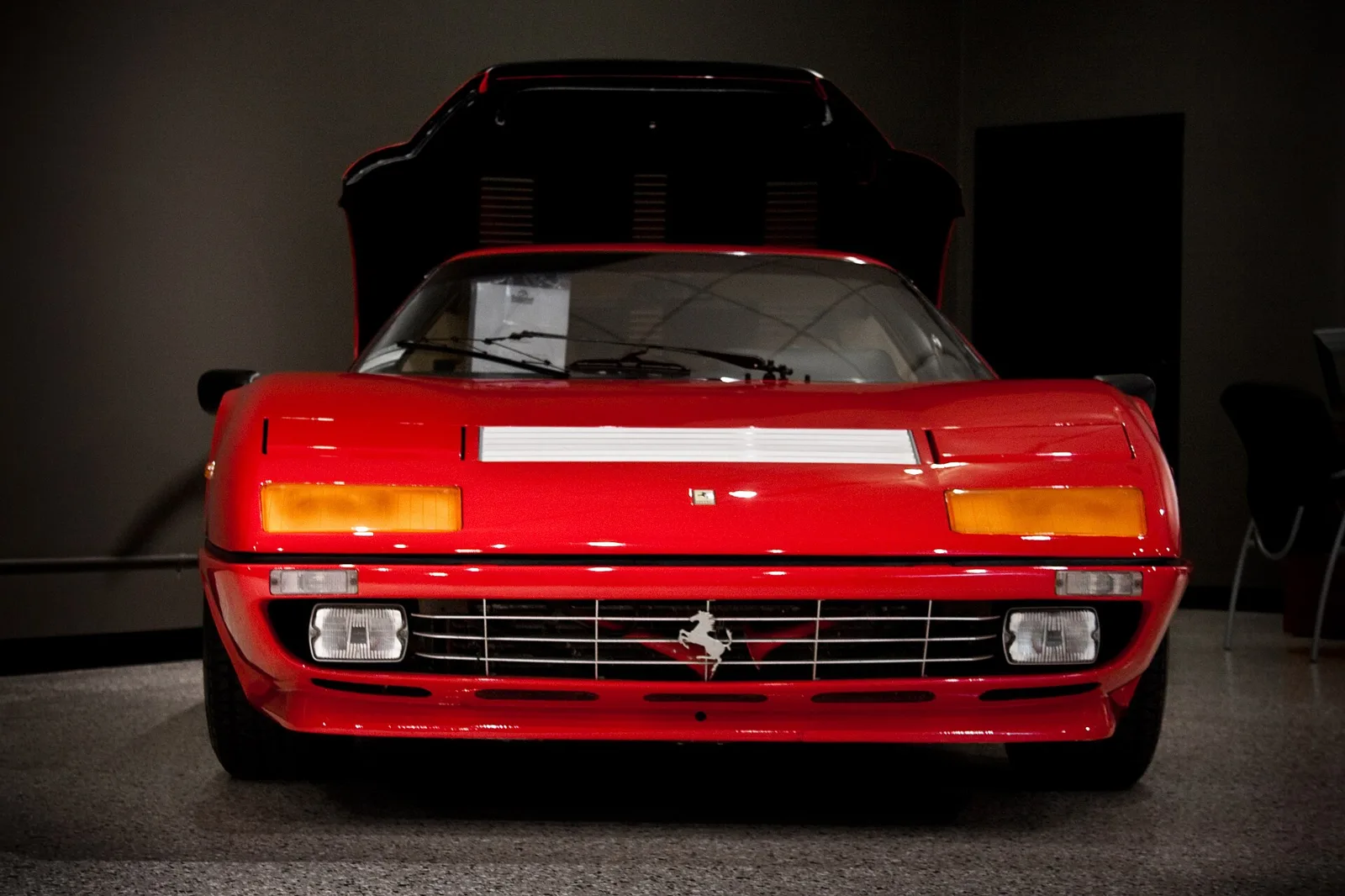
Designed at Pininfarina and built from 1973 to 1984, the BB series gave Ferrari its first mid-engined twelve-cylinder road car.
A mid-engined twelve-cylinder sports car from Ferrari, the Berlinetta Boxer ran through the 365 GT4 BB, BB 512 and BB 512i. Fioravanti's styling and a flat-12 engine defined the series until the Testarossa arrived in 1984.
The Ferrari Berlinetta Boxer, usually shortened to BB, was a family of mid-engined two-seaters that Ferrari made in Italy between 1973 and 1984. Pininfarina's Leonardo Fioravanti shaped the bodies, and each car carried a flat twelve-cylinder engine behind the cabin. It was the marque's first mid-engined road car with a twelve-cylinder unit.
What is the Ferrari Berlinetta Boxer?
The BB was a mid-engined sports car whose twelve-cylinder engine lay flat behind the seats. The first model, the 365 GT4 BB, was followed by the BB 512 in 1976 and the fuel-injected BB 512i in 1981, before the Testarossa took over in 1984.
Each generation kept the same basic idea, but the engine grew and the body was reworked. The 365 GT4 BB was the first Ferrari road car to place a twelve-cylinder behind the driver, which made it a clean break from the Daytona's front-engined layout.
A mid-engined flat-12 that Ferrari resisted for years before the BB series became its first.
Why did Ferrari resist mid-engined road cars for so long?
Enzo Ferrari believed that buyers would struggle with a mid-engined road car, and his engineers needed years to bring him round. Mid-engined rivals, however, began to beat Ferrari on the track in the late 1950s, and that pressure slowly shifted his thinking.
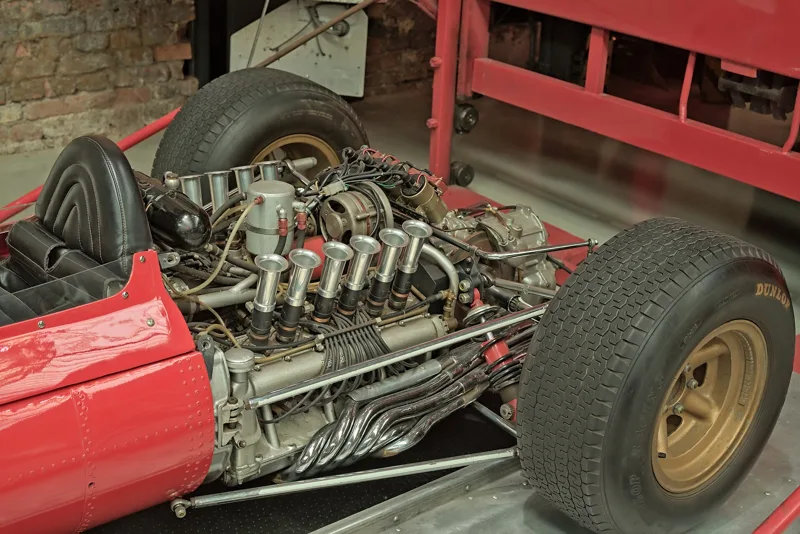
The mid-engined path opened with the 246 P Formula One car in 1960 and the Dino SP prototypes in 1961. In 1963 the V12 racing engines moved to the rear as well. The first road-going Ferraris with that layout were the Dino 206 GT and 246 GT/GTS of 1967, sold under the cheaper Dino name.
Ferrari's flagship V12 road cars, meanwhile, stayed front-engined into the early 1970s. The Daytona and the 365 GTC/4 arrived in 1968 and 1971 with their engines up front, so the BB was the first mid-engined twelve-cylinder road car from the company.
Where did the flat-12 come from?
Ferrari first raced a flat-12 in the 512 F1 of 1964, whose 1.5-litre unit was designed by Mauro Forghieri, the technical director of the racing department. That architecture reappeared in several Formula One and sports prototype cars, among them the 212 E of 1968, the 312B of 1970 to 1975 and the 312PB of 1971.
The road-going engine of the 365 GT4 BB grew out of these racing units. It was not a copy, but it inherited their architecture and the engineering thinking behind cars that had already been winning races.
Who designed the 365 GT4 BB?
Angelo Bellei led the Ferrari engineers who began work on the successor to the 365 GTB/4 Daytona in 1969. The new car kept the Daytona's model number but carried a rear-mounted flat-12 running lengthways, a layout that was new for Ferrari's road cars. The team borrowed chassis ideas from the 250 LM and the Dino 206 and 246.
The first prototype was shown at the 1971 Turin Motor Show. Giorgio Enrico, a Ferrari test driver, ran an extended road and track programme, and the production car differed little from the prototype. Because the layout and engine were already familiar to the team, the car reached buyers in 1973.
How was the flat-12 put together?
Giuliano de Angelis supervised the Tipo F102A engine. It came from the 3.0-litre flat-12 that Forghieri had designed for the 1969 312B, and from the road engine of the 365 GTB/4. Its displacement was 4,390.35 cc, and its bore and stroke matched the 365 GTB/4's dimensions of 81 mm and 71 mm.
The block was a silumin alloy with iron liners, and the pistons were light alloy. Each head carried two overhead camshafts and two valves per cylinder, and four cams were turned by a pair of toothed belts. Four three-barrel Weber carburettors fed the engine, which used a single Magneti Marelli distributor.
The engine used a wet sump at first, and the BB 512 later moved to a dry sump to avoid oil starvation. The first prototype reportedly made 380 bhp at 7,100 rpm, while brochures for the production version quoted 360 bhp at 7,500 rpm. Published figures differed from one publication to the next.
Is the Berlinetta Boxer engine really a boxer?
Strictly speaking, no. In the F102A and its descendants, each pair of opposing pistons shared one crank pin and moved in the same direction. In a true boxer the opposed pistons move in opposite directions. Forghieri himself argued that the engine should be called a flat-12, with its banks set at 180 degrees.
The name stuck regardless. Ferrari's own publicity and the motoring press used it for the whole series, and the flat layout still gave the car the low centre of gravity that mattered in practice.
How was the 365 GT4 BB's drivetrain arranged?
The five-speed manual transaxle and its limited-slip differential sat beneath the engine, next to the oil sump. A single-plate dry clutch was mounted at the rear of the engine, and power travelled through drop gears and a horizontal shaft to the transaxle.
This arrangement raised the centre of gravity, but it shortened the drivetrain from front to back, allowing a short wheelbase and a generous cabin. The Tipo F102A evolved into the F102B for the BB 512, the F110A for the 512i and, eventually, the engines of the Testarossa.
What did the BB look like?
Pininfarina's body was styled under Fioravanti, drawing on the one-off P6 Berlinetta Speciale of 1968. The 1971 prototype had a low wedge nose with hidden headlamps, a sharply raked windscreen and a broad tail ending in a vertical panel. Wind tunnel work refined the car, and a spoiler was added across the sail panels behind the cabin.
Steel formed the central bodywork, while the front and rear covers and the doors were aluminium. The valances were fibreglass. Both the front and rear covers hinged as clamshells, giving access to the engine and the small front luggage bay.
The prototype was finished with a horizontal split line near the top of the wheel rims, with satin black below it, and that two-tone look went into production. Ferrari later used the same treatment on the 308, where it was called Boxer paint. Production cars had six tail lamps, against four on the prototype.
How was the chassis built?
The chassis was a tubular steel frame, the usual Ferrari method of the time. Bellei said the frame drew heavily on the 250 LM and the Dino cars. The central body formed a semi-monocoque with the frame, while the outer panels carried little load and sat on light subframes that could crumple in a crash.
Each wheel had double wishbones. A coil spring and damper sat at each front wheel, with a pair at each rear wheel. Anti-roll bars at both ends, unassisted rack and pinion steering and disc brakes at all four corners completed the set-up, and the first cars wore Michelin XWX tyres.
How many 365 GT4 BBs were built?
The production car appeared at the 1973 Paris Motor Show just as the oil crisis hit, so early demand was weak. Ferrari had planned only 25 cars, and the first year produced about two dozen. Later the line reached roughly one car a day. Between 1973 and 1976, 387 were made, which makes it the rarest BB.
Of those, 88 had right-hand drive and 58 of them were earmarked for Britain. Scaglietti made the bodies and Maranello handled final assembly. The 1973 price was 18,290,000 lire, rising to 24,375,000 lire by 1976, when the car cost about US$30,000.
Reviewers liked the handling and the straight-line speed. Road & Track's 1975 test car had a slipping clutch, yet still managed 7.2 seconds to 60 mph and a top speed of 175 mph. Car and Driver's 1976 test of a fully working car recorded 6.1 seconds to 60 mph.
What did the BB 512 change?
The BB 512 replaced the 365 GT4 BB in 1976 and was first shown at that year's Paris show. Its name reflected the five-litre flat-12 and revived the name of Ferrari's 512 racer. Ferrari usually named its twelve-cylinder road cars after their per-cylinder capacity, so this was a break with habit.
The engine, now the F102B, measured 4,943 cc with an 82 mm bore, a 78 mm stroke and 9.2:1 compression. Ferrari first claimed 360 bhp but later revised the figure to 340 bhp (250 kW). Peak power arrived at 6,200 rpm instead of 7,000, while torque rose to 449 N-m (331 lb-ft) at 4,300 rpm, which made the power easier to use.
Autocar tested a BB 512 in May 1978, recording 6.2 seconds to 60 mph and 163 mph (262 km/h). The car was later listed in the Guinness Book of Records as the fastest independently road-tested production car, although other tests produced higher numbers.
Chassis changes were limited. The rear tyres widened to 225/70 VR 15 on 9-inch wheels, which pushed the rear track out to 1563 mm. A new chin spoiler stopped the nose lifting at speed, twin tail lamps replaced the triple units and NACA ducts behind the doors cooled the exhaust and rear brakes. In total 929 were built between 1976 and 1981.
What was the BB 512i?
The 512i arrived in 1981 as the final model. Its engine, the Tipo F110A, used Bosch K-Jetronic fuel injection, which lowered emissions and improved driveability. Camshaft timing changed, and the ignition gained a built-in rev limiter. It was rated at 340 bhp (250 kW) at 6,000 rpm, the least powerful of the three.
Spotting the 512i was easier thanks to small white running lamps in the nose, a grille that revealed the driving lamps and red fog lamps in a reworked rear valance. Michelin TRX tyres replaced the XWX, and air conditioning, power windows and a stereo were standard. Only 1,007 were built between 1981 and 1984, and a few cars were trimmed in Zegna wool.
How did the BB sell in North America?
Neither the BB nor the Lamborghini Countach was built to American or Canadian rules. Enzo Ferrari reasoned that tighter regulations and the 55 mph limit would keep American demand small, and the 365 GT4 BB had been planned as a modest run for Europe.
Americans bought the cars regardless, and dealers and owners paid to modify them to meet EPA and Department of Transportation rules. This grey market era ran from 1976 to 1988, and by 1985 it had reached 66,900 vehicles. Richard Fritz and his firm Amerispec were the first to legalise a BB.
Amerispec's federalisation involved more than 75 changes, with the front bumper and subframe rebuilt to meet the 5 mph standard. Carburettored cars needed secondary air injection and catalytic converters, while the fuel-injected 512i needed fewer changes. A new BB cost an average of US$14,000 to federalise. A 1990 law ended the practice, and later imports had to wait until the cars were 25 years old.
How did the BB perform in racing?
Scuderia Ferrari never raced the 365 GT4 BB. Luigi Chinetti's North American Racing Team, known as NART, campaigned modified road cars with some factory help. In 1974 it acquired two 365 GT4 BBs and converted both for competition.
Chassis 18139 was taken apart and rebuilt with a roll cage, a larger fuel tank, stiffer suspension and wider bodywork. It entered the 1975 Daytona, retired after a hub carrier broke, finished sixth at Sebring and then ran Le Mans in 1977, finishing 16th overall. For 1978 it had a factory 512 engine and placed 16th overall and third in class at Le Mans.
Ferrari then built the 512 BB LM as a competition car in 1978. The first series produced roughly 400 to 440 bhp, but its three factory cars all failed at Le Mans that year. The second series used Lucas mechanical injection for about 470 to 480 bhp, and 25 S2 cars were built. The best finish came in 1981, with fifth overall and a win in the GTX class at Le Mans.
Where did the BB name come from?
The letters BB appeared in Ferrari's sales literature and in press coverage of the 365 GT4 BB, BB 512 and BB 512i. Insiders, however, have offered two competing explanations, and both suggest that Berlinetta Boxer was a name added to the letters after the fact.
Forghieri argued that the B stood for Bialbero, meaning twin-cam, because the engine was not really a boxer. Fioravanti offered a more colourful account: the team called the prototype Brigitte Bardot because it was so beautiful, and the nickname was shortened to BB. Berlinetta Boxer was supposedly coined later, since naming a Ferrari after an actress was thought unseemly.
What are the Berlinetta Boxer specifications?
| Specification | Detail |
|---|---|
| Years built | 1973 to 1984 |
| Designer | Leonardo Fioravanti, Pininfarina |
| 365 GT4 BB engine | 4,390.35 cc flat-12, Tipo F102A |
| 365 GT4 BB output | 360 bhp at 7,500 rpm (production) |
| BB 512 engine | 4,943 cc flat-12, Tipo F102B, 9.2:1 compression |
| BB 512 output | 340 bhp (250 kW), revised figure |
| BB 512i engine | Tipo F110A with Bosch K-Jetronic injection |
| BB 512i output | 340 bhp (250 kW) at 6,000 rpm |
| Gearbox | Five-speed manual transaxle, limited-slip differential |
| Suspension | Double wishbone at all four wheels |
| Production totals | 387 (365 GT4 BB), 929 (BB 512), 1,007 (BB 512i) |