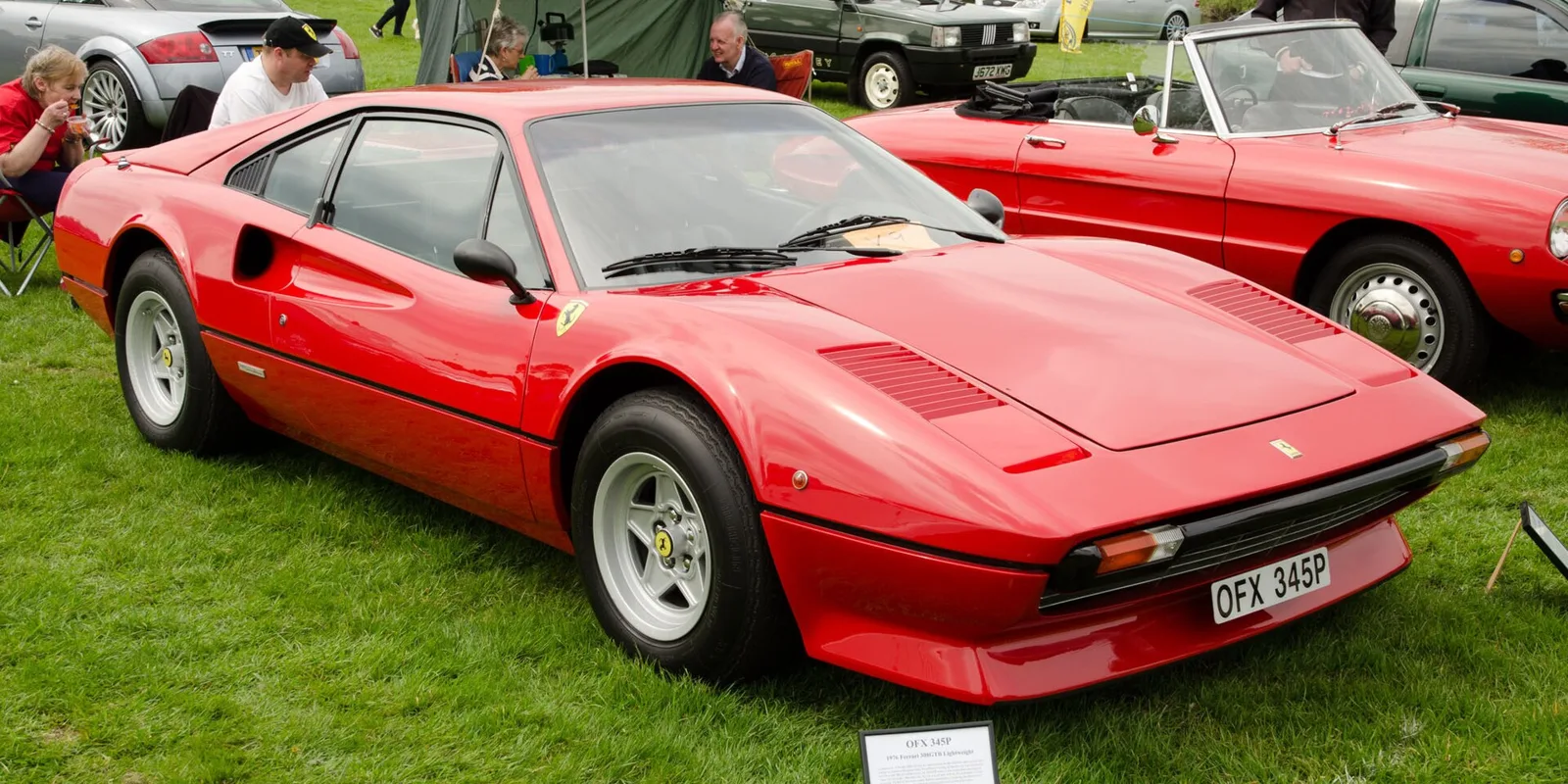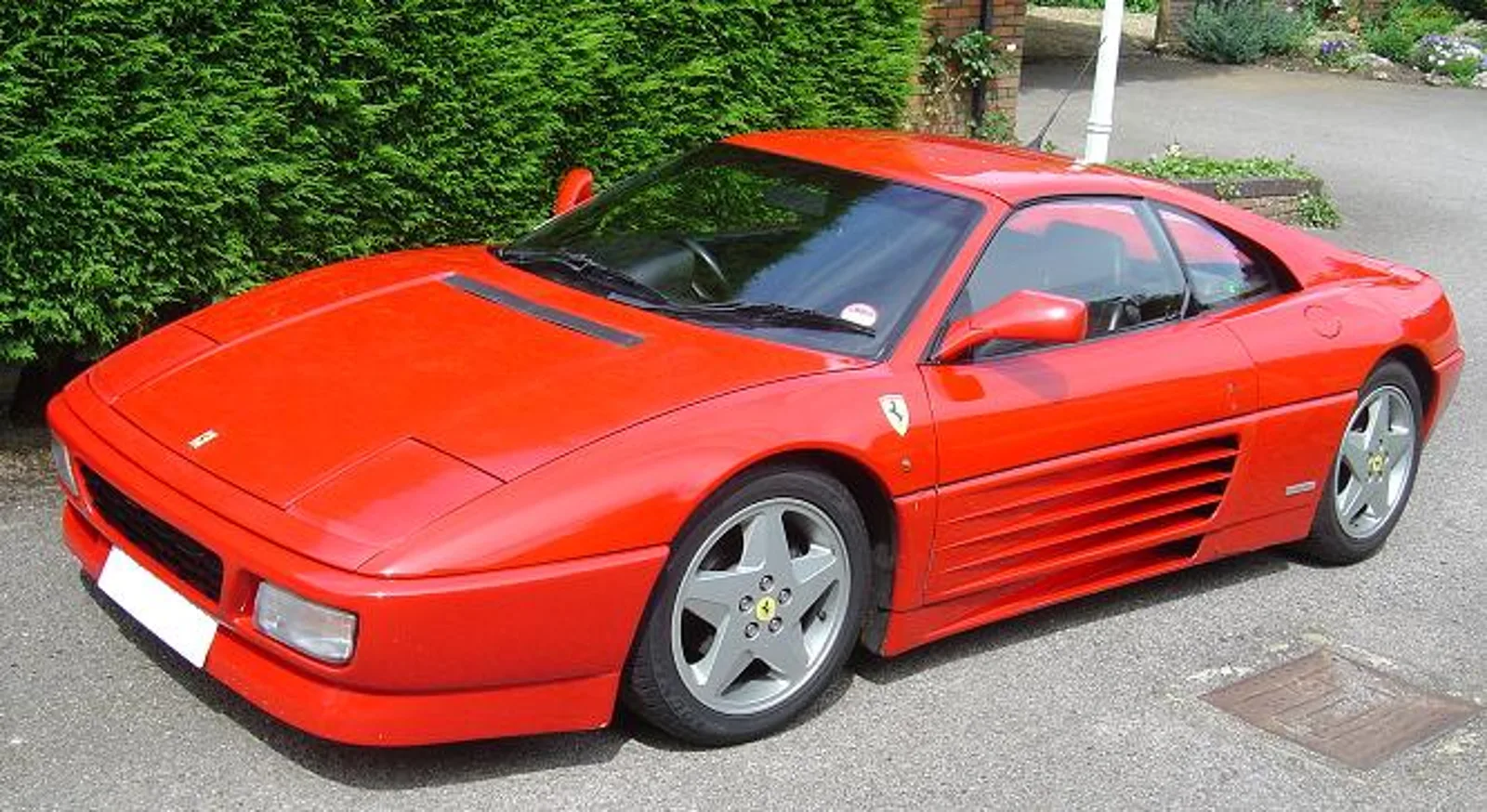
A 3.4-litre V8, Fioravanti styling and a racing career that ran from the Challenge series to the 24 Hours of Le Mans.
The Ferrari 348 is a mid-engined two-seat sports car with a 3.4-litre naturally aspirated V8, built by Ferrari from 1989 to mid-1994. It came as a coupe, a targa and later a Spider, and it used a transverse gearbox. The F355 replaced it.
The Ferrari 348 was a two-seat, mid-engined sports car with an 8-cylinder engine that succeeded an earlier Ferrari model. It stayed in production until mid-1994, when the F355 took its place, and it was the last V8 whose development Enzo Ferrari oversaw. Coupe, targa and convertible versions turned it into a broad range rather than a single model.
Where did the 348 come from?
The 348 replaced the 328 in 1989 and was the final 8-cylinder car developed under Enzo Ferrari before his death. The car was then commissioned for production after his death, and it stayed on sale until mid-1994, when the F355 succeeded it.
Ferrari gave the model a number that followed its own logic. The first two digits show the engine displacement and the last shows the cylinder count, so 348 means 3.4 litres and 8 cylinders. The car is also known by the Type F119 designation.
The 348 was the first standard Ferrari road car with a mid-engined, longitudinal V8 since the 288 GTO. That layout set it apart from the models that came before it.
A mid-engined V8 with a transverse gearbox, sold as a coupe, targa and convertible, and raced at Le Mans.
What engine did the 348 use?
The 348 used a naturally aspirated 3.4-litre quad-cam V8 with four valves per cylinder. The engine was mounted longitudinally, and in its first form it produced 300 PS (221 kW; 296 hp). Its displacement was 3,405 cc, which put it in the tb and ts models.
The engine had a compression ratio of 10.4 to 1 on the early cars. Peak torque reached 324 Nm (238 lb ft) at 4,200 rpm, delivered through a five-speed manual gearbox.
The GTB, GTS and Spider used the F119H engine from late 1993. Its compression rose to 10.8 to 1, and output reached 320 PS (235 kW; 316 hp) at 7,200 rpm. North American cars were rated at 312 hp (233 kW; 316 PS).
Why was the gearbox mounted across the car?
The gearbox sat transversely behind the engine, a layout taken from the Ferrari 312T Formula One car. It was the first street Ferrari to use the design, and the letter t in the tb and ts names refers to it. The gearbox was a five-speed manual.
The layout paired a longitudinal V8 with a sideways gearbox. That combination is the reason the tb and ts names carry the letter t, and it set the 348 apart from the cars that came before.
How was the 348 styled?
Leonardo Fioravanti oversaw the 348's design, and it was the last model he led as chief stylist. Its body echoed the Testarossa, with straked side air intakes and rectangular taillights. Radiators moved from the nose to the sides, which widened the car and made its doors very wide.
Fioravanti's earlier credits included the F40, Daytona, 512 Berlinetta Boxer, 288 GTO, P5 and P6. The F40 was then the world's fastest production car, which put the 348 in very fast company.
The F355 that succeeded the 348 went back to the round taillights and rounded side scoops of the 328. That return made the 348 stand apart from its successor in styling terms.
What systems did the 348 carry?
The 348 used dual-computer engine management with twin Bosch Motronic electronic control units. It also had double-redundant anti-lock brakes and self-diagnosing air conditioning. The Motronic system was upgraded in 1990 from version 2.5 to version 2.7, and later cars gained new starter motors.
Oil was supplied by a dry sump system, which kept the engine lubricated at high speed and during hard cornering. Because of this layout, the oil level could only be read accurately on the dipstick with the engine running.
Other engineering details included adjustable ride-height suspension and a removable rear sub-frame. From 1993 the battery moved into the front left fender, and the cars used Japanese starter motors and Nippondenso generators.
The 348 used OBD-I engine management. European and general market cars did not have the self-test push button, which is needed to run that diagnostic feature.
How many 348s were built?
Ferrari built 2,894 348 tb coupes and 4,228 348 ts targas. The GTB and GTS added 440 cars, of which 222 were berlinettas and 218 were targas. Production of those later versions ended in May 1994, after which the F355 took over.
The Spider arrived in 1993 as a convertible, and its rear track was 50 mm (2.0 in) wider than that of the tb. It sat alongside the GTB and GTS in the later range.
No separate Spider total is given here, so the figures above should be read as the coupe, targa and GTB or GTS counts.
What was the 348 Serie Speciale?
The Serie Speciale was a run of 100 limited-edition cars built between 1992 and 1993 for the US market. Each car was numbered from 1 to 100, and the engine was revised to 316 PS (232 kW; 312 hp) at 7,200 rpm.
Changes included a rear track 50 mm wider and Pirelli P Zero tyres. The car also gained a new front spoiler.
Inside, the seats were trimmed in Connolly leather, a detail that set the special edition apart from the standard car.
How did the GTB, GTS and Spider differ?
The GTB and GTS were revised 348 GT models introduced in late 1993. They used the F119H engine with a 10.8 to 1 compression ratio and 320 PS (235 kW; 316 hp) at 7,200 rpm. The Spider convertible arrived in 1993 as a companion to them.
The fuel tank was smaller, holding 88 L (23.2 US gal; 19.4 imp gal). Performance was sharpened as well, with a top speed of over 280 km/h (over 174 mph) for the GTB and GTS.
The GTB and GTS reached 0-100 km/h (62 mph) in 5.4 seconds and 0-161 km/h (100 mph) in 12.0 seconds, with a quarter mile of 13.6 seconds.
The GTB and GTS were built for under a year before production ended in May 1994.
What was the 348 GT Competizione?
The 348 GT Competizione was a lightweight 1993 homologation car for the GT Championship. Only 50 were made, 8 of them right-hand drive. It used 320 PS (235 kW; 316 hp) at 7,000 rpm and 324 Nm of torque at 5,000 rpm.
Weight came down through carbon-Kevlar composite doors and bumpers. The dry weight was 1,180 kg (2,601 lb), which is the figure that matters for a homologation car.
Which custom and one-off 348s were built?
Zagato announced its Elaborazione package for the 348 tb between 1991 and 1992. The changes were cosmetic, and the package included a new bumper without a fake grille, a glass engine cover and a double-bubble roof.
Zagato planned 22 cars but built only 10.
The Barchetta Competizione was a one-off built from a crashed 348. Its weight was reported at 1,100 kg (2,425 lb).
How did the 348 race?
The 348 raced in the Ferrari Challenge series from 1993, and in GT events in Europe and the United States. Michelotto prepared 11 CSAI-GT examples for 1993, but only two saw true competition use. Jolly Club and Team Repsol then carried the car to notable results.
The Challenge cars used slick tyres, a new body kit and a roll bar. The G-spec cars had to adopt H-spec cylinder heads and injection. The final Challenge season was 1995, when the F355 Challenge replaced it.
Jolly Club campaigned a 348 with real success, winning sequential outright titles in 1993 and 1994, plus 3 category titles. Michelotto built two further cars in 1994 as 348 GTC-LMs for the GT2 class.
Team Repsol finished 4th in GT2 at the 1994 24 Hours of Le Mans, 11th overall. The GTC-LMs also placed 2nd and 6th at the Vallelunga 6hr and 4hr races and 5th at Spa 4 hours, while another Michelotto 348 took 7th in GT2 at the Daytona 24 hours.
Was the 348 used as a test mule?
Yes. Two of the three test mules built for the Ferrari Enzo were 348s, designated M1 and M3. The M3 carried a V12 engine and gearbox, and its engine produced 679 PS (499 kW; 670 hp), a figure well above the 348's own output.
Ferrari did not keep the car, which was auctioned in 2005 for a six-figure sum in euros. Because it mixed parts from several models and was not road-legal, it became known as the Frankenstein Ferrari.
How did critics receive the 348?
Critics were largely positive when the car debuted at the Frankfurt Auto Show in September 1989. Road & Track judged it the better exotic against the NSX in 1991. Paul Dean of the Los Angeles Times called it a better looking, stronger and faster successor to the 308 and 328 in July 1990.
Gavin Green, writing in Car Magazine in October 1990, praised the cockpit. Autocar's July 1993 comparison of the 348tb against the NSX, the 911 Turbo and the Lotus Esprit found more steering feedback in the Ferrari.
Not every reviewer was enthusiastic. Motor Trend noted a 0-60 mph time of about 6 seconds, which an L98 Corvette could beat, and a slalom speed a little over 63 mph that a Nissan 300ZX Turbo bettered. It also likened the engine note to a high-pitched turbine.
The dummy front grille drew criticism as a styling copout. Evo's 2015 retrospective compared the 458 Italia with the 308, 348, F355, 360 and F430, and singled out the 348's steering as among the best its writer had driven.
Wheels magazine in May 1994 said the gearbox was stiff when cold, and that the drivetrain needed the full voice of the engine to work properly.
Early 348s could oversteer at the limit, and later cars received revised rear mounting points.
Former Ferrari president Luca Cordero di Montezemolo disliked the car and scolded engineers over it. Niki Lauda was asked for a test drive, and he agreed with Montezemolo's verdict.
What are the Ferrari 348 specifications?
| Specification | Detail |
|---|---|
| Type | F119, mid-engined two-seat sports car |
| Engine (tb, ts) | 3,405 cc V8, 32 valves, DOHC |
| Compression (tb, ts) | 10.4 to 1 |
| Power (tb, ts) | 300 PS (221 kW; 296 hp) at 7,200 rpm |
| Torque (tb, ts) | 324 Nm (238 lb ft) at 4,200 rpm |
| Power (GTB, GTS, Spider) | 320 PS (235 kW; 316 hp) at 7,200 rpm |
| Compression (GTB, GTS, Spider) | 10.8 to 1 |
| Top speed (tb, ts) | 267 km/h (166 mph) |
| 0-97 km/h (60 mph) (tb, ts) | 6.0 seconds |
| Top speed (GTB, GTS) | over 280 km/h (over 174 mph) |
| 0-100 km/h (62 mph) (GTB, GTS) | 5.4 seconds |
| Fuel tank (GTB, GTS) | 88 L (23.2 US gal; 19.4 imp gal) |
| Gearbox | 5-speed manual, transverse |
| Production | 2,894 tb; 4,228 ts; 440 GTB and GTS |
| GT Competizione | 50 built; 1,180 kg (2,601 lb) dry weight |