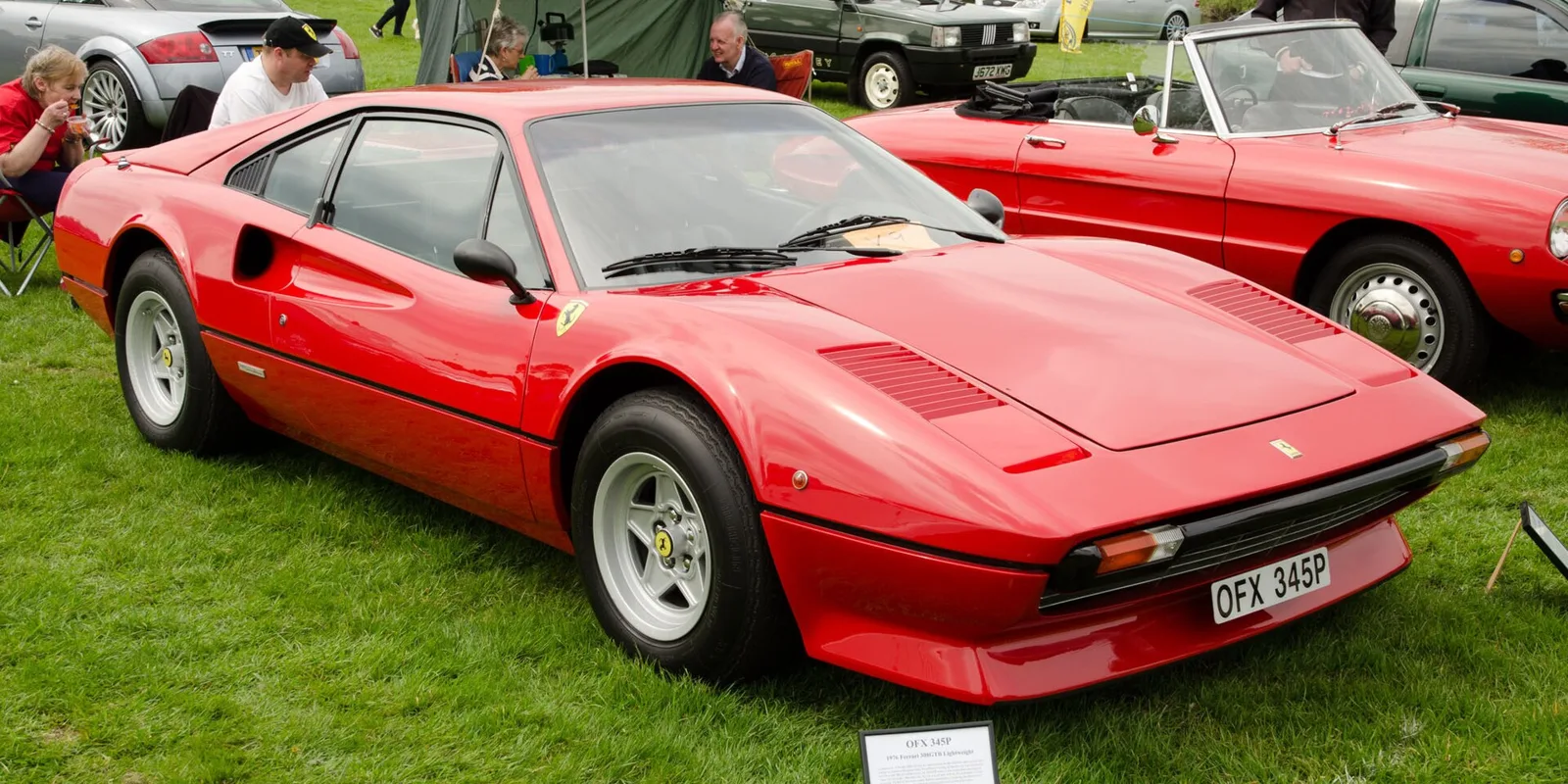
Pininfarina styling, a transverse V8, a turbocharged two-litre sibling and a rally programme built around the same basic car.
Ferrari's 308 was a mid-engined berlinetta and targa sports car built from 1975 to 1985. Early European examples produced 255 PS (188 kW; 252 bhp), and the range later gained fuel injection, a four-valve head and a turbocharged two-litre sibling.
The Ferrari 308 was a mid-engined two-seater sports car that Ferrari built from 1975 until 1985, sold as the GTB berlinetta and the targa-topped GTS. It took over from the Dino 246 and carried a transverse 90 degree V8 directly behind the seats. Pininfarina styled the body, and the car went on to spawn fuel-injected, turbocharged and competition versions.
The 308 was never a single, unchanged model. Over its decade on sale it gained fuel injection and a four-valve head, while a two-litre sibling for Italy added turbocharging. Rally teams and a television series gave the name a wider audience beyond the showroom.
This profile covers the GTB and GTS first, then the 208, the rally cars and the US market.
Where did the 308 come from?
Ferrari introduced the 308 GTB at the 1975 Paris Motor Show as the successor to the two-seater Dino 246. It sat beside the Bertone-shaped Dino 308 GT4, a 2+2 that offered more seating. The targa-topped GTS followed at the 1977 Frankfurt Motor Show.
The two cars were closely related. The GT4 used the same tube platform, but because it was a 2+2 it had a longer wheelbase. The 308 was mechanically similar to the original Dino, which gave the new car a familiar set of foundations.
That leaves the GTB and GTS as the true two-seaters built on the shorter platform.
Ferrari built the car until 1985, when the 328 GTB and GTS took its place. Carrozzeria Scaglietti built the bodies throughout, while Pininfarina supplied the styling.
A Pininfarina-styled replacement for the Dino, the 308 later reached the rally stage and prime-time television.
Design and chassis
The chassis was a tube frame with a separate body. Pininfarina's Leonardo Fioravanti drew that body, and he had already shaped several celebrated Ferraris before the 308 appeared.
The suspension combined double wishbones with coaxial coil springs and hydraulic dampers. Anti-roll bars were fitted on both axles, the brakes were four vented discs, and the steering was unassisted.
The gearbox was a five-speed unit with full synchromesh and a dog-leg pattern. A clutch-type limited-slip differential was fitted to all models, and the engine sat transversely, in unit with the transaxle.
Targa-topped GTS models had a removable roof panel that stowed behind the seats in a vinyl cover when it was not in use.
What engine did the 308 use?
The 308 used a 90 degree V8 with a flat-plane crankshaft, two belt-driven overhead camshafts per bank and transverse mounting. Early European cars produced 255 PS (188 kW; 252 bhp), peaking at 6600 rpm, while American cars were rated at 240 PS (177 kW; 237 bhp), reached at 6,600 rpm.
Four twin-choke Weber 40DCNF carburettors fed the engine, and single coil ignition handled the spark.
Lubrication differed by market. European cars kept a dry sump until 1981, while Australian, Japanese and US cars used a wet sump.
The 1975 American car matched the European engine speed of 6600 rpm, but its power output was lower.
Production numbers and body changes
Early GTB bodies were made from glass-reinforced plastic (GRP), which kept the weight at 1,050 kg (2,315 lb). Steel bodies from June 1977 added approximately 150 kg (331 lb) to the car.
Sprintpack was an option that brought 16-inch wheels, a sports exhaust, Borgo pistons and a deeper spoiler.
Between 1975 and 1980 Ferrari built 2,897 GTB and 3,219 GTS. Only 808 of the fibreglass cars were made, and every one of them had Berlinetta bodywork.
The GTBi and GTSi that followed sold in smaller numbers, with 494 GTBi and 1743 GTSi produced.
How did fuel injection change the 308?
Bosch K-Jetronic injection arrived in 1980 and gave the cars the GTBi and GTSi names. Fuel injection cut pollutants at a cost to performance, lowering output to 214 PS (157 kW; 211 bhp) in Europe and 205 PS (151 kW; 202 bhp) in the US. The four-valve Quattrovalvole followed at the 1982 Paris Motor Show.
Before that change, the cars had used four twin-choke Weber carburettors.
The Quattrovalvole used a 2,927 cc V8 with an 81 mm x 71 mm bore and stroke. European cars made 240 hp (177 kW) at 7000 rpm, with torque of 260 Nm (192 lb ft) at 5000 rpm, while US cars were rated at 230 hp (172 kW) on the SAE net basis, at 6800 rpm.
Each cylinder carried four valves, with DOHC 32-valve heads on the new engine. On US cars the compression ratio came down to 8.6:1 from 9.2:1.
The Quattrovalvole was built between 1982 and 1985, with 3042 GTS and 748 GTB produced in that period. The GTS made up most of that output.
What was the 208 and who was it for?
The 208 GTB and GTS were two-litre versions of the 308, introduced in 1980 and aimed mainly at Italy. Italian tax treated engines above two litres far more harshly, with VAT of 38 percent against the standard 18 percent. The 208 engine displaced 1,990.64 cc and made 155 hp (114 kW) at 6800 rpm.
The 208 is frequently described as the slowest Ferrari ever made. Even so, it beat the 208 GT4 Bertone in a 1980 Motor Trend test.
A turbocharged version, the 208 GTB Turbo, was unveiled at the 1982 Turin Motor Show. It was the first turbocharged road-going Ferrari and used a KKK K26 turbocharger.
The turbo produced 220 hp (162 kW) at 7000 rpm, with torque up 18 percent. The car was claimed to reach 0-97 km/h (0-60 mph) in 6.6 seconds.
The two-litre cars numbered 140 GTB and 160 GTS, built in 1980 and 1981. The turbo era closed in 1985, with 437 GTB Turbo cars and 250 GTS Turbo cars built.
Rally and racing variants
Michelotto, a Padua-based Ferrari dealer, built rally versions of the 308 from 1978 through 1986. Ferrari supplied bare chassis and engines, which Michelotto turned into complete rally cars.
Michelotto built 11 Gr.4 specification rally cars. Their two-valve engines used Bosch Kugelfischer injection and produced approximately 288-330 bhp.
In 1981 the Charles Pozzi team ran four Gr.4 308s, and Jean-Claude Andruet won the Targa Florio and the Tour de France Automobile that year.
Andruet and Michele Petit then finished second on the 1982 Tour de Corse. That result was the best official World Rally Championship finish for the 308.
Michelotto also built four Gr.B cars, homologated in October 1982, then again in January 1983 and April 1983.
What was the 308 GT/M?
The 308 GT/M was a rally car developed by Ferrari and Michelotto for Group B competition, and it used a 3.0 litre engine mounted longitudinally. Only three chassis were built, and the programme was cancelled when Group B was banned for 1987.
Its output was roughly 363-370 bhp at 8900 rpm. At 840 kg (1,850 lb) the car sat 120 kg under the Group B minimum.
The body was made of Kevlar and carbon fibre, and development began in November 1982.
Ferrari tested the car at Fiorano from 1984 to 1986. On racing tyres it lapped in 1:24.6, and it accelerated to 100 km/h (62 mph) in under 4 seconds.
At Fiorano the GT/M beat the F40 at 1:25 and the 512 BB/LM at 1:26.6, which made it quicker than both.
The three chassis were numbered 001, 002 and 003.
From the 308 to the 288 GTO
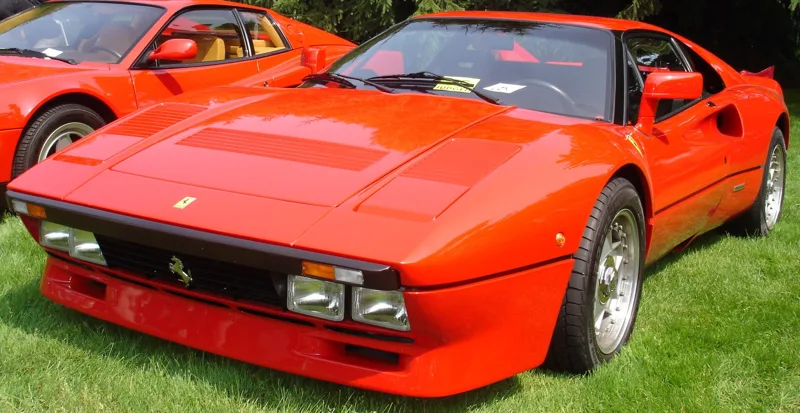
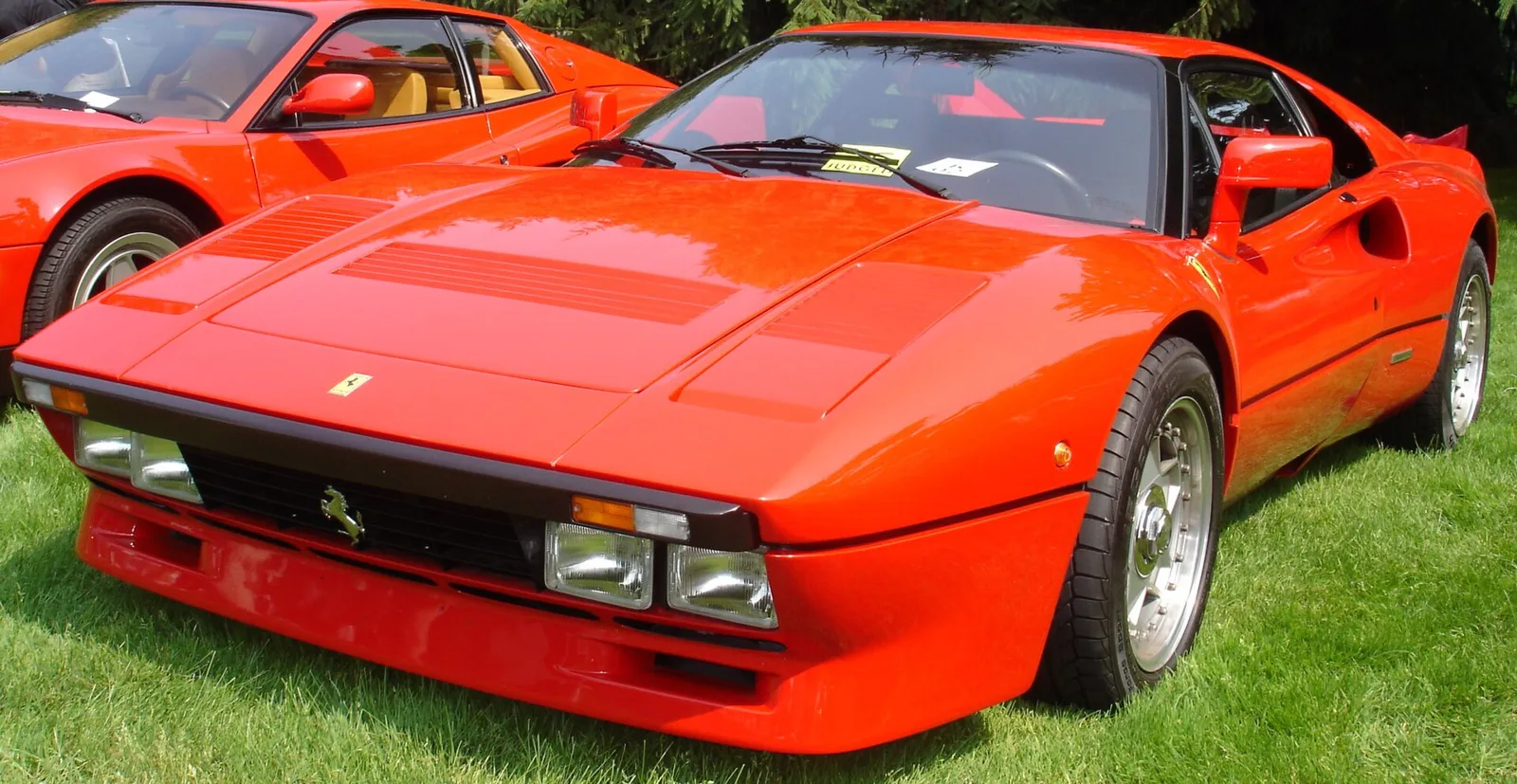
The 288 GTO arrived in 1984 and is regarded as the first Ferrari supercar. It borrowed its styling from the European 308 GTB QV.
The Quattrovalvole had appeared at the 1982 Paris Motor Show, so the 308 family ran from that show to the 288 GTO in 1984. Its status as the first supercar sets it apart from the 308 range it grew from, even though the two shared styling.
United States model
The US version differed in several ways. Its bumpers absorbed 5-mph impacts without damage, and cars sold there needed lead-free petrol and a catalytic converter.
From 1979 to 1981 the US speedometer carried a 55 marker, set up for the 85 mph limit.
The compression change and the catalytic converter meant the American cars were tuned differently from the European versions.
Why is the 308 famous on television?
The 308 became famous through Magnum, P.I., a television drama in which Tom Selleck's Thomas Magnum drove one around Oahu for eight seasons from 1980 to 1988. The show used several cars across its run, and most of them were auctioned off after filming.
The cars carried the licence plate ROBIN 1, and their models changed across the run.
Season 1 used a 1979 308GTS, seasons 2-6 used a 1981 308GTSi, and seasons 7-8 used a 1984 308GTSi quattrovalvole.
Sports Car International also honoured the car in 2004, placing it number five among the top sports cars of the 1970s.
What are the Ferrari 308 specifications?
The Ferrari 308 was a transverse 90 degree V8 mid-engined two-seater with a fully synchromesh 5-speed manual gearbox. Its tube frame carried a separate body, and the table below lists the key figures for each version, from the 1975 car to the GT/M.
Output ranged from 255 PS (188 kW; 252 bhp) in 1975 European trim to 240 hp (177 kW) in later Quattrovalvole form. The table keeps the road cars apart from the 208 and the GT/M, so each row can be read on its own.
| Specification | Detail |
|---|---|
| Layout | Mid-engined two-seater, transverse 90 degree V8 |
| Production | 1975 until 1985, replaced by the 328 GTB and GTS |
| Displacement | Quattrovalvole V8: 2,927 cc, 2.9 L and 178.6 cu in |
| Power, 1975 Europe | 255 PS (188 kW; 252 bhp), 6600 rpm |
| Power, 1975 US | 240 PS (177 kW; 237 bhp), 6,600 rpm |
| Power, Quattrovalvole Europe | 240 hp (177 kW) at 7000 rpm |
| Power, Quattrovalvole US | 230 hp (172 kW) on the SAE net basis, 6800 rpm |
| Torque, Quattrovalvole Europe | 260 Nm (192 lb ft) at 5000 rpm |
| Weight, GRP body | 1,050 kg (2,315 lb) |
| Gearbox | Fully synchromesh 5-speed dog-leg manual |
| 208 Turbo | 220 hp (162 kW) at 7000 rpm; 0-97 km/h (0-60 mph) in 6.6 seconds |
| GT/M | 3.0 litre, approximately 363-370 bhp at 8900 rpm; 840 kg (1,850 lb) |
_-_14453314104_(cropped).jpg)