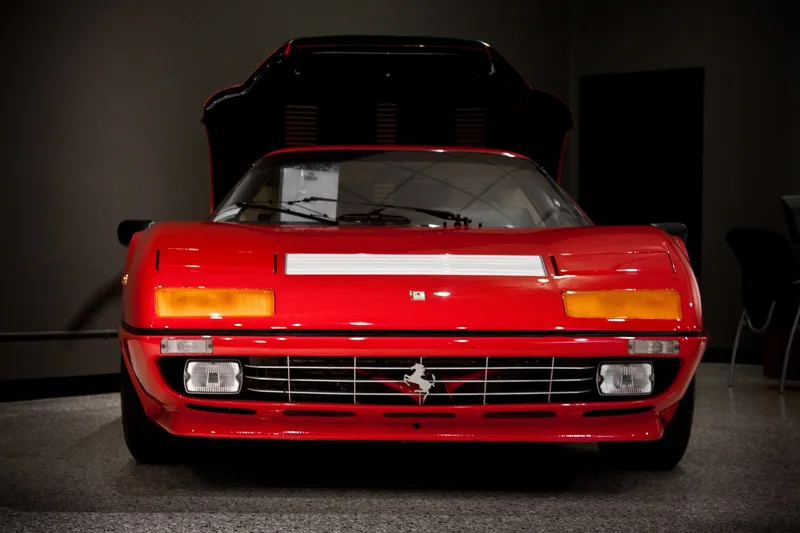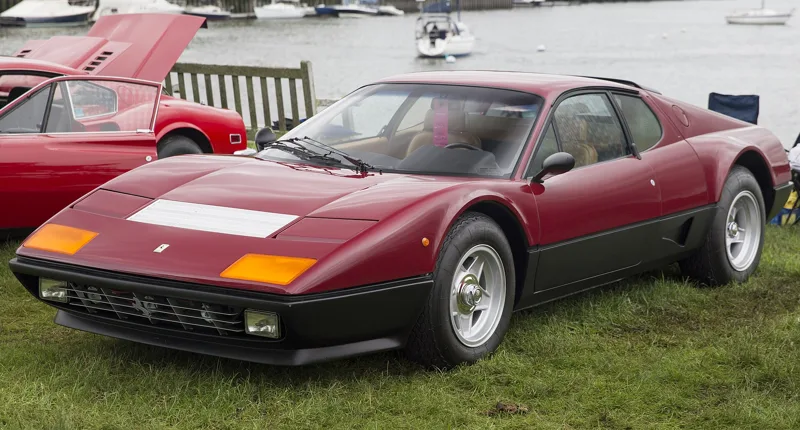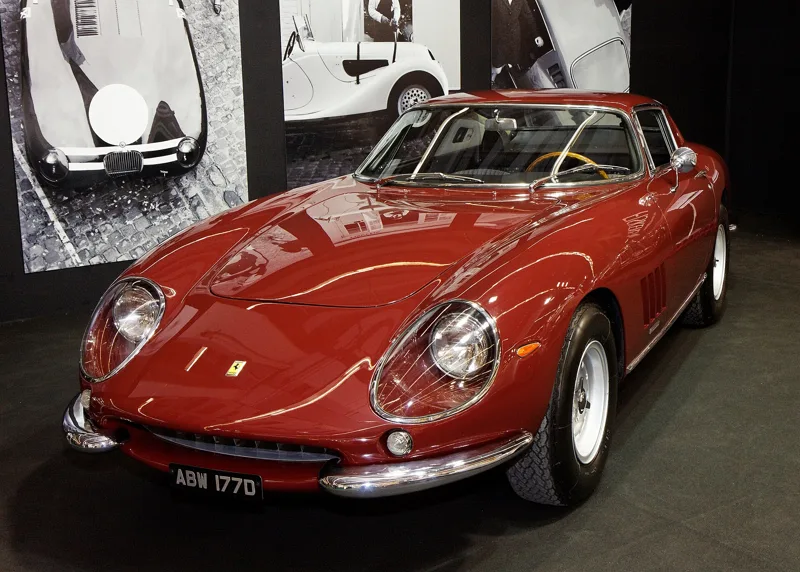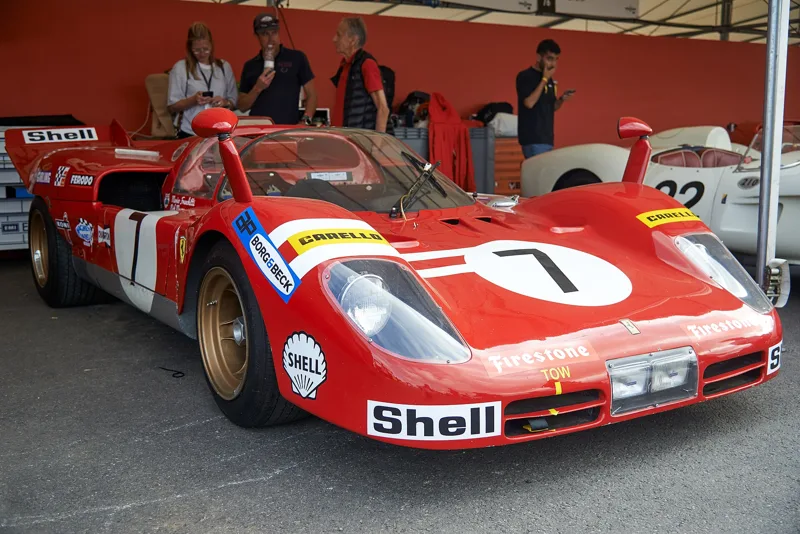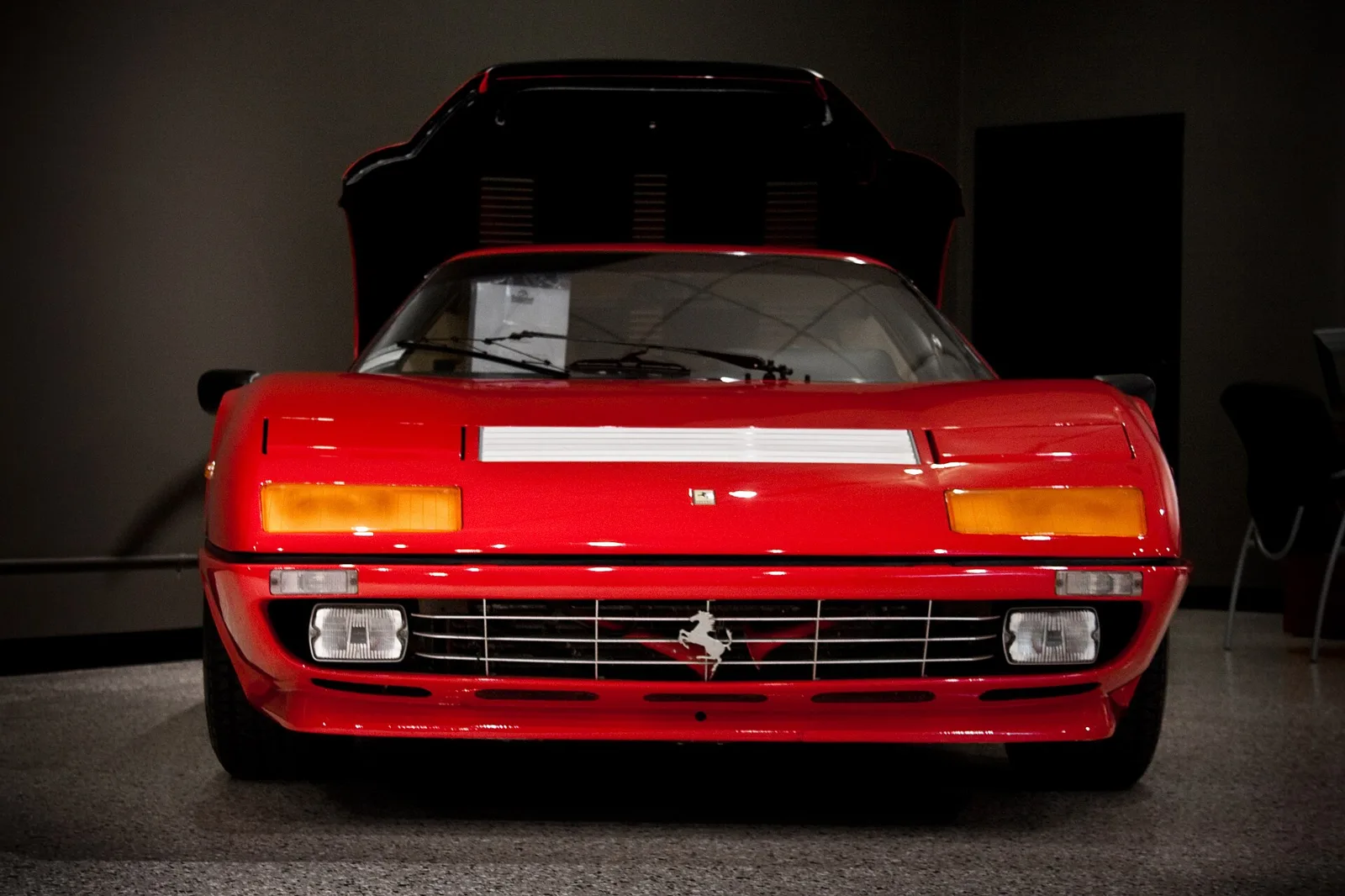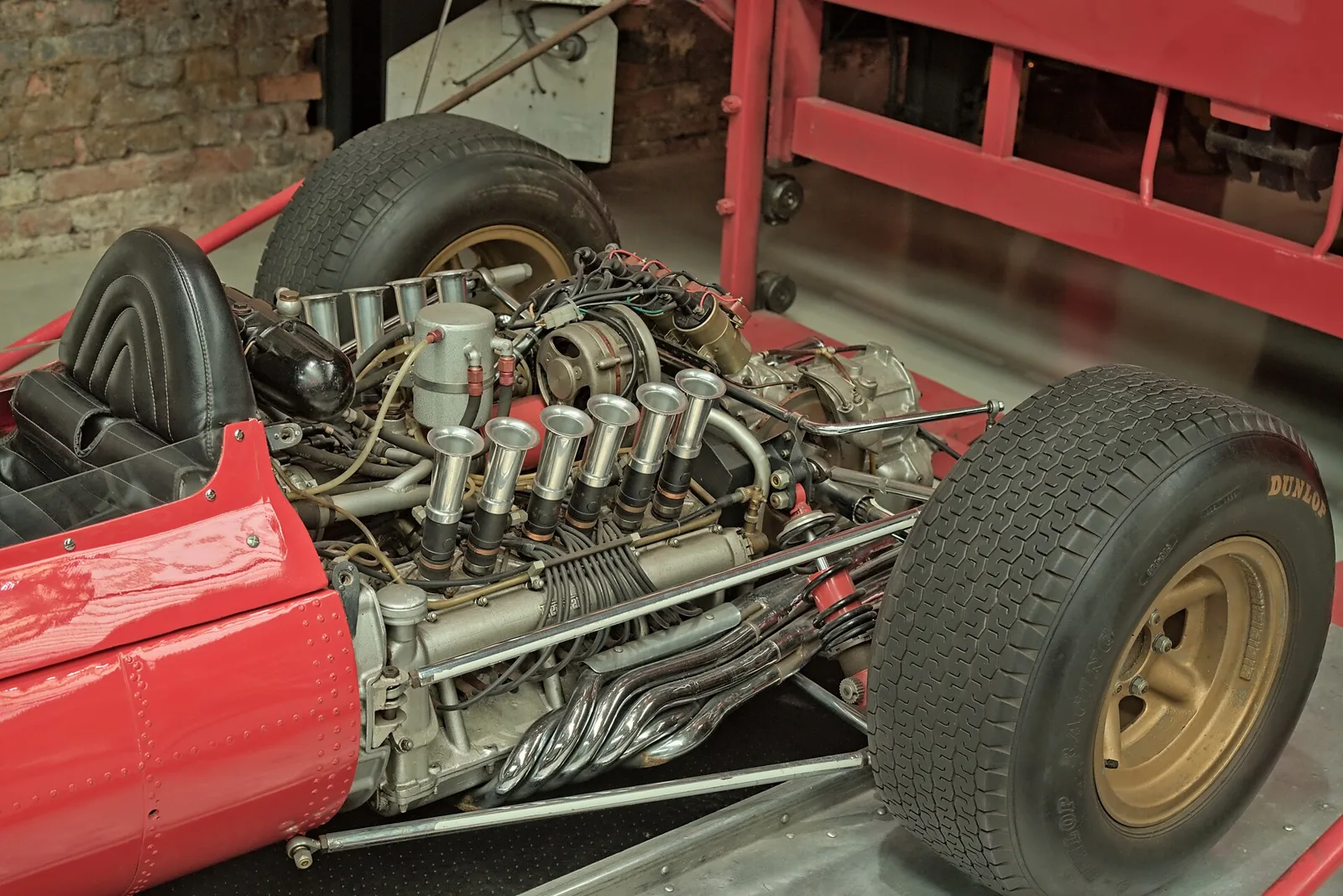
A horizontally opposed twelve that Ferrari raced for sixteen years and sold in road cars for twenty-three, from the 365 GT4 BB to the F512 M.
The Ferrari flat-12 was a DOHC engine with two banks of six cylinders at 180 degrees, built from 1964 to 1996. It raced in Formula One and sports cars, and it powered road models from the 365 GT4 BB to the F512 M.
The Ferrari flat-12 was a family of DOHC petrol engines that Ferrari produced from 1964 to 1996. It began as a racing unit in the Formula One and sports racing cars of the late 1960s and 1970s, and it reached the road with the 365 GT4 BB in 1973. Its last road application was the F512 M, which ended production in 1996.
What is a Ferrari flat-12?
A Ferrari flat-12 has two banks of six cylinders set 180 degrees apart. The layout gives the engine a low profile, which Ferrari used to lower the centre of gravity and improve handling. Because the two cylinder banks sit so low, it was also useful in aerodynamic terms on the 312 B and 312 T cars.
Ferrari's flat-12 is not a boxer in the strict sense. The corresponding connecting rods on each bank share a single crankpin, a crank design that Ferrari carried over from its earlier V12 engines. In a true boxer, such as a flat-six Porsche, the paired pistons move in opposite directions, while in the Ferrari unit they travel together.
The engine goes by three names. Flat-12 describes the cylinder layout without saying anything about the crank, 180 degree V12 refers to the V12-derived crank and bank angle, and boxer is the popular term in the press and in Ferrari's own sales literature. Each name captures part of the design, and the enthusiasts who use them rarely agree on which is best.
A flat-12 that started on a 1964 Formula One grid and finished its road life in the F512 M, three decades later.
How did the flat-12 begin in racing?
Ferrari's first flat-12 was the 1.5-litre Tipo 207, designed by Mauro Forghieri and used in the 1964 and 1965 Ferrari 1512 Formula One car, which was also known as the 512 F1. No flat-12 car of any kind had raced before it. Before this, Ferrari had built only V and straight-cylinder engines.
The Tipo 207 displaced 1,489.63 cc, using 56.0 mm x 50.4 mm dimensions and a compression ratio of 9.8:1. Its crankcase was cast in aluminium alloy, and the crankshaft was held by seven main bearings. Camshafts driven by gears, four in total, served one intake and one exhaust valve for each cylinder, and the first version used Lucas indirect injection before switching to Bosch before the 1964 debut.
The engine produced 217 hp (220 PS; 162 kW) at 12,000 rpm, against 207 hp (210 PS; 154 kW) at 11,000 rpm for the contemporary 158 V8. That made it one of the most powerful 1.5-litre Formula One engines of its time. Its torque curve was too narrow to give a clear advantage, and by late 1965 the 1512 was no longer competitive.
What did the Tipo 232 and Tipo 001 achieve?
The 2-litre Tipo 232 was built for the 1968 Ferrari Sport 2000, later renamed the 212 E Montagna. Stefano Jacoponi based it on the Tipo 207, but it had four main bearings and a 27 degree included valve angle. Its displacement was 1,990.08 cc, measured as 65 mm x 50 mm, with a compression ratio of 11:1.
When first installed the Tipo 232 gave 290 bhp (220 kW) at 11,500 rpm. During the 1969 season the engine was further developed, and it produced 315 to 320 bhp for short bursts and 295 bhp consistently. The European Hill Climb Championship, with its short courses, suited it well, and 1969 brought a strong season, although it was not designed for endurance racing.
The Tipo 001 was a 3-litre flat-12 that powered the 312 B Formula One cars and 312 PB sports prototypes between 1970 and 1974. Mauro Forghieri designed it to replace the ageing Colombo V12, and Fiat's money first went into the Tipo 001 after the company took a 50% stake in 1969, which made it the earliest Ferrari F1 unit Fiat paid for. Its displacement was 2,991 cc, built on 78.5 mm x 51.5 mm dimensions, with compression at 11.8:1.
Ferrari first reported 455 bhp (339 kW) at 11,500 rpm for the Tipo 001. By the end of 1970 development had lifted the figure to 480 bhp (360 kW) at 12,600 rpm, and in the 1974 312 B3 it reached 485 bhp (362 kW) at 12,500 rpm. A detuned version in the 312 PB produced 440 bhp (330 kW) at 10,800 rpm, rising to 470 bhp (350 kW) at 11,500 rpm in 1973.
Compared with the Cosworth DFV V8 it rivalled, the flat-12 weighed roughly 15 kg (33 lb) more, though it had four extra cylinders and larger dimensions. Forghieri was strongly influenced by the DFV when designing the Tipo 001, especially in the way oil moved inside the crankcase. Titanium connecting rods and a Pirelli rubber coupling to the flywheel were among its refinements.
How did the Tipo 015 succeed the 001?
The Tipo 015 was a 3-litre flat-12 used by the 312 T series of Formula One cars from 1975 to 1980. Its design leaned heavily on the Tipo 001, yet it was reworked to suit the 312 T's transverse gearbox. Its 80 mm x 49.6 mm dimensions gave a compression ratio of 11.5:1 from a displacement of 2,991 cc.
Development continued throughout the engine's racing life. Magnesium and titanium parts spread through the design, while the cylinder heads, combustion chambers and intake ducting were refined. The first 312 T produced about 500 bhp (370 kW) at 12,200 rpm, and reached 510 bhp (380 kW) at 12,200 rpm in the 1978 312 T3, and 515 bhp (384 kW) at 12,300 rpm in the 1979 312 T4.
The Tipo 015 was succeeded in 1980 by the Tipo 021 turbocharged V6 in the 126C. It was also Ferrari's last naturally aspirated engine until 1989, which makes it a notable point in the company's history. The flat-12's racing story ended with the 312 T series, and the road cars carried the layout forward.
| Engine | Displacement | Headline output | Application |
|---|---|---|---|
| Tipo 207 | 1,489.63 cc | 217 hp (220 PS; 162 kW) at 12,000 rpm | 1964 Ferrari 1512 F1 |
| Tipo 232 | 1,990.08 cc | 290 bhp (220 kW) at 11,500 rpm | Sport 2000 and 212 E Montagna |
| Tipo 001 | 2,991 cc | 485 bhp (362 kW) at 12,500 rpm | 312 B and 312 PB |
| Tipo 015 | 2,991 cc | 515 bhp (384 kW) at 12,300 rpm | 312 T series |
| F102A | Shared with the Tipo 251 V12 | 360 bhp (268 kW) at 7,500 rpm | 365 GT4 BB |
| F113G | 4942 cc | 434 bhp (324 kW) at 6,750 rpm | F512 M |
How did the road engines begin with the 365 GT4 BB?
The Tipo F102A was the first flat-12 fitted to a Ferrari road car, the 365 GT4 BB built from 1973 to 1976. Giuliano de Angelis and Angelo Bellei oversaw its design, which took its displacement, bore, stroke, rods and pistons from the Tipo 251 V12 that the BB replaced. It had two valves per cylinder and belt-driven twin overhead camshafts per bank.
The F102A used two banks of triple-choke Weber carburettors and a Magneti Marelli Dinoplex ignition system. Its block and heads were made from Silumin light alloy, with pistons of Borgo light alloy and cast iron liners. The crankshaft was machined from a single billet of steel, and the wet sump held 12 litres (13 US qt) with twin oil filters.
The first prototype was reported to make 380 bhp (280 kW) at 7,100 rpm and to propel the test car to 302 km/h (188 mph). The production version was quoted at 360 bhp (268 kW) at 7,500 rpm, with 311 ft lb (422 N m) of torque at 4,500 rpm. The owner's manual gave 344 PS (253 kW; 339 hp) at 7200 rpm, which shows how the published figures varied.
What changed with the BB 512 and the 512i?
In 1976 Ferrari launched the BB 512, which carried an enlarged version of the engine. The Tipo F102B measured 4942 cc, with 82 mm x 78 mm dimensions, compression stood at 9.2:1. Camshaft timing was also changed, and the car received a dry sump system to deal with the higher cornering loads of its wider tyres.
Ferrari first claimed 360 bhp (270 kW) at 6800 rpm and 331 lb ft (449 Nm) of torque for the F102B, but later publications lowered this to 340 bhp (250 kW). The flatter torque curve of the larger engine made it easier to drive, and it allowed Ferrari to meet tougher pollution and noise rules without losing performance.
The F102B also powered the 512 BB LM racing cars. Series 1 cars made about 400 bhp (300 kW), while series 2 cars with Lucas mechanical injection reached approximately 475 to 480 bhp (354 to 358 kW). In 1981 the BB 512i replaced the 512 with the Tipo F110A, which used Bosch K-Jetronic injection and produced 340 bhp (250 kW) at 6,000 rpm.
What did the Testarossa and F512 M engines offer?
The Testarossa arrived in 1984 with the Tipo F113A, the first roadgoing Ferrari flat-12 to use four valves per cylinder. Its 390 PS (287 kW; 385 hp) made it the most powerful engine fitted to a production sports car at its launch. The bore and stroke and 4942 cc displacement matched the F110A, but the four-valve head changed the character of the engine.
Export versions for the United States, Canada and Japan received a catalytic converter and KE-Jetronic injection. European cars gained those features in 1986, when the revised engine was known as the F113B. The F113A used a Marelli Microplex MED120 ignition system together with Bosch K-Jetronic injection, and that combination was refined over the years.
The 512 TR of 1991 used the F113D, with redesigned inlet plenums, larger valves and a Bosch Motronic M2.7 system. Its peak was 422 bhp (315 kW) at 6,750 rpm, with torque of 362 lb ft (491 Nm) at 5,500 rpm. In 1994 the F512 M brought the F113G, which had a lightened crankshaft, titanium connecting rods, new pistons and a stainless steel low back-pressure exhaust. Its compression ratio rose to 10.4:1 and its output reached 434 bhp (324 kW) at 6,750 rpm.
Why did flat-12 production end?
Flat-12 production ended with the F512 M. Its place in the Ferrari line-up was taken by the front-engined 550 Maranello, which used the new 65 degree F133 V12. The flat-12 had served the company for more than three decades, from its first race appearance to its last road car.
Ferrari's flat-12 also had an unexpected aircraft connection. In the late 1960s the Franklin Engine Company ordered an engine for a small twin-engined aircraft, and Forghieri adapted a flat-12 for the purpose. The aircraft project was cancelled when Franklin entered receivership, but the design work was carried into the Tipo 001 racing engine.