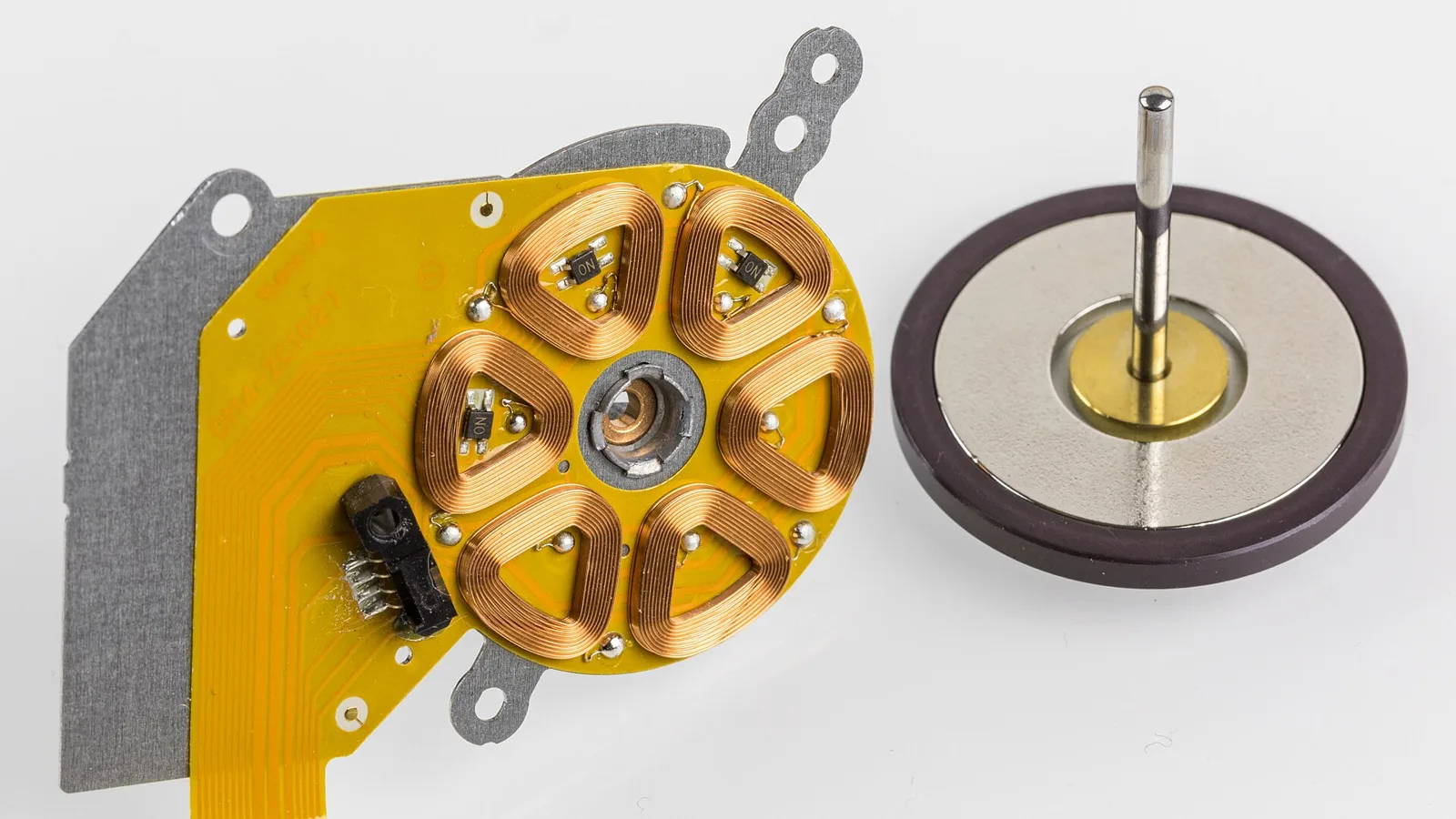
A flat, disc-shaped motor makes torque from width rather than length.
An axial flux motor is a flat, disc-shaped electric motor whose magnetic field runs parallel to the shaft, giving more torque from a shorter package than a radial motor. YASA, owned by Mercedes-Benz, makes the best-known examples, and Mercedes began large-scale production of them in June 2026.
In October 2025 the British firm YASA announced a prototype electric motor weighing 12.7 kg that produced a peak of 750 kW (1,005 hp) on the dynamometer. One of the best radial motors on the road weighs 31.4 kg for 500 kW. That gap is the clearest sign yet of why a flat, pancake-shaped electric motor is being fitted to the next generation of electric supercars.
What is an axial flux motor?
An axial flux motor, also called an axial gap motor or a pancake motor, is an electric motor in which the gap between the rotor and the stator lies parallel to the axis of rotation. In the more familiar radial flux motor, the parts are cylinders nested one inside the other, and the magnetic field crosses the gap outward from the centre. In an axial design, the rotor and stator are facing discs, and the field runs along the shaft.
The shape matters because of leverage. In a radial motor, getting more torque means a longer, heavier motor. In an axial motor, torque climbs in proportion to the cube of the disc's diameter, but a radial motor gains only by the square. Picture a spanner: a longer handle gives more turning force. An axial motor uses a wide disc as that handle, so it earns its torque from radius rather than length and ends up shorter and wider than a radial equivalent.
The disc form also gives a larger magnetic surface and more surface area for cooling than a radial motor of the same volume. In an oil-cooled design, that means the fluid touches more of the working parts directly.
An axial flux motor earns its torque from width rather than length, and that is why it can be so short.
Axial flux vs radial flux
None of this is brand new. The layout is as old as the first electromagnetic motors, but it stayed rare until strong permanent magnets and brushless DC motors arrived, which exploit its strengths better. Axial motors have been common in low-power uses, where a motor can be built straight onto a printed circuit board. High-power brushless axial motors are a more recent development and are only now starting to appear in some electric vehicles.
The advantages
- The rotor can often be made significantly lighter.
- Most structural parts are flat and can be made without specialised casting or tooling.
- A straight magnetic path through the windings lets designers use grain-oriented electrical steel, with its higher permeability and lower core losses.
- Flat coils allow rectangular copper strips, which simplifies high-current windings.
- Some designs can be stacked to give more power in modular steps.
The drawbacks
- The rotor is typically much wider, which raises rotational inertia. Higher centrifugal forces can also limit the maximum speed.
- Wedge-shaped segments cause uneven flux distribution, and because they narrow towards the centre there is less room for windings and connections.
- A dual stator, single rotor layout, the more common choice for high power, needs a housing yoke that adds iron losses. A single stator, dual rotor layout can dispense with the yoke, saving weight and raising efficiency.
Radial flux motors, meanwhile, dominate production. They suit high-volume manufacturing and deliver good efficiency and power, but they grow heavier and longer as torque requirements rise. Makers of axial designs claim as much as four times the torque density, and twice the power density, of radial motors in the same class.
The YASA motor and where it came from
If you search for an axial flux motor you will almost certainly meet the name YASA. The company, a British manufacturer, takes its name from yokeless and segmented armature. Its motor was developed in 2008 for the Morgan LIFEcar at the University of Oxford by Dr Malcolm McCulloch together with Dr Tim Woolmer, at the time a PhD student. YASA was founded in September 2009 to commercialise it.
The yokeless part is the trick. By removing the stator yoke, the design is said to reduce iron mass by as much as 80 percent, and segmented coils simplify winding and use less copper.
The company's timeline reads like a slow build followed by a sudden jump:
- In 2015 YASA began serial production of its P400 series for volume carmakers.
- In January 2018 its first series production facility, able to build 100,000 units a year, was opened by Greg Clark, then the UK business secretary.
- In May 2019 Ferrari selected a YASA motor for the SF90 Stradale, its first hybrid production series supercar.
- On 22 July 2021 Mercedes-Benz acquired the company. Just before that, YASA spun out Evolito to develop the technology for aviation.
- On 21 May 2024 it won approval to build its new headquarters on a former RAF base at Bicester, in Oxfordshire.
YASA motors have powered a long list of specialist machines: the Drive eO PP03, the first electric car to take overall victory at the Pikes Peak International Hill Climb, the Jaguar C-X75 concept, the Koenigsegg Regera, and a converted Lola Le Mans prototype from Drayson Racing that took the world electric land speed record in 2013. The Lamborghini Revuelto, McLaren Artura and Ferrari 296GTB are also named as users.
What the production motors deliver
The P400R series produces up to 160 kW (210 hp) at its peak and 370 N m of torque, with a continuous rating of up to 100 kW, and its stator is cooled with oil. The larger 750R makes up to 200 kW (270 hp) and about 790 N m at the peak, with continuous power of up to 70 kW.
Mercedes AMG axial flux: from concept to production line
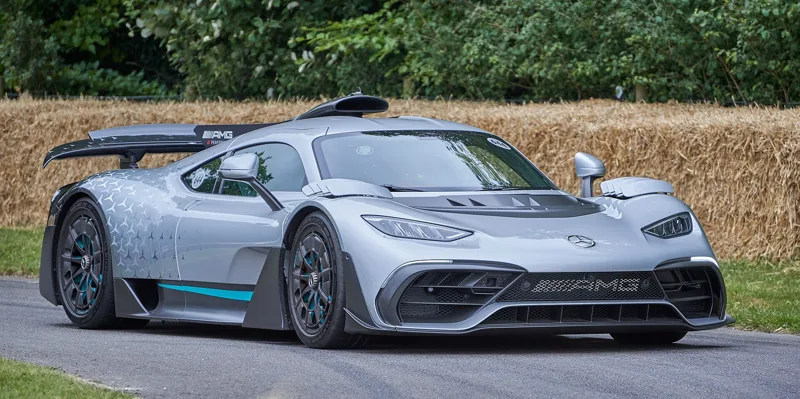
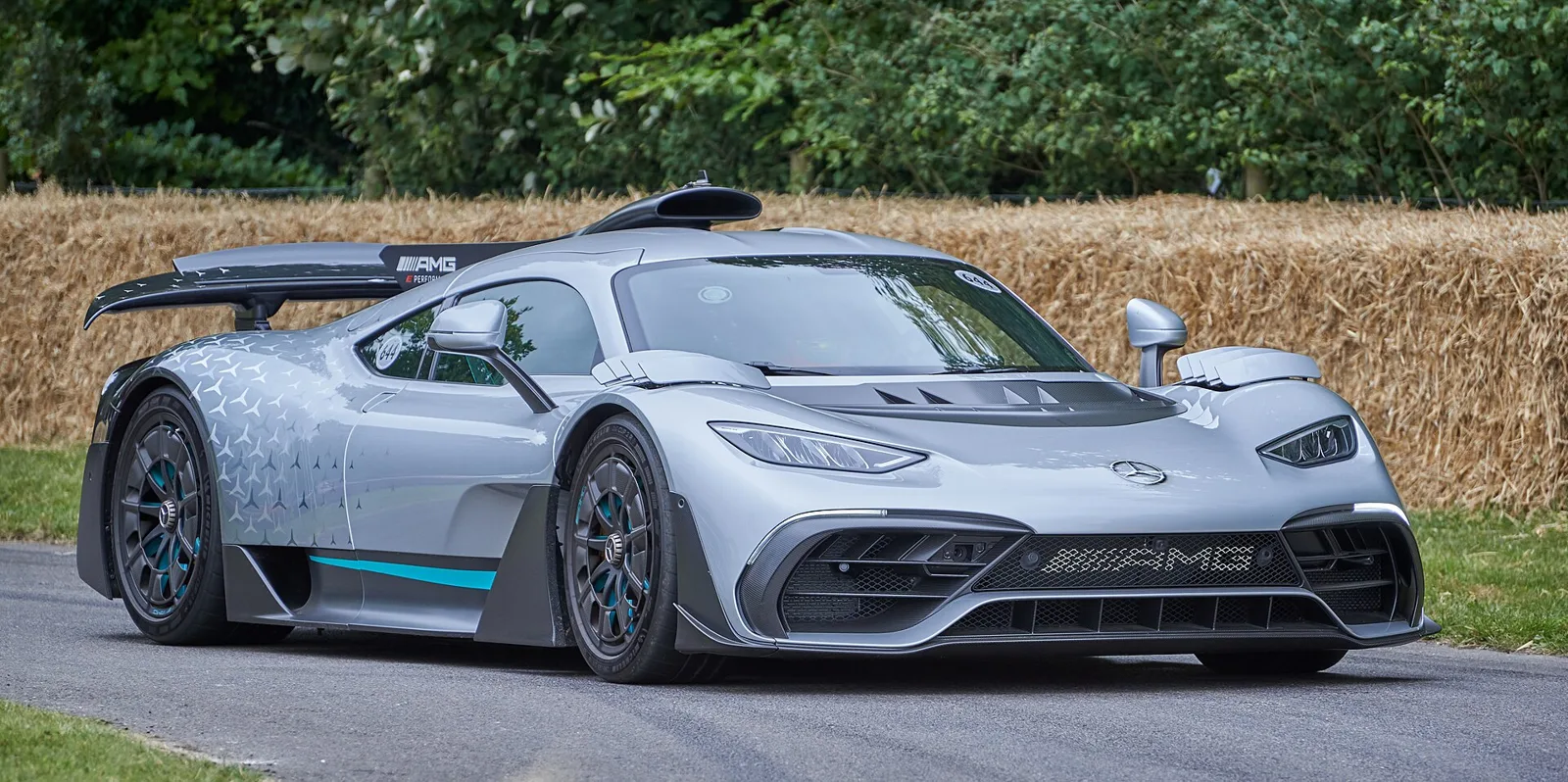
Mercedes-AMG showed what it wants to do with this motor on 25 June 2025 in Affalterbach. The Concept GT XX carries three electric motors, a pair behind and a single unit ahead, adding up to a peak of 1000 kW (1360 hp). The axial flux motors are comparatively short, and they come from YASA. The battery is built from cylindrical cells, runs above 800 V and sits in the middle of the car.
The car then went to the Nardo Ring in August 2025. A pair of GT XX cars lapped non-stop, apart from frequent fast charges at up to 900 kW, at above 290 km/h. The faster covered 5480 km (3405 mi) in 24 hours, a new electric-vehicle record. That also beat the 5411 km (3362 mi) record distance of the Le Mans 24 Hours, set in 2010 by an Audi R15 TDI. The overall FIA 24-hour record, 7740.576 km, set by a Volkswagen W12 in 2002, still stands.
In June 2026 Mercedes-Benz began large-scale production of axial flux motors at its Berlin-Marienfelde factory. The first car to use them will be the Mercedes-AMG GT 4-Touring Coupe, in its high-performance form. An earlier plan had named 2026 as the year Mercedes would begin series production.
How axial flux motors compare on power density
Power density, output per kilogram, is the number designers care about most.
| Motor | Type | Peak power | Mass | Power density |
|---|---|---|---|---|
| YASA prototype, October 2025 | Axial flux | 750 kW (1,005 hp) | 12.7 kg | 59 kW/kg |
| YASA prototype, July 2025 | Axial flux | 550 kW (738 hp) | 13.1 kg | 42 kW/kg |
| YASA P400R | Axial flux | 160 kW (210 hp) | - | 6.67 kW/kg |
| Lucid Motors | Radial flux | 500 kW | 31.4 kg | 16 kW/kg |
| Helix SPX242-94 | Radial flux | 368 kW | 33 kg | Over 11 kW/kg |
Other motors in the same family
YASA is not alone. Emrax also sells axial flux units, the 228, 268 and 348, rated at 4.58, 5.02 and 4.87 kW/kg. Rolls-Royce used three axial flux motors in its Spirit of Innovation aircraft, and Flying Whales announced in 2025 that Evolito, the aviation spin-out from YASA, would supply motors for its aircraft. Aircraft are a demanding customer, because every kilogram saved in the motor is a kilogram that can go into range.
The mechanical choices inside an axial motor also vary. Some use a single rotor, some two, and some use two stators. Stacking is possible too: YASA's stackable 750R is described as delivering 800 N m from a unit 98 mm (3.9 in) long.
What stands in the way of axial flux EV motors?
If axial flux motors are so strong, why does nearly every electric car still have a radial one? The answer is largely scale and cost. Lucid, Rivian and Tesla all use radial flux motors, which suit large production runs and low prices, and Lucid, with a motor of about 30 kg, is credited with the best real-world efficiency of any production electric car in the United States, at 146 MPGe in 2026 testing. A wider axial rotor brings its own limits through inertia and centrifugal force, and its narrow centre leaves little space for windings.
Magnets are the other issue. Most modern designs use permanent magnets, which depend on rare earth elements whose prices fluctuate. Induction designs avoid them, though they run less efficiently at low loads. The motors of Tesla's early models were induction types, and Tesla moved the rear motor of the Model 3 to permanent magnets in 2017.
What it means if you buy or drive an electric performance car
For the driver, the case rests on sustained performance. According to YASA, its motors can hold 75 percent of peak power continuously because of direct oil cooling, while radial equivalents often sag to half of their peak when worked hard for long. If that holds up on a track day, it means less power fade in a car that is pushed hard. YASA also claims a gain of 5 to 10 percent in efficiency over radial designs in everyday driving.
Lighter motors can also allow smaller batteries or better handling, since some comparisons show axial designs cutting motor mass by half. For a supercar buyer, less mass and a short motor can give designers freedom over where it sits.
Where this goes next
Several plans point beyond the supercar. YASA says it is investigating motors inside the wheels, since an axial motor's low mass does not excessively raise unsprung mass. BMW Vision Neue Klasse prototypes were seen with wheel hub motors and no brake calipers, although the Munich start-up DeepDrive is working on dual-rotor radial flux motors rather than axial ones.
In aviation, YASA targets motors delivering 50 kW/kg to make electric flight possible, and the Rolls-Royce ACCEL, the current electric aircraft speed record holder, uses three axial flux motors. Conifer plans to offer iron-based units from 1 to 25 hp, with in-wheel versions aimed at scooters, ATVs and urban delivery vehicles. All of these are intentions and prototypes. What is already under way is the production of the motors in Berlin since June 2026.