A battery and powertrain company that became an electric car maker, built the Air and Gravity in Arizona and now plans midsize SUVs and robotaxis.
Lucid is an American electric car maker headquartered in Newark, California, which began as the battery firm Atieva in 2007. It started Air production in Arizona in 2021, builds the Gravity SUV, and has been majority owned by Saudi Arabia's sovereign wealth fund since 2019.
Lucid is an American electric vehicle company headquartered in Newark, California, and it also supplies EV powertrains to other carmakers. It began production of the Lucid Air sedan in September 2021 at its factory in Casa Grande, Arizona, and it started building the Gravity SUV in December 2024. Its majority owner has been Saudi Arabia's sovereign wealth fund since April 2019.
Where did Lucid start?
The company was founded in 2007 as Atieva. Its founders included Tesla vice president Bernard Tse, Sam Weng, co-founder of Astoria Networks, and the inventor Sheaupyng Lin. Atieva set out to build electric vehicle batteries and powertrains for other manufacturers, rather than complete cars of its own.
In 2011 Atieva began working with the cell maker Lishen to build battery packs for electric buses in China. Early investors included Tsing Capital, Mitsui, Venrock and JAFCO, and in 2014 the state-owned carmaker BAIC bought a 25 percent stake in the business.
A battery start-up that became a car maker, built a 1,000 hp sedan in Arizona and is now planning SUVs and robotaxis.
How did Atieva become Lucid Motors?
In 2013 the British engineer Peter Rawlinson joined Atieva as chief technology officer and a board member. He had been vice president of engineering and chief engineer of the Model S at Tesla. In October 2016 the company rebranded as Lucid Motors and announced its intent to develop an all-electric, long-range, high-performance car.
Rawlinson added the chief executive job in April 2019 while keeping his technical role and his board seat. Development of the first car had started in 2014, after years of battery work.
Who has funded Lucid?
Talks with the Public Investment Fund over $1 billion were disclosed on 17 September 2018. The money arrived in April 2019 and paid for the final engineering, testing and production of the Air, the first phase of the Arizona plant and an early retail push in North America.
Share prices later rose sharply. For a time the company recorded an unrealised gain of $20 billion from an investment of $2.9 billion, though that was a paper figure rather than cash. In February 2021 Lucid agreed to merge with Churchill Capital Corp IV, a listed blank-check company, in a deal valued at $11.75 billion. The company went public on 26 July 2021, when the Public Investment Fund held 60 percent of the shares.
In August 2024 the fund's affiliate, Ayar Third Investment Co., provided a further $1.5 billion. The package included $750 million of convertible preferred stock, with the balance as an unsecured loan.
How did the Air reach production?
A prototype of the Lucid Air was unveiled in December 2016, and the company used a Mercedes Metris van nicknamed Edna to develop its powertrain. Production was first expected in spring 2021, and the first cars came off the Casa Grande line on 28 September 2021. Deliveries started in late October of that year.
Output was lower than hoped at first. Lucid built 7,180 vehicles in 2022, citing supply chain problems, and 8,428 in 2023, which met the upper end of its guidance. In December 2025 an interim chief executive said the company was on track for around 18,000 EVs that year, the low end of its forecast range.
What does the Lucid Air offer on paper?
The Air Pure, announced in November 2020, was quoted with a projected range of 406 miles (653 km), 480 hp (360 kW) and a starting price of US$77,400. The line-up grew to the Touring, Grand Touring and Dream Edition, and the top-spec cars produce more than 1,000 hp (750 kW).
The Air uses Mobileye EyeQ4 chips and eight cameras for driver assistance, and it is described as autonomous ready. Its infotainment runs on Android Automotive, and Amazon's Alexa assistant can handle navigation, calls, media and smart home control while driving. The car also appeared in several episodes of season four of the Amazon series Goliath.
How far and how fast can the Air go?
On 16 September 2020 the US Environmental Protection Agency rated the Air at 520 miles (840 km) on a single charge. In September 2021 the Dream Edition Air was rated at 520 miles, and the Grand Touring at 516 miles, making the Dream the longest-range EV the EPA had rated at that time.
Software limits the sedan to a top speed of 217 mph (349 km/h). A special test version with the limiter disabled reached 235 mph (378 km/h) on the high-speed track at the Transportation Research Center in Ohio in July 2017. The 2022 Air Grand Touring used two electric motors that together gave 819 hp (611 kW), with 885 lb ft (1,200 N m) of torque.
Lucid raised prices from 1 June 2022, and the base price of the Air rose by as much as 13 per cent. The car still earned recognition, with Motor Trend naming the Air its 2022 Car of the Year, the first brand-new model to take the award. In April 2023 the company began delivering a blacked-out Stealth Air, and that month the Air also won World Luxury Car of the Year 2023.
What is the Lucid Gravity?
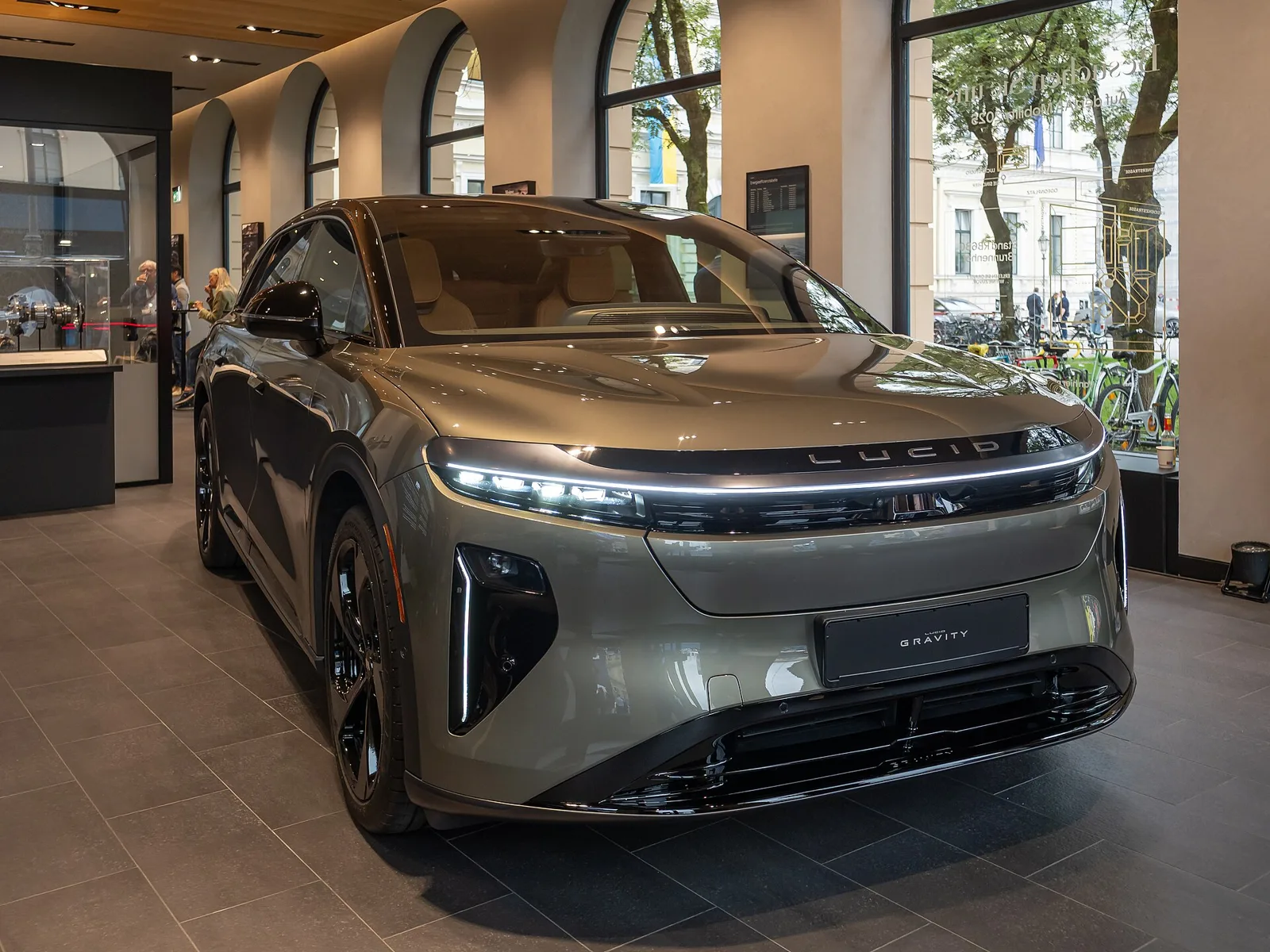
Lucid first teased an electric SUV concept in September 2020 as Project Gravity, with only a brief image and video. Patent filings showed sleek headlamps like the Air, a short bonnet and a large windscreen, along with a horizontal beltline and expansive glass.
The Gravity was unveiled on 16 November 2023 at the Los Angeles Auto Show, with a planned range of 440 miles from a dual-motor layout and a 0-60 mph time of 3.5 seconds. The starting price was set below $80,000. A charging start-up called Gravity Inc. challenged the name at the US Patent and Trademark Office, but the two sides settled in June 2024 and Lucid kept it.
Orders opened on 7 November 2024, and the first production unit was completed at Casa Grande on 5 December 2024. Gravity parts also reach the Lucid plant in the King Abdullah Economic City in Saudi Arabia, where final assembly serves the Saudi market. The Grand Touring version offers 828 hp and an EPA-rated range of up to 450 miles (720 km).
How did the Aston Martin deal work?
In June 2023 Lucid agreed to develop and supply electric motors, powertrains and battery systems for Aston Martin's planned fully electric range. The deal was worth $450 million. Aston Martin would pay Lucid $132 million in cash for its expertise, give Lucid a 3.7 percent stake worth $100 million, and guarantee purchases of at least $225 million of powertrain components.
The arrangement shows Lucid's second business line: alongside selling its own cars, it supplies drivetrain technology to other automakers.
Where does Lucid build its cars?
Work on the Casa Grande, Arizona factory began in December 2019, and it is the first greenfield electric vehicle plant in the United States. Construction was completed on 1 December 2020, and the site, known as AMP-1, aims to reach 400,000 cars a year once all four phases are finished.
The US$700 million facility started the Air in 2021, and a second phase lifted planned capacity from 34,000 to 90,000 vehicles a year. The land is owned by Pinal County, which bought the 500-acre site for $29.94 million, financed through bonds, and leases it to Lucid.
In February 2022 Lucid announced a plant in Saudi Arabia to build 150,000 vehicles a year, working with the Saudi Ministry of Investment, the Saudi Industrial Development Fund and the King Abdullah Economic City. That April the Saudi government said it planned to buy at least 50,000 and possibly up to 100,000 Lucid electric vehicles over a decade as it reduces its reliance on oil.
How is Lucid's battery supply arranged?
The Air was planned around a 900V-plus electrical architecture and custom lithium-ion cells in the 2170 format. Agreements were signed with Samsung SDI and LG Chem by 2019, and in February 2020 LG Chem agreed to supply cells for the Air through 2023. On 13 December 2022 Panasonic Energy and Lucid signed multi-year agreements to supply batteries.
Lucid also made battery packs for Formula E's Gen2 cars across the 2018-2019 to 2021-2022 seasons, working with McLaren Applied Technologies and Sony. The Formula E specification called for a pack weighing 250 kg (550 lb), with 54 kWh of energy and peak power of up to 250 kW.
How does Lucid charge its cars?
In 2019 Lucid partnered with Electrify America, giving drivers access to its nationwide network. The Air can add up to 300 miles (480 km) in 20 minutes on a 350 kW charger, or 200 miles in 12 minutes. In 2022 Lucid also launched its own home charger, which adds 80 miles of range in an hour.
Late in 2023 Lucid said it would fit North American Charging System ports, and from 31 January 2025 the Gravity was delivered with one. The Air needed an adapter until it gained access to the Supercharger network in the second quarter of 2025. The Air's RangeXchange feature can also charge other electric vehicles through a dedicated adapter.
In July 2025 the company claimed a Guinness World Record for the Air Grand Touring, with a range of 1,205 km (749 mi) on a single charge.
What are Lucid's midsize and robotaxi plans?
In May 2024 Rawlinson announced a midsize SUV to be built in Saudi Arabia, with production targeted for late 2026 and a starting price of about $48,000. At an investor event on 12 March 2026, Lucid named three midsize models: the Cosmos, focused on efficiency, space and performance, the Earth, with intermediate off-road ability, and an unnamed third model for adventure driving.
On 18 July 2025 Uber, Nuro and Lucid announced a partnership to put at least 20,000 Lucid Gravity cars with Nuro autonomous technology on Uber's platform as level 4 self-driving vehicles, with launch planned for 2026. Lucid would receive $300 million from Uber. At the same 2026 event the company also introduced the Lunar, a two-seat concept for robotaxi use.
Who runs Lucid now?
Bernard Tse led the company from 2007 to 2019, and Peter Rawlinson from 2019 to 2025. Marc Winterhoff served as interim chief executive from 2025 to 2026. On 14 April 2026 Silvio Napoli, chairman and chief executive of the Schindler Group, was named the next permanent CEO. In July 2026 Alexander De Bock, formerly chief financial officer of TI Automotive, was announced as CFO.
Lucid key figures
| Item | Detail |
|---|---|
| Air Pure | 406 miles (653 km) projected, 480 hp (360 kW), US$77,400 starting price |
| Air EPA range | 520 miles (840 km) rated 16 September 2020 |
| Air top speed | 217 mph (349 km/h) software-limited |
| Air Grand Touring | 819 hp (611 kW) combined from two motors |
| Gravity | 440-mile range, 0-60 mph in 3.5 seconds, under $80,000 starting price |
| Gravity Grand Touring | 828 hp, EPA range up to 450 miles (720 km) |
| Production 2022 | 7,180 vehicles |
| Production 2023 | 8,428 vehicles |
| Casa Grande capacity plan | 400,000 cars a year across four phases |