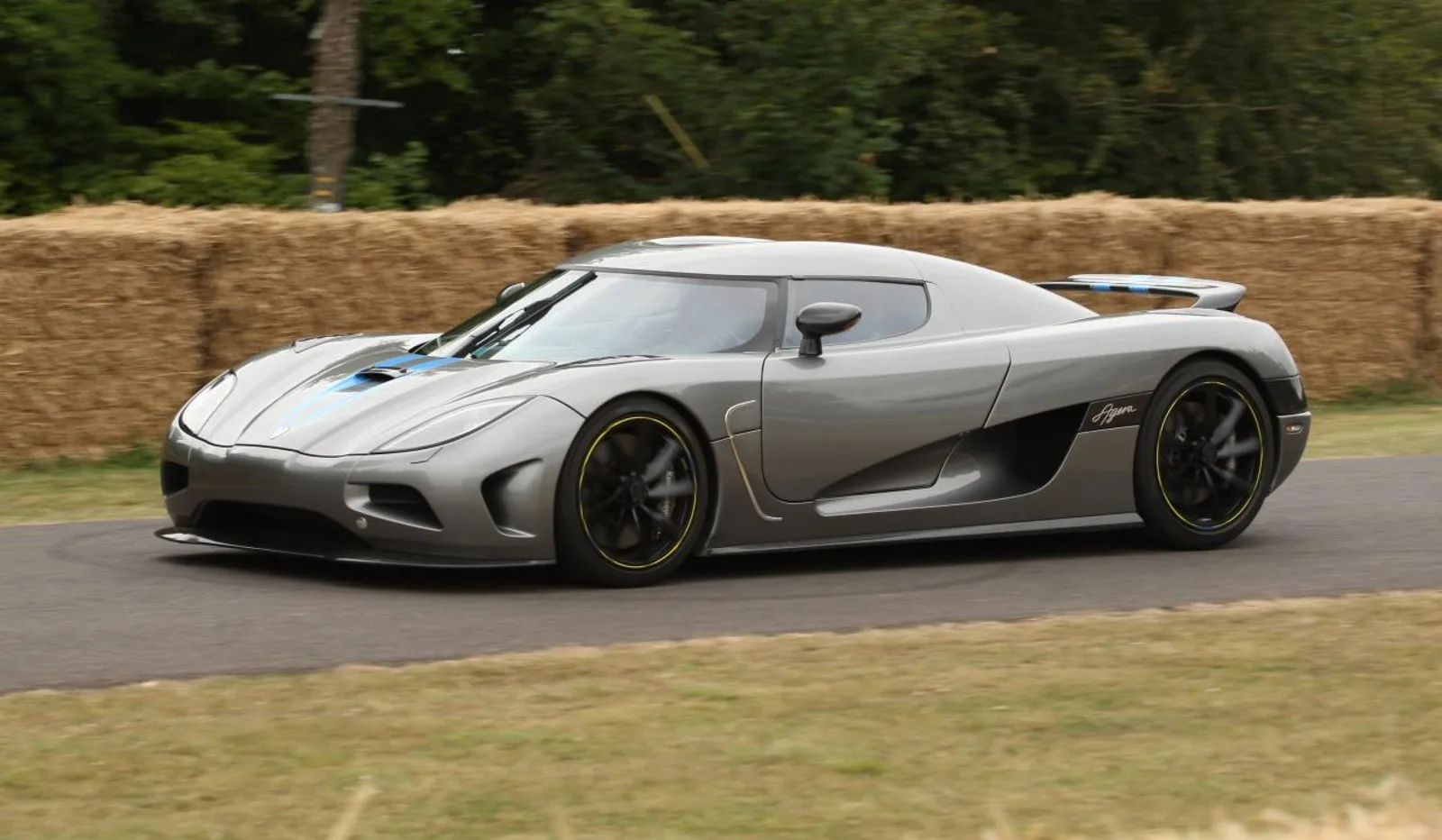
Founded in 1994 in Sweden, Koenigsegg has set production car speed records with the CCR, Agera and Regera, and it builds its own engines and gearboxes.
Koenigsegg is a Swedish car maker, founded in 1994 by Christian von Koenigsegg, that develops its own engines, transmissions and software. Its CCR, Agera RS and Regera set production car speed records. The company is based in Angelholm and has about 850 staff.
Koenigsegg Automotive AB is a Swedish maker of high-performance sports cars based in Angelholm, in Skane County. It was founded in 1994 by Christian von Koenigsegg, and it is known for building most of its key systems, including engines, transmissions and software, in-house. Its cars have also set several production car speed and acceleration records.
Who founded Koenigsegg and how did it start?
Christian von Koenigsegg founded the company in 1994, when he was 22 years old. He had the idea after watching the Norwegian stop-motion film The Pinchcliffe Grand Prix in his youth, and he gathered 60,000,000 kronor from investors to launch the business.
The company started in Olofstrom and moved to Angelholm in the early 2000s. Its first main goal was a world-class sports car, and the early years were spent on long development and testing before a car could reach customers.
A small Swedish maker that builds its own engines, gearboxes and software, and has set some of the fastest production car records on record.
What was the factory like on the old airfield?
A production building was gutted by fire on 22 February 2003. The company then took over a disused airfield, and by late 2003 a hangar and an office block there had become a car factory. The plant still sits beside Angelholm airport, which remains in use.
The old military runway serves for shakedown and high-speed runs on production cars, which is a rare asset for a maker of this size. A new plant opened near the old building in July 2023, doubling production capacity. It reflected a company that had outgrown its converted hangars.
What does the Koenigsegg badge represent?
The Koenigsegg badge was designed in 1994 by Jacob Laftman. It draws on the family's heraldic arms, a shield used by the von Koenigsegg family since the 12th century. After the company moved onto the airfield, it adopted a ghost symbol that had been used by the Swedish Air Force squadron based there.
The symbol appears on models built in the factory converted from that squadron's hangar, as a tribute to the airfield's history.
How did the first prototypes come together?
The initial design of the CC was drawn by Christian von Koenigsegg. The industrial designer David Crafoord turned the sketches into a 1:5 scale model, which was later scaled up to make the base plug for the first prototype, finished in 1996.
The early prototypes used an Audi V8, but that supply contract fell through. The next candidate was a Flat-12 race engine from Motori Moderni, which had been raced under the Subaru badge in the 1990 season. The engines were bought and modified, but the deal failed when the founder of Motori Moderni died and the company went bankrupt.
Koenigsegg later developed its own engine. It started from a Ford Modular architecture in 2012 and then moved on to engines, control systems and transmissions of its own, which is unusual for a small sports car maker.
When did customers get the first Koenigsegg cars?
A full carbon-fibre production prototype in white made its public debut at the 2000 Paris show. Stephan Reeckmann was the first buyer, placing a deposit in 2001, and a red CC8S reached another customer in 2002. The CC8S was the first street-legal production car from the company, introduced in 2002.
The CCR followed in 2004 as a more powerful version of the CC8S, shown in Geneva. Just 14 were built. The CCX arrived in 2006 to meet worldwide regulations, which demanded extensive development against the strictest safety and emissions standards. Koenigsegg had to develop its own engine and related technologies to meet them.
What were the CCXR and the Trevita?
In 2007 Koenigsegg premiered the CCXR, a biofuel and flex-fuel version of the CCX. Its modified engine, fuel system and engine management let it run on normal gasoline, ethanol or any mixture of the two, and ethanol's higher octane rating helped it make more power.
The Trevita was announced in 2009 as a special edition, and three were planned. Only two were finished because of technical problems. Its body was made from Koenigsegg's own diamond-coated carbon fibre, and it was based on the CCXR, which gave it 759 kW (1,032 PS; 1,018 hp) on biofuel.
How did the Agera, Regera and Jesko follow?
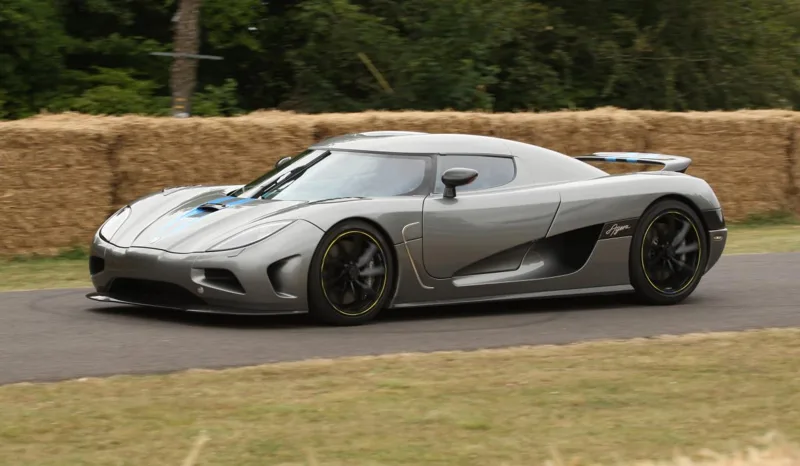
The Agera was announced at the 2010 Geneva Motor Show. It had a Koenigsegg-developed 5.0-litre V8 with 716 kW (973 PS; 960 hp), mated to a new 7-speed dual-clutch transmission. Its interior lighting used microscopic holes to hide the lights until they were switched on.
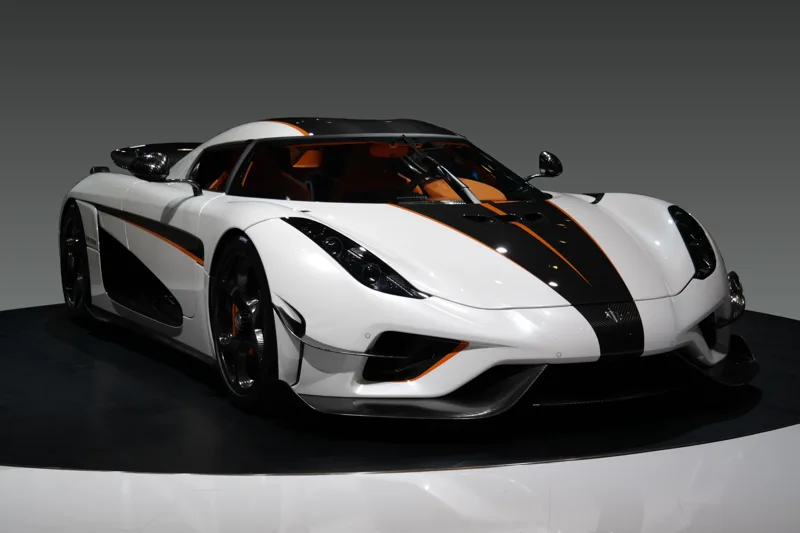
The Regera was presented at the 2015 Geneva Motor Show. It used the Koenigsegg Direct Drive system and no conventional gearbox. Production of the Agera ended in July 2018, after eight years on sale.
The Jesko was revealed at the 2019 Geneva Motor Show and named after the founder's father, Jesko von Koenigsegg. Its engine develops the Agera's 5.0-litre V8 further, and on normal gasoline it produces 955 kW (1,298 PS; 1,281 hp).
How does the Regera's Direct Drive system work?
The Koenigsegg Direct Drive, or KDD, is a patent-pending hybrid powertrain that removes the typical multi-speed gearbox. It links the internal combustion engine to the rear axle through a hydraulic coupling called HydraCoup, with a single fixed 2.73:1 final drive ratio.
At low speeds the internal combustion engine is disconnected, and two electric motors on the rear wheels provide the drive. At higher speeds the engine is connected through the coupling, and a third electric motor on the driveshaft adds boost and torque vectoring.
Three axial-flux electric motors make up the system. One sits on the crankshaft and works as a starter and generator, while two larger units drive the rear wheels. A high-voltage battery pack supports them.
What makes the Jesko's gearbox unusual?
The Light Speed Transmission is a 9-speed gearbox with seven clutches, designed for the Jesko. It removes the standard synchronisers, which lets it shift in about 2ms. The company says this makes it much shorter and lighter than usual dual-clutch units, at 90 kg.
The gearbox is a key part of the company's view that its systems should be developed in-house. Most of the core systems, subsystems and parts are made in-house rather than bought from outside suppliers.
What is FreeValve and why does it matter?
FreeValve is Koenigsegg's camless valve actuation system. It replaces the traditional camshaft with electro-hydraulic-pneumatic actuators, which allow the intake and exhaust valves to be controlled independently. The approach can improve torque, fuel efficiency and emissions control, and it can run the engine on either a two-stroke or a four-stroke cycle.
Koenigsegg has also developed a camless piston engine, which first appeared in the Gemera, unveiled on 3 March 2020.
How were the Gemera and CC850 positioned?
The Gemera was unveiled online on 3 March 2020. It was planned as a limited run of 300 units and is Koenigsegg's first four-seater. Its small engine is called the Koenigsegg TFG, short for Tiny Friendly Giant. The CC850 is part of the current range, alongside the Jesko and the Gemera.
Its Engaged Shift System, a manual and automatic shift arrangement, later won Top Gear's innovation award in 2023.
Which speed and acceleration records has Koenigsegg set?
On 28 February 2005 the CCR took the Guinness title for the fastest production car, reaching 387.866 km/h (241.009 mph) at the Nardo ring in Italy. It beat the McLaren F1, but the Bugatti Veyron took the record back in September 2005 at 408.47 km/h (253.81 mph).
In 2008 the German magazine sport auto ran a 0-300-0 km/h test for production cars, and the CCX won with a total time of 29.2 seconds. The Agera R set the 0-300 km/h Guinness record in September 2011 with 14.53 seconds, and the One:1 cut that to 11.92 seconds on 8 June 2015.
On 4 November 2017 an Agera RS averaged 447.19 km/h (277.87 mph) over a closed section of a Nevada road, with test driver Niklas Lilja at the wheel. Its top speed was 457.94 km/h (284.55 mph), and the run made it the fastest production car in the world on average speed.
Records followed in the acceleration tests as well. The Agera RS set 0-400-0 km/h in 36.44 seconds on 1 October 2017, and the Regera set 31.49 seconds in September 2019 and 28.81 seconds in June 2023. The Jesko Attack set a production car lap record at Laguna Seca of 1:24.86 on 18 August 2024.
In August 2025 the Jesko Absolut took back the 0-400-0 km/h crown with 25.21 seconds. That result came only a short time after a rival hypercar had set a close record, showing how fierce the contest had become.
How does Koenigsegg run its business?
Koenigsegg is noted for its high degree of vertical integration. It develops engines, transmissions and software in-house, and it has built a small but highly specialised company around that approach. In January 2019 the company sold a 20% stake to the Swedish electric carmaker NEVS for US$171 million.
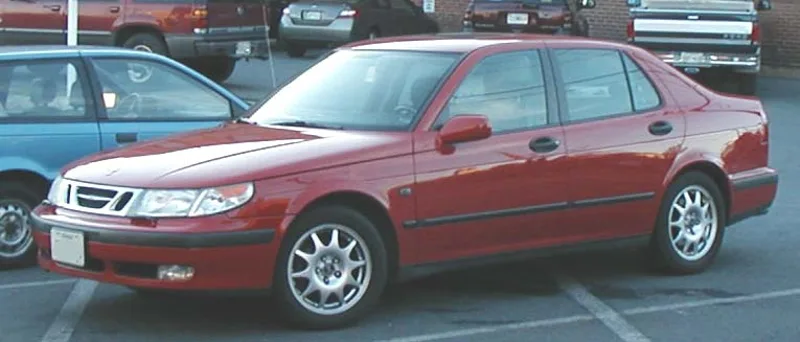
Koenigsegg bought the stake back in 2021 and owns 100% of the company again. Koenigsegg also tried to buy Saab. A letter of intent was signed in June 2009, with US$600 million of financing from the European Investment Bank. BAIC joined as a minority stakeholder in September 2009, but in November 2009 Koenigsegg dropped the purchase. The scale contrast was striking. In 2008 Koenigsegg, with a staff of 45, produced 18 cars, while Saab, by contrast, had 3,400 staff and built more than 93,000 cars.
How large is Koenigsegg today?
At the end of 2023 Koenigsegg had just under 800 employees, and it now employs approximately 850 staff. Because it builds its own engines and gearboxes, development of each new car stays close to its production line. The July 2023 factory doubled its production capacity, which was needed to support the Jesko, Gemera and CC850.
The company's base is a major production and research and development complex at a former Swedish Air Force base, and the old runway is still used for testing.
What awards has Koenigsegg won?
Top Gear's Hypercar of the Year went to the Agera in December 2010, and the Jesko took the honour later. Top Gear also gave the company its innovation of the year award in 2023 for the CC850's shift system. Koenigsegg's design work has been recognised with a Red Dot award for excellent design and the National Swedish Design Prize.
In 2023 Christian von Koenigsegg received the FIA President's Innovation Medal.
Key Koenigsegg figures at a glance
| Item | Detail |
|---|---|
| Founded | 1994 by Christian von Koenigsegg, aged 22 |
| Prototype finished | 1996 |
| CC8S | Introduced 2002 as the first street-legal production car |
| CCR record | 387.866 km/h (241.009 mph), 28 February 2005 |
| Agera | 5.0-litre V8, 716 kW (973 PS; 960 hp) |
| Regera drive | Koenigsegg Direct Drive, 1:1 link through HydraCoup |
| Jesko engine | Development of the Agera V8, run on normal gasoline |
| Gearbox | Light Speed Transmission, 9-speed with 7 clutches |
| Gemera | Four-seater, limited to 300 units |
| Staff | Approximately 850 |