How a 1894 race car changed the way drivers steer, and how tilt, telescope, safety and button designs shaped the wheel we use today.
A steering wheel is the control a driver turns to steer a vehicle, and the rest of the steering system responds to that input. Almost all modern land vehicles use one, and most cars now pair it with hydraulic or electric assistance.
Few parts of a car are used as often as the steering wheel, yet its design has changed a great deal since the first automobiles. The wheel is the part of the steering system the driver manipulates, and everything else in the system responds to it.
What is a steering wheel?
A steering wheel, also called a driving wheel or hand wheel, is a type of steering control in vehicles. It is used in most modern land vehicles, including all mass-production cars, buses, trucks, tractors and tanks. The driver's input reaches the road wheels through direct mechanical links, or through hydraulic or electric assistance.
Steering wheels are designed with ergonomics in mind, because drivers may keep their hands on them for many hours. A typical circular wheel has a steel or magnesium rim with a plastic or rubberised grip moulded over and around it. Some drivers add vinyl or textile covers for grip, comfort or decoration.
Mechanical types include recirculating ball and rack and pinion steering gears. Hydraulic power steering, abbreviated HPS, assists the driver, and in some modern cars computer-controlled motors provide electric power steering.
Ship's wheels had been used on sea vessels near the start of the 18th century, although historians are unclear when that approach to steering first appeared. Many people see the ship's wheel as a likely inspiration for the car version.
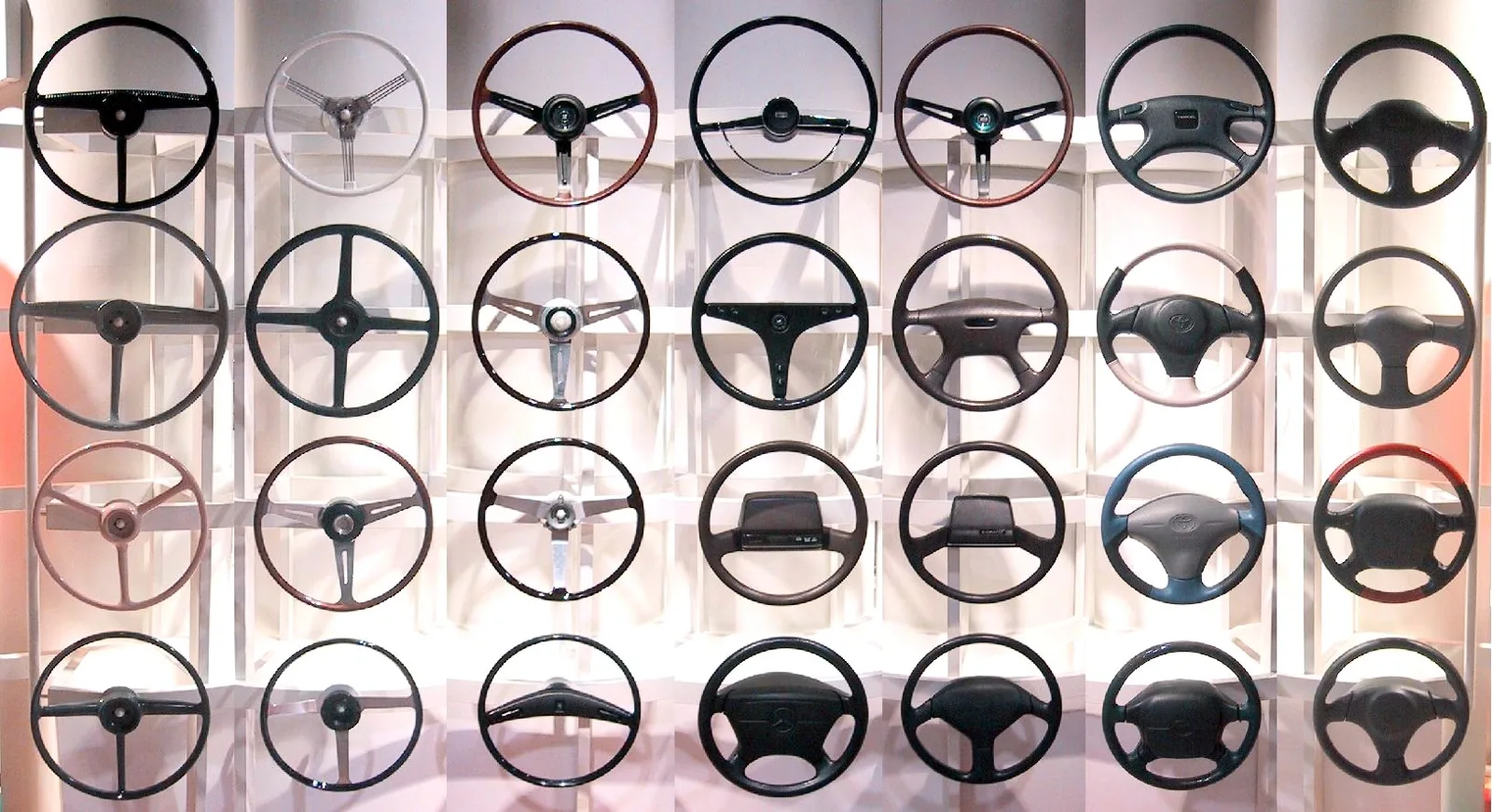
Land vehicle wheels are generally circular, mounted to the steering column by a hub that connects to the outer ring through one or more spokes. Single-spoke wheels are a relatively rare exception, and other vehicles may use a butterfly shape or a yoke.
A racing experiment from 1894 that grew into a control panel, a safety device and a driver interface.
How did the steering wheel replace the tiller?
The first automobiles were steered with a tiller. Alfred Vacheron's Panhard 4 hp, fitted with a wheel for the 1894 Paris-Rouen race, is believed to be among the earliest uses of the principle. Within a decade the steering wheel had entirely replaced the tiller in automobiles.
From 1898 the Panhard et Levassor cars were equipped with steering wheels as standard. Charles Rolls brought the first British car with a steering wheel into Britain in 1898, a 6 hp Panhard imported from France, and Arthur Constantin Krebs replaced the tiller with an inclined wheel for a Panhard in the 1898 Paris-Amsterdam-Paris race.
Thomas B. Jeffery and his son Charles developed experimental cars in 1898 with a left-hand steering wheel. The early Ramblers of 1902 still used tillers, but a tiller that arrived in early 1903 became a steering wheel by the end of that year, and by 1904 all Ramblers had steering wheels.
At Jeffery's insistence, the driver's position moved to the left side of the car during the 1903 Rambler production. Most other makers began offering left-hand drive in 1910, and soon after most cars in the US had converted.
Why is the steering wheel on the left or the right?
The side of the car where the driver sits depends on the traffic. Vehicles that operate in left-side traffic usually put the driver and steering wheel on the right, which is right-hand drive, and the converse applies in right-side traffic, which is left-hand drive.
Left-hand drive became the norm in most markets, while right-hand drive persists where traffic keeps to the left. Buses and delivery vans move the driver to one side, usually the side closer to the opposite lane of travel. Some vehicles place the driver in the centre with no passenger space on either side, and certain high-performance sports cars do the same, such as the McLaren F1.
What shapes have steering wheels taken?
Most steering wheels are circular, but design has varied. Some Tesla models use a yoke, a rectangle with rounded edges and two pistol grips. The C8 Corvette has a squircle, a square-type wheel with rounded corners and a flat bottom that eases driver egress while the flattened top improves the line of sight.
GM sought a US patent for a modular control whose shape can change from a circle to a yoke. The steering wheel has persisted because driving requires precise feedback, which a large interface provides.
Early Formula One cars used wooden steering wheels taken from road cars. Without cabin packaging limits they were made as large as possible to reduce the effort needed to turn, and wheels shrank as cars grew lower through the 1960s and 1970s.
Spokes have also changed. Most early cars had four-spoke wheels, and the Banjo steering wheel, an early option, had wire spokes that absorbed vibration from the road. Most Banjo wheels had three or four spokes made from four or five wires each, hence the name.
How did steering wheels become adjustable?
Edward James Lobdell developed the original tilt wheel in the early 1900s. A seven-position tilt wheel was introduced by GM's Saginaw Division in 1963, for all passenger car divisions except Chevrolet, which received it in 1964. Tilt works through a ratchet joint in the column, and the wheel moves in an arc.
The pivot can sit slightly forward on the column, giving vertical movement with little real tilt, or close to the wheel, changing the angle with almost no change in height.
Telescoping wheels came next. Many pre-war British cars had them, and in 1949 the Jaguar XK120 introduced a driver-adjustable wheel supplied by Bluemel. The 1955 to 1957 Ford Thunderbird had 3 inches (76 mm) of total travel, reduced to 2 inches (51 mm) in 1956.
GM did not offer a telescoping wheel of its own until the 1965 Corvette and Corvair, which had a 3 inch (76 mm) range. The GM column was released by twisting a locking ring around the centre hub. Bernard Maurer of GM's Saginaw Steering Gear Division had filed a patent for a telescoping wheel in July 1942, so the idea was known long before it reached production.
The swing-away column arrived on the 1961 Ford Thunderbird and moved the wheel 9 inches (229 mm) to the right when the car was in park, easing entry and exit. Ford's tilt-away wheel of 1967 replaced it after updated safety standards, offering less movement but a more convenient pop-over function.
How did steering wheels become safer?
Stiff wheels on fixed columns raised the chance of impalement in a serious crash. A collapsible column was first devised in 1934, though it did not sell successfully. By 1956 Ford had a safety wheel set high above the post with spokes that flexed, although the column itself stayed rigid.
In 1968 US regulations under FMVSS Standard No. 204 set limits on the rearward movement of the steering wheel in a crash, and collapsible columns had to meet them. Before that, the Citroen DS used a curved and off-centre single-spoke wheel designed to deflect the driver away from the column.
An airbag is now installed within the steering wheel to minimise injury from the driver's head or body contacting the wheel during a collision.
How did power steering change the wheel's role?
Power steering gives the driver reduced effort to steer. Most modern power steering is hydraulic, although electrical systems are gradually taking over. Mechanical power steering appeared on 1953 Studebakers, but hydraulic assistance prevailed. Electric systems use computer-controlled motors rather than hydraulic pressure.
Other approaches have come from experiments, such as the 1965 Mercury Park Lane concept car, whose wrist-twist controls used two 5-inch (127 mm) rings. None has yet matched the success of the conventional large wheel.
The wheel still has to convey torque to the steering system, which matters most in vehicles without power steering or in the rare event of a loss of assist.
Which controls sit on the steering wheel?
The horn switch was traditionally on the wheel hub or centre pad, sometimes on the spokes or in a decorative horn ring, which avoided moving a hand from the rim. Electrical connections are made through a slip ring. The horn switch remains the oldest of these controls.
The steering wheel and its column are the usual place for driver-activated controls such as the horn, turn signals and wipers. The wheel can also carry cruise control, audio and telephone controls and paddle shifters, so the driver can keep a grip while using them.
The first button added to a steering wheel switched the electric horn, and it remains the oldest of these controls. Later the Rim Blow design integrated the horn switch into the rim. In 1966 Ford offered Highway Pilot speed control with pad-mounted rocker switches on its Thunderbird, and in 1974 Lincoln added two rocker switches for cruise control on the Continental.
Pontiac offered a steering wheel with 12 buttons for audio functions in 1988, on the Trans-Am and other models. The 1990s then brought a proliferation of new buttons for audio, telephone and voice navigation, and scroll wheels that set volume or page through menus.
What are the key dates in steering wheel history?
| Year | Development |
|---|---|
| 1894 | Alfred Vacheron fits a steering wheel to a Panhard 4 hp for the Paris-Rouen race |
| 1898 | Panhard et Levassor fit steering wheels as standard; Charles Rolls imports the first British example |
| 1903 | Rambler tiller becomes a steering wheel by the end of the year |
| 1910 | Most makers begin offering left-hand drive |
| 1934 | First collapsible steering column invented, though never successfully marketed |
| 1956 | Ford safety steering wheel with flexing spokes set high above the post |
| 1961 | Swing-away column on the Ford Thunderbird |
| 1963 | Seven-position tilt wheel from GM's Saginaw Division |
| 1965 | Telescopic wheel on the Corvette and Corvair |
| 1967 | Ford tilt-away wheel after updated safety standards |
| 1968 | FMVSS Standard No. 204 limits rearward wheel movement in a crash |