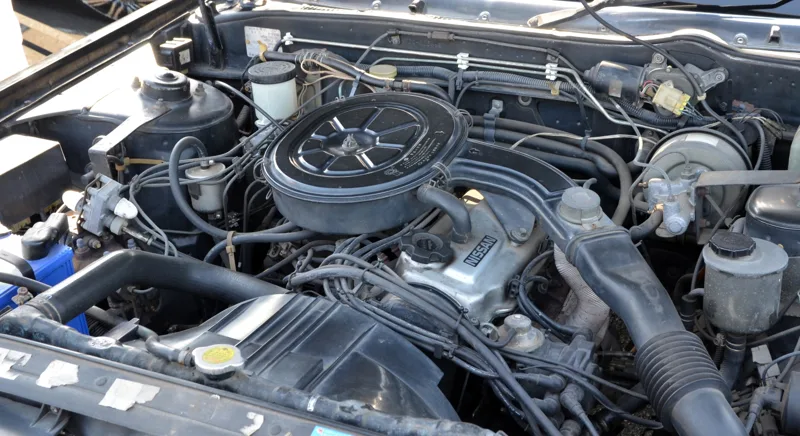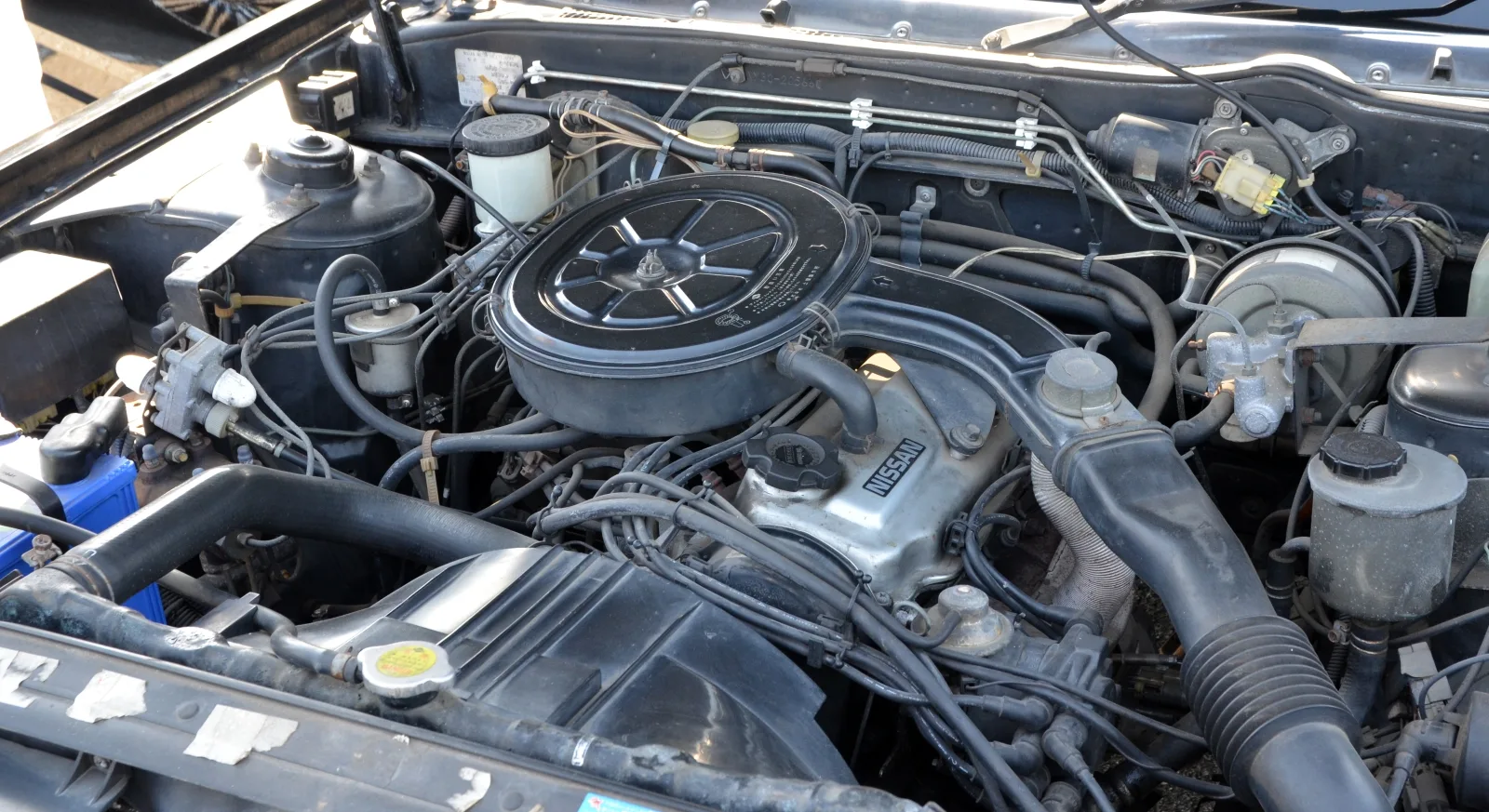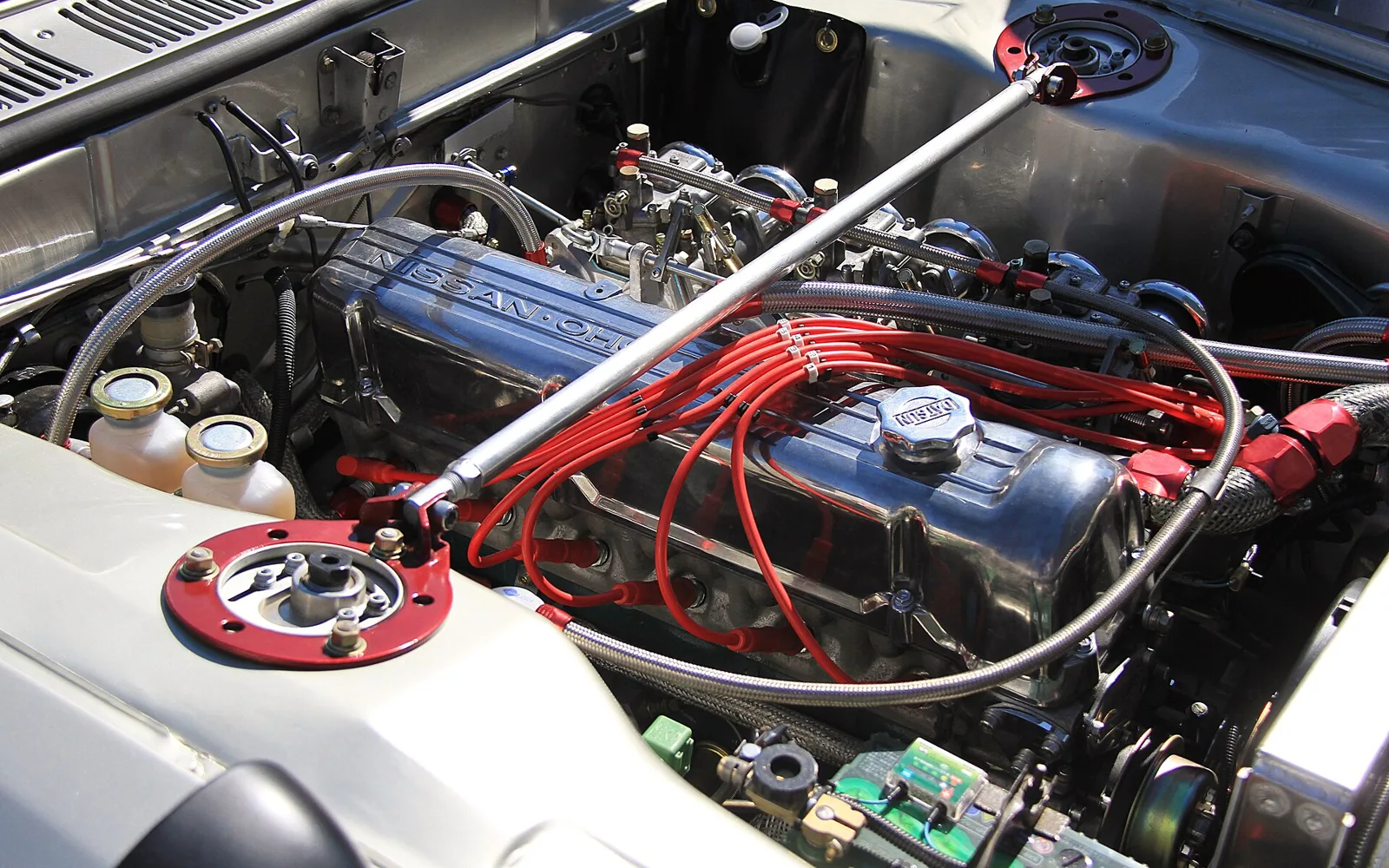
Nissan's iron-block, aluminium-head L series from the L20 six of 1966 to the L28 turbo, with competition twin-cam heads and aftermarket DOHC conversions.
Nissan's L series ran from 1966 to 1986 as a set of iron-block fours and sixes with aluminium heads. Its single overhead cam engines reached 2.8 litres at the top of the range, and the Datsun 510 and 240Z were among the cars that used them.
The Nissan L series was a family of inline-four and inline-six petrol engines built from 1966 to 1986, with capacities from 1.3 to 2.8 litres. It powered the Datsun 510, the 240Z sports car and the Nissan Maxima, and it is remembered for its reliability and for how easily its parts interchanged between versions.
What was the L series?
Each version had two valves per cylinder in a single overhead cam layout, an iron block and an aluminium head. Owners valued it for durability and for parts that could be swapped between versions. The family ran for more than twenty years and suited sporting and everyday cars alike.
Its head was a non-crossflow design, which means the intake and exhaust ports sit on the same side, and the design was simple to service. The four-cylinder engines were later replaced by the Z series and then the CA series, while the six-cylinder units gave way to the VG and RB series.
An iron block, an aluminium head and a family that stretched from 1.3 to 2.8 litres across twenty years.
How did the L series begin?
The L series started with the L20 six in 1966. Datsun rushed the engine into production, and its design was modelled on a Mercedes overhead cam engine. The rushed development caused problems, and the six was dropped two years on.
The four-cylinder L16 followed in 1967. Nissan's Small Engine Division gave it a full design and development cycle, and the layout drew on the Mercedes-Benz M180 and the Prince G engine that Prince had built.
The L20A replaced the original L20 in 1970. It was based on the L16 design and kept the bore and stroke of the first L20, producing 115 PS (85 kW) and powering the Fairlady Z through to 1983.
What were the four-cylinder L engines?
The four-cylinder line covered the L13 at 1.3 litres, the L14 at 1.4 litres, the L16 at 1.6 litres and the L18 at 1.8 litres. The L16 was the mainstay, fitted to the Bluebird and the Datsun 510 from 1967 to 1973.
The L13 was a short-stroke L16 with an 83 mm bore and a 59.9 mm stroke. It appeared in 1967, reached Canada in 1968 only, and in export form it peaked at 6000 rpm with 77 hp (57 kW; 78 PS) SAE.
The L14 was sold in most markets but never in the United States. With a single carburettor it made 85 PS JIS, and twin SU carburettors lifted the figure to 95 PS JIS at 6400 rpm.
The L16 was a 1.6 litre unit fed by a two-barrel Hitachi SU carburettor and built from 1967 to 1973. In US trim it reached 96 hp (72 kW; 97 PS), with 135 Nm (100 lb ft) of torque arriving at 3600 rpm. The L16T used twin SU carburettors and flat-top pistons borrowed from the 240Z, and it made 109 PS (80 kW; 108 hp).
The L18 took over from the Prince G-18 in 1975, and production ran from 1972 to 1976. Its most common trim peaked at 5000 rpm with 105 PS (77 kW; 104 hp). The fuel-injected L18E reached 115 PS (85 kW; 113 hp) at 6200 rpm and powered the S11 Silvia from 1976.
What was the L20B and why did it matter?
The L20B was a 2.0 litre (1,952 cc) with an 85 mm bore and an 86 mm stroke, built from 1974 to 1985. It used 60 mm main bearings and a forged U60 crankshaft with a six-bolt flywheel boss, and it took a taller deck to suit its longer stroke.
In US trim the L20B was rated 110 hp (82 kW) in 1974 and 1975 in the Datsun 610, with 152 Nm (112 lb ft) of torque. In 1977 and 1978 it was rated 97 hp (72 kW) in the 200SX, where it produced 138 Nm (102 lb ft).
Carburettors were used on every US application, and the engine was spread across six model families: the A10, 610, 710, S10, 620 and 720. That breadth made it the most versatile powerplant in Nissan's US line-up at the time.
Datsun's competition department offered 50 mm Solex twin-choke kits for the L20B, which lifted its output sharply. The engine also became a common choice for turbocharging because of its strong, nearly square layout.
How did the six-cylinder L engines develop?
The six-cylinder L series began with the 2.0 litre L20 and grew to the 2.8 litre L28, and the range covered carburettor, injected, turbocharged and diesel forms. Later versions added Bosch fuel injection, turbocharging and diesel options, and the L28ET turbo went into the 280ZX Turbo.
The L20ET was developed from the fuel-injected L20E and produced 145 PS (107 kW; 143 hp). It went into models such as the C210 and R30 Skylines, the Laurel and Leopard, and early Fairlady Zs, and it is credited as the first turbo engine from Japan.
The L24 was a 2.4 litre built from 1969 to 1984. In standard form it made 130 PS (128 bhp; 96 kW), and a twin SU carburettor version reached 150 PS (148 bhp; 110 kW). The L24E added injection from 1977 and produced 138 hp (103 kW; 140 PS).
The 2.6 litre L26 replaced the Prince G-20 in 1975. The 2.8 litre L28 was carbureted at first and, in the 160-series Patrol, peaked at 4800 rpm with 120 PS (88 kW).
The L28E used Bosch L-Jetronic injection, and it was one of the first Japanese vehicles to use the technology. Its output rose from 135 PS (99 kW; 133 hp) to 145 PS (107 kW; 143 hp) after the 1981 revisions, which added a flat-top piston and a high quench head.
The L28ET was created in December 1980 by turbocharging the L28E for the 280ZX Turbo. Japan's transport ministry allowed turbochargers only in cars under 2 litres, so the L28ET was never sold at home. It produced 180 bhp (182 PS; 134 kW) and used a single turbocharger with no intercooler.
The LD28 was the diesel version of the L28, built with a 7-main bearing block like every L series six. It found its way into the Gloria, Cedric and Laurel, and the Albin 27 boat used a version of it.
What were the LZ competition engines?
The LZ was a competition-only twin-cam head fitted to a standard L block, built to boost the L series' output for racing. Its 16-valve layout powered rally cars, Formula Pacific racers and Group 4, Group 5 and Group C entries.
Engine sizes ran from 1.4 litres in the PB110 '1200' up to 2.2 litres in rally Bluebirds. The naturally aspirated LZ14 of 1.6 litres had an 87.8 mm bore and a 66 mm stroke, and it dominated many Formula Pacific events.
For qualifying, the tuned LZ14 reached 240 PS (177 kW; 237 hp), with its peak at 11,000 rpm, while Formula Pacific engines made 205 PS (151 kW; 202 hp) and peaked at 10,200 rpm. Some Japanese classes used a T05B turbocharger with low-compression pistons and electronic injection.
The turbo version of the LZ reached 570 PS (419 kW; 562 hp) at 7600 rpm and 539 Nm (398 lbf ft) at 6400 rpm. A Silvia and a Skyline driven by Hoshino in the mid-1980s used the turbo LZ, and the 1983 Silvia S12 'White Lightning' Group 5 car used the LZ20B to produce 500 PS.
How did aftermarket DOHC heads change the L series?
Osamu Okazaki designed a 16-valve DOHC cylinder head for the four-cylinder L engines in 1974, and his company OS Giken built it. The head used a crossflow layout instead of the original reverse-flow design, and it lifted a naturally aspirated engine to 230 hp (170 kW; 230 PS).
OS Giken also made a 24-valve head for the six. The TC24-B1 made 320 PS (235 kW) naturally aspirated, with a 9,000 rpm redline, and very few original examples survive. A 2013 redesign used gear-driven timing, coil-pack ignition and optional fuel injection, producing 420 hp (310 kW; 430 PS) and a 10,000 rpm redline.
Nismo released its own TLX head in 2024, with individual throttle bodies and coil-pack ignition. It was planned for a 2.9 litre (2,949 cc) version with around 300 hp (224 kW; 304 PS) and a 7,500 rpm redline, and Nismo announced production on 19 June 2025.
Pams Labo showed its LZ6 at the 2025 Tokyo Auto Salon, with a 3.1 litre capacity and gear-driven timing. Its 9,500 rpm redline and output of more than 400 hp (298 kW; 406 PS) placed it among the strongest L-based builds.
A different route is the RBL, where the DOHC top end comes from the RB family and the bottom end from the L. Only a handful were made, and claimed outputs run from about 300 to 400 hp with a 9,000 rpm redline.
What were the main L series specifications?
| Engine | Displacement | Output | Context |
|---|---|---|---|
| L16 | 1.6 L, 1,595 cc | Peak 6000 rpm, 96 hp (72 kW; 97 PS) | US trim, 1967 to 1973 |
| L18 | 1.8 L, 1,770 cc | Peak 5000 rpm, 105 PS (77 kW; 104 hp) | 1972 to 1976 |
| L20B | 2.0 L, 1,952 cc | 110 hp (82 kW), 1974 to 1975 | US Datsun 610 |
| L24 | 2.4 L, 2,393 cc | 130 PS (128 bhp; 96 kW) | 1969 to 1984 |
| L28E | 2.8 L, 2,753 cc | 145 PS (107 kW; 143 hp), 1981 to 1983 | Bosch L-Jetronic injection |
| L28ET | 2.8 L, 2,753 cc | 180 bhp (182 PS; 134 kW) | 280ZX Turbo |
| LD28 | 2.8 L, 2,792 cc | 91 PS (67 kW; 90 bhp) at 4600 rpm | Diesel, pre-combustion chamber |
| LZ14 | 1.6 L, 1,598 cc | 240 PS (177 kW; 237 hp) with its peak at 11,000 rpm | Tuned for qualifying |