How Jaguar's IRS, first fitted to the E-Type in 1961, combined a rubber-mounted crossbeam with radius arms and inboard brakes, and how the design evolved into the modern multi-link system.
Jaguar's independent rear suspension was a crossbeam-mounted design first used on the 1961 E-Type. It evolved through two generations and a modern multi-link unit, and the first version was prized for ride quality and roadholding.
Jaguar's independent rear suspension, or IRS, was a common feature of the company's cars for almost half a century. It first appeared in 1961 and went through two major configuration changes before the last version appeared in 2006. The first generation established the marque's reputation for suspension sophistication, because it gave a smooth ride, excellent roadholding and low noise, vibration and harshness, known as NVH.
When did Jaguar introduce independent rear suspension?
The first Jaguar IRS arrived in 1961, when independently sprung rear wheels were still rare on British cars. Most production cars of the time used live rear axles. The first applications were the E-Type sports car, from its 1961 launch, and the Jaguar Mark X saloon, introduced later that year at the top of the range.
Development took five years. A prototype in a Mark 2 saloon cut unsprung weight by 190 lb (86 kg) relative to a live rear axle. The assembly was made in three sizes, with different track widths to suit different models, and it continued in use until production of the XJS ended in 1996.
Jaguar's first independent rear was a removable crossbeam that isolated the cabin, with a bonus of passive rear steer.
Why is independent rear suspension better?
Independent suspension lowers unsprung mass, which helps roadholding. When it is properly designed, it keeps the road wheels perpendicular to the surface during cornering and over uneven ground, which further improves grip. It also reduces the transmission of road undulations into the body, which makes the ride smoother.
Jaguar's design also suited production in a practical way. The IRS was built into a fabricated steel subframe that could be removed from the car as one complete assembly. That feature later made it attractive to kit-car builders and low-volume specialist makers.
| Element | First generation (1961) | Second generation (1986) |
|---|---|---|
| Subframe | Steel crossbeam cradle on four rubber vee-blocks | Approximate triangle bolted to the front of the differential |
| Upper link | Driveshaft with a universal joint at each end | Driveshaft still acts as the upper link |
| Lower link | Steel tube with forked ends | Fabricated steel box section, wider at the base |
| Radius arms | Two per side | Eliminated |
| Springing | Two coil units per side | One spring and damper per side |
| Rear brakes | Inboard, on the differential | Outboard, on the driveshaft ends |
How is the first generation laid out?
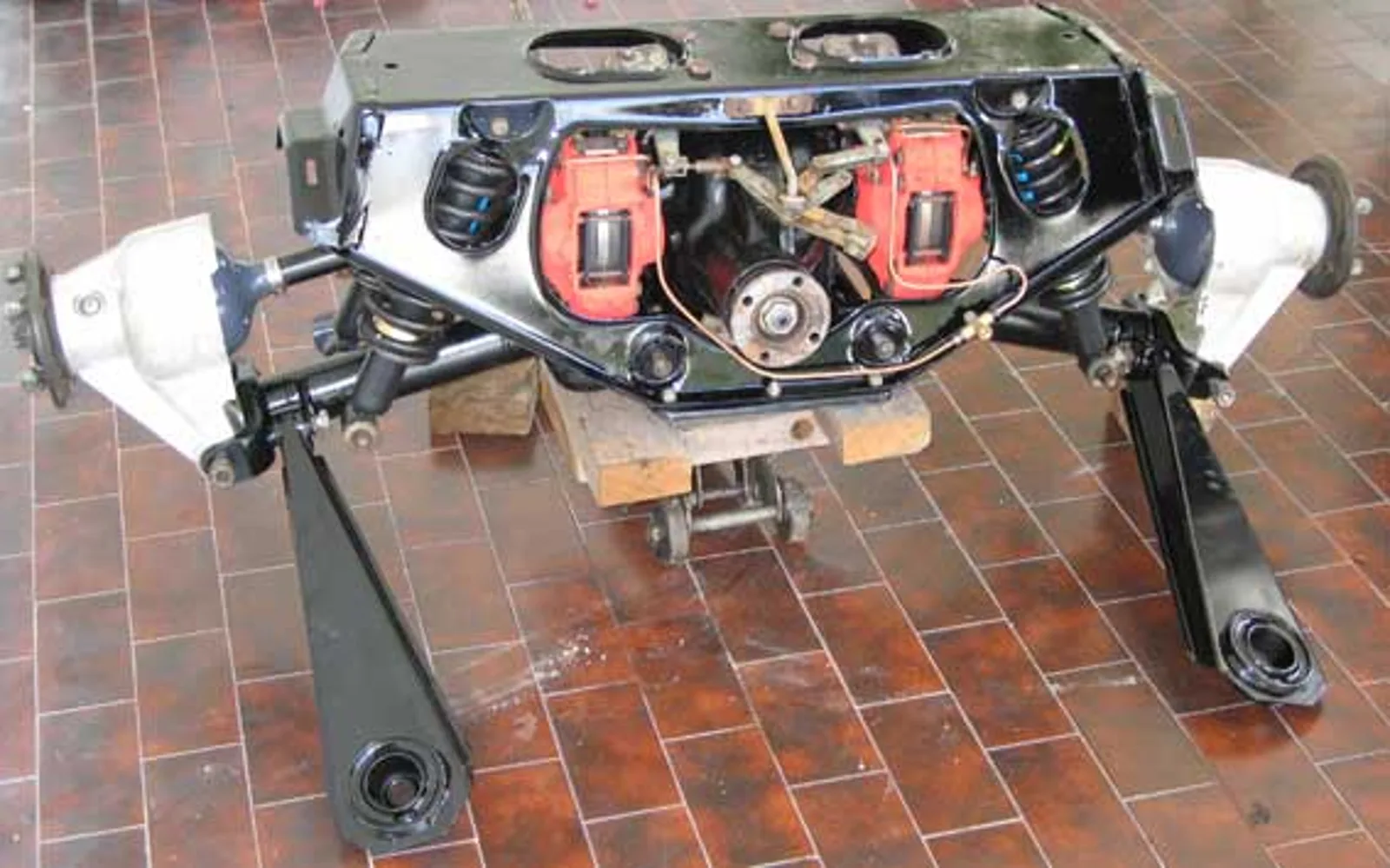
The complete rear suspension sits in a steel crossbeam cradle, attached to the body by four rubber vee-blocks. The cradle also carries the differential and the inboard brakes. The rear wheels are located transversely by top links and wheel carriers, and by lower links. The top link doubles as the driving half-shaft, carried on a universal joint at each end, so drive passes through as the wheel travels.
The lower link pivots next to the differential casing at its inner end, and at the wheel carrier at its outer end. The pivot bearings at each end are widely spaced to give the maximum longitudinal rigidity. Two coil spring and damper units sit on each side of the differential casing, four in total, attached to the crossbeam at the top and the lower link at the bottom.
The hub carrier runs in bearings set in a large cast aluminium hub carrier. The top link's universal joints act as its inner and outer pivots. Knock-off wheels mate with a splined stub axle, while five-lug wheels use a stub axle and hub plate.
Later XJS cars with outboard rear brakes used one cast steel unit that combined the carrier, the discs and the parking drum.
What does the crossbeam do for refinement?
To insulate the passenger compartment from noise, vibration and harshness, the suspension was carried in a separate crossbeam assembly. Those four rubber vee-blocks hold it in place. The radius arms, the only other body connections, sit in Metalastik bushes with metal sleeves inside rubber, so metal never touches metal between suspension and body.
The bushes and vee-blocks are positioned to keep the suspension mounting rigid enough for good control while still isolating the body from noise and vibration. The roller bearings used at the top and lower link pivots reduce friction compared with plain bearings, improving the smoothness and speed of suspension response.
How do the radius arms and differential work together?
The lower link is not designed to carry normal acceleration and braking loads alone, so two radius arms run forward from each lower link to the unitary body beneath the rear of the cabin. Each arm attaches just outboard of the bottom spring mountings and pivots vertically about its fixing bolt. Safety straps keep the arms close to the body if one of the front bolts comes loose.
Units from Salisbury (4HU) or Dana, both hypoid spiral bevel designs, gave final drive ratios from 2.88:1 to 4.55:1. The mounting bolts carry small holes in their heads for safety wire, a detail that matters because they are reachable only with the whole assembly out. A limited-slip differential was standard on some models and optional on others.
What is passive rear steer?
The radius arms do not sit on the same axis as the lower link inner pivots, so free movement might seem impossible without bending components. The crossbeam is rubber mounted, however, and body roll causes the whole crossbeam and lower links to pivot slightly about its mounting points. That produces a small amount of passive rear wheel steer, which can noticeably improve handling.
The effect is lost when Jaguar components are reused in other vehicles. There the differential is often rigidly mounted to the chassis, and different radius arm layouts are used, so the passive steer does not occur.
How were the springs and brakes arranged?
Four coilover spring and damper units attach to the crossbeam at the top and to the lower links at the bottom. Using two units per side was unusual, but it allowed smaller springs that take up less space and protrude less into the luggage area. It also shared the load between the front and rear of the crossbeam.
Some models also had an anti-roll bar, a torsion bar arrangement intended to reduce body roll in corners. The brakes were the most unusual feature. For the first 32 years of production the disc brakes sat inboard, at the inner ends of the driveshafts, to reduce unsprung weight at the outer end. The hydraulic calipers were mounted directly on the differential, and heat from the brakes could damage the differential output seals, although that was never fully prevented.
The parking brake used separate mechanical calipers acting on the discs. For the 1993 to 1996 XJS, the brakes were moved outboard. That change used hub carriers from the second-generation IRS, which had been in production for seven years on the XJ6 (XJ40). Outboard brakes removed the heat transfer problem and made servicing easier, and the parking brake then used shoes inside a drum in the centre of the disc.
Which cars used the first generation?
The unit's self-contained design meant a builder could lift the whole crossbeam out as one piece and fit it elsewhere without rebuilding the rest of the car.
Several Jaguars were fitted with the first generation IRS as original equipment, with the narrow, medium or wide version of the assembly chosen according to the model's rear track. Because of its self-contained design, the unit was also popular to retrofit to other cars, including by hot-rodders.
Its retrofit list is long. It has been fitted to AC Cobra replicas, the Ford Mustang, the MG MGB, several Panther models, the Reliant Scimitar, the Toyota Hilux and the Triumph TR7.
How did the second generation change the design?
Jaguar made several fundamental changes for the XJ40, launched in 1986. The subframe became an approximate triangle bolted to the front of the differential, with link rods supporting the rear of the differential from the floor structure. Rubber bushes at the attachment points provided the necessary NVH suppression.
The fixed-length driveshaft remained as the upper link, but the lower wishbone was rebuilt as a fabricated steel box with a far broader base. Because the front and rear pivots were so far apart, the radius arms could be eliminated. The twin springs were replaced by a single spring and damper, acting against the body rather than the subframe.
The brakes moved to the outboard ends of the driveshafts for better heat dissipation and easier servicing. The net result was lower overall weight, but unsprung weight rose because moving the brakes outweighed the savings on springs and dampers, and NVH isolation deteriorated slightly. In 1993 late XJ40 models gained an eccentric bolt that allowed rear toe-in adjustment without bending the arms.
Which cars carried the second generation?
The second generation was fitted to the XJ40, the XJ (X300), the XJ (X308), the XK (X100) and the Aston Martin DB7 as original equipment. A derivative of the first-generation unit remained in use on the DB7 until 2004.
What is the current IRS?
For the launch of the S-Type (X200), Jaguar, then under Ford ownership, developed a new and complex multi-link suspension for the Ford DEW98 platform. The driveshafts no longer formed part of the structure, so they could use constant-velocity joints that allowed their length to vary with suspension travel.
That system, with modifications, went on to the XJ (X350) in 2003, the XK (X150) in 2006, the XF (X250) in 2007, the revised XJ (X351) in 2010, the XF Sportbrake (X250) in 2012 and the F-Type (X152) in 2013. A heavily revised version was also planned to underpin future Land Rover products, starting with the Range Rover (L405).
Because the driveshafts no longer carry structural loads, the joints at each end can change length as the suspension moves, which is the job the fixed-length half-shaft once did in the earlier designs.