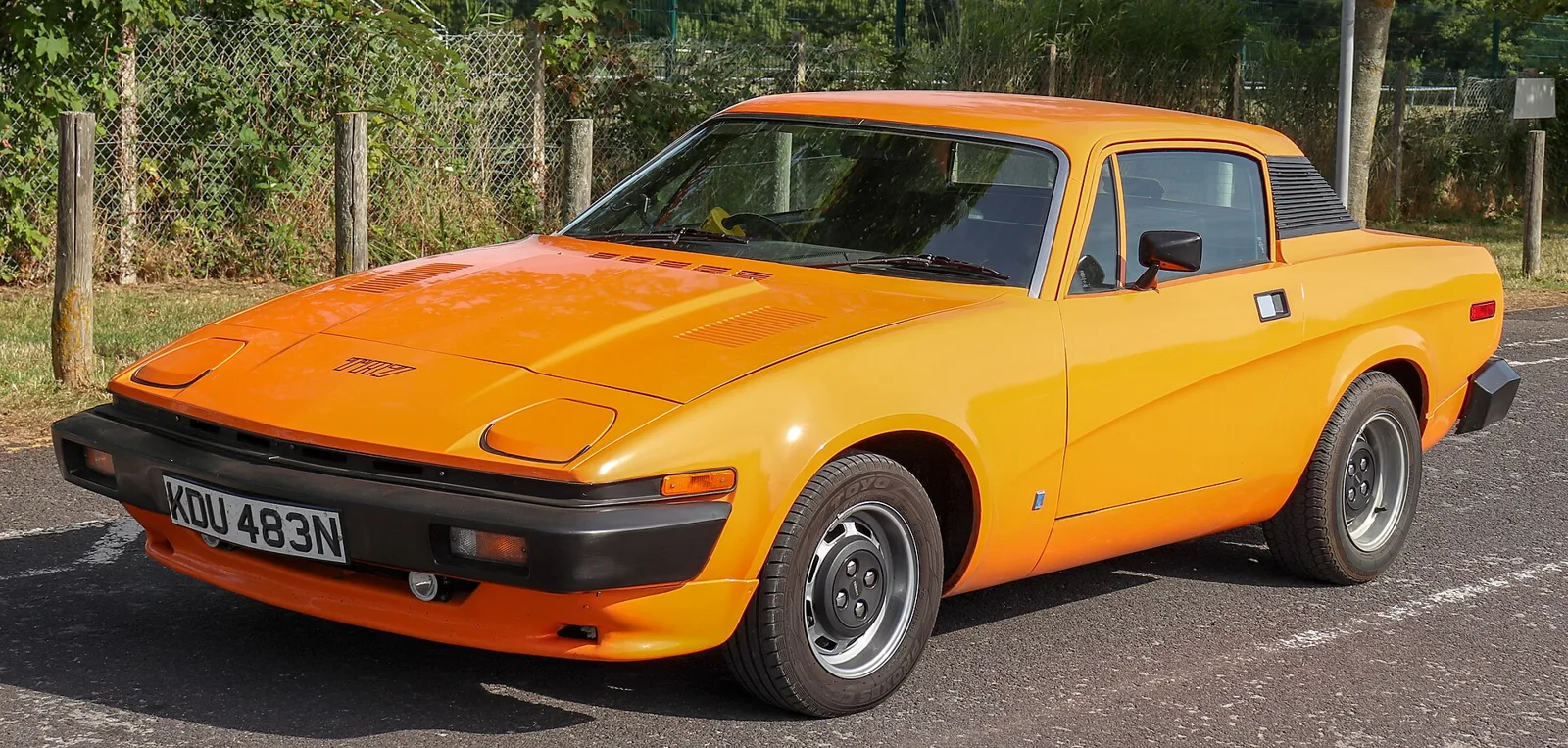
Harris Mann's wedge styling sold well in America, but strikes, build quality and a crowded British Leyland range cut its life short.
The Triumph TR7 was a British wedge-shaped sports car built by British Leyland from 1974 to 1981. It began as a fixed-roof coupe with a 2.0-litre four-cylinder engine, later gained a convertible, and roughly 115,000 were produced before the Solihull line closed.
Few cars capture the problems of 1970s British Leyland as neatly as the TR7. Its wedge styling was modern and its American sales were strong, yet strikes, build quality and a crowded range plan cut its life short. With it went the long run of Triumph sports cars that had started in the 1950s.
Where and when was the TR7 built?
The TR7 was built in the United Kingdom from September 1974 until October 1981. The maker was British Leyland Motor Corporation, which became British Leyland (BL) in 1975. Production began at Speke in Liverpool, moved to Canley in Coventry in 1978, and finished at Rover's Solihull plant from 1980.
The car reached American showrooms first, in January 1975, and it did not appear in Britain until May 1976. Demand across the Atlantic delayed the UK launch at least twice, and new TR7s were still being sold into 1982.
Development went ahead under the codename Bullet. Upmarket versions were discussed with MG badging, and an early clay model carried the name MG Magna, but no MG-badged car reached production. Styling came from Harris Mann, who had also drawn the Princess, and advertising called the TR7 the shape of things to come.
A wedge-shaped coupe that sold well in America and was undone by quality problems at home.
What did the TR7 look like?
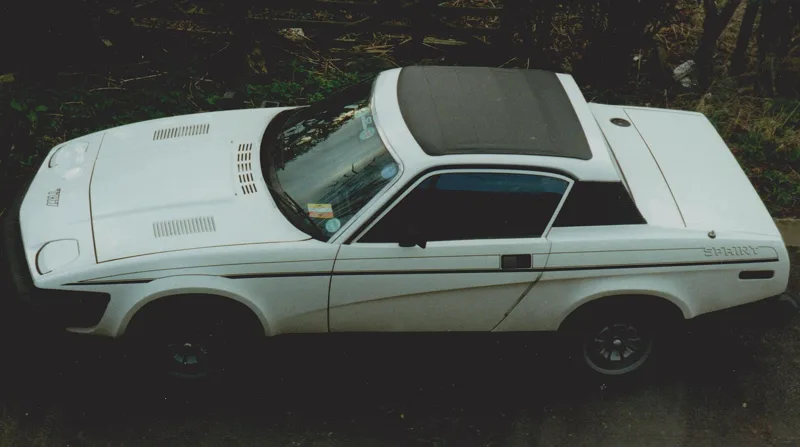
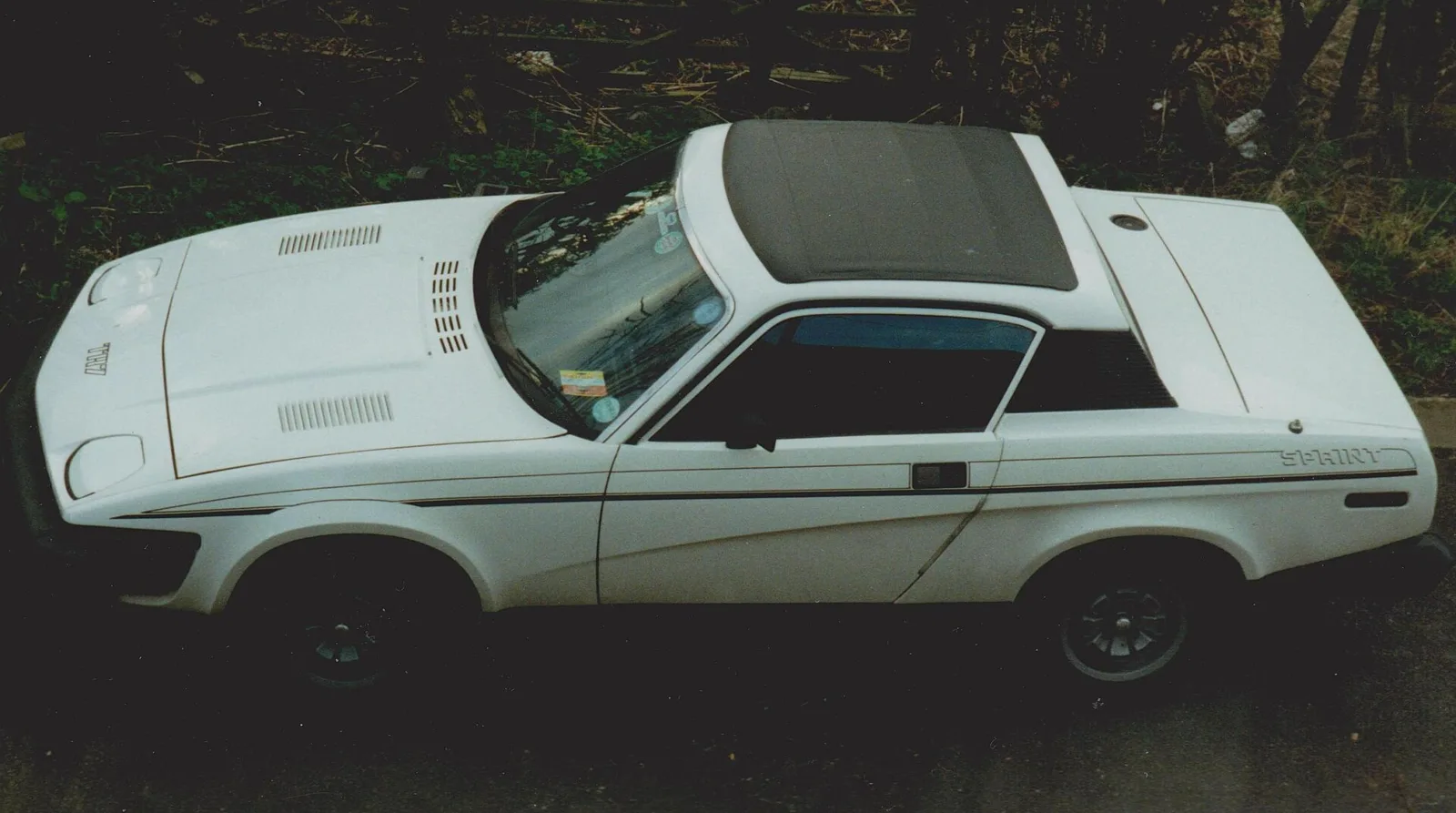
The TR7 was a wedge with a crease, a swage line that ran from the back of the car to just behind the front wheel. It measured 160 in (410 cm) long and 66 in (170 cm) wide, on an 85 in (220 cm) wheelbase, and weighed 2,205 lb (1,000 kg) as a coupe.
The TR7 was the first TR not offered as a convertible in its original form. It arrived as a two-door fixed-roof coupe, a decision that came from BL's reading of the American market. Roll-over concerns were growing in the United States, and legislation to ban open-top cars was being discussed.
America was the most valuable market for Triumph's sports cars, so BL avoided the risk by offering the car only as a fixed roof. The feared law never arrived, and in 1979 Triumph introduced a drophead coupe, first in the US and then in Britain in early 1980.
The bonnet carried a double bulge once the V8 version was planned, a shape needed to clear its carburettors. The double bump later appeared on cars assembled at Canley and at Solihull. Interior trim was also refreshed in March 1977, with red or green tartan inserts replacing the earlier broadcord seat covers.
How did the TR7 engine and running gear work?
Under the bonnet was a 1,998 cc four with eight valves, a design shared with the Dolomite 1850 engine. Triumph enlarged it to 2 litres, fitted bigger carburettors and mounted it in-line at the front, driving the rear wheels. At 3,500 rpm the engine produced 119 lb ft (161 N m) of torque.
Early cars had a four-speed gearbox. A five-speed manual and a three-speed automatic became available from 1976. A European test car took about 10 seconds to reach 0-60 mph (97 km/h) and reached 108.5 mph (175 km/h) at the top end.
The front suspension used coil springs, damper struts and a lower single link. The rear was a four-link layout, also on coil springs. Anti-roll bars sat at both ends, and braking used discs up front with drums behind.
North American cars were rated at 92 bhp (69 kW). Australian buyers were given that same version so that the car met local emissions rules.
What were the TR7's key specifications?
The TR7's specifications were modest by later standards but typical of its period: a 2-litre four rated at 105 bhp (78 kW), rear-wheel drive and a maximum of 108.5 mph (175 km/h). The table below gathers the key figures, including the lower output of the North American version.
| Specification | Detail |
|---|---|
| Built | September 1974 to October 1981 |
| Engine | 1,998 cc eight-valve four-cylinder, enlarged to 2 litres |
| Power | 92 bhp (69 kW) North American; 105 bhp (78 kW) reached at 5,500 rpm |
| Torque | 119 lb ft (161 N m), reached at 3,500 rpm |
| Gearbox | Four-speed; five-speed manual or three-speed automatic from 1976 |
| 0-60 mph | About 10 seconds in a European test |
| Top speed | 108.5 mph (175 km/h) |
| Dimensions | 160 in (410 cm) long, 66 in (170 cm) wide, 49.5 in (126 cm) high |
| Wheelbase | 85 in (220 cm) |
| Kerbside weight | 2,205 lb (1,000 kg), coupe |
| Production | Approximately 115,000 in total, including 28,864 convertibles |
Why did the TR8 use a V8 engine?
The TR8 was a TR7 fitted with a Rover V8 of 3.5 litres giving 135 bhp (101 kW). Triumph built it for the American market in 1977 and 1978, and it was launched only as a convertible. The engine swap needed a bulge in the bonnet, which gave the car its double bump.
A few genuine TR8s stayed in Britain, and those are now very rare. Most went to the US, where sales were disappointing. Build quality at Triumph was poor at the time, and the pound rose to about $2.40 by 1980, which made Triumphs expensive against their rivals.
About 400 hard-top TR8s were built at Speke and Canley for the Group 4 homologation of the TR7 V8 rally car. Some TR7s may also have been converted by BL to TR8 specification, and the car was described as a TR7 V8 until the TR8 name was approved.
Which limited and special versions were built?
The best-known limited version was the 1980 Spider, a US-only drophead in maraschino black. Around 1,070 carburetted Spiders were built at Solihull, plus 548 fuel-injected cars for California. Grinnall later converted 350 convertibles with Rover SD1 parts, and each carried Grinnall badging.
The Spider borrowed alloy wheels and a steering wheel from the TR8, with reflective red striping and pewter grey carpet. Its chassis numbers ran from 400301 to 401918, and the fuel-injected cars made up the upper part of that sequence. The radio-cassette was fitted at the port of entry rather than at the factory.
Almost a decade after the TR7 ended, Grinnall Specialist Cars reworked existing TR7 and TR8 cars. They received TR8 subframes and dashboards, plus V8 engines, some bored out, with suspension, gearbox and brakes sourced from the Rover SD1. The wings were widened to fit the SD1 axles and suspension.
Which TR7 variants were cancelled?
Several were planned, including a 16-valve Sprint, a 2+2 fastback called Lynx, a joint MG-Triumph project named Broadside and an MG version called Boxer. None reached full production, although 58 prototype and pre-production cars were built in 1977 and 18 Lynx prototypes were made.
The TR7 Sprint carried the 16-valve Dolomite Sprint unit and was built at Speke. Its chassis numbers started with ACH rather than ACG. The Heritage Trust records cover 58 cars made between February and October 1977, and as many as 61 may have existed in total.
Lynx was meant to replace the Triumph Stag. It had a wheelbase 12 in (300 mm) longer, a Rover V8 and a rear axle from the SD1. Its cancellation followed the closure of Speke and doubts about sales. Broadside, with a wheelbase 5 in (130 mm) longer, was dropped later in 1979 for lack of funding.
Boxer was an MG version of the TR7 hardtop. It gained an MG grille, headlights similar to a Porsche 928's and a tail panel with lights from the Rover SD1. It was rejected because it looked too close to the standard car.
How did the TR7 perform in rallying?
British Leyland ran a TR7 rally team from 1976 to 1980. They started out with the 16-valve Dolomite Sprint unit, then changed to the Rover V8. They did well on tarmac but struggled on gravel, and Tony Pond was the team's most successful driver.
John Buffum took the SCCA Pro Rally title from 1977 to 1980 in TR7 and TR7 V8 cars. The V8 cars remain strong performers in classic rallying today.
The 16-valve rally car gained Group 4 approval in October 1975 under the FIA's 100-off rule. That rule let makers list optional kits after a set number had been made available, rather than requiring the cars to be built. The rules changed in 1976, so BL had to win approval for the 16-valve head again for 1978.
The V8 car was homologated on 1 April 1978 as a separate model, although it was given the TR7 V8 name because the TR8 had not yet launched. The FIA rules required about 400 cars, but fewer than 150 were believed to have been built by then.
Why did quality problems hurt the TR7?
Quality problems damaged the car's image in the market. Strikes at the Speke works near Liverpool, which were frequent, along with poor relations between management and the workforce, were the main causes. Quality improved after production moved to Canley and later Solihull, but by then the reputation was gone.
In a Frankfurt Motor Show preview from September 1977, the German title Auto, Motor und Sport said that a TR7 press car's engine overheated and began to boil during a top-speed run on a test strip 4 km (2.5 miles) long. British Leyland technicians had been looking into the car for nineteen days without comment.
What ended TR7 production?
BL's chairman, Michael Edwardes, inherited a company in which sports cars were a low-volume niche it could barely afford. The MGB was axed to protect TR7 sales, but the TR7 itself was cut in 1981, which ended car production at Solihull. The Dolomite had gone a year earlier.
Solihull then became an exclusively Land Rover plant. The Triumph name survived until 1984 on the Acclaim, a licence-built Honda Ballade made at Cowley. It was sold as a family saloon rather than a sports car, so the lineage ended with the TR7.
Approximately 115,000 TR7s were built, including 28,864 convertibles, along with approximately 2,800 TR8s. Those figures show a car that sold in good numbers, even though its reputation at home was damaged by quality problems.