A British coupe that became a sports estate and then a convertible, built on a steel chassis with a fibreglass body and Ford engines for 22 years.
The Reliant Scimitar was a British sports car series built from 1964 to 1986. It started as the GT coupe, became the GTE sports estate and ended with the GTC convertible in 1980, with a fibreglass body and Ford engines throughout.
The Reliant Scimitar was a series of sports cars built by the British maker Reliant from 1964 to 1986. It began as a coupe called the GT, grew into the GTE sports estate in 1968 and ended with the GTC convertible in 1980. Every model used a fibreglass body on a steel box-section chassis, with Ford engines under the bonnet.
Where did the Scimitar name come from?
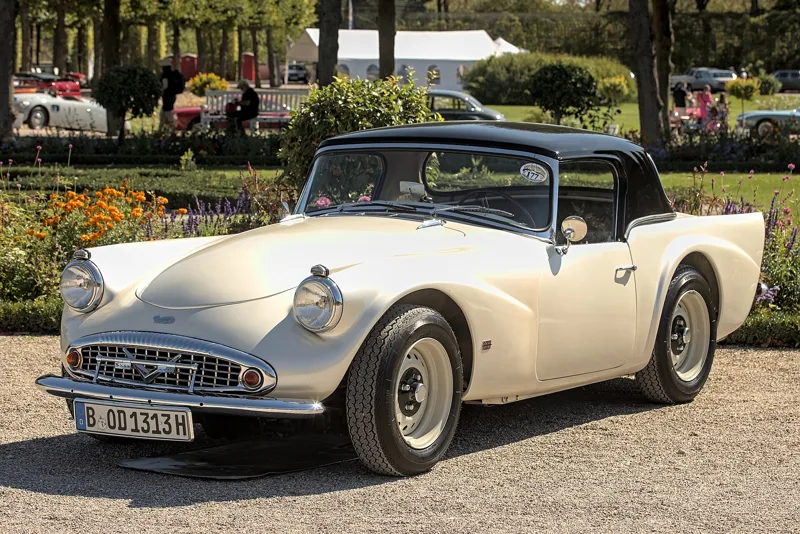
The first Scimitar was a coupe that Reliant developed from a design by David Ogle. Ogle had produced a car called the SX250 on a Daimler SP250 chassis, and Reliant managing director Ray Wiggin saw it at the 1962 Motor Show. Daimler passed on the design, so Reliant bought the rights and adapted it to its own running gear.
The new car kept the Sabre's chassis and its straight-six Ford engine. With triple SU carburettors it produced 120 bhp, and Reliant launched it at the 1964 Earls Court Motor Show at 1,292 pounds sterling. The price included wire wheels and a well-equipped interior, and buyers could add overdrive, an electric sunroof or a ZF gearbox.
Reliant turned a Daimler-derived coupe into a sports estate, then a convertible, with a fibreglass body and Ford power throughout.
How did the first Scimitar GT change?
The first Scimitar GT, known as the SE4, used a 2.6-litre straight-six borrowed from the Zephyr and Zodiac saloons, and many of its components were shared with other Reliant models to keep costs down. Reliant built just over 1,000 SE4s across the type's life.
In late 1966 Ford dropped the straight six, and Reliant replaced it with the 3.0-litre Essex V6 used in the Mark IV Ford Zodiac. The shorter engine sat further back in the bulkhead, the lower wishbones were repositioned, and the structure was reinforced. A higher-ratio rear axle of 3.58:1 replaced the earlier 3.875:1 unit, and wider steel wheels became standard.
The interior was also revised, with an all-black trim scheme and black instrument bezels replacing the chrome. The padded fascia gained crash pads top and bottom, and the ventilation used directional jets copied from Ford. Autocar tested the 3-litre car in January 1967 and was impressed with its low-revving engine, its ride and handling, its steering and its brakes, while the ventilation was still not ideal.
In September 1967 Reliant introduced a cheaper 2.5-litre version of the V6, which cost about 120 pounds less and could still exceed 110 mph (177 km/h). Only the badge on the boot showed the engine size. The standard GT stayed in production until November 1970.
What made the Scimitar GTE a sports estate?
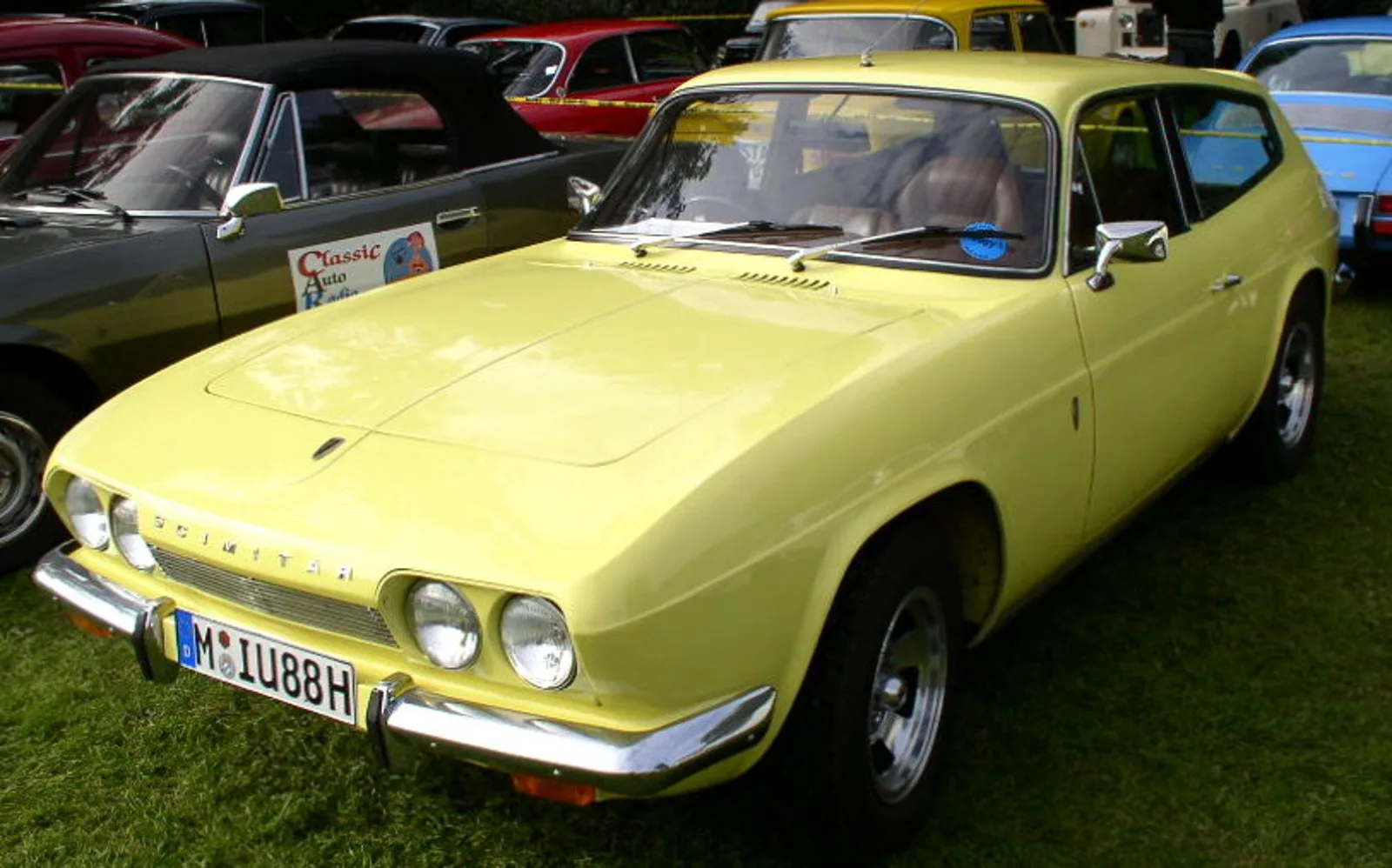
The GTE was a four-seat sports estate that Reliant launched in 1968. Its body came from an Ogle design study for an estate, with Tom Karen supplying the proposals. The main change from the GT was the sports estate hatchback body shape, and the proposals drew on the GTS estate car experiment that Ogle had built earlier.
Ray Wiggin, John Crosthwaite and Ken Wood, the fibreglass specialist, went to Ogle's Letchworth studio to see mock-up bodies. Wiggin gave Wood the go-ahead to build a full master, and the SE5 was ready for the 1968 Motor Show after less than a year of work. Crosthwaite worked with Ogle stylist Peter Bailey to refine the prototype.
The SE5 required a substantially new chassis. Engineer John Crosthwaite and his team designed a longer frame, revised suspension, a rollover bar, a new cooling system and a relocated fuel tank of 17 1/4 imperial gallons (78 L). The spare wheel moved into the nose to free up rear space, and the flat dashboard was later replaced with a curved one.
Power still came from the 3.0-litre Essex V6. Reliant claimed more than 120 mph (193 km/h) for the SE5, and a Borg-Warner 35 automatic became an option in 1970. Overdrive on the four-speed manual followed in 1971, and the car had a hatchback body.
The SE5A arrived in 1972 with a small power increase of 7 hp (5 kW) and a higher maximum engine speed. Reliant said the GTE could now reach 60 mph in 8.5 seconds, and its top speed rose to 121 mph (195 km/h). The SE5A is identified by reverse lamps set into the rear clusters rather than below the bumper. Badging also changed, with the Scimitar lettering switched from a narrow style to a fatter one.
How did Autocar judge the early GTE?
In October 1968 Autocar put a manual 3-litre GTE through its paces. It reached 117 mph (188 km/h), ran 0-60 mph in 10.7 seconds and returned 18.5 miles per gallon overall, The car cost 1,759 pounds sterling including sales taxes, while the MG MGC GT was 1,337 pounds and the Rover 3500 was 1,791 pounds.
The GTE was an immediate success, and the Volvo 1800ES, its most direct rival, was still four years away when the Autocar test ran. Reliant built 4,311 SE5s, and GT production was cut back so that GTEs outnumbered coupes four to one. The company increased its volume by 20 per cent in the first year, and the SE5A became the best seller of all, with 5,105 cars built.
The royal connection helped. In November 1970 Princess Anne received a manual overdrive SE5 as a combined 20th birthday and Christmas gift from the Queen and the Duke of Edinburgh. The car was finished in Air Force blue with grey leather and registered 1420 H, a number chosen to mark her role with the 14th/20th Hussars. She went on to own eight other GTEs.
How did the SE6 series change the GTE?
The SE6 series, built from 1975 to 1986, aimed the GTE at the executive market. The wheelbase grew by 4 in (10 cm) and the track by 3 in (8 cm), which made the cars longer and wider and gave rear-seat passengers more legroom and easier access, which strengthened the car's claim to be a genuine four-seater.
Other changes were visible at a glance. The outer headlamps grew from 5 3/4 in to 7 in, and the chrome bumpers gave way to rubber ones. Buyers could also order a Laycock overdrive working on third and fourth gears. The SE6 ran from 1975 to late 1976, and 543 were built before it gave way to the SE6A.
The SE6A changed the brakes to Lockheed units and revised the suspension. The rear reflectors turned orange instead of red, and the vertical grooves on the front bumper were deleted. At 3,877 cars, the SE6A was the most popular version of the SE6 shape.
Why did the SE6B switch to a Ford Cologne engine?
The SE6B was introduced at the 1980 Geneva Motor Show and used the German-built Ford Cologne 2.8-litre V6 in place of the Essex. The Cologne gave similar power but less torque at low revs, so the final drive ratio moved from 3.31:1 up to 3.54:1 to compensate.
When Autocar tested an SE6B with automatic transmission in 1981, it ran 0-60 mph in 10.8 seconds and reached 116 mph (187 km/h). Only 407 SE6Bs were manufactured before production ceased by 1986, and many owners later replaced the troublesome Pierburg or Solex carburettors with Weber units. The battery was moved to make room for injection equipment, but none left the factory fitted with it, and from around 1983 some cars came with a galvanised chassis as standard.
Why was the Scimitar GTC convertible a hard sell?
The convertible project started in 1977, when Tom Karen adapted his GTE design into a four-seat open car with a good-sized boot. The GTC went on sale in March 1980 and gained a hardtop after that year's Birmingham show. Its 11,360 pounds sterling price was 10 per cent more than the SE6B.
The timing was poor. The country slid into recession in 1980, and Reliant struggled to sell its convertibles, so many cars sat at the factory for months until buyers were found. By 1986 the GTC cost 20 per cent more than a Ford Escort XR3i Cabriolet, which was a similar offer in seats and performance.
The car was built with a roll hoop from the GTE, linked to tubes around the windscreen in a T-bar arrangement that stiffened the open body. Its hood frame was adapted from a Triumph Stag, with a bespoke mohair cover. Because it kept a separate chassis, it avoided the scuttle shake that unit-construction convertibles often suffered.
How many Scimitar GTCs were built?
Reliant built 442 production GTCs, plus one prototype. Of these, 340 were made in 1980, the first year of production. Output for 1981 to 1986 was, in order, 3, 20, 24, 29, 13 and 13 cars. Most cars registered in 1981 had actually been built in 1980. Demand fell sharply after the launch year, which the figures make plain.
Cars from production number 372 onward had a factory galvanised chassis, while earlier cars had painted steel. The GTC weighed less than the SE6B it was based on, and its 1980 price of 11,360 pounds sterling is worth more than 40,000 pounds sterling today.
What are the Reliant Scimitar specifications?
| Specification | Detail |
|---|---|
| Maker | Reliant, Britain |
| Production span | 1964 to 1986 |
| Body | Fibreglass on a steel box-section chassis |
| GT engine | 2.6-litre Ford straight six, then 3.0-litre and 2.5-litre Essex V6 |
| GTE engine | 3.0-litre Essex V6, 135 bhp in the SE6 series |
| SE6B engine | 2.8-litre Ford Cologne V6 |
| Top speed, SE5A | 121 mph (195 km/h) |
| Top speed, 1981 SE6B test | 116 mph (187 km/h) |
| GTE wheelbase, SE6 | Increased by 4 in (10 cm) |
| Convertible launch | March 1980, GTC |
| GTC built | 442 plus one prototype |