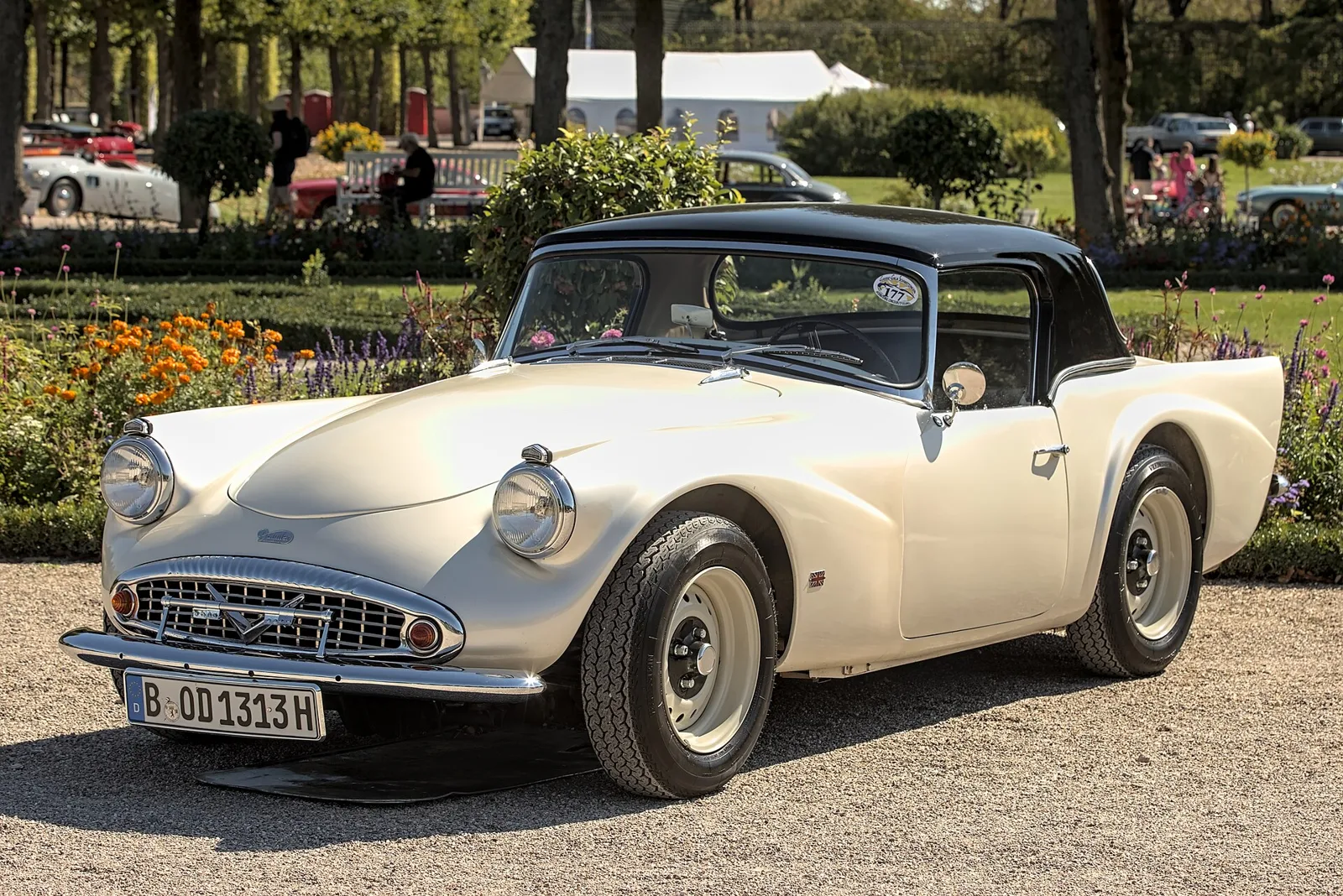
Built in Coventry from 1959 to 1964, the Daimler SP250 paired a fibreglass body with a 2.5-litre V8, was launched as the Dart and then reshaped by its new owner Jaguar.
Built in Coventry from 1959 to 1964, the Daimler SP250 used a fibreglass body, a 2547 cc V8 producing 140 bhp and a chassis based on the Triumph TR3. Launched as the Dart, it was renamed after Dodge objected, and 2,654 cars were built.
The Daimler SP250 was a fibreglass sports car built by the Daimler Company in Coventry from 1959 to 1964. It was the last car Daimler launched before BSA sold the company to Jaguar in 1960, and its 2.5-litre V8 later found a home in a Daimler saloon built under Jaguar ownership.
Where did the Daimler SP250 come from?
The SP250 grew out of a project led by Edward Turner, who became managing director of BSA's Automotive Division in 1956. He was first asked to design a V8-powered saloon, and the engine drawings were finished by March 1958. The saloon prototype, project DN250, was never examined by the 1958 committee, which looked at the sports car prototypes instead.
The committee's feasibility study projected a profit of more than GBP 700,000. It assumed 1,500 cars in the first year of production and 3,000 a year in the second and third years, with two-thirds of sales expected in the United States. The study recommended a fibreglass body, because tooling would cost GBP 16,000 rather than the GBP 120,000 a steel body needed.
Fibreglass also meant a shorter path to production and cheaper styling changes. Management made many features optional, because US import duties did not apply to optional extras.
A fibreglass V8 sports car that began as the Dart, was rebuilt by Jaguar and still has a restored prototype sibling.
What was the chassis and original specification?
The original version, later called the A-spec, could reach 120 mph (193 km/h). Its chassis was a 14-gauge ladder frame with cruciform bracing, based on the Triumph TR3, and it flexed enough that doors could occasionally come open. That flex damaged the car's reputation for years afterwards.
Its body was fibreglass, with disc brakes at all four corners by Girling. The V8 was a 2.5-litre hemi-head unit designed by Edward Turner. It was described as a 2+2, but the bench-like rear seat offered very little legroom unless the front seats were pushed fully forward.
Bumpers were originally an optional extra. A-spec cars carried two short chromium-plated whiskers either side of the front grille and short vertical overriders at the rear, which were left off when the rear bumper was ordered. Early A-spec cars had recesses behind the door handles, and these were phased out.
What engine powered the SP250?
The 2547 cc V8 had an iron block and aluminium hemispherical cylinder heads, with single central camshaft-operated valves working through short pushrods. Twin SU carburettors and an 8.2:1 compression ratio produced 140 bhp at 5800 rpm, with maximum torque of 155 lb ft (210 Nm) at 3600 rpm.
The crankshaft had five main bearings and was dynamically balanced, and the valve gear used double heavy-duty springs. Ignition came from a coil and distributor, and lubrication came from a submerged gear oil pump with a full-flow filter. The sump held 1.75 US gallons.
The manual gearbox was the first of its type Daimler had used since the 1930s, when the company moved its range to preselector transmissions. It was reverse engineered from the Standard gearbox used in the Triumph TR3A, with synchromesh on the top three ratios, and an automatic was available as an option.
Steering was a cam and follower system, and the rear axle was a hypoid bevel with a 3.58:1 ratio. The front suspension was independent with coil springs, while the rear used a live axle on half-elliptic leaf springs with oversize dampers.
Why did Daimler offer so many optional extras?
Daimler turned many of the car's features into paid extras, since US import duties were charged on the car but not on optional add-ons. The list included wire wheels, whitewall tyres, an adjustable steering column, a hardtop, front and rear bumpers, windscreen washers, a heater, fog lights, seat belts and overdrive or automatic transmission.
The approach let the basic car be sold at a lower price, while buyers and dealers could add what they wanted. It also shows how seriously the company treated the American market, which it expected to take two-thirds of sales.
How did the SP250 get its name?
The car was launched as the Daimler Dart at the New York Motor Show in April 1959, where it was unofficially voted the ugliest car at the show. Chrysler, whose Dodge division held the trademark on the Dart name, ordered Daimler to change it under threat of legal action.
With little time to find a new name, Daimler used the project number SP250 as the model name instead. The project number became the name the car is remembered by.
Did the police use the SP250?
Between 26 and 30 black SP250s were used by the Metropolitan Police in London. The Traffic Department used them to catch speeders, especially cafe racers. The police cars used the Borg-Warner Model 8 three-speed automatic, which suited town work and high-speed chases.
The automatic was also more economical, because it avoided the clutch wear that a manual car would build up when it spent between 18 and 24 hours a day in traffic duty.
Forces in Bristol, Cambridge, Liverpool, Manchester, Southend and Surrey used the SP250 for speed enforcement, and police in Australia and New Zealand did too. After the first section of the M1 opened in 1959, the Bedfordshire police used it for motorway patrol.
What did Jaguar change after buying Daimler?
Jaguar bought Daimler in 1960 and was immediately concerned about the chassis flex. It introduced the B-spec, with extra outriggers on the chassis, a strengthening hoop between the A-posts and an adjustable steering column. B-spec and C-spec cars lacked the A-spec whiskers, and some had no optional front bumper.
The C-spec, introduced in April 1963, added a trickle-charger socket, a heater and demister unit and a cigarette lighter as standard. It was a refinement rather than a major change.
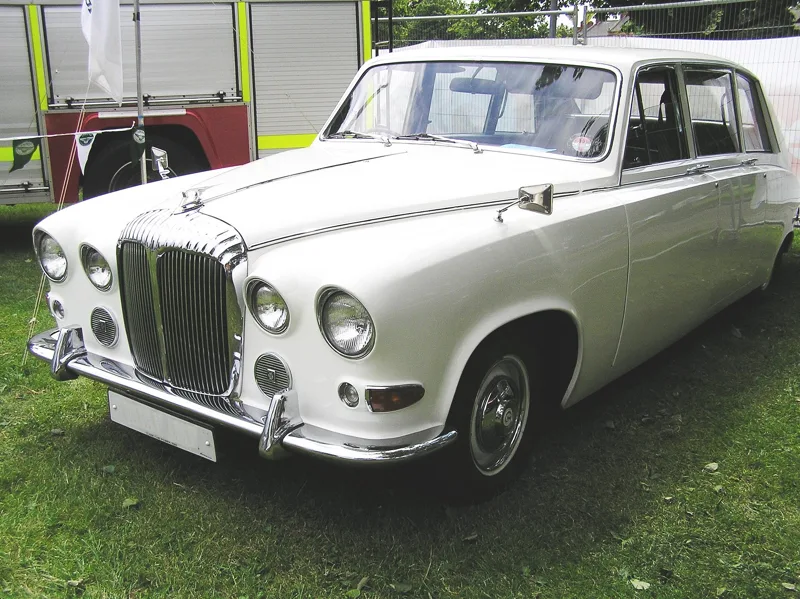
Jaguar also reused the SP250's V8 in a smaller Daimler saloon, a Jaguar Mark 2 with the engine modified to fit its bay. The saloon was called the Daimler 2.5-litre V8 from 1962 to 1967, then the V8-250 until 1969. By 1995 it had the highest production figures of any Daimler car.
What was the DP250 and why was it never built?
The DP250 was a sports saloon based on the SP250 chassis. A DP250 on chassis 100571 appeared at Hooper's stand during the coachbuilder's last appearance at the Earls Court Motor Show in 1959. Between two and seven prototypes were made, and Daimler prepared a sales brochure, but the car never entered production.
The show car had a steel body, although some prototypes may have used fibreglass. After Jaguar bought Daimler, William Lyons ordered a fibreglass DP250 completed, then had it scrapped on sight and ended the project. None survive, and the show car is believed to have been destroyed in testing at MIRA.
Was there a coupe version of the SP250?
Ogle Design produced a coupe version called the SX250, which was shown at the 1962 Earls Court Motor Show. Daimler did not take it up, so the proposal never reached showrooms under the Daimler name.
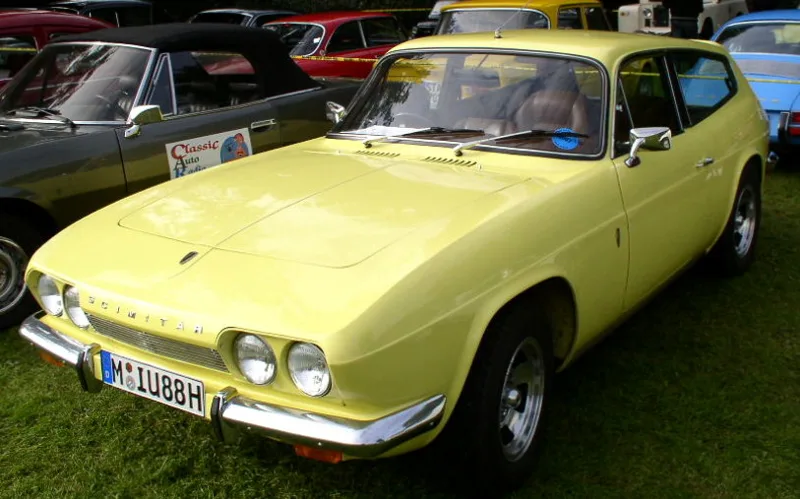
The body design did not disappear entirely, because it was later used for the Reliant Scimitar. That gave the SX250 a second life in another British sports car.
What was the SP252 and why was it shelved?
The SP252 was a replacement for the SP250 that Sir William Lyons designed between 1961 and 1963. Daimler had allocated six prototype chassis numbers, and three of them, 100003, 100004 and 100005, were left unallocated after the original programme used the first three.
Chassis 100003 received rack-and-pinion steering and torsion bar front suspension, borrowed from the E-type. The car was said to be unstable. Fred Gardner, who ran Jaguar's prototype bodyshop, built a wood and fibreglass mock-up, and Lyons allowed development to continue even though he was not ecstatic about it.
A full fibreglass body was fitted to chassis 100004 on standard SP250 running gear. That body was then moved onto a standard B-spec chassis, given the last unallocated number, 100005, and nominated as the SP252. The car was painted maroon and fitted with a grey leather interior.
Lyons drew heavily on the E-type, which had launched in Geneva in 1961 to strong sales. The front wings were changed radically, the wheel arch flares were removed, the grille became cleaner and slimline bumpers carried E-type overriders. The interior was largely E-type parts, including the wood-rimmed steering wheel.
Lyons judged the project uneconomic, because the fibreglass body was very labour-intensive and took two and a half times as many man-days to build as the E-type. Even a sale of the SP252 would never have been profitable, so the project was shelved and the car was put in a corner of the Browns Lane factory.
How did the SP252 survive?
In 1967 the SP252 was spotted in storage by Peter Ashworth, an entertainments entrepreneur and regular Jaguar customer, who wanted it for his wife. Jaguar managing director Lofty England agreed to sell it, and it was registered LHP 307F in September 1967.
Mrs Ashworth, who already owned a V8 saloon, was not impressed by the heavy steering, and the car went back to the factory. Duncan Saunders, later patron of the Daimler Lanchester Owners Club, drove it in early 1968, when the odometer showed just 619 miles and the asking price was around GBP 700 to GBP 800.
Tom Sweet bought the car later in 1968 for GBP 750 and kept it until 1994, when Brian Peacock took it on. Peacock began a long restoration that took 8 to 9 years, repairing the chassis and bodywork, overhauling the brakes and suspension, repainting the car and fitting a new windscreen and interior.
The grille was rebuilt during the restoration, following 1968 photographs in which the original was believed to be cardboard and silver paper. Peacock handcrafted the traditional Daimler flutes, since a Daimler, it was thought, must have its crinkles. Today the car is shown at the Jaguar Daimler Heritage Trust.
How fast was the SP250 on the road?
A hardtop car tested by The Motor in 1960 reached 123.7 mph (199.1 km/h) and went from 0-60 mph (97 km/h) in 8.9 seconds. Fuel economy came to 25 mpg imperial (11 L/100 km; 21 mpg-US), and the test car cost GBP 1,489 including taxes.
Those figures placed the SP250 firmly among the quicker sports cars of its time, even though its reputation also rested on its looks.
Daimler SP250 specifications at a glance
| Specification | Detail |
|---|---|
| Production | 1959 to 1964, Coventry |
| Engine | 2547 cc V8, aluminium hemispherical heads |
| Output | 140 bhp at 5800 rpm |
| Torque | 155 lb ft (210 Nm) at 3600 rpm |
| Compression and carburation | 8.2:1, twin SU carburettors |
| Brakes | Girling discs on all four wheels |
| Rear axle | Hypoid bevel, 3.58:1 |
| Top speed (The Motor, 1960) | 123.7 mph (199.1 km/h), hardtop |
| Price (1960 test car) | GBP 1,489 including taxes |
| Total production | 2,654 in five years |
Legacy and later models
The SP250 sold well short of the committee's hopes, despite the optimism of the feasibility study. Jaguar considered the SP252 but judged that its cost would have been higher than the E-type's, creating internal competition with a product that had no practical profit margin.
The car was also a fixture in popular culture. In the early novels the heroine Modesty Blaise drove an ivory SP250, which also turned up now and then in the comic strip.
Die-cast makers kept the car in miniature. Spot-on produced a model in the 1960s in colours including red and light blue. Crossway introduced a model in 2007, NOREV made an open-top version, and Oxford Diecasts produced several police and civilian versions.
_Classic-Gala_2022_1X7A0341.jpg)