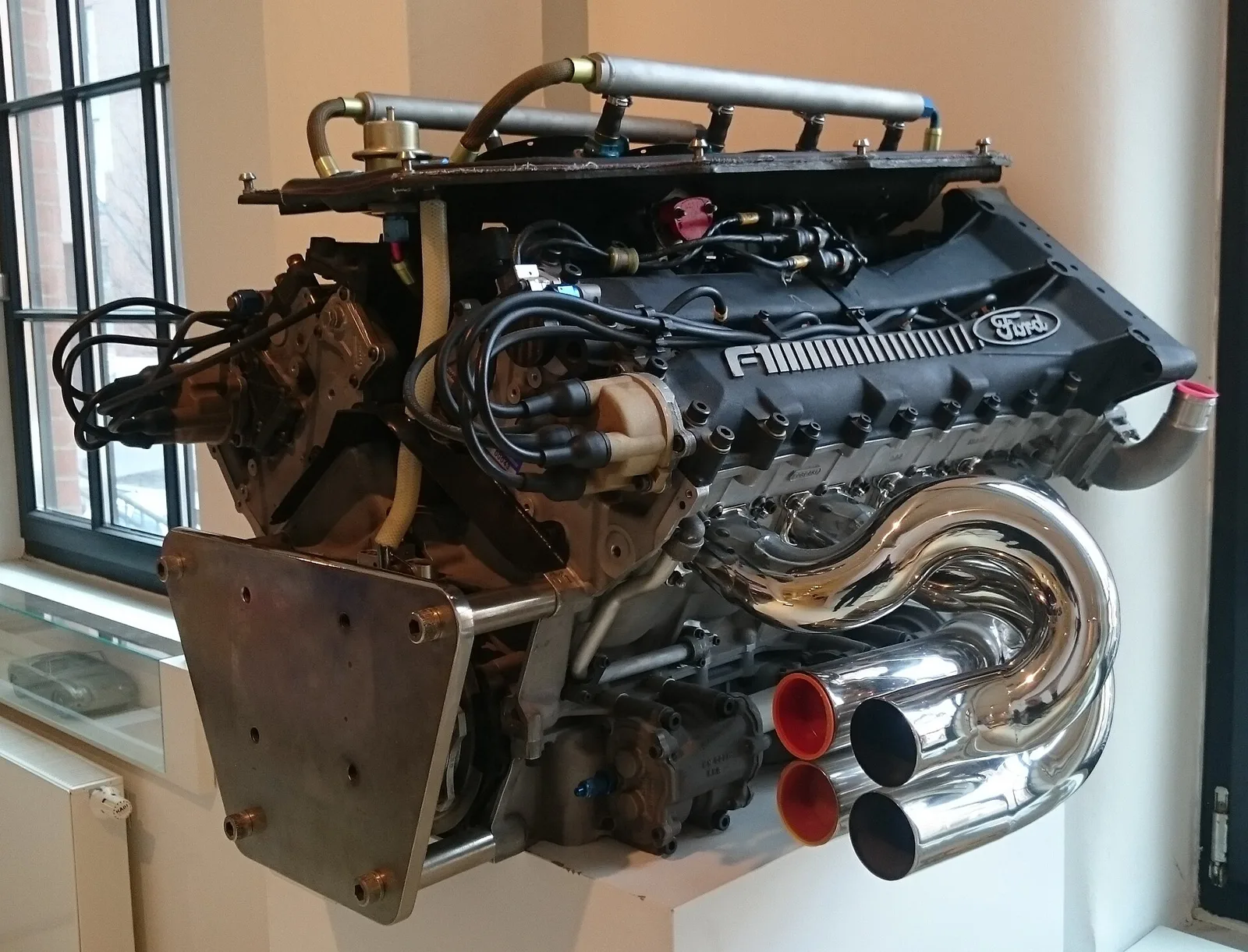
Cosworth and Ford's naturally aspirated V8 for the 1989 to 1994 Formula One seasons, from the Benetton works cars to the back of the grid.
Built by Cosworth and Ford, the HB was a Formula One V8 of 3.5 litres used from 1989 to 1994. Benetton and McLaren won races with it, and customer teams ran it too, with the final version reaching about 725 hp.
The Ford-Cosworth HB was a 3.5-litre naturally aspirated V8 that Cosworth designed and built with Ford for Formula One. It raced from the 1989 French Grand Prix to the end of the 1994 season, and it was supplied to a wide range of teams. Its best years were with Benetton and McLaren, although its later customers ran it as the lowest-cost option on the grid.
Where did the HB come from?
Cosworth had dominated Formula One with the DFV, a 3.0-litre naturally aspirated engine that Ford funded and that raced from 1967. The DFV won 155 world championship races and took 12 drivers' and 10 constructors' titles between 1967 and 1983, which makes it the most successful engine in the sport's history. Turbocharged engines overtook it after 1977, and by 1986 only turbos were allowed.
When the FIA allowed 3.5-litre naturally aspirated engines from the 1987 season, Cosworth was the one manufacturer able to respond at short notice. The DFZ was built within three months from the DFV block as an interim solution. The DFR followed in 1988, and 14 mainly smaller teams ran it as a customer engine through 1991, in several specifications.
Ford and Cosworth decided at the start of 1988 that the DFR could not hold its own against the ten- and twelve-cylinder engines of Ferrari, Honda and Renault. First drawings of the new engine were made in May 1988, and the first blocks ran on the test bench in December 1988. The HB went racing at the French Grand Prix in July 1989.
An eight-cylinder built to replace the DFV, which won a Japanese Grand Prix, a championship lap and the back of a grid.
How was the HB designed?
Geoff Goddard designed the HB, and he and John Hancock led its development. Cosworth was then working closely with Benetton's technical director, Rory Byrne. Brian Hart, who had worked on the DFR, was not involved in its design.
Cosworth chose an eight-cylinder layout, even though the common view at the time favoured ten- or twelve-cylinder units for efficiency. A twelve was judged too big and too fuel-intensive, and a ten was considered too exotic for the team. The decisive factor was Cosworth's experience with eight-cylinder engines from the DFV.
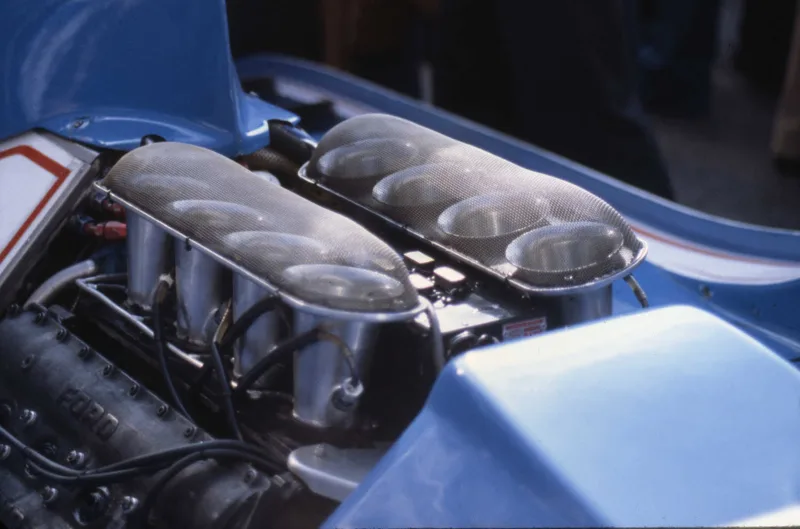
The aluminium alloy block was smaller than the DFV's, and it had no reserves for enlargement. The cylinder banks were set at 75 degrees, a narrower angle than the 90 degrees of the DFV series. That gave aerodynamic advantages, especially in the airflow to the rear of the car. Cosworth and Ford did not publish the bore and stroke, although the estimate is 96 mm x 60.4 mm, giving a displacement of 3,498 cc.
Each bank carried two overhead camshafts, gear-driven at first and later chain-driven from the HB VI. There were four valves per cylinder. Cosworth tested a five-valve head on converted DFR blocks but judged it unnecessary. Ignition and injection usually came from Ford, although the Minardi engines used Magneti Marelli electronics.
How did the HB develop through its eight stages?
The first version, HB-I, debuted in July 1989 and was used only by Benetton. Its output was put at 630 hp, roughly 40 hp above the DFR. HB-II followed at the Japanese Grand Prix that October, and Benetton used it for its first win in the series.
HB-IV arrived for the 1990 British Grand Prix, with redesigned pistons, cylinder heads and valve control. Cosworth claimed it produced over 650 bhp and reached about 13,000 rpm. HB-V appeared at the third race of 1991 in San Marino, with chain-driven camshafts and output around 670 hp.
HB-VI came at the start of 1992 with semi-pneumatic valve control, which replaced valve springs with air pressure. HB-VII was introduced at the fifth race of 1992 in San Marino, producing 710 hp but with less low-end torque. HB-VIII was first used in practice at the 1993 German Grand Prix, with 725 hp and a top speed of 13,700 rpm.
| Version | Introduced | Output | Main users |
|---|---|---|---|
| HB-I | July 1989 | About 630 hp | Benetton |
| HB-IV | 1990 British Grand Prix | Over 650 bhp | Benetton and Jordan |
| HB-V | 1991 San Marino | About 670 hp | Benetton, Lotus and McLaren |
| HB-VII | 1992 San Marino | 710 hp | Benetton and McLaren |
| HB-VIII | 1993 German Grand Prix practice | 725 hp | Benetton, McLaren and most customers in 1994 |
How did Benetton use the HB?
Benetton's B189 carried the HB at the French Grand Prix in 1989. Alessandro Nannini finished second before retiring, and later that season he won the rain-hit Japanese Grand Prix with the HB II, after Ayrton Senna was disqualified. His teammate Emanuele Pirro had to wait longer for the new car and engine.
The 1989 season started badly. Long test sessions in the new car made crankshaft faults more frequent, and those problems were not resolved until June 1989. Over the second half of the year, both Benetton drivers retired five times through chassis problems or driving errors.
In 1990 Benetton fought the smaller teams that had the older DFR engine, and its qualifying was affected by Pirelli's qualifying tyres. Nelson Piquet won in Japan and Australia, and the team finished third in the constructors' title with 71 points. In 1991 the HB V gave Piquet a win in Canada, and the team scored 38.5 points.
The team's peak came in 1992, when it scored 91 points, its best result to that point. Michael Schumacher won his first race in Belgium that year, and at least one Benetton driver stood on the podium in 11 of 16 races. The 1993 season was the last for the HB at Benetton, and Schumacher's one win was not enough to beat McLaren.
Why did the customer teams struggle?
Benetton had the best HB engines, while customer teams received units one or more development stages behind. Jordan Grand Prix became the first customer in 1991, with HB-IV engines that were older than the Benetton units. Motor costs were 4.5m pounds of a 7m pound budget, and the team scored 13 points to finish fifth in the constructors' title.
Eddie Jordan's outfit obtained HB units via direct links with Cosworth in autumn 1990. Jordan ran the HB-IV through its first season and then dropped the engine for free Yamaha V12s in 1992.
Lotus and Fondmetal received HB-V engines in 1992. Fondmetal was the weakest of the customers that year, and it stopped racing in late summer. Lotus scored 13 points and finished fifth in the constructors' title, after a restructuring that followed the 1991 financial crisis.
Lotus fell into arrears with its engine lease payments over the year. When Team Lotus went bankrupt at the end of 1994, the engine debts were still among its open claims.
McLaren was the most successful customer. It was supplied with HB-V engines in 1993, while Benetton refused to share its HB-VII units. Cosworth took over the maintenance of McLaren's engines itself, to avoid any conflict of interest, and the team's electronics were developed with TAG.
McLaren received HB-VII engines from the British Grand Prix. At the 1993 German Grand Prix, when the HB VIII made its debut, McLaren had access to it in Friday practice, while Benetton only had it on the Saturday.
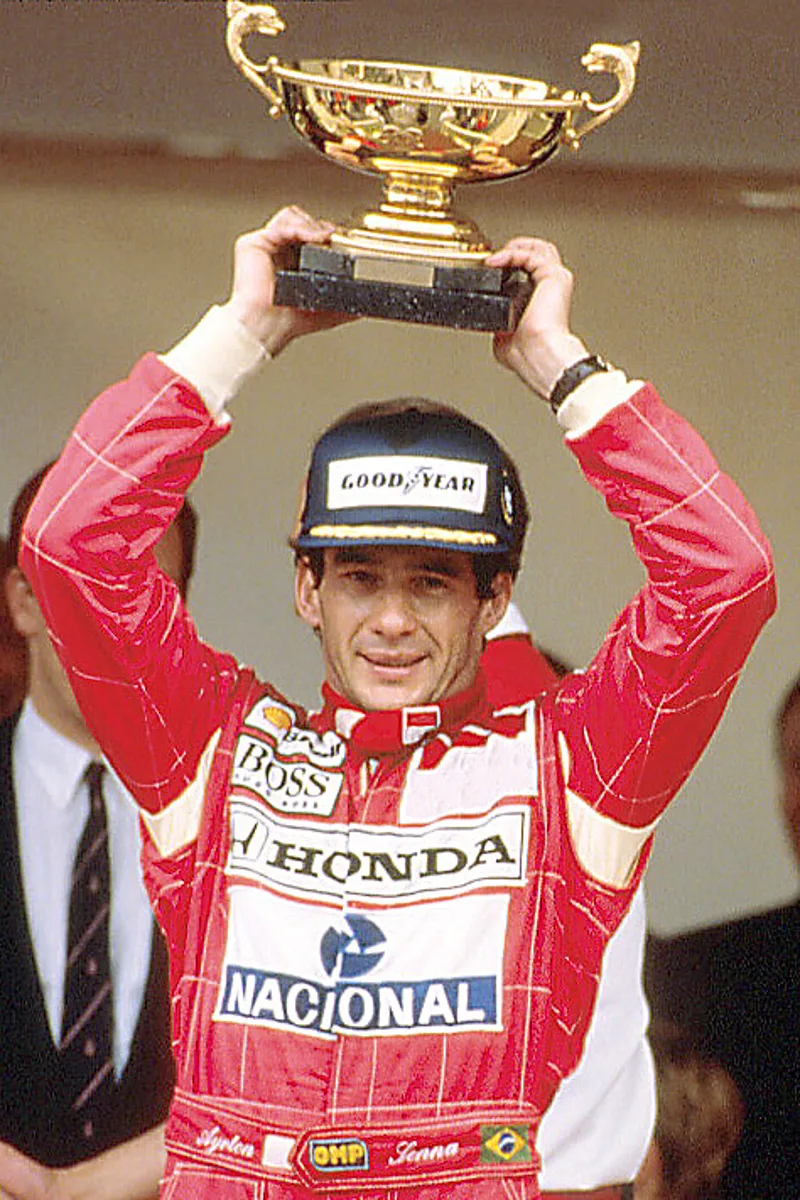
Ayrton Senna's driving covered the power deficit. He won three races with the HB V in the first half of 1993, including a famous wet European Grand Prix at Donington Park, where he lapped the entire field apart from second-placed Damon Hill. He went on to win in Japan and Australia with the HB VIII, and McLaren finished second in both championships.
Which teams ran the HB at the back of the grid?
Minardi received HB-III blocks in 1993, which had been raced by TWR in the Jaguar XJR-14 sports car the previous year. The M193 gave Christian Fittipaldi a fourth place at Kyalami, and the team scored seven points to finish eighth. In 1994 Minardi signed a direct contract with Cosworth and gained access to HB-VII and HB-VIII engines.
Footwork switched to HB engines for 1994 as a stopgap, and Fittipaldi finished fourth at the Pacific and German Grands Prix. The team scored nine points and finished ninth in the constructors' title. Larrousse used HB-VII and HB-VIII engines in 1994, and Erik Comas finished sixth in two races, which were the only points the team scored that year.
From the Belgian Grand Prix onwards, Larrousse relied on pay drivers whose payments kept the team alive. By the close of that year the outfit was insolvent.
Simtek debuted in 1994 with an HB, and the season was a disaster. Roland Ratzenberger died at Imola in the third race of the year, and Andrea Montermini was injured in Spain four weeks later. Jean-Marc Gounon achieved Simtek's best result, ninth in France, while David Brabham was the fastest of the team's drivers, and Simtek finished second to bottom in the championship.
What happened after the HB was retired?
The HB ran alongside Cosworth's successor until the end of 1994, when it was made obsolete by the FIA's cut of the displacement limit to 3.0 litres for 1995. The successor was an eight-cylinder called the EC, which Benetton used exclusively and which was marketed as the Ford Zetec-R. Michael Schumacher won his first world title with it in 1994.
Cosworth also developed the ED from the HB, which was available as a pure customer engine from 1995 to 1997 alongside the more powerful Zetec units. The HB family had become known as the motor of the poor, a label earned by a decade of compromise between cost and performance.
Did the HB race outside Formula One?
The HB was hardly used in sports car racing. Tom Walkinshaw Racing installed an HB-III in a Group C Jaguar XJR-14, and the cars won the 1991 430 km Monza race and the Silverstone and Nurburgring events. Walkinshaw decided not to use the car at Le Mans in 1991, because the engine was not believed to be able to run continuously for 24 hours without problems.
In 1992 the XJR-14 raced in the IMSA GTP series, where Davy Jones took victories at Road Atlanta and Mid-Ohio. The Jaguar-badged HB had been developed to 650 bhp at 11,500 rpm for that programme.