How the research on quiet hybrids led to US, EU, Japanese and UK rules, and how carmakers from Nissan to Tesla built artificial sounds into their cars.
Electric vehicle warning sounds are artificial noises that alert pedestrians to quiet hybrids and electric cars at low speed. US and EU rules now require them, with the US threshold set at 18.6 mph (30 km/h).
Electric vehicle warning sounds are artificial noises designed to alert pedestrians to hybrids, plug-in hybrids and battery electric vehicles travelling at low speed. Regulators decided they were needed because electric-mode vehicles are much quieter than combustion cars, which makes them harder to notice for people who rely on sound. Since the early 2010s, governments in several regions have written sound requirements into law.
Why do electric vehicles need warning sounds?
Engine noise has always told pedestrians and cyclists that a car is approaching. A vehicle running in all-electric mode removes much of that cue, and for people with visual impairments the loss can be serious. Warning sounds therefore give quiet vehicles a substitute signal, which may be triggered by the driver, like a horn, or switch on automatically at low speed.
The sounds vary widely. Some are plainly artificial, such as beeps and chimes, while others imitate engine noise or the sound of tyres rolling over gravel. The design question is how to make a sound easy to hear without being intrusive, and that question has shaped both the research and the regulations.
Quiet electric cars gave pedestrians less warning, and regulators responded by requiring a sound that drivers cannot easily silence.
What did the early research find?
Concern grew as electric and hybrid sales rose in several countries. Some members of the blind community said they relied on combustion engine noise when crossing streets and regarded quiet hybrids as a possible hazard. A 2009 study saw no meaningful gap in pedestrian crash rates for quiet hybrids moving straight ahead, but it found hybrids involved in twice as many pedestrian crashes when reversing, parking or making similar slow manoeuvres.
The problem was not unique to electric cars. In 2007 Munich researchers concluded that conventional vehicles can be heard too late in busy surroundings for safe avoidance. They compared the distance at which an approaching car became audible with its stopping distance, and proposed an algorithm to estimate audibility from auditory masking.
A 2008 study at the University of California, Riverside, funded by the National Federation of the Blind, examined hybrids in electric mode. Recordings of a Toyota Prius and a combustion Honda Accord were played to listeners as both cars approached at 5 miles per hour (8.0 km/h). Listeners located the Honda at 36 feet (11 m), but could not identify the hybrid until it was 11 feet (3.4 m) away, leaving roughly two seconds to react.
| Study | Year | Main finding |
|---|---|---|
| Technical University of Munich | 2007 | Ordinary cars often detected too late in background noise |
| University of California, Riverside | 2008 | Hybrid detected only at 11 feet (3.4 m), against 36 feet (11 m) for the Honda |
| Western Michigan University | 2008 | Hybrids and conventional cars equally safe above about 20 miles per hour (32 km/h) |
| NHTSA | 2009 | Hybrids involved in twice as many pedestrian crashes in low-speed manoeuvres |
Did the noise tests change the picture?
They did. When a second trial added the sounds of two idling combustion cars to simulate a car park, the hybrid had to come 74 percent nearer than the combustion car before listeners could place it. The combustion car was judged at 28 feet (8.5 m). The result suggested that in realistic conditions a pedestrian might not detect a hybrid until it was about one second away.
Western Michigan University researchers, writing in 2008, reached a different conclusion for higher speeds. Above about 20 miles per hour (32 km/h), tyre and wind noise supply most of the audible cues, so hybrids and conventional cars were equally safe. Hybrids pulling away from traffic lights were also found not to pose a risk, because the Prius models studied engaged their engines when accelerating from a standstill.
A 2009 study by the US National Highway Traffic Safety Administration, known as NHTSA, found that crashes involving pedestrians and bicyclists were more frequent for hybrids in low-speed manoeuvres such as reversing or leaving a parking zone. Those incidents tended to happen in low-speed zones, during daytime and in clear weather. The study also found higher rates for hybrids turning, and for bicyclist crashes in similar manoeuvres.
In September 2010 Volvo Cars and the Swedish energy company Vattenfall reported on the opening stage of Volvo's V70 plug-in hybrid demonstration. Before the trial, drivers worried that quiet cars endangered pedestrians and cyclists. Afterwards several said the issue was less serious than they had expected, although some reported incidents of not being noticed and others said they drove more carefully as a result.
How did the United States set its rules?
The Pedestrian Safety Enhancement Act of 2010 cleared the Senate by unanimous consent on 9 December 2010, and the House of Representatives passed it by 379 to 30 on 16 December 2010. President Barack Obama signed it into law on 4 January 2011. The act did not set a speed for the simulated noise. It required the US Department of Transportation to write a safety standard that would let blind and other pedestrians reasonably detect a nearby electric or hybrid vehicle.
NHTSA published a proposed rule in January 2013. It would have required hybrids and electric vehicles travelling below 18.6 mph (30 km/h) to emit sounds that pedestrians could hear over background noise. The 30 km/h limit was chosen because the sound levels of those vehicles roughly matched those of similar combustion cars at that speed. Manufacturers would choose their sounds from a range of options, and similar vehicles would have to use the same sound.
Carmakers argued that the rule was complicated and prescriptive, and that some of its costs were unnecessary. Some said there was no need for sound when a car was stationary, and they asked for a later start date. NHTSA delayed its final ruling several times before issuing it in February 2018. The regulation required 50 percent of quiet vehicles to have warning sounds by September 2019, and full compliance by September 2020. The agency estimated that the sounds would prevent 2,800 pedestrian and cyclist injuries over the life of each model year.
What does the European Union require?
In 2011 the Commission produced draft guidance on AVAS, the acoustic vehicle alerting system. It recommended a continuous sound from start-up up to about 12 mph (20 km/h), and during reversing where relevant, and it listed sounds that were not acceptable. The guideline allowed a pause switch for temporary deactivation.
On 6 February 2013 MEPs backed draft legislation that would tighten noise caps and add alert sounds for hybrid and electric cars. The approved text said the sound should be continuous, easy to read as vehicle behaviour, and similar to a combustion car of the same category. In April 2014 Regulation (EU) No 540/2014 made AVAS mandatory for all new electric and hybrid electric vehicles, with a transitional period of 5 years.
The rule set the detail. Vehicles approved from 1 July 2019 had to fit an AVAS, and newly registered quiet electric and hybrid models from July 2021 had to comply. At 12 mph (20 km/h) or slower the vehicle must produce a continuous noise of at least 56 dBA within 2 metres, and the maximum level is 75 dBA.
How did Japan, China and the UK respond?
Japan began assessing countermeasures in July 2009, through a committee on quiet hybrids and other vehicles. In January 2010 the transport ministry, the Ministry of Land, Infrastructure, Transport and Tourism, issued guidance on quiet hybrids and similar vehicles, and the 2010 Toyota retrofit was designed to meet them.
China explored guidelines for an acoustic alerting system on low-speed electric vehicles from December 2018, and it implemented them in September 2019. The UK took a more evidence-led route. The Department for Transport commissioned research on accidents involving blind or vision-impaired pedestrians, and the Transport Research Laboratory reported in 2011 that there was little correlation between accident rates and noise level for most vehicles.
The UK also gave a practical lesson. Its law requires a hazard warning sound to be switchable off during the night hours of 11:00 pm to 6:00 am, and Nissan's Leaf alert could not be switched off in that way, so it was removed from cars delivered in the UK. The 2014 UK model enabled the system by default, while a button on the dash let drivers turn it off until the next ignition cycle.
How do carmakers' systems differ?
Carmakers took a range of approaches. Toyota and Fujitsu Ten developed an automatic warning system, and Toyota began selling a retrofit device in Japan in August 2010 for the third-generation Prius, priced at 12,600 yen (about US$150) including consumption tax. Its sound rises and falls with speed, and it works up to about 25 km/h (16 mph). Toyota's Vehicle Proximity Notification System appeared on all 2012 model year Prius family vehicles in the United States.
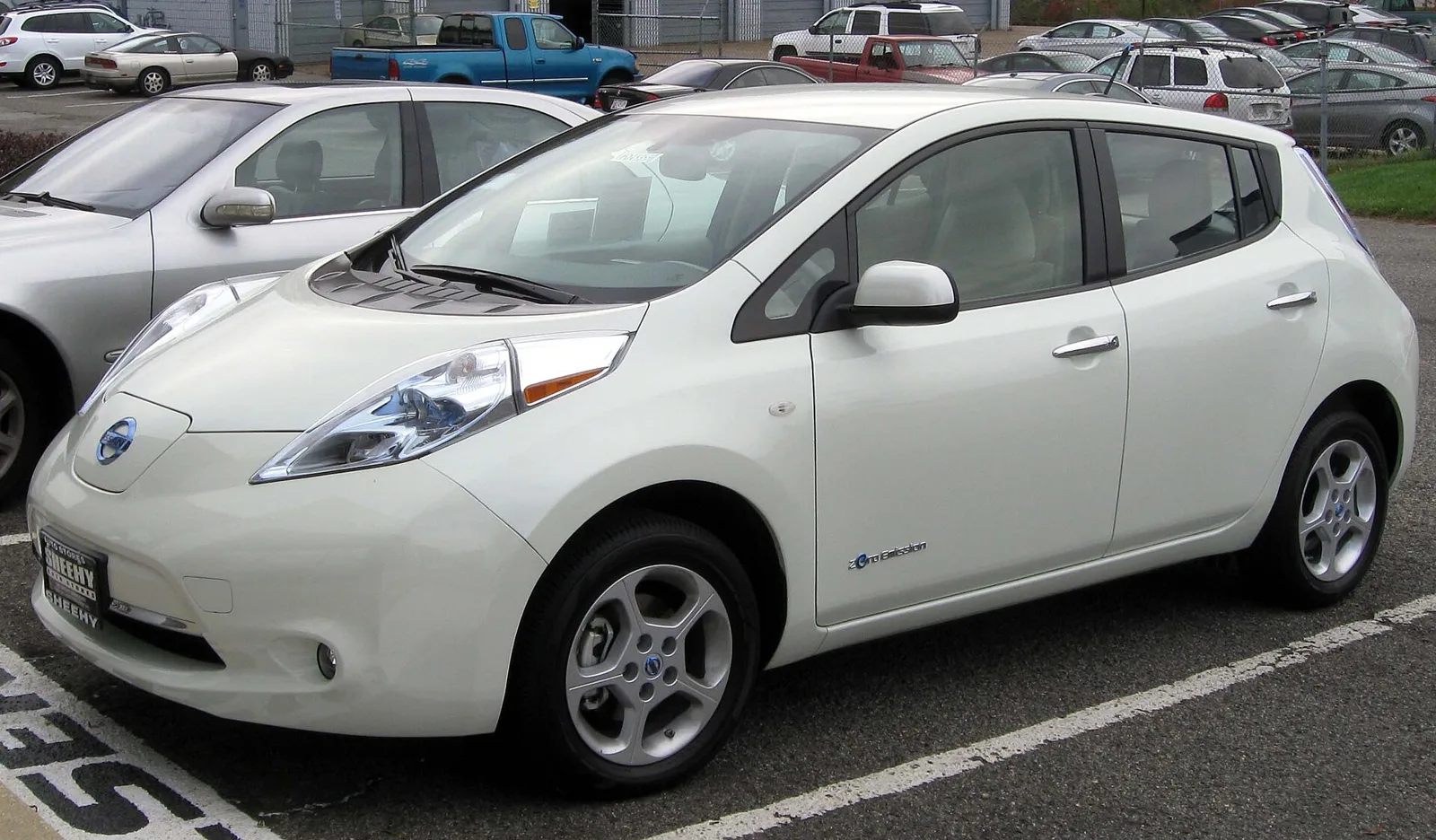
Nissan's Vehicle Sound for Pedestrians uses a sine-wave sound that sweeps from 2.5 kHz at the top to 600 Hz at the bottom. It is louder when the Leaf starts, produces an intermittent sound in reverse, and stops at 30 km/h (18.6 mph) before resuming below 25 km/h (16 mph). Nissan's 2011 Leaf let the driver switch it off temporarily, but the system reset at the next ignition cycle, and later models removed the option altogether.
Chevrolet's Volt uses a manually activated Pedestrian-Friendly Alert, which sounds horn-like chirps. General Motors said the hardest problem was building an active system that could tell a pedestrian apart from another vehicle. Hyundai's Virtual Engine Sound System, first tested in September 2010 on BlueOn electric hatchbacks, produced an idling engine sound, and Hyundai removed the on-off button from US Sonata Hybrids after learning that regulators would not allow such switches.
Other makers went further. The Fisker Karma played its sound through a pair of bumper speakers below 25 mph (40 km/h), and its sound was chosen after three sound companies supplied samples. Lotus's HALOsonic system, shown on the Evora 414E Hybrid at the 2010 Geneva Motor Show, could generate engine sounds inside the car and warning sounds outside. Tesla added a Pedestrian Warning System in September 2019 that operates at low speeds, and Volkswagen offered an e-Sound module up to 30 km/h.
Ford took a different path. For its Focus Electric it developed four alternative sounds and asked fans to vote on Facebook in June 2011, but it held off fitting a system unless federal law required one.
What do the critics say?
Several anti-noise and electric car advocates oppose artificial warning sounds, arguing they add noise pollution. They also opposed proposed US legislation that would require warning sounds with no driver switch. Robert S. Wall Emerson of Western Michigan University argued that several luxury petrol cars are already quieter than hybrids, and that pedestrian safety is a quiet car issue rather than a hybrid one.
Advocates for blind people have pressed the other way. The National Federation of the Blind welcomed the alert on the Leaf but objected that the driver could switch it off, and it wanted a continuous sound for reversing and warnings when a car was idling. The Guide Dogs for the Blind Association pressed MEPs to vote for mandatory sound generators.