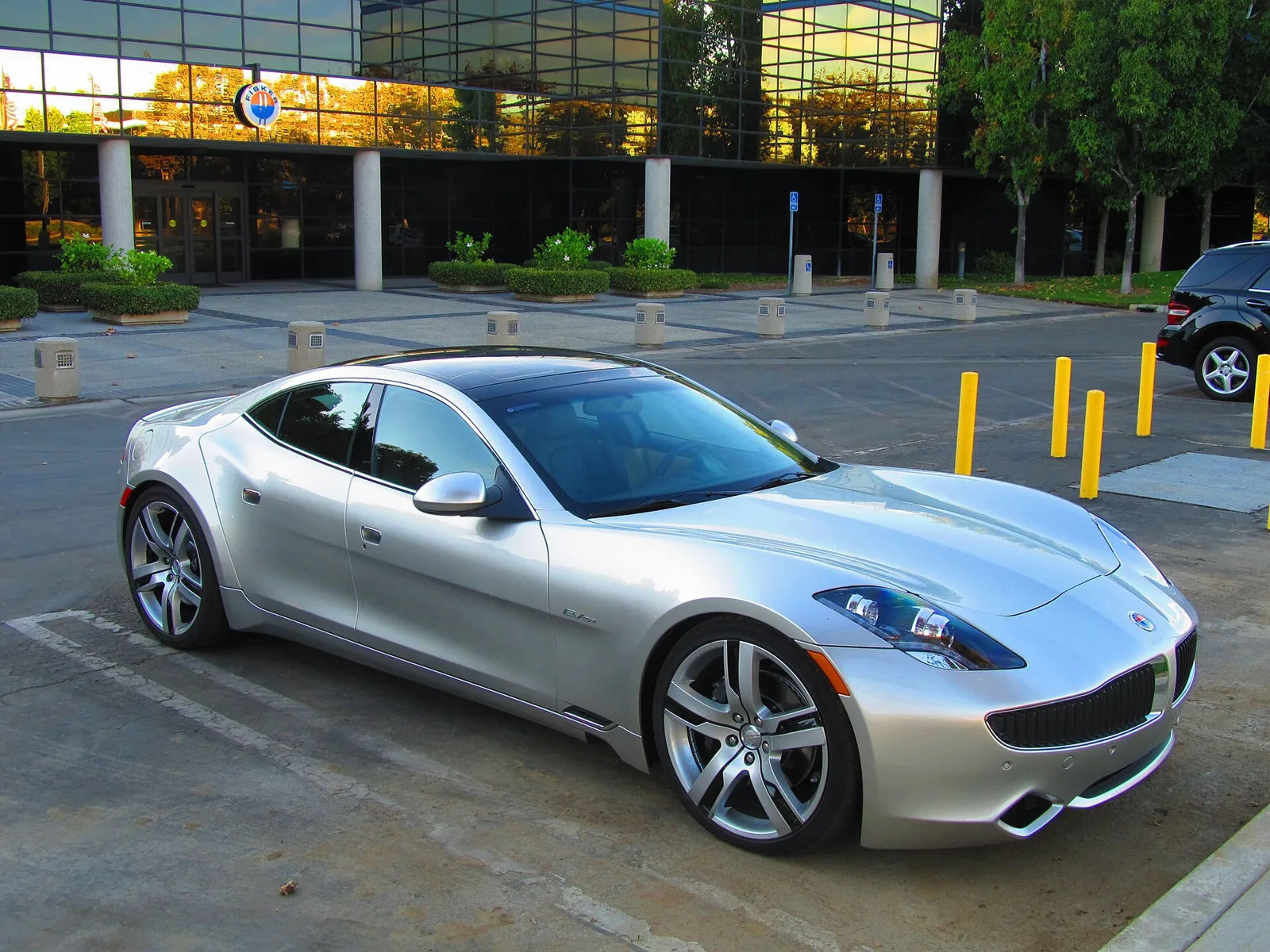
A luxury sedan with two 120 kW motors, a generator engine, solar roof and a price near US$116,000, made from 2011 until the company's collapse.
The Fisker Karma was a plug-in range-extended luxury sedan built by Valmet in Finland from 2011 to 2012. It used two electric motors, a 20.1 kWh battery and a generator engine, and about 2,450 were built before production stopped.
The Fisker Karma was a luxury plug-in range-extended electric sports sedan that Fisker Automotive sold between 2011 and 2012. Its two electric motors were fed by a battery and, when that ran low, a small petrol engine acting as a generator. Valmet Automotive built the cars in Finland, and the model became a symbol of the company's rise and fall.
Where did the Fisker Karma come from?
Fisker first displayed the Karma at the 2008 North American International Auto Show in Detroit. It was the debut product of a young manufacturer started on 5 September 2007 in Anaheim, California. Fisker and Valmet reached an agreement in 2008, and the final assembly contract was signed on 13 November 2008.
Pre-orders opened in the United States in 2008, and the company scheduled deliveries for late 2009. Henrik Fisker reported 1,300 orders in 2009, and the first production model appeared at the 2010 Paris Motor Show. By July 2011 the company said it had received 3,000 pre-orders, and the plug-in hybrid was sold out until early 2012.
The launch slipped more than once. The market date moved to September 2010, and the company missed its target of building 70 to 100 test cars that year before production finally began in July 2011.
A plug-in sedan with a generator engine, a solar roof and a price that climbed to US$116,000 before the company failed.
How was the Karma powered?
The Karma was a range-extended electric vehicle, or series hybrid. A pair of 120 kW (161 hp) electric motors drew power from a 20.1 kWh lithium-ion battery supplied by A123 Systems, or from a generator. The battery ran down the centre of the car, between the front and rear seats, which is why the Karma seats four rather than five.
Once the battery was depleted, or when the driver activated the Sport paddle on the steering wheel, a front-mounted 260 hp, 2.0-litre Ecotec turbocharged four-cylinder took over. That engine came from General Motors and drove a generator that sent electricity straight to the motors. The electric motors remained the only mechanical drive to the wheels.
Because the petrol engine only generated electricity, the Karma was around half as efficient as the Chevrolet Volt in all-electric mode. The battery could also be charged from the grid, which made it a plug-in hybrid as well as a range extender.
The Karma's two motors produced 201 bhp (204 PS) each, and Fisker's figures put combined output at 403 hp (301 kW; 409 PS), with torque of 1,300 N m (959 lb ft). Fisker quoted a top speed of 201 km/h (125 mph) and a 0-97 km/h (0-60 mph) time of 5.9 seconds in Sport mode.
How far could the Karma go?
The US Environmental Protection Agency rated the Karma at 4.5 L/100 km (52 MPG-e; 62 mpg-imp) in all-electric mode, with an official all-electric range of 51 km (32 mi). In gasoline-only mode the rating was 12 L/100 km (20 mpg-US; 24 mpg-imp). Because of its small cabin, the EPA classed the Karma as a subcompact car.
The total range with a full tank and a fully charged battery was 370 km (230 miles). The EPA estimated energy consumption at 65 kWh per 100 miles.
German inspection body TUV found an all-electric range of 83 km (52 mi) in stealth mode. In charge-sustaining sport mode it recorded 9.2 L/100 km (26 mpg), and its combined figure was 2.1 L/100 km equivalent, or 112 MPG-e, with emissions of 51 g/km of CO2.
A solar-paneled roof, made by Asola Advanced and Automotive Solar Systems and standard on the car, could generate about half a kilowatt-hour a day. Fisker estimated it could add 4 to 5 miles (6.4-8.0 km) of range a week in sunny conditions, although the panels only charged the 12-volt accessory battery.
What did the Karma cost?
Deliveries to US retail customers began in November 2011. The first cars had been priced at US$95,900 for the basic model and US$109,850 for the top version. In December 2011 the prices rose to US$102,000 for the base EcoStandard and US$116,000 for the top EcoChic, with an EcoSport in between at US$110,000.
The EcoChic was the animal-free version. It had a natural fabric interior with an ultrasuede dash, and real leaf fossils were embedded in glass inserts in the doors and console. The base model used salvaged or reclaimed lumber, and leather was offered as an option, although the hides were chosen to show more of the animal than would normally be used for luxury trim.
The Karma also carried a warning sound for pedestrians. It switched on automatically only in all-electric mode below 25 mph (40 km/h). The car weighed 2,400 kg (5,300 lb).
How many Karmas were sold?
Output started in July 2011, and the first two cars reached US owners on 26 July 2011. The Valmet plant in Finland started with five cars a week, and by December 2011 it was building 25 units a day.
More than 2,000 cars had reached customers in North America and Europe by the end of 2012. About 200 were delivered in 2011 and roughly 1,800 in 2012. The US took roughly 1,600 cars by the end of 2013, while Europe absorbed 533 by the end of 2014.
The Netherlands was the top European market, with 166 units sold through June 2013. Switzerland took 55 cars through June 2013, Belgium 52 through November 2012 and France 44 through December 2014.
Why did production stop?
Production was suspended in November 2012 when the sole battery supplier, A123 Systems, filed for bankruptcy after two battery recalls. Fisker could not carry on building the Karma without that supplier, and about 2,450 cars had been built since 2011.
Fisker furloughed its US workers in late March 2013 and filed for bankruptcy in November 2013. The US Department of Energy auctioned the company's debt, and Hybrid Technology LLC bought it for US$25 million.
The government loan had been a central problem. The Department of Energy had awarded a US$529 million green-energy loan in 2010 to help move the Karma into the American market. Fisker collected nearly US$200 million before the government froze the loan in February 2012, because the company was failing to meet its milestones.
Who revived the Karma after Fisker?
Fisker sold off its remaining assets, including designs, plug-hybrid powertrain rights and a Delaware plant, to Wanxiang of China. The new owners restarted production in September 2016 under the Karma Automotive name. After several announcements by the Wanxiang Group about an upgraded car, the model was renamed the Karma Revero, and orders were taken from September 2016.
The updated car is sold as the Karma Revero by Karma Automotive, the name that replaced Fisker Automotive under Wanxiang ownership.
Which recalls and fires affected the Karma?
In December 2011 Fisker recalled the first 239 Karmas built between July and 3 November 2011 because of a risk of battery fire from a coolant leak. Fewer than 50 of those cars had reached customers, and no car had been involved in a fire at that point. The problem was found at the Valmet plant when workers noticed coolant dripping.
Most affected customer cars were back in service by 2 January 2012, after new battery packs were fitted or a hose clamp repair was made. A second recall in August 2012 covered about 2,400 Karmas to repair a faulty cooling fan unit.
A Consumer Reports test car, bought for US$107,850 in March 2012, broke down with fewer than 200 miles on the odometer. The fault traced back to a defective battery caused by a misaligned welding robot at the A123 factory. A123 replaced affected batteries at a cost of US$55 million, and the Karma's warranty was extended to 60 months and 60,000 miles in North America.
Fire incidents followed. A Karma was the reported origin of a home fire in Fort Bend County, Texas, in May 2012, though the cause was never fully established. In August 2012 a car caught fire in a parking lot in Woodside, California, and the investigation traced it to a low-temperature cooling fan.
On 29 October 2012 Hurricane Sandy flooded the Port Newark-Elizabeth Marine Terminal, and 16 Karmas caught fire there. Fisker's investigation put the cause down to residual salt damage inside a vehicle control unit, not the lithium-ion battery. Another 330 Karmas were lost when a shipment from Europe was flooded at the same terminal.
How did reviewers and awards treat the Karma?
The British television series Top Gear liked both the styling and the hybrid system. Presenter James May tested it alongside guest Brian Johnson, and May later gave the EcoChic his Car of the Year award for 2011. Top Gear Magazine also chose it as its Luxury Car of the Year in December 2011.
Automobile Magazine gave the Karma its 2012 Design of the Year Award in November 2011, and Time included it among its 50 Best Inventions of 2011. It was also listed in the Green Design 100 for 2009. German magazine Auto Bild gave Fisker its Golden Steering Wheel as a Classic Car of the Future in 2012.
The Karma also became a prop. Producers of the TV show Two and a Half Men chose it for the character Walden Schmidt, a young tech entrepreneur, to show his wealth and eccentricity.
What legal fight involved Tesla?
On 14 April 2008 Tesla Motors sued Fisker Automotive, alleging that Henrik Fisker had taken Tesla's Model S hybrid technology and used it to develop the Karma. Tesla also argued that Fisker Coachbuild's design work for the Model S was substandard, and that Fisker had moved its best ideas to the Karma.
On 4 November 2008 Tesla agreed to drop the suit after an interim ruling in favour of Fisker. Fisker's news release said Tesla was ordered to pay US$1,144,285 in costs.
Were there other Karma variants?
Fisker showed a short-wheelbase convertible called the Sunset at the 2009 Detroit Auto Show, with series production as the intent. At the 2011 Frankfurt Motor Show it showed the Surf, a sports wagon with a three-dimensional honeycomb grille. Both were put on hold in August 2012 while the company focused on its planned mid-sized Atlantic sedan.
The VLF Destino was a prototype internal combustion car based on the Karma, proposed for production by VLF Automotive. Karma Automotive's updated version became the Karma Revero.
What are the Fisker Karma specifications?
| Specification | Detail |
|---|---|
| Type | Range-extended plug-in series hybrid, four seats |
| Electric motors | Two 120 kW (161 hp) units; 201 bhp (204 PS) each |
| Combined output | 403 hp (301 kW; 409 PS); 1,300 N m (959 lb ft) of torque |
| Range extender | 260 hp 2.0-litre Ecotec turbo four-cylinder |
| Battery | 20.1 kWh lithium-ion, A123 Systems |
| Top speed | 201 km/h (125 mph) |
| 0-97 km/h (0-60 mph) | 5.9 seconds in Sport mode, per Fisker |
| EPA all-electric | 4.5 L/100 km (52 MPG-e); range 51 km (32 mi) |
| EPA gasoline-only | 12 L/100 km (20 mpg-US; 24 mpg-imp) |
| Total range | 370 km (230 miles) |
| Curb weight | 2,400 kg (5,300 lb) |
| Launch price | US$102,000 EcoStandard; US$116,000 EcoChic |