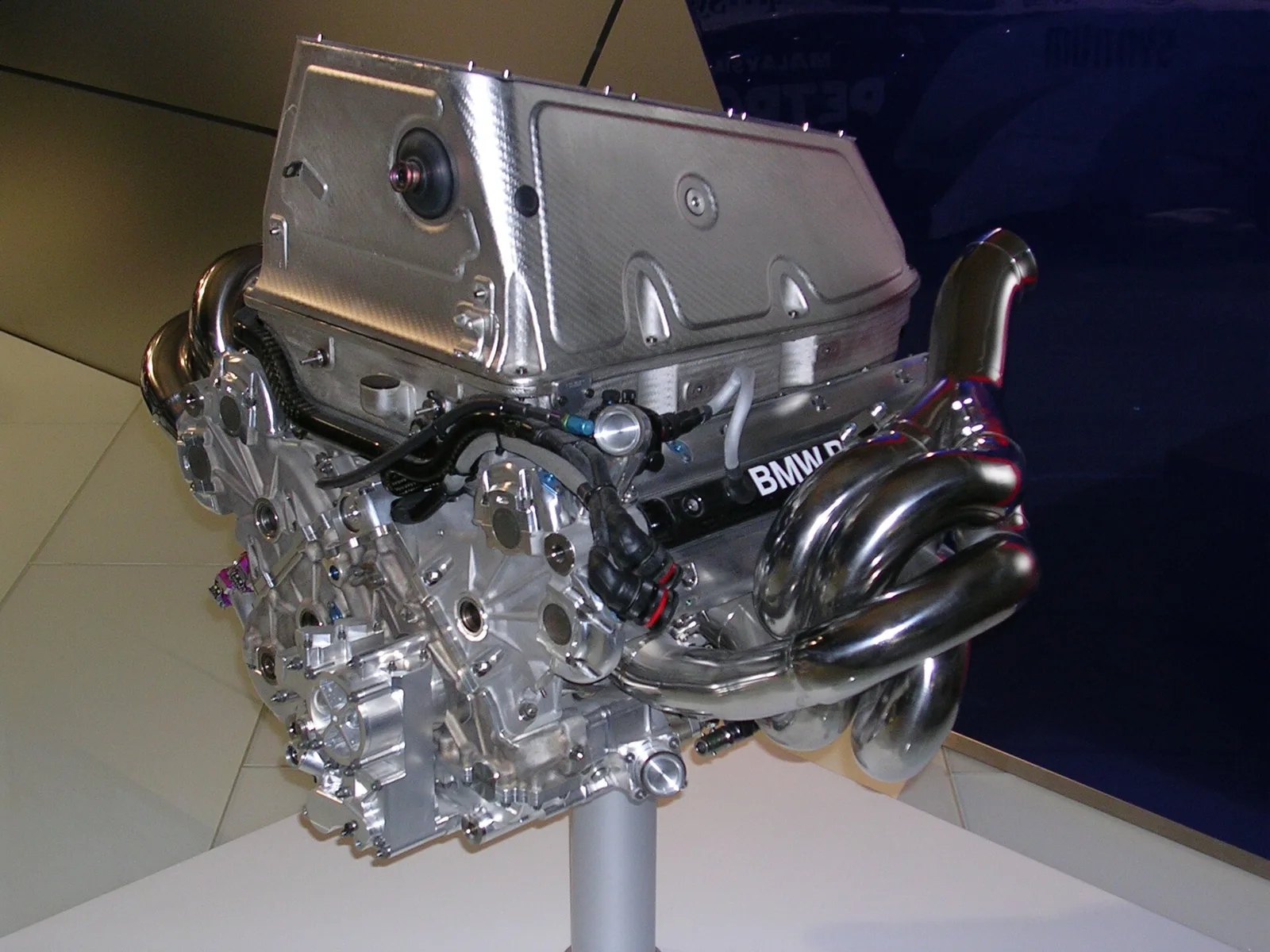
Naturally aspirated 3.0-litre V10s that carried BMW back into Formula One in 2000, powered Williams to race wins and remained in use until BMW Sauber's exit in 2009.
The BMW E41 and P80 were naturally aspirated 3.0-litre Formula One V10 engines used from 2000 to 2009. The E41 powered Williams in 2000, the P80 followed in 2001 with 880 hp, and the family continued in the BMW Sauber team until BMW withdrew at the end of 2009.
The BMW E41 and P80 were families of naturally aspirated 3.0-litre Formula One V10 engines that BMW designed and built from 2000 onwards. The E41 took the company back into the sport with Williams, and the P80 followed a year later with a clear jump in power. The same architecture carried BMW through its partnership with Williams and then into its own Sauber team until 2009.
What were the BMW E41 and P80 engines?
The E41 and P80 were naturally aspirated Formula One V10 engines designed by BMW, and the first of them entered service in 2000. They were built in partnership with Williams, and the family continued through 2006 during the Sauber years. Each unit displaced 2998 cc, which matched the 3.0-litre formula that ruled the sport at the time.
The E41 used a 72 degree cylinder bank angle, while the P80 moved to a 90 degree layout. The P80 became the basic type number that BMW kept for the rest of its Formula One involvement, with later evolutions carrying the same code in updated forms.
A 3.0-litre V10 that took BMW from a standing start in Melbourne to Formula One race wins within a decade.
Why did BMW return to Formula One in 2000?
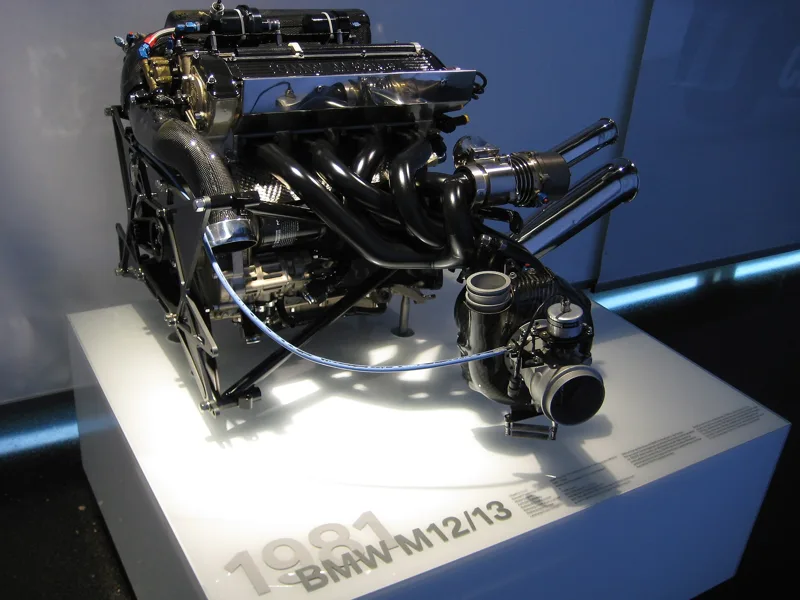
BMW had a long history with the sport, having supplied Brabham from 1982 to 1987. Brabham won the 1983 world championship with the turbocharged BMW M12/13 inline four, and the engine was later sold under the Megatron name after BMW withdrew at the end of 1988. Turbo engines were banned from 1989.
The Williams link came after Renault left the sport at the end of 1997, leaving the team without an engine partner. Williams had collected drivers' championships in 1992, 1993, 1996 and 1997 with Renault power, and the team needed a new engine partner. Development of a naturally aspirated V10 of three litres for the new rules kept BMW busy for 18 months, while Williams ran rebadged Renault engines as Mecachrome and then Supertec in the meantime.
How did the E41 engine take shape?
BMW had earlier worked on several naturally aspirated 3.5-litre twelve-cylinder engines. When the regulations prescribed ten-cylinder engines of up to 3.0 litres, BMW produced the E41/2, which then formed the basis of the E41/4 V10 with its 72 degree cylinder bank angle.
The internal designations tell part of the development story. The engine's code R39-9 shows the ninth revision of the design, with R standing for racing specification. Each revision refined the same basic layout, and the final stage was the one used at the end of the 2000 season.
How did the E41/4 perform in 2000?
The E41/4 was ready for the 2000 season and was fitted to the Williams FW22, driven by Ralf Schumacher and Jenson Button. Its designation R39-9 showed that the engine went through nine revisions during its development life. In its final stage, used at the end of 2000, it produced 596 kW (810 hp) at 17,500 rpm, and in qualifying it reached 17,800 rpm.
The debut came at the Australian Grand Prix in Melbourne on 12 March 2000, when Ralf Schumacher finished third. That was the best Formula One result by an engine manufacturer in more than 30 years, and Schumacher added two more podium finishes during the season. Williams finished third in the Constructors' Championship, ahead of engine makers with more recent experience.
What changed with the P80 in 2001?
After the more conservative E41, BMW designed the P80 for the 2001 season. The engine produced 656 kW (880 hp) at 18,000 rpm, a significant jump on its predecessor. Its cylinder bank angle was 90 degrees, with a bore of 95mm, a stroke of 42.3mm and a cylinder spacing of 103.5mm.
The P80 was designed by a small team of fewer than 20 employees, which began work in January or February 2001, before the earlier engine had even made its racing debut. The design phase ran from March to June 2001, and component testing started in August. The first bench run came on 21 September 2001 for an engine of almost 5,000 parts, and the first driving test followed on 3 October.
Published figures of 19,000 rpm and 900 hp circulated before the car ran, but BMW Motorsport director Mario Theissen dismissed them as speculation.
How did the Williams years unfold?
In 2001 Ralf Schumacher and new team-mate Juan Pablo Montoya scored four race wins between them, but they lost further chances to unreliability and racing incidents. The FW23 chassis lacked the downforce to match Ferrari and McLaren everywhere, yet on power-sensitive tracks like Hockenheim and Monza it was the best car on the grid.
In 2002 the FW24 was more reliable, and the team climbed to second in the Constructors' standings. Its only win came at the Malaysian Grand Prix with Schumacher, despite Montoya taking seven pole positions. In 2003 both drivers won twice, and Montoya stayed in the Drivers' title hunt until the penultimate race of the season.
Why did the Williams partnership end?
The 2004 FW26 had a radical nose section designed by Antonia Terzi, but it did not work, and Williams slipped to fourth. The season was marked by a double disqualification from the Canadian Grand Prix over brake duct irregularities, and by Schumacher's spinal injuries after a fast accident at the United States Grand Prix. Montoya's win at the Brazilian Grand Prix was the team's only victory that year.
In 2005 the team dropped to fifth and no driver won a race, although the team enjoyed a double podium at Monaco. Mark Webber, Nick Heidfeld and Antonio Pizzonia were the drivers that year, and none of them reached the top step. BMW believed its engines could win championships but were being held back by the Williams chassis. The company offered to buy the team outright, but Frank Williams refused, and BMW bought Sauber instead, ending its deal with Williams.
What was the BMW Sauber P86 era?
BMW bought the Swiss Sauber team in June 2005, and the new BMW Sauber team was based at Sauber's headquarters in Hinwil, Switzerland, with BMW's Munich base supplying the engines. For 2006 the rules changed to a 2.4-litre V8 formula, and BMW built the new P86 at Munich. The team kept Petronas and Credit Suisse as sponsors and signed Nick Heidfeld as lead driver, with Robert Kubica as third driver.
The first season brought two podium finishes and fifth place in the Constructors' Championship with 36 points. Kubica made his debut at the Hungarian Grand Prix after Jacques Villeneuve left the team following a heavy crash, and the change became permanent.
Villeneuve had earlier taken the team's first points with seventh place in Malaysia. Heidfeld finished fourth in Australia, and later took the team's first podium at Hungary from tenth on the grid. Kubica's seventh place in Hungary was later lost when his car was found to be underweight. The team's livery of BMW blue and white with a hint of red stayed for its whole Formula One life.
How strong was BMW Sauber in 2007 and 2008?
The 2007 F1.07 topped the timing sheets at times in winter testing. Heidfeld scored the team's best result that year with second at the Canadian Grand Prix, and the team ended the year in second place behind a McLaren that had been excluded, with 101 points. Kubica returned from injury to finish fourth at the French Grand Prix.
The 2008 season produced the team's only victory, and it also brought several strong results along the way. Kubica was second in Monaco, only three seconds behind the McLaren of Lewis Hamilton, and both Ferraris were behind the BMW pair at that race. Kubica took the team's first pole position at Bahrain, and the team scored its first win at the Canadian Grand Prix, a one-two finish with Kubica's first race victory ahead of Heidfeld. Development then switched to the 2009 rules, which frustrated Kubica, and the team struggled in the second half of the year.
What went wrong for BMW Sauber in 2009?
BMW Sauber started 2009 with real hopes of a title challenge, but the opening round went badly. Robert Kubica was running third when he collided with Sebastian Vettel while battling for second place, and he was forced to retire. Nick Heidfeld then put the team on the podium in Malaysia, its first of the year.
After six races the team had collected only 6 points and sat eighth out of 10 teams in the Constructors' Championship. An upgrade package, including an improved regenerative braking system and a double-deck diffuser, was planned for Turkey. The new diffuser was fitted, but the energy recovery system would not go on the new car, so both drivers raced without it.
Once the British weekend's qualifying was over, Mario Theissen confirmed that KERS development had been dropped in favour of aerodynamic work. Kubica scored the team's first points since Turkey at the European Grand Prix in Valencia,.
Why did BMW leave Formula One?
BMW announced its withdrawal after a board meeting on 28 July 2009, with chairman Norbert Reithofer describing it as a strategic decision. A buyer, Qadbak Investments, was announced in September, but its attempt to buy the team failed in November because it lacked the money and was a shell company without investors.
Peter Sauber then repurchased the team, conditional on an entry for 2010 from the FIA, which was granted in December 2009. The team used Ferrari engines in 2010, and the BMW V8 era ended with the team's sale back to its founder.
Specifications at a glance
| Engine | Year | Layout | Bore x stroke | Cylinder spacing | Output | Torque |
|---|---|---|---|---|---|---|
| E41/4 | 2000 | V10, 72 degrees | 94.0mm x 43.2mm | 107mm | 596 kW (810 hp) at 17,500 rpm | 350 N.m (258 lb-ft) |
| P80 | 2001 | V10, 90 degrees | 95mm x 42.3mm | 103.5mm | 656 kW (880 hp) at 18,000 rpm | 350 N.m (258 lb-ft) |