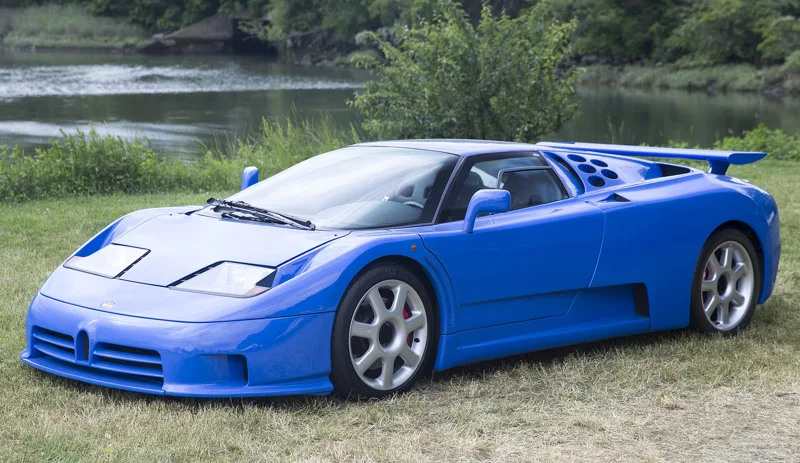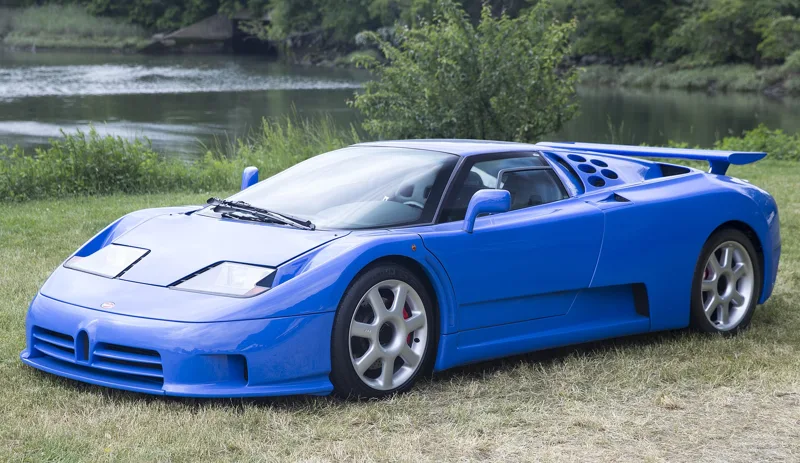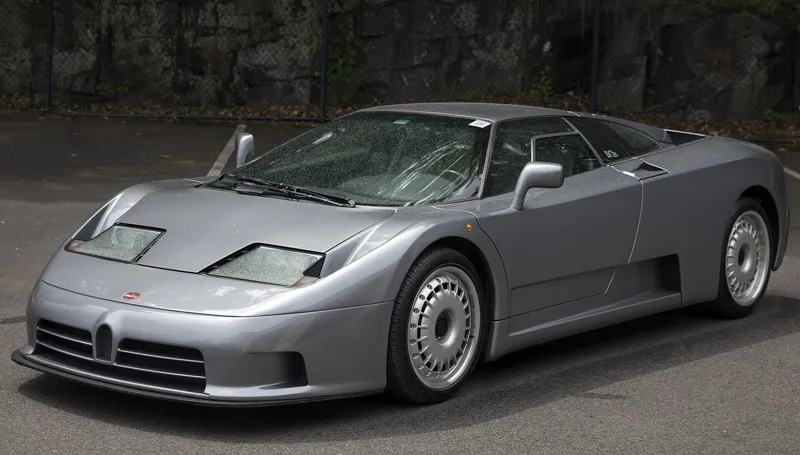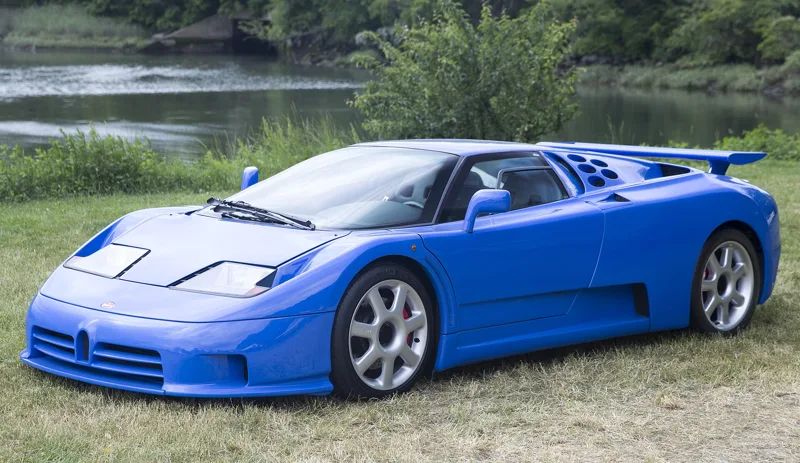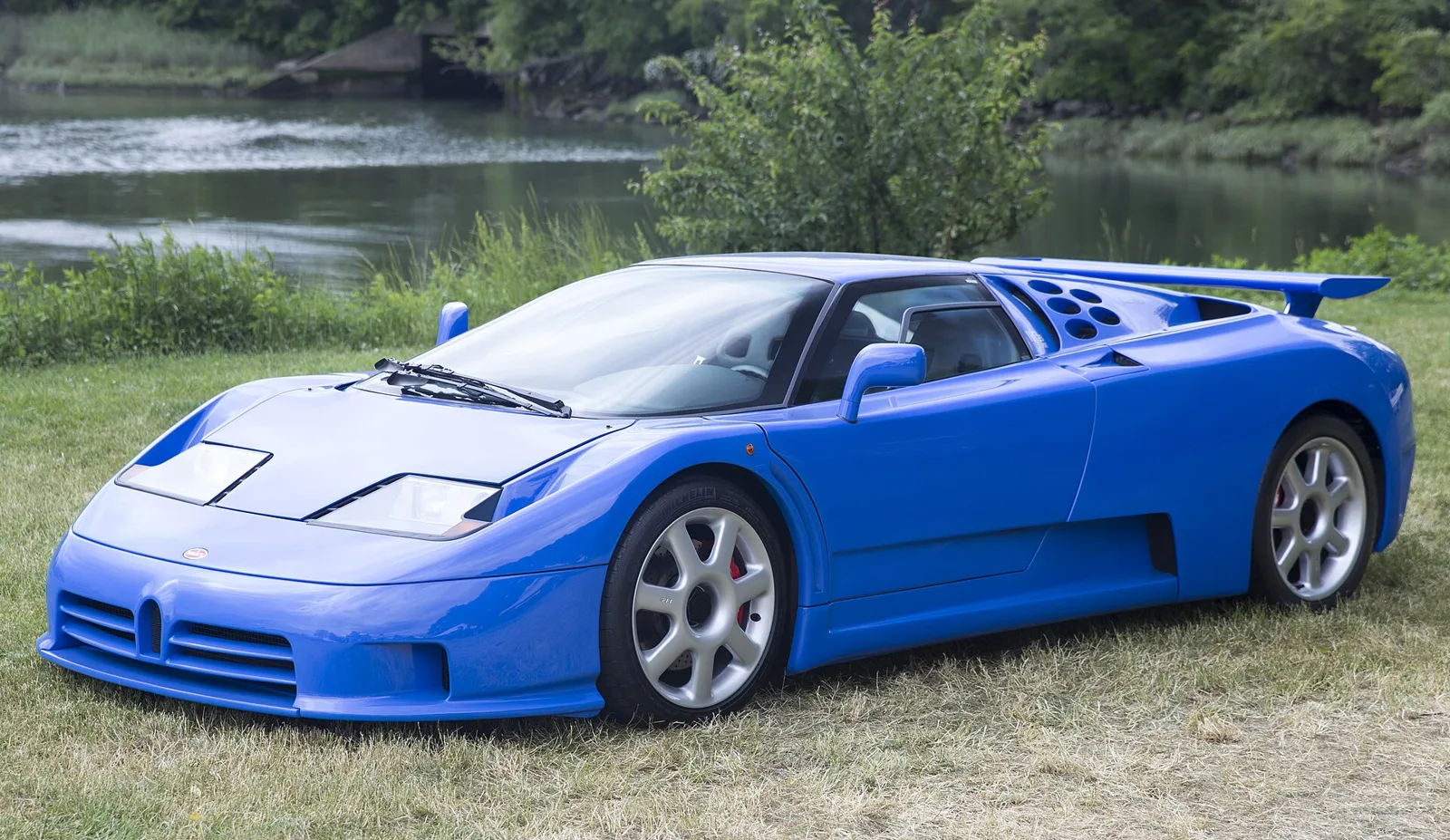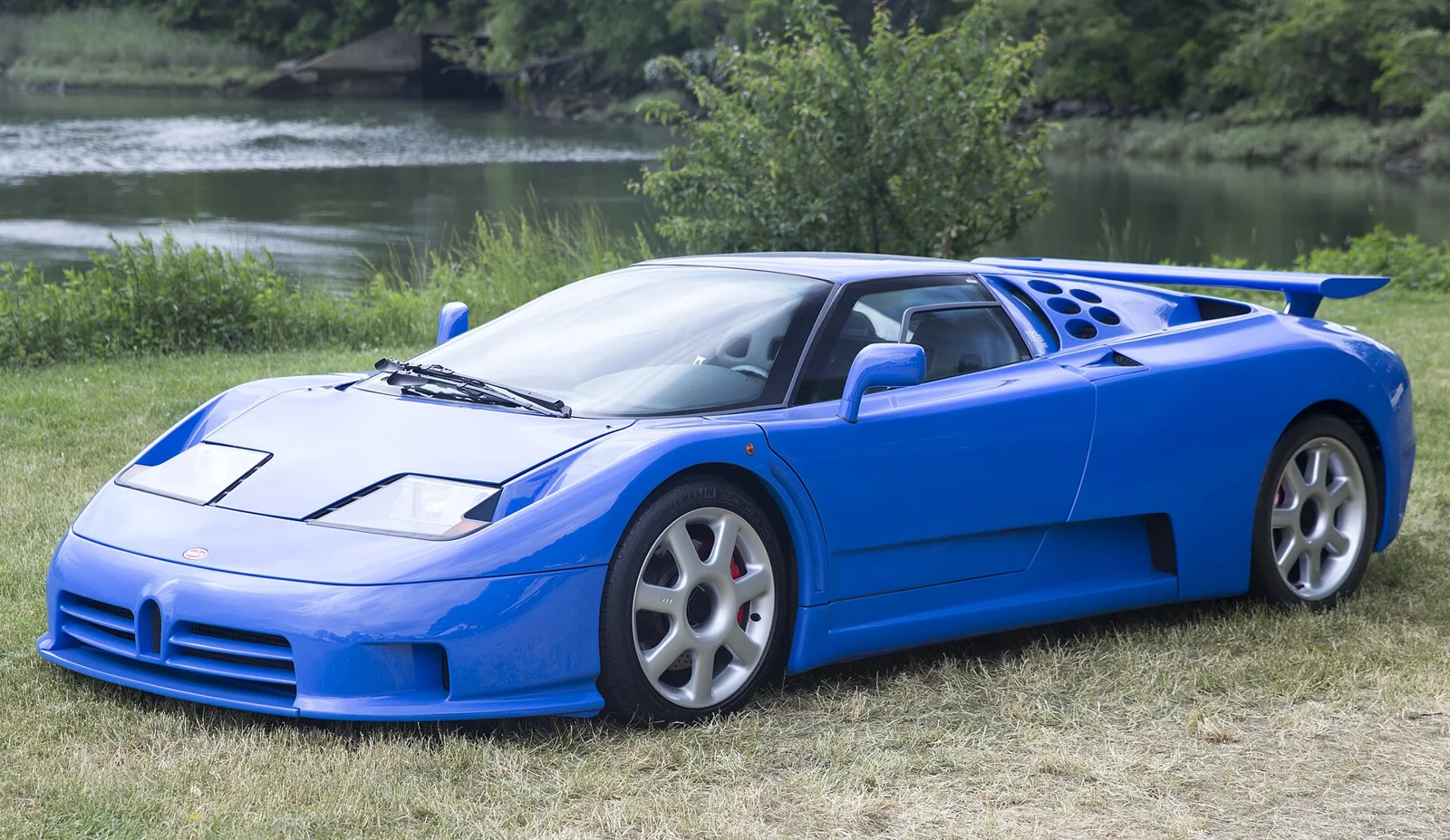
Two mid-engined V12 supercars of the early 1990s, both touched by the same designer: origins, engineering, four-wheel drive, performance and the buyer each suited.
The Bugatti EB110 and Lamborghini Diablo were rival V12 supercars from the early nineties. The EB110 ran from 1991 to 1995 with four turbochargers, and 139 examples were made. The Diablo ran from 1990 to 2001 with a 5.7 L V12 and spawned many variants.
The Bugatti EB110 and the Lamborghini Diablo were both mid-engined V12 supercars of the early 1990s, and both owed part of their shape to Marcello Gandini. The Diablo was the Italian maker's flagship for most of the decade, while the EB110 was the car that restarted Bugatti. The two cars took very different routes to their engines, chassis and drive systems.
This comparison looks at why the two were rivals, how each came about, what engines and chassis they used, how they were styled, how they performed, how they were varied over their lives, and which buyer each car suited on the facts available.
Why were the Bugatti EB110 and Lamborghini Diablo rivals?
They were rivals because both sold to the same small group of wealthy buyers who wanted the most extreme road cars of their time. Between 1992 and 1995 the EB110 was measured against the Diablo, along with the Jaguar XJ220, Ferrari F40, Ferrari F50 and McLaren F1. The Diablo was the Lamborghini that most buyers would have considered in that group.
The Diablo was also the more established car. It was presented for sale on 21 January 1990, a year before the EB110 went into production, and it stayed in production until 2001. The EB110 had a shorter life, built from 1991 to 1995 by a company that was liquidated when that period ended.
Both cars had a Lamborghini connection, which is one of the threads running through this comparison. The EB110 was conceived by Paolo Stanzani, who had worked on Lamborghini's Miura, Countach and Urraco, while the Diablo was the successor to the Countach. That shared heritage shaped how the cars were engineered and how they were talked about.
Two mid-engined V12 supercars with a shared designer: one built on four turbochargers, the other a Lamborghini that gained all-wheel drive.
How did the two cars come about?
The Diablo began as Project 132, started in June 1985 as a replacement for the Countach. The brief asked for a top speed of at least 315 km/h (196 mph). Lamborghini was financed at the time by the Mimran brothers, and Chrysler bought the company in 1987 to fund the car's completion.
The EB110 began as a Stanzani project. He discussed a new supercar with Ferruccio Lamborghini at the end of 1984, and development started in 1986 under the code FL12. Bugatti Automobili S.p.A. was founded on 14 October 1987, after Romano Artioli's company had bought the Bugatti brand.
Gandini linked the two projects. He had designed the Countach's two predecessors and was contracted for the Diablo, while the EB110 design was also drawn in part by his hand. Chrysler's design team later reworked the Diablo's styling to soften its sharp edges.
Development cost also tells a story. The Diablo is believed to have cost a total of 6 billion Lire. The EB110's path was marked by changes of direction and by arguments over its chassis and interior.
What engines did the two cars use?
The EB110 used a 3500 cc V12 sized to match the Formula One rules of 1987. Stanzani judged the naturally aspirated form inadequate for a supercar in torque and power, so turbocharging was built in from the start.
Four turbochargers were chosen instead of two larger units. The aim was to reduce the lag caused by the rotational inertia of the compressors and turbines. That decision was made for technical, marketing and strategic reasons, and it gave the EB110 a character very different from the Diablo's.
The Diablo used a 5.7 L version of Lamborghini's existing V12, with dual overhead cams and four valves per cylinder. Computer-controlled multi-point fuel injection fed the engine, and in its original form the unit made 492 PS (362 kW; 485 hp), along with 580 N-m (428 lb-ft) of pulling power.
Over its life the Diablo's engine was tuned several times. The SE30 Jota pushed output to 595 PS (438 kW; 587 hp), and its torque to 639 N-m (471 lb-ft) in race trim, while the 1995 SV raised output to 510 PS (375 kW; 503 hp) at 7,100 rpm. By 1998 the VT Roadster had 530 PS (390 kW; 523 hp) with variable valve timing.
How did the chassis and drive systems differ?
The EB110 chassis was built from two aluminium skins bonded to an aluminium honeycomb core. The skins were typically 0.9 to 1.5mm thick, and the honeycomb was 8 to 12mm thick. Stanzani chose the material for its stiffness, its cost and its repairability in Italy.
Artioli wanted a carbon-aluminium chassis, believing that carbon would be the future of supercars and that his safety concerns justified it. Aerospatiale quoted both options, and Stanzani judged the carbon version financially unviable. Later tests found the carbon chassis stiffer, but also heavier and significantly more expensive.
The Diablo was rear-wheel drive with a mid-mounted engine, which was a deliberate choice for weight balance. Its character changed in 1993 with the VT, the first all-wheel drive Lamborghini production sports car. A viscous centre differential could direct up to 25% of the torque to the front wheels when the rear wheels slipped.
The EB110's original concept was four-wheel drive, and its handling story came from the balance between its front and rear axles. Test drivers reported too much understeer, so Nicola Materazzi changed the torque split from 40:60 to 27:73. He based the new figures on dynamic load under acceleration, following an approach used on 1980s rally cars such as the Audi Quattro.
Who styled the two cars?
Several designers proposed bodywork for the EB110, including Paolo Martin, Giorgetto Giugiaro, Bertone and Marcello Gandini. Gandini was well known to Stanzani and had worked on many performance cars, including the Lamborghini Miura and the Lancia Stratos. His design went forward, although the company's president disliked its angular language.
Gandini then produced a second design with softer lines, revised lights and new rear wheel arch proportions. Cooling ducts moved from the bonnet to the front bumper, and the scissor doors and large windscreen were kept. Artioli wanted more detail changes, which Gandini refused, so Gianpaolo Benedini finished the work.
The Diablo's original design also came from Gandini. Chrysler's management was displeased with it, so its Detroit design team carried out a third extensive redesign that smoothed out the sharp edges and corners. Gandini later realised his original idea in the Cizeta-Moroder V16T.
The Diablo's styling was later refreshed in the 1999 facelift, and the roadster concept of 1992 gave the car an open-top silhouette.
Which car performed better on the figures?
The Diablo has the fuller performance record in this comparison. Its 325 km/h (202 mph) top speed was quoted for the original car, and Acceleration tests by Auto Motor und Sport gave 4.5 seconds to 100 km/h (62 mph), 9.3 seconds to 160 km/h (99 mph) and 13.7 seconds to 200 km/h (124 mph).
The Diablo was also the first production Lamborghini with a top speed above 200 mph (322 km/h). Its later variants pushed the figure further, with the 1998 VT Roadster quoted at 335 km/h (208 mph).
The EB110 has no performance figures in this comparison. That means no direct judgement on speed, acceleration or lap time can be made. The handling changes to its torque split show that the car was tuned on track rather than on paper, but that is not a measured performance result.
Both cars were fast in their own way. The EB110 offered four turbochargers and a four-wheel drive concept, while the Diablo offered a larger, more conventional V12 that gained all-wheel drive only in its 1993 VT form. The figures available favour the Diablo on record and leave the EB110's pace an open question.
How many versions were built?
The EB110 was built in 139 examples, plus a small number of post-production cars finished after the company was liquidated. The last was built by Dauer Sportwagen in 2002, and an unfinished example was completed in 2019. It was the only production model made by Artioli's Bugatti.
The Diablo came in many forms. The SE30 of 1993 marked the company's 30th anniversary, with 150 built. About 15 of those were converted to Jota specification, although 28 Jota kits were produced. The VT Roadster arrived in December 1995 with a removable carbon fibre targa top.
A later special was the Monterey Edition, a limited 20-car run for the US market in 1998. The Diablo SV Roadster was a rarer case still, with only one prototype and a single production example completed on 6 April 1998, making it the rarest series-production Lamborghini ever built.
Which buyer suits each car?
On the facts given, the EB110 suits a buyer drawn to a revived marque, a turbocharged V12 and a chassis with a debated material history. The Diablo suits a buyer who wants a V12 supercar with a long production run, a documented performance record and a choice of rear-wheel drive or all-wheel drive.
A buyer who values the story of a rebirth would find the EB110 fascinating. Its turbochargers, its aluminium chassis debate and its design revisions reflect a project pulled in several directions at once, and its company did not survive the decade.
A buyer who wants a broader range would look to the Diablo. It ran from 1990 to 2001, produced coupes, roadsters, SE30 and SV specials and the VT all-wheel drive car. That range makes it easier to find a version to suit a particular taste.
Neither car is shown to be better across the board. The EB110 has the dramatic engineering narrative and the rarer history, while the Diablo has the fuller performance record and the broader family of variants. The better choice depends on whether the buyer prizes the Bugatti story or the Lamborghini record.
Specifications at a glance
| Feature | Bugatti EB110 | Lamborghini Diablo |
|---|---|---|
| Production | 1991 to 1995 | 1990 to 2001 |
| Cars built | 139 examples plus post-production cars | No figure given |
| Engine | 3500 cc V12 with four turbochargers | 5.7 L V12, four valves per cylinder |
| Power | No figure given | 492 PS (362 kW; 485 hp) in original form |
| Torque | No figure given | 580 N-m (428 lb-ft) |
| Drive | Four-wheel drive in the original concept | Rear-wheel drive; VT all-wheel drive from 1993 |
| Top speed | No figure given | 325 km/h (202 mph) |
| 0-100 km/h | No figure given | 4.5 seconds |
| Designer | Marcello Gandini, refined by Gianpaolo Benedini | Marcello Gandini, refined by Chrysler's Detroit team |
| Best-known variant | Only one model | SE30 Jota at 595 PS (438 kW; 587 hp) |
| Rivals | Diablo, XJ220, F40, F50, McLaren F1 | No figure given |