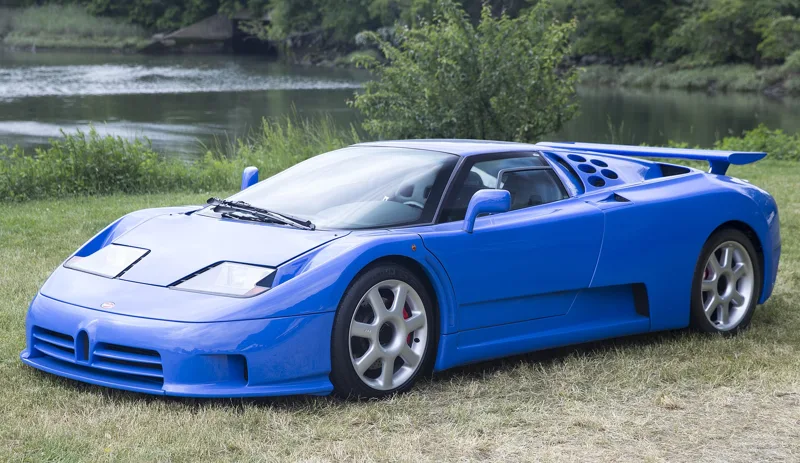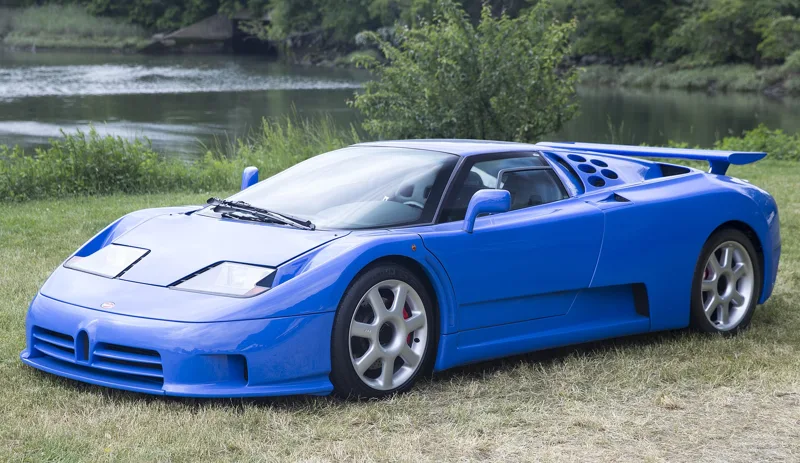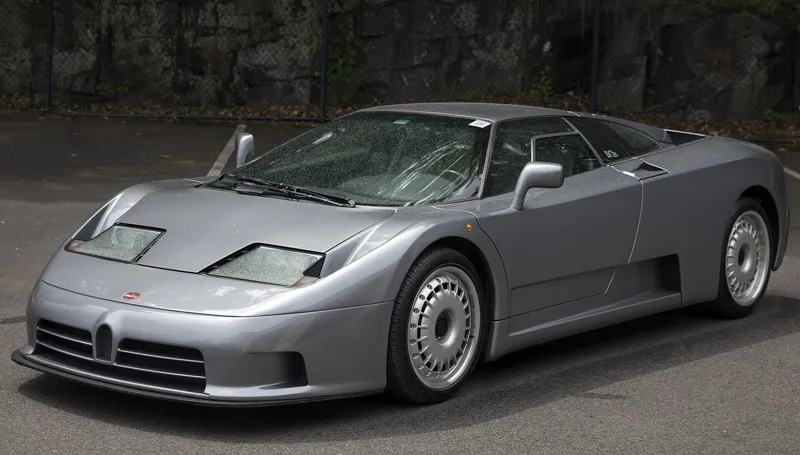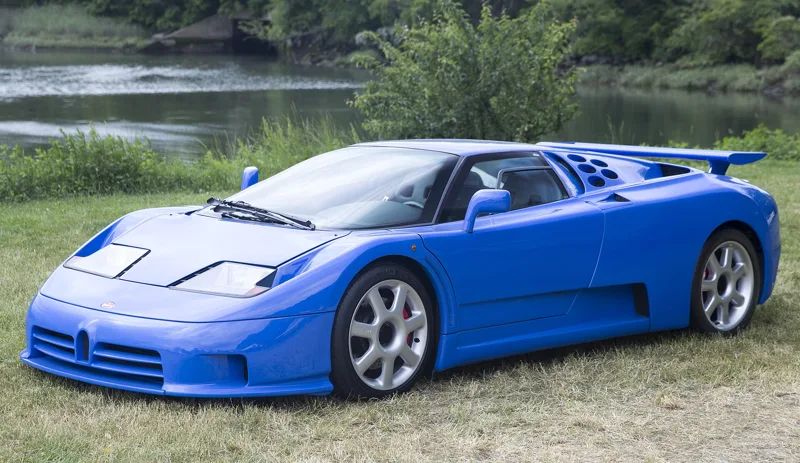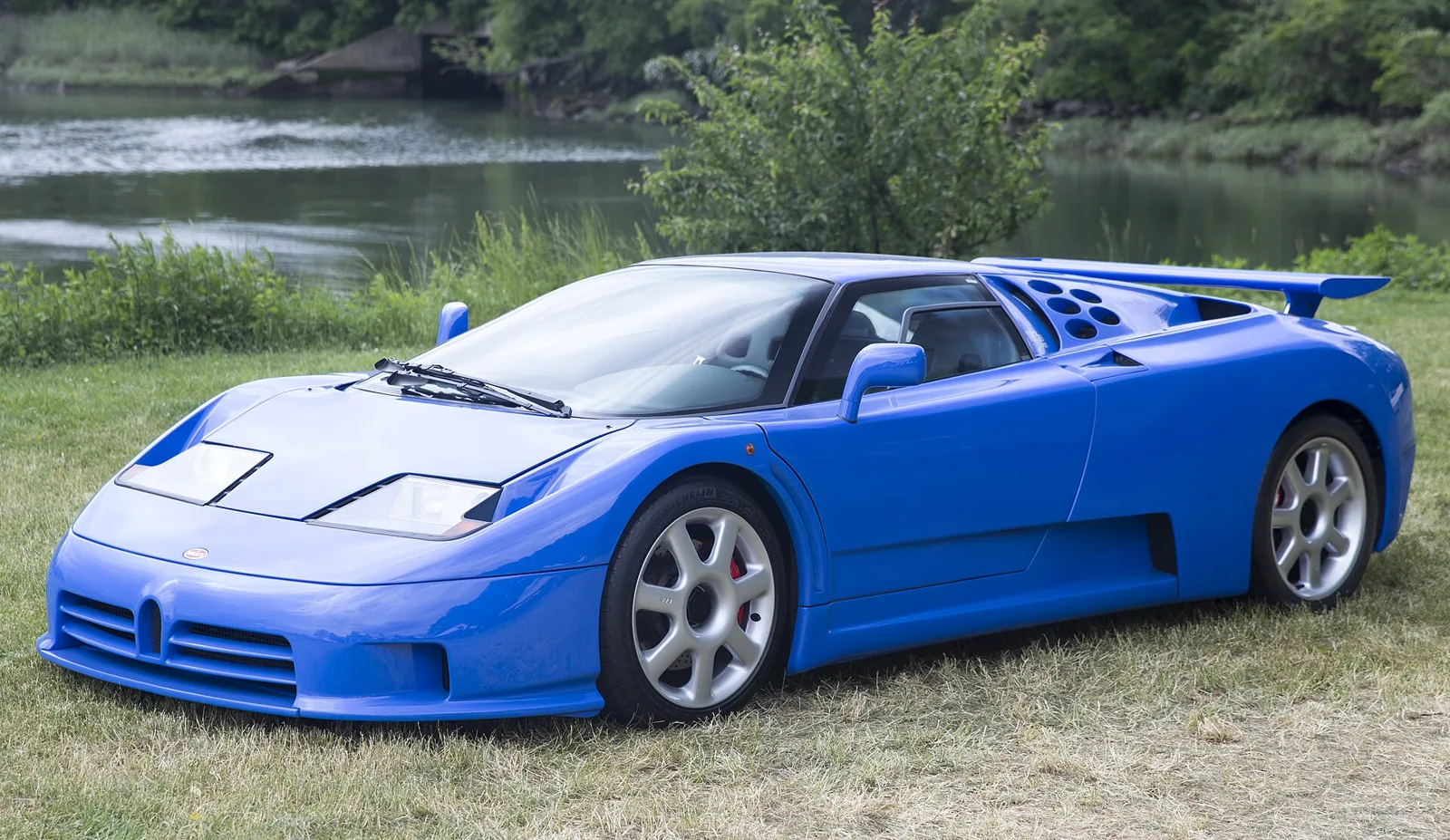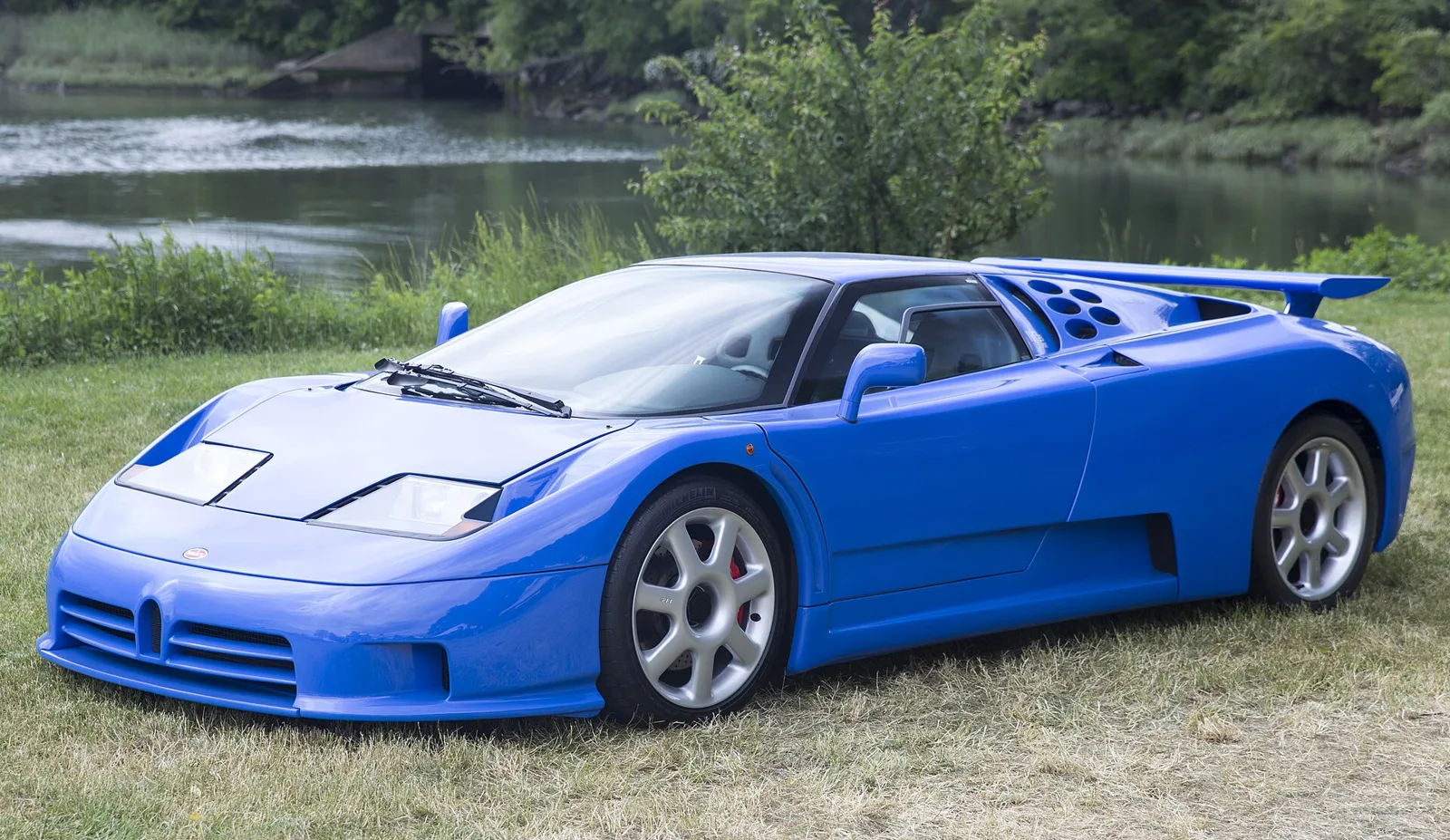
A revived Bugatti with four turbochargers set against Ferrari's naturally aspirated V12 flagship: origins, engineering, styling, performance and the buyer each suited.
The Bugatti EB110 and Ferrari F50 were limited-production supercars from the early 1990s. The EB110 was built from 1991 to 1995 with four turbochargers and 139 examples were made. The F50 was built from 1995 to 1997, used a naturally aspirated 4.7-litre V12 and reached 349 cars.
The Bugatti EB110 and the Ferrari F50 were two of the most ambitious sports cars of the early 1990s, and both belonged to the same rarefied class. The EB110 restarted the Bugatti name after decades of silence, while the F50 was Ferrari's limited-run flagship with a naturally aspirated V12. Their contrasting engineering choices make them a revealing pair to compare.
This comparison covers how each car came about, the engines and chassis behind them, their styling, their performance and track figures, how many were built, and which buyer each car suited on the facts available.
Why were the Bugatti EB110 and Ferrari F50 rivals?
They were rivals because both were exotic, limited-production sports cars aimed at the very top of the market. Between 1992 and 1995 the EB110 was measured against the Lamborghini Diablo, Jaguar XJ220, Ferrari F40, Ferrari F50 and McLaren F1. The F50 arrived in 1995 and was built until 1997, so the two overlapped for a short but important period.
The EB110 carried a heavy symbolic weight. It restarted Bugatti's presence in the car industry after a hiatus of nearly 40 years, since 1952. The F50, by contrast, came from a marque with an unbroken supercar lineage, so the two cars carried very different expectations into the same showrooms.
Both cars were built in small numbers, and both were expensive to make. Any comparison of the two therefore has to start from how many each one was able to produce.
A revived Bugatti with four turbochargers against Ferrari's naturally aspirated V12: two very different answers to the supercar question.
How did the two cars come about?
The EB110 began as a project of Paolo Stanzani, who first discussed a new supercar with Ferruccio Lamborghini at the end of 1984. Development started in 1986 under the code FL12, short for Ferruccio Lamborghini 12-cylinder. Bugatti Automobili S.p.A. was founded on 14 October 1987, after Romano Artioli's Autoexpo had bought the Bugatti brand earlier that year.
Stanzani brought a Lamborghini pedigree to the project. He had worked on the Miura, Countach, Espada, Urraco, Jarama and Jalpa, and he chose Tecnostile, a Modena engineering firm, to carry out much of the early development. Several Lamborghini people followed him to the new company, which gave the project real depth of experience.
The F50 had a different start. Its design evolved from the 1989 Ferrari Mythos concept car, and Pininfarina produced the body. Its V12 was derived from the 3.5 litre engine of the 1990 Ferrari 641 Formula One car, so the F50 was rooted in racing from the first drawing.
Production ran in parallel with those origins. The EB110 was built by Bugatti Automobili S.p.A. from 1991 until 1995, when the company was liquidated. The F50 was built by Ferrari from 1995 until 1997, with the last car leaving the line in July 1997.
What engines did the two cars use?
The EB110 used a 3500 cc V12 sized to match the Formula One rules of 1987, and it relied on four turbochargers. Stanzani judged that the naturally aspirated form could not produce enough torque and power for a supercar, so turbocharging became central to the design.
The choice of four turbochargers, rather than two larger units, was made to cut the lag caused by the rotational inertia of the compressors and turbines. Engine configuration, size and turbocharging were chosen for technical, marketing and strategic reasons together, and the result gave the EB110 a distinctive character.
The F50 used a 4.7 litre naturally aspirated V12 with 60 valves. Its engine was a 65 degree unit with a variable-length intake manifold, a carbon fibre reinforced intake and a dry sump with three scavenger pumps. It produced 382 kW (520 PS; 513 hp) at 8,500 rpm, with 471 N-m (347 lb-ft) of torque at 6,500 rpm.
The F50's engine predated the car itself. It was used in the Ferrari 333 SP in the American IMSA GT Championship in 1994, which made it eligible for the stock engine World Sports Car category. That racing heritage gave the F50 a credible technical foundation before the road car was finished.
How did the chassis differ?
The EB110 chassis was built from flat aluminium panels, with two aluminium skins bonded to an aluminium honeycomb core. The skins were typically 0.9 to 1.5 mm thick and the honeycomb 8 to 12 mm, and the sheets were glued and riveted into a three-dimensional shape. Stanzani favoured this construction for its stiffness, its cost and its repairability in Italy.
Romano Artioli was not convinced. He pushed for a carbon-aluminium chassis because of his concern for safety and his belief that carbon composites would dominate future supercars. Stanzani asked Aerospatiale to quote both options, and the carbon-fibre version was judged financially unviable at the time.
Later tests showed that the carbon chassis was stiffer than the aluminium one, but it was also heavier and significantly more expensive. The carbon version kept the same dimensions and panel split lines, and it was built from separate panels bonded and riveted together so that very large autoclaves were not needed.
The F50 took a different route from the start. Its central tub was carbon fibre, built in a sandwich construction with a Nomex honeycomb core. Its torsional stiffness is quoted at 34,570 N-m (25,500 lb-ft) per degree, and its front and rear wishbones carried push-rods, coil springs and Bilstein monotube dampers.
Electronic adaptive damping on the F50 could change its setting quickly. The maximum reaction time from minimum to maximum damping force was 140 milliseconds, while the average reaction time was 25 to 30 milliseconds.
Who styled the two cars?
Several designers were invited to propose bodywork for the EB110, including Paolo Martin, Giorgetto Giugiaro, Bertone and Marcello Gandini. Martin's proposal was avant-garde but rejected by the Bugatti management. Giugiaro's Bugatti ID90 prototype appeared later, at the 1990 Turin Auto Show.
Gandini's design was the one that went forward. It had been well received by Stanzani, and Gandini went on to design the Lamborghini Diablo soon afterwards. Prototypes bodied by Ilas began testing in 1991, though the company's president was not happy with the angular design, its shovel nose or its flared rear wheel arches.
A second Gandini design softened those lines, with revised lights and subtly different rear wheel arches, and it moved the cooling ducts to the bumper. The scissor doors and the large windscreen were kept. Gandini refused the further detail changes Artioli wanted, which would have altered the car's character, so Gianpaolo Benedini made the final changes to the front intake.
The F50's styling was simpler to describe. Pininfarina took the car's design from the Mythos concept and added cues from contemporary Formula One cars, particularly at the front. The result was a two-door, two-seat targa top with a clear racing lineage in its look as well as its engine.
Which car performed better?
On the figures given, the F50 has the fuller performance record. It reached 97 km/h (60 mph) in 3.8 seconds and 161 km/h (100 mph) in 8.5 seconds, and it covered the quarter mile in 12.1 seconds at 198 km/h (123 mph). Its claimed top speed was 325 km/h (202 mph), and it stopped from 70 mph (113 km/h) in 176 ft (54 m).
The F50 also posted track times at several circuits. Fiorano was lapped in 1:27.00, Tsukuba in 1:05.81, Sugo in 1:38.573 and Suzuka in 2:25.525 in 2000. Its skidpad figure was 0.95 g, and its weight split was 42%/58% front to rear.
The EB110 has no performance figures in this comparison, so a like-for-like verdict cannot be reached. What the record does show is that its handling was reworked after test drivers raised concerns. Its front-to-rear torque split was changed from 40:60 to 27:73 after test drivers reported too much understeer, a shift made on dynamic load rather than static weight.
The racing derivatives tell a different story. The F50 GT was tuned to around 750 brake horsepower at 10,500 rpm and was quicker in a 1996 test than the 333 SP, yet the project was cancelled when Ferrari moved away from GT racing. Six chassis were planned and only three complete chassis were sold.
How many of each car were built?
The EB110 was built in 139 examples, plus a small number of post-production cars that were finished after the bankruptcy. The last was built by Dauer Sportwagen in 2002, and one unfinished example was completed in 2019. It was the only production model made under Artioli's Bugatti.
The F50 was built in 349 cars between 1995 and 1997, with the last rolling off the production line in July 1997. That was a larger run than the EB110's, although both cars remained rare by any standard, and each one carries a strong following among collectors.
Production scale alone does not settle which car is the better buy. The EB110's small run came from a company that was liquidated in 1995, while the F50 was built by Ferrari itself.
Which buyer suits each car?
On the facts given, the EB110 suits a buyer drawn to a revived marque with a turbocharged V12, a chassis with a debated material history and a car that carried the Bugatti name back into the modern era. The F50 suits a buyer who wants a naturally aspirated Ferrari V12 with a documented track record and a clear racing heritage.
A buyer who values the story of a rebirth, and who is comfortable with the uncertainties of a short-lived company, would find the EB110 a fascinating object. Its turbochargers, its aluminium chassis debate and its design changes all reflect a project that was pulled in several directions at once.
A buyer who wants a car with a clear performance figure set would look to the F50. Its published performance, track times and racing derivative give a fuller picture of what the car could do, and its naturally aspirated engine offers a different kind of response from the EB110's turbocharged power delivery.
Neither car is shown to be better across the board. The EB110 has the more dramatic engineering story and the rarer history, while the F50 has the fuller performance record and the larger production run. The right choice depends on whether the buyer prizes the narrative of the EB110 or the measured record of the F50.
Specifications at a glance
| Feature | Bugatti EB110 | Ferrari F50 |
|---|---|---|
| Production | 1991 to 1995 | 1995 to 1997 |
| Cars built | 139 examples plus post-production cars | 349 |
| Designer | Marcello Gandini, refined by Gianpaolo Benedini | Pininfarina, from the 1989 Mythos concept |
| Engine | 3500 cc V12 with four turbochargers | 4.7 L naturally aspirated V12, 60 valves |
| Power | No figure given | 382 kW (520 PS; 513 hp) at 8,500 rpm |
| Torque | No figure given | 471 N-m (347 lb-ft) at 6,500 rpm |
| Chassis | Aluminium skins and honeycomb; carbon option tested | Central carbon fibre tub |
| Gearbox | No figure given | Six-speed manual, rear-wheel drive |
| Weight split | No figure given | 42%/58% front/rear |
| 0-97 km/h (60 mph) | No figure given | 3.8 seconds |
| Top speed | No figure given | 325 km/h (202 mph), claimed |
| Track time | No figure given | Fiorano 1:27.00 |
| Racing derivative | No figure given | F50 GT, around 750 brake horsepower |
| Rivals | Diablo, XJ220, F40, F50, McLaren F1 | No figure given |