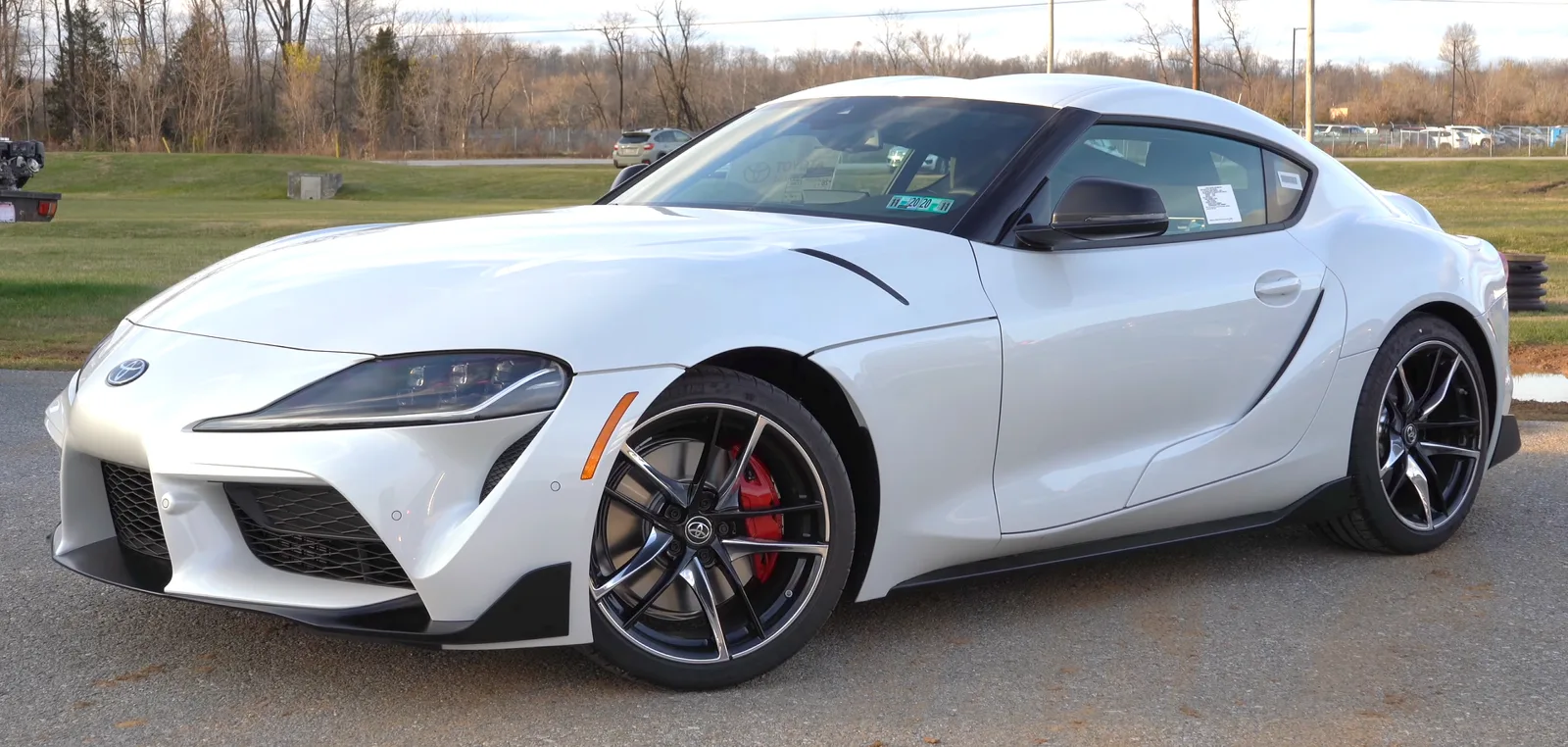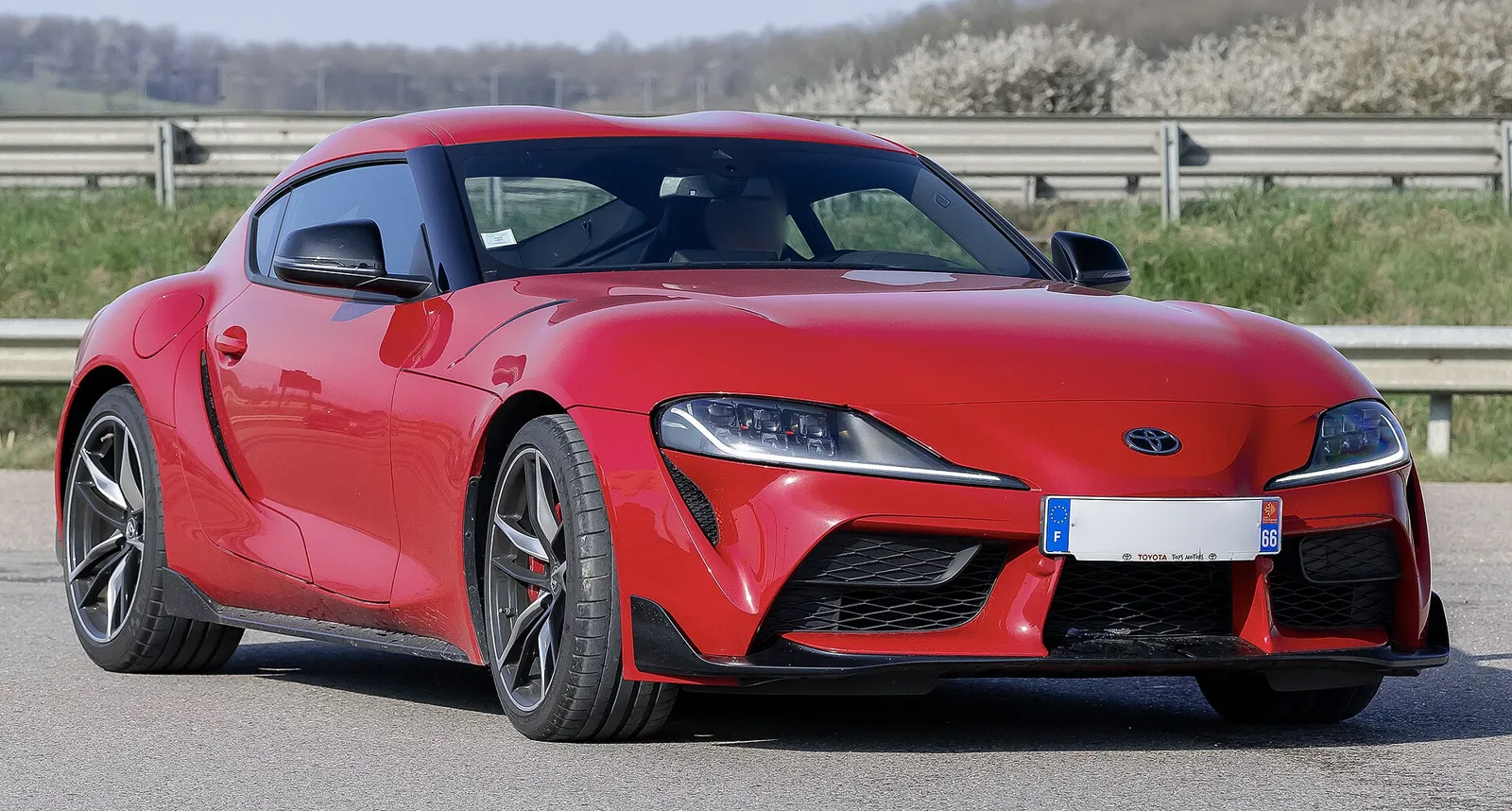
Toyota's fifth-generation Supra, built by Magna Steyr in Austria alongside BMW, ran from 2019 to March 2026 and left a strong racing legacy.
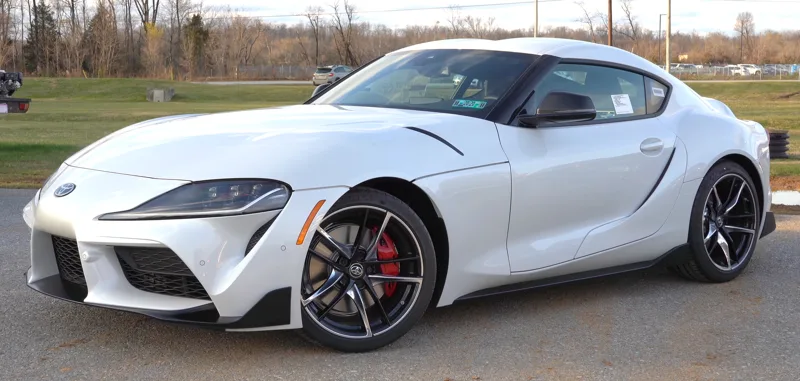
The Toyota Supra J29/DB is the fifth-generation Supra, built by Magna Steyr in Austria from 2019 until March 2026. It shared its platform with the BMW Z4, used BMW-sourced turbo engines and ended with a 300-unit Final Edition.
The Toyota Supra J29/DB was the fifth-generation Supra, a rear-wheel-drive sports car built by Magna Steyr in Austria for Toyota between 2019 and 2026. Developed with BMW under the Toyota Gazoo Racing banner, it ended production in March 2026 with no successor planned.
Where did the Supra J29/DB come from?
The fifth-generation Supra succeeded the A80, which ceased production in 2002. Toyota developed the car with BMW, and it uses a platform shared with the BMW Z4 G29. Both cars were built at the Magna Steyr plant in Graz, Austria.
Toyota filed for the Supra name in 2010 and renewed its US trademark on 10 February 2014. A European trademark application followed in June 2016. Motor Trend had earlier linked a successor to the FT-HS concept shown in 2007, and it reported a possible 3.5-litre V6 hybrid.
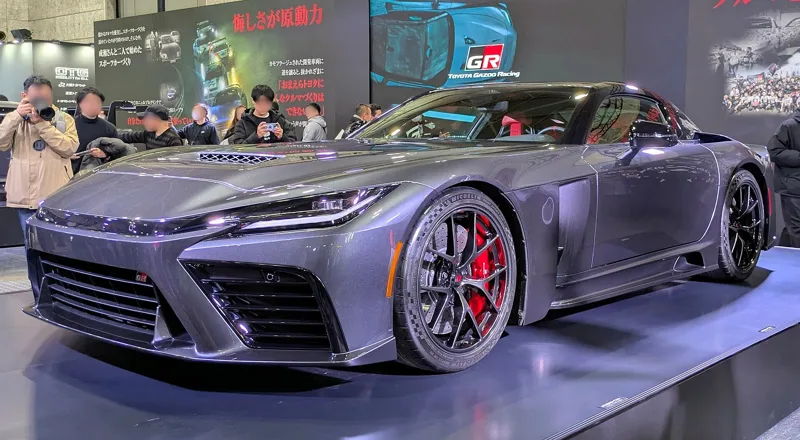
The FT-1 concept, unveiled on 13 January 2014 at the North American International Auto Show, was a front-engined, rear-wheel-drive car that Toyota linked to the 2000GT and earlier Supras. Toyota suggested a price of around US$60,000, but the production car ended up smaller and more of a pure sports car.
The partnership had a turning point. BMW had considered using one of its own platforms, but chief engineer Tetsuya Tada declined, and the two companies co-developed a new architecture instead. Tada later described the car as much more hardcore and track-focused than the BMW.
Two carmakers, one platform and a nameplate that waited 17 years to return to the road.
How did the Supra reach the public?
A pre-production car in camouflage appeared at the Goodwood Festival of Speed on 12 July 2018. The full reveal came at the January 2019 Detroit auto show, where Akio Toyoda unveiled the car alongside two-time Formula One champion Fernando Alonso. Sales in Japan began on 17 May 2019.
The car was engineered for an ideal 50-50 front-rear weight distribution. Toyota benchmarked it against the Porsche Cayman S (982), just as the earlier Supra had been measured against the Porsche 968, and it tested the car extensively at the Nurburgring.
The first production car was auctioned in January 2019 at Barrett-Jackson for US$2.1 million. The buyer, Craig Jackson, chairman and chief executive of the auction house, took a one-off matte grey car with a red interior and VIN 20201. All of the money went to the American Heart Association and the Bob Woodruff Foundation.
Launch dates followed quickly. US sales began on 22 July 2019 with a base price of US$49,990, and Australian sales started on 2 September 2019. The European launch took place at the 2019 Geneva International Motor Show, ending a 17-year hiatus for the nameplate.
Which engines did the Supra offer?
The Supra used two BMW-sourced turbocharged engines: a B48 2.0-litre four and a B58 3.0-litre six. The four produced 145 to 190 kW (194 to 255 hp), while the six produced 250 to 285 kW (335 to 382 hp), with 495 to 500 N-m of torque from the 3.0.
The 2.0-litre was first offered in Japan, parts of Asia and Europe, and reached the United States in 2020 for the 2021 model year. The 2.0 was dropped for the 2025 model year, leaving the 3.0 in the US range.
The 3.0 was updated for the 2021 model year in the United States, with 285 kW (382 hp) and 499 N-m (368 lb-ft). Revised engine tuning, a 10.2:1 compression ratio, and a six-port cylinder head and turbo manifold replaced the earlier 11:1 two-port version. The 2.0 that year was rated at 190 kW (255 hp) and 400 N-m (295 lb-ft).
What gearboxes did the Supra use?
Toyota fitted a ZF 8HP eight-speed automatic as the main gearbox, recalibrated by Toyota with its own software. A dual-clutch unit was considered first, but Toyota chose the ZF for its smoothness, reliability and weight savings.
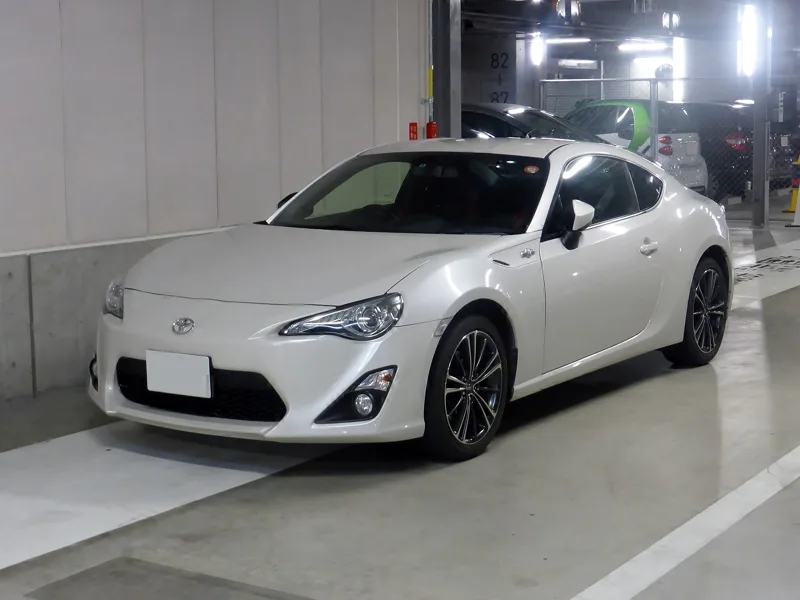
A manual was not offered at launch. The torque-converter automatic shifted faster, handled a lot of torque, and separated the Supra from the Toyota 86. A ZF S6-53 six-speed manual arrived in 2022 for the 2023 model year, for the six-cylinder only, with rev-matching and a shorter final drive ratio than the automatic.
How quick was the Supra in independent tests?
Car and Driver recorded 0-97 km/h (0-60 mph) in 3.7 seconds for the 3.0 in December 2019, which was 0.3 seconds quicker than Toyota's own claim. The quarter mile took 12.2 seconds at 183 km/h (114 mph). An August 2020 test of the 2.0 model reached 0-97 km/h in 4.7 seconds.
Sport Auto set a Nurburgring Nordschleife lap of 7:52.17 minutes in August 2019, using a 2020 GR Supra on factory Michelin Pilot Super Sport tyres. The 2.0 model reached a quarter mile in 13.3 seconds at 167 km/h (104 mph) in the August 2020 test.
How was the Supra engineered with BMW?
The platform took elements from BMW M cars, including the suspension design, forged control arms and an electronic differential. Toyota wanted a rear-wheel-drive sports car to rival the Porsche Cayman S, while BMW wanted a roadster, and the two plans combined into one platform that could carry both a coupe and a convertible.
After the shared platform was set, each company developed its own chassis, exterior, interior and tuning. On the Supra the side sills were significantly wider and stiffer, the chassis had more bracing, and the engine sat further back for better weight distribution. The fake vents on the exterior were leftovers from the race prototype, designed so owners could make them functional.
Toyota used BMW for the engines and for the small switchgear, but the interior design, layout and parts such as the seats and steering wheel came from Toyota. Akio Toyoda said the design and performance identity traced back to the Toyota 2000GT.
What was the A90 Final Edition?
The A90 Final Edition was unveiled in late November 2024 for Europe and Japan as the last edition of the A90 Supra. It was limited to 300 units, with 150 for Japan and 150 for Europe, and it added 70 kW (94 hp) and 70 N-m (52 lb-ft) over the standard 3.0 to reach 324 kW (434 hp) and 571 N-m (421 lb-ft).
Parts came from the GT4 race car, including a carbon-fibre front spoiler, canards, a removable bonnet duct, a swan-neck rear wing and the race car's rear subframe. The chassis received KW suspension and an Akrapovic titanium exhaust, while the brakes were Brembo units with 15.6-inch front rotors and four pistons per caliper. Forged wheels measured 19 inches at the front and 20 inches at the rear, and carbon-fibre Recaro Podium CF seats completed the cabin.
The extra power came from a revised intake air path, a low-back-pressure catalyst and optimised engine controls. Toyota also added a baffle plate to the oil pan to keep the oil even under higher g-forces, and it improved cooling with a sub-radiator, larger differential fins and a stronger radiator fan.
What trims and markets did the Supra have?
In Japan the car came in SZ, SZ-R and RZ trims. The SZ used the 145 kW (194 hp) 2.0 on 17-inch single-tone wheels, while the SZ-R had the 190 kW (255 hp) version with 18-inch two-tone wheels, eight-way powered seats, a 12-speaker JBL stereo and a head-up display. The RZ used the 3.0 on 19-inch two-tone wheels.
Japanese cars also came with a Toyota Supra safety suite, including autonomous emergency braking, lane departure alert, a blind spot monitor, adaptive cruise control and rear cross traffic alert. The Toyota Gazoo Racing Recorder logged driving data to an SD card, and an optional dashcam could be synchronised with it.
The 2020 RZ output rose to 289 kW (387 hp) in Japan, and a Horizon Blue Edition of 100 units followed that year. A 35th Anniversary Edition of 35 units marked the 1986 Toyota Supra A70 in 2021, with matte black 19-inch forged wheels and a carbon ornament.
In the UK the car came as the 2.0 Pro, 3.0 and 3.0 Pro, and Australia offered the GT and GTS. Australia also released a 2025 Track Edition with an 8-speed manual, which stopped selling in August 2025. Other markets included Mexico from 22 August 2019, South Africa, South Korea, Malaysia, the Philippines, Taiwan, Indonesia and Thailand.
Which special editions did the US get?
The US received a special edition for each model year. The first 1,500 Launch Edition cars came for 2020, followed by the 1,000-unit A91 Edition for 2021, the 600-unit A91-CF for 2022, the 500-unit A91-MT for 2023 and the 900-unit 45th Anniversary Edition for 2024.
The Launch Edition came in Absolute Zero White, Nocturnal Black or Renaissance Red, with red mirror caps, all-black wheels and a numbered carbon plaque carrying a replica of Akio Toyoda's signature. The A91 Edition added matte black stripes on the C-pillars, a carbon rear lip spoiler and an exclusive black and Alcantara interior with blue stitching.
The A91-CF added a carbon-fibre body kit with a front splitter, side skirts and a duckbill spoiler, plus matte black wheels. The 45th Anniversary Edition honoured the first Supra, the 1978 Celica Supra. It used Mikan Blast orange and a manually adjustable rear spoiler that rises about 75 mm (3 inches) above the decklid.
The 2026 model year was the final year of the generation. The US Final Edition used the standard 285 kW (382 hp) engine, even though the version sold elsewhere had a more powerful engine.
Did the Supra succeed in motorsport?
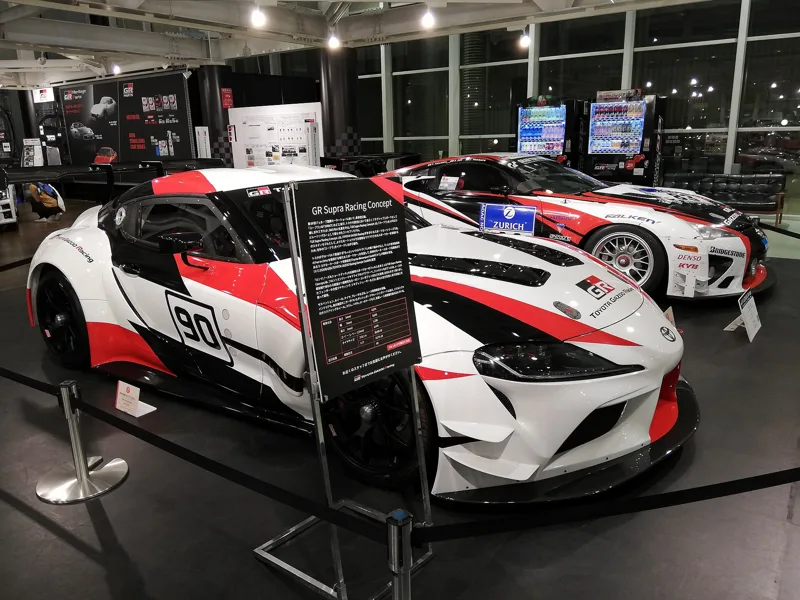
Yes. The GR Supra GT4 went on sale to customer teams from March 2020 in Europe, and by 2022 it had won 11 national and international GT4 championships. Super GT from 2020 added GT500 and GT300 cars, and the GT500 had taken 24 race wins and four championships by 2025.
The GT4 production car was unveiled in October 2019 with a 320 kW (429 hp; 435 PS) engine, a seven-speed automatic, an Akrapovic exhaust, an FIA seat with a six-point harness, Brembo brakes and KW dampers. The GT4 EVO followed in October 2022, with up to 660 N-m (487 lb-ft) of torque and revised brake and ABS settings.
Toyota Gazoo Racing's GT500 used a 500 kW (670 hp) 2.0-litre RI4A turbo four, and the GT300 used a 5.4-litre 2UR-GSE V8. TGR Team au TOM'S won the GT500 title in 2021 with Yuhi Sekiguchi and Sho Tsuboi, and it won again in 2023, 2024 and 2025. Saitama Green Brave took the GT300 title in 2023.
In the NASCAR Xfinity Series, Toyota Gazoo Racing debuted the Supra in 2019. Christopher Bell scored the first win at Atlanta on 23 February, and the car won six of the first 11 races of the season. Daniel Hemric won at Phoenix to claim the 2021 title, and Ty Gibbs took seven wins and the 2022 championship.
Drifting took up the car too. Daigo Saito raced the first fifth-generation GR Supra in the D1 Grand Prix from 2019, and Papadakis Racing ran a Formula Drift car with a modified B58 making over 745 kW (1,000 hp). Fredric Aasbo won the 2021 and 2022 Formula D Championship. The Supercars Championship will use the car from 2026, with the 5.0-litre V8 from the Lexus RC F GT3.
What awards did the Supra win?
The Supra picked up Auto Bild's Golden Steering Wheel for Best New Sports Car in 2019 and Esquire's Car of the Year for 2019. It made Car and Driver's 10Best list for 2020, 2021 and 2023, and it won J.D. Power's ALG Residual Value Award in 2023 and 2024.
Sport Auto named it Best Handling Car of 2020, ahead of the McLaren 600 LT, Porsche 718 Cayman GT4 and BMW M8 Competition. SEMA named it Sport Compact of the Year for 2021, and Autocar gave it the Miles of Smiles award in 2023.
Were there known problems or recalls?
A known issue was wind buffeting when both side windows were open, caused by Helmholtz resonance from about 55 km/h (35 mph). Toyota acknowledged it but did not recall the car for it. In September 2019 the US safety regulator also announced BMW-linked recalls that touched the Supra.
The seat belt recall involved improperly welded guide loop mounts on seven units, only one of which had reached an owner. The backup camera recall covered several BMW models, the Supra among them, and a software patch fixed the issue.
Specifications at a glance
| Specification | Detail |
|---|---|
| Model codes | J29/DB, marketed as A90 and A91 |
| Production | Magna Steyr, Graz, Austria; 2019 to March 2026 |
| 2.0-litre engine | B48 turbo four, 145 to 190 kW (194 to 255 hp), 320 to 400 N-m |
| 3.0-litre engine | B58 turbo six, 250 to 285 kW (335 to 382 hp), 495 to 500 N-m |
| Automatic | ZF 8HP eight-speed, recalibrated by Toyota |
| Manual | ZF S6-53 six-speed, six-cylinder only, from 2022 |
| 0-97 km/h (3.0) | 3.7 seconds, Car and Driver, December 2019 |
| Quarter mile (3.0) | 12.2 seconds at 183 km/h (114 mph) |
| A90 Final Edition | 324 kW (434 hp); 571 N-m (421 lb-ft); 300 units |
| US base price | US$49,990 at launch in July 2019 |
| Launch auction | US$2.1 million, Barrett-Jackson, January 2019 |