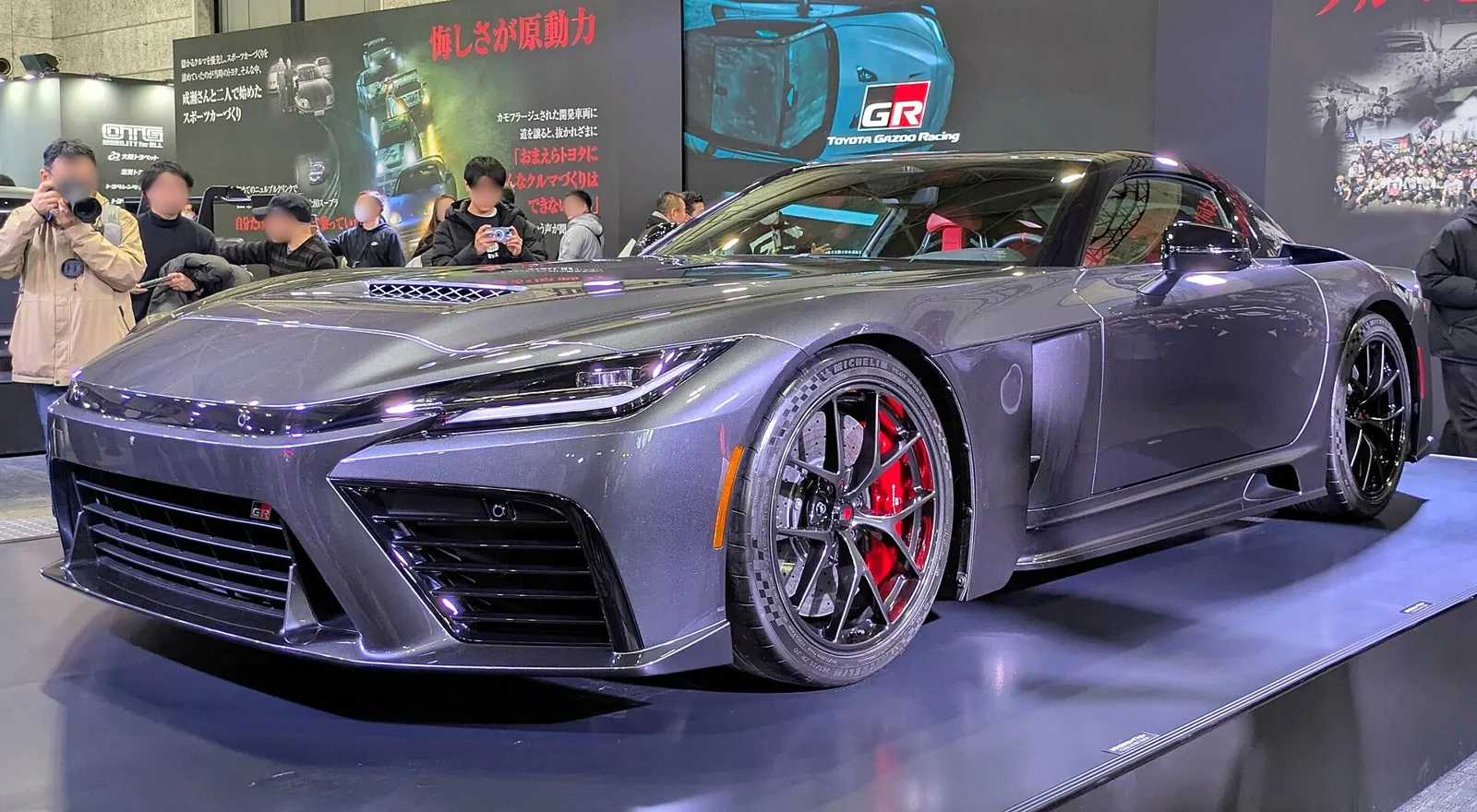
A twin-turbo V8 with a hybrid motor, a first aluminium space frame for Toyota and a design that began with airflow, due in production from 2027.
Toyota's GR GT is a flagship sports car revealed on 5 December 2025, with production planned for 2027. Under the skin sit a twin-turbo 3,998 cc V8 and a hybrid motor producing 650 PS, wrapped in an aluminium space frame. American buyers will find it at select Lexus dealerships.
The Toyota GR GT carries no Toyota badge. It is a twin-turbocharged V8 hybrid grand tourer, built on an aluminium frame that Toyota has never used before and shaped by airflow before styling.
What is the Toyota GR GT?
The GR GT is a V8 hybrid grand tourer from Gazoo Racing, the performance arm of Toyota, with production due to start in 2027. Toyota unveiled it at a world premiere on 5 December 2025, alongside a GR GT3 race car and a battery-electric LFA Concept. In the United States it will be sold through select Lexus dealerships rather than Toyota showrooms.
Toyota calls it simply the GR GT, and the bodywork leaves the Toyota name off, which underlines its standing as a pure Gazoo Racing product. It sits in what the trade calls the S-segment. It is the fifth GR-branded car, the third that Toyota builds itself, and the first standalone GR-branded car.
It is the fifth GR-branded car, the third that Toyota builds itself, and the first standalone GR-branded car.
How did the GR GT get from concept to reveal?
The story starts in January 2022, when Toyota showed the GR GT3 Concept in Tokyo, presenting it as a taste of the GT3 racing category and of a possible road-going version needed for homologation. Nearly four years of patents, trademarks, spy photos and teasers followed.
- January 2022: the concept appears in Tokyo, and Toyota says it hopes to have a working prototype by the end of the year.
- September 2022: patent drawings show the concept without its rear wing, a hint that a road car was in mind as well as a racer.
- March 2023: a GR GT3 prototype is spotted testing at Fuji Speedway.
- January 2024: Toyota files a trademark for the name GR GT, which confirms a flagship sports car and grand tourer.
- October 2024: the road-going car is seen testing on public streets.
- July 2025: camouflaged road and race prototypes make their public debut at the Goodwood Festival of Speed.
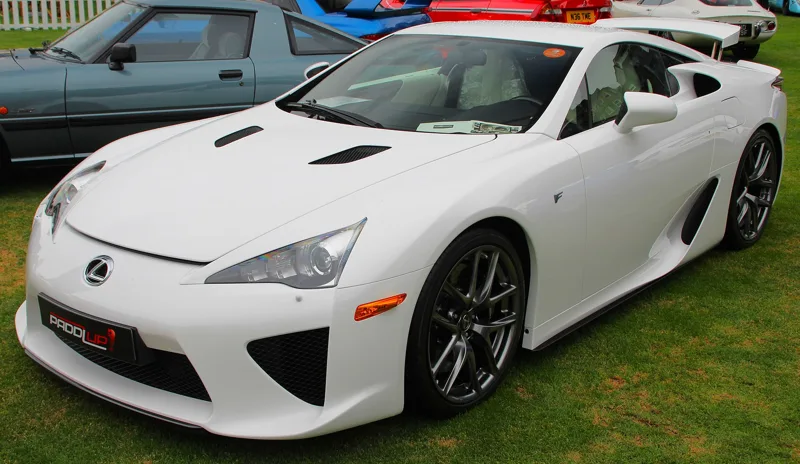
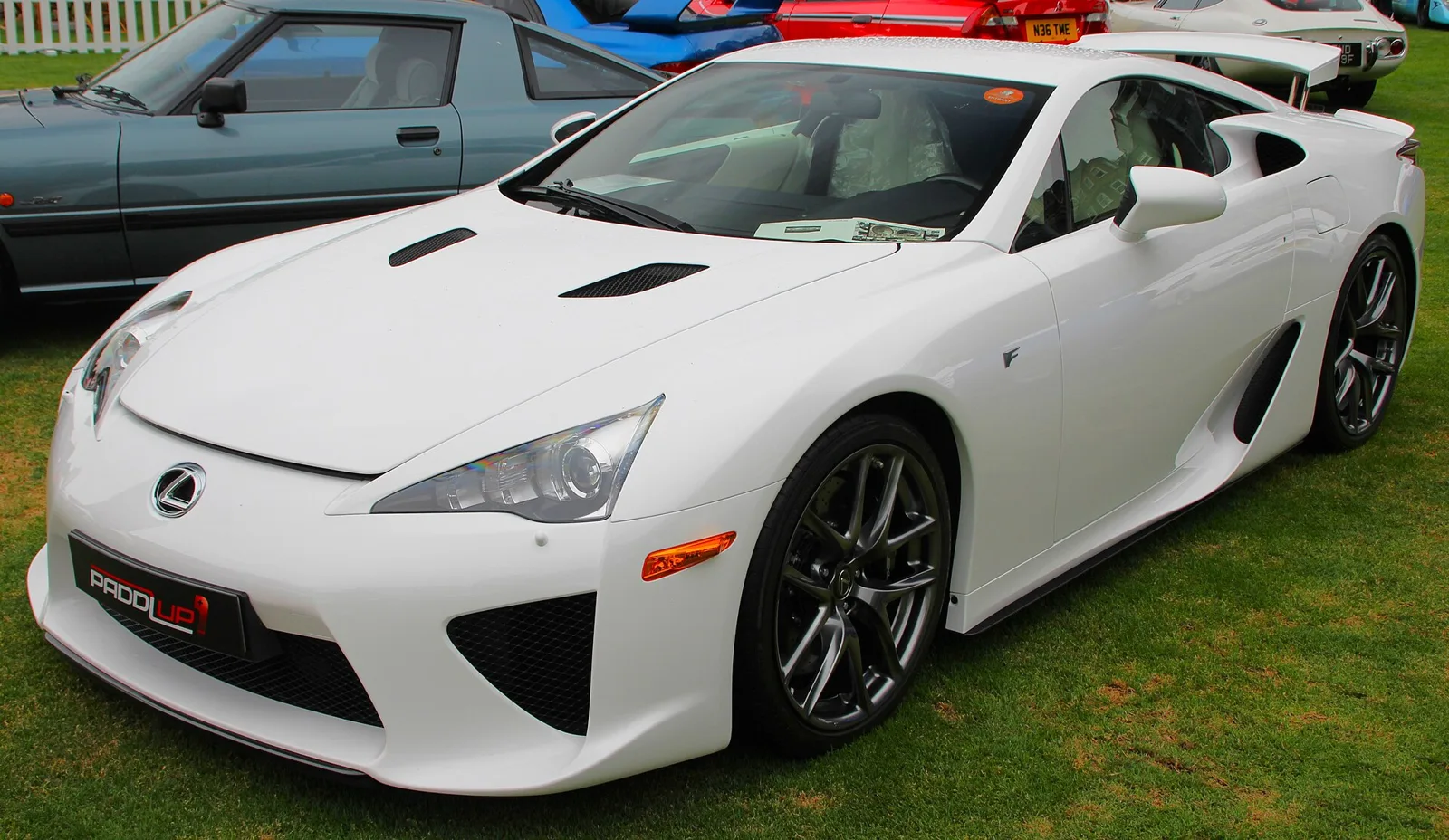
- October 2025: Toyota teases the car beside two of its past performance cars, the 2000GT and the Lexus LFA.
- November 2025: an advertisement shows all three racing in a speedway and confirms the reveal date.
- 5 December 2025: the uncamouflaged car and the GR GT3 race car appear together.
- January 2026: the pair make their first auto show appearance at the Tokyo Auto Salon.
The race car was spotted on track more than a year before the road car was seen on public streets, a sequence that sits comfortably with the way the concept was first described: a racing class first, with a road version to follow.
Why does Toyota want a V8 hybrid flagship?
The clearest answer lies in what Gazoo Racing is for. The division exists to turn lessons from competition into better road cars, and a halo model gives that mission a visible peak. Its production range had run from the GR Supra to the GR Yaris, GR86 and GR Corolla before the GR GT arrived above them.
Gazoo Racing began small. In 2007 an in-house team made up of student test drivers and mechanics, headed by the Toyota test driver Hiromu Naruse, entered the 24 Hours Nurburgring on a minimal budget with Altezzas and BMW E90s. Akio Toyoda, then a vice president of Toyota, drove alongside them. The company formed the Gazoo Racing Company in 2017 as an in-house business, with the stated aim of feeding what it learns in racing back into road cars.
Each GR car so far has had its own recipe. The GR Supra rides on a platform it has in common with the BMW Z4 and is built by Magna Steyr in Austria. The GR86 is developed jointly with Subaru and built at Subaru's Gunma plant. The GR Yaris and GR Corolla come from Toyota's own GR Factory inside the Motomachi plant, where cars are assembled at stations rather than on a conveyor belt. The GR GT is the first to stand entirely on its own.
Lineage is part of the pitch too. Toyota placed the GR GT next to the 2000GT and the Lexus LFA in its teaser campaign, and the LFA was among the development cars Gazoo Racing worked on in its early years, having been conceived to school both drivers and machines on the Nurburgring. That helps explain why a Toyota-built car will be sold in American Lexus showrooms.
Racing results give the badge its weight. Since 2016 the team racing as Toyota Gazoo Racing has taken four World Endurance Championship titles, with three Le Mans wins in the TS050 Hybrid and two in the GR010 Hybrid. In rallying, the manufacturers' title came in 2018, 2021 and again in 2022, the first year of the GR Yaris Rally1. The GR GT3 race car is the next competition car to share its name with a road car.
What powers the Toyota GR GT?
A new 3,998 cc twin-turbocharged V8, coded G40E, working with a single electric motor built into the rear transaxle. Together they deliver up to 650 PS (478 kW; 641 hp) of system output, plus 850 Nm (627 lb ft) of torque. It is the first Toyota V8 with a 90-degree angle between its two banks of cylinders.
Toyota says the brief for the engine was to make it thoroughly compact and light, so the car could have a low overall height and a low centre of gravity. Several choices serve that goal. Its bore of 87.5 mm and stroke of 83.1 mm (3.4 in by 3.3 in) keep the engine short from top to bottom, because a wide, shallow cylinder takes less vertical space than a narrow, deep one.
The turbochargers sit inside the vee between the cylinder banks, a layout known as a hot vee. Think of packing a suitcase with the bulky items in the middle rather than strapped to the outside. A dry sump system keeps the oil in a separate tank, which lets the oil pan under the engine be thinner. Fuel reaches the cylinders through both port and direct injection.
The drive layout is just as deliberate. Power runs to the back through a rigid torque tube in carbon-fibre reinforced plastic, a shaft housing that takes the drive from the engine to a transaxle mounted over the rear axle. That unit combines the electric motor-generator, a newly developed eight-speed automatic gearbox and a mechanical limited-slip differential. A wet start clutch, which is a multi-plate clutch running in oil, takes the place of a torque converter and sends drive straight to the tyres.
Moving the gearbox rearwards, and placing the drive battery and fuel tank to match, leaves the weight split at 45:55 from front to rear. In plain terms, slightly more of the car rests on the driven wheels than on the front pair.
How is the GR GT built?
The GR GT uses an all-aluminium space frame, a first for a Toyota. Large hollow aluminium castings form the main parts of the structure, joined with extrusions, and Toyota claims high rigidity from careful component placement and joining techniques. Carbon-fibre reinforced plastic is used for the bonnet, roof and rear bulkhead, among other panels, and the finished car weighs 1,750 kg (3,858 lb).
Both axles use low-mounted double wishbone suspension with forged aluminium arms. A double wishbone layout locates each wheel with two arms, one above the other, which gives engineers fine control over how the tyre meets the road. Toyota developed the geometry from scratch and says the target was linear response together with a high degree of control.
The standard tyres are Michelin Pilot Sport Cup 2 covers, developed specifically for this car. Brembo supplies carbon ceramic brake discs. The stability control system can be adjusted through several levels, altering how much it intervenes in both drive force and braking.
Why did aerodynamics come first?
A claimed top speed of more than 320 km/h (199 mph) leaves little room to treat airflow as an afterthought. Toyota says the exterior design was settled second, after the aerodynamic and cooling needs had been fixed, which reverses the usual order on a production car.
The engineers fixed the packaging around an aerodynamic model, an ideal shape proposed by the aerodynamics team, and then held long discussions with the exterior designers. Specialists who had worked on cars in the FIA World Endurance Championship joined that effort. The finished car is 4,820 mm long on a 2,725 mm wheelbase, 2,000 mm wide and only 1,195 mm high (189.8 in, 107.3 in, 78.7 in and 47.0 in).
Inside, Toyota gave priority to driving position and visibility, aiming for a layout that suits both professional and individual drivers, on a circuit and on the road. Driving switches sit close to the wheel, with shapes that make them easy to find and press by feel. The shift-up indicator and gear position display were sized and placed to be read at a glance whether the car is on a track or a street.
GR GT and GR Supra compared
| Detail | GR Supra | GR GT |
|---|---|---|
| Status | Built 2019 to 2026, no planned successor | Production due from 2027 |
| Built by | Magna Steyr, Graz, Austria | Toyota |
| Engine | BMW-sourced turbocharged 2.0-litre four or 3.0-litre six | Toyota 3,998 cc twin-turbo V8 with hybrid motor |
| Strongest version | 324 kW (434 hp) in the 300-unit Final Edition | 650 PS (478 kW; 641 hp) system output |
| Gearbox | ZF eight-speed automatic; six-speed manual on six-cylinder cars from the 2023 model year | Eight-speed automatic with wet start clutch in a rear transaxle |
| Structure | Platform shared with the BMW Z4 | All-aluminium space frame with carbon-fibre panels |
| Weight balance | Engineered for 50-50 front to rear | 45:55 front to rear |
| US launch price | US$49,990 in 2019 | Not announced |
The Supra was a smaller, cheaper proposition, conceived with BMW and benchmarked against the Porsche Cayman S. It bowed out in March 2026 following a seven-year run, with no successor planned. The two cars share neither a platform nor an engine maker, so the GR GT reads as a new top rung of the GR range, not a replacement.
What does the GR GT mean for someone hoping to buy one?
Production is due to start in 2027, and the car will go on sale through select Lexus dealerships in the United States.
Toyota describes a brief that covers circuit use and daily use, with a driving position meant to work for professionals and ordinary owners alike. The tyres were developed for the car, the brakes are carbon ceramic and the stability control has adjustable levels, so the hardware leans towards track days even if the layout allows for road use.
Where this goes next
The only firm date is the start of production in 2027. The GR GT3 race car unveiled at the same premiere is the competition side of the project, and a battery-electric LFA Concept was shown beside it.
Around the car, the organisation is changing shape. In January 2026 Toyota announced that Toyota Gazoo Racing would revert to the name Gazoo Racing, and that its European arm would be renamed Toyota Racing, with the exercise completed in January 2027. In Australia a factory GR Supra has contested Supercars since 2026, run by Walkinshaw TWG Racing.
Formula One is the unsettled part. In October 2024 Toyota and Haas announced a technical partnership, and Akio Toyoda stressed that the company was not making a comeback but offering its engineers, staff and drivers experience of the sport. In January 2025 a Toyota motorsport director, Masaya Kaji, said the company was looking into returning. In December 2025 the two companies announced a title sponsorship, so the team runs in 2026 as TGR Haas F1 Team. Toyota previously ran a factory team from 2002 to 2009 and never won a race.

_at_Osaka_Auto_Messe_2026_(cropped).jpg)