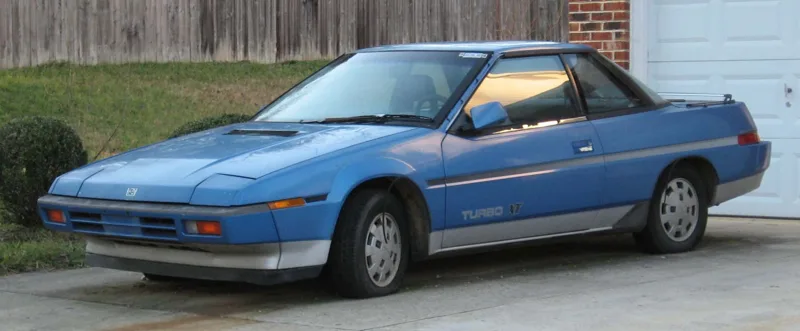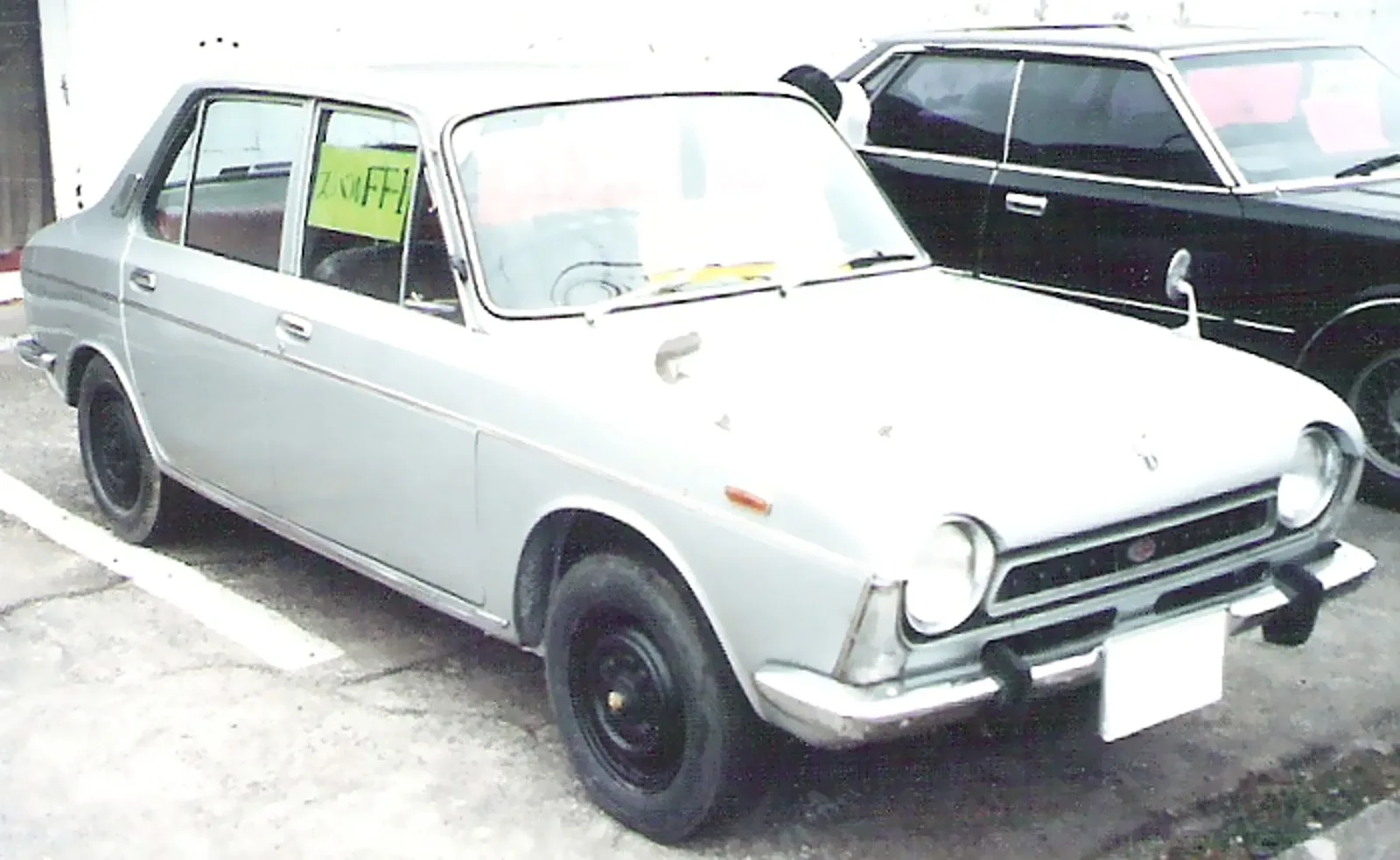
Subaru's first front-engine, front-wheel drive car, built from 1966 as the 1000 and sold abroad as the Star, with a boxer engine and an unusual drive joint.
Known in America as the Star, this car began life as the Subaru 1000 in 1966. It was a front-engine, front-wheel drive compact with a water-cooled boxer engine, built by Fuji Heavy Industries until 1969. Subaru kept the FF-1 name until 1972.
The Subaru 1000, later the FF-1, was built by Fuji Heavy Industries from 1966 to 1969 and sold as the FF-1 until 1972. It was the company's first front-engine, front-wheel drive car, and its boxer engine made it the first production Subaru of that layout. The export name Subaru Star also carried the car into the American market.
What is the Subaru FF-1 Star?
The FF-1 Star is the later name of the Subaru 1000, a compact car that marked a break from Subaru's rear-engined kei cars. It was the first Subaru in the Japanese government compact car classification. Earlier models such as the 360 and the Sambar were rear-engined, rear-wheel drive kei cars.
The car was a development of the 1000 and was facelifted and enlarged for its 1969 launch. Its name changed as it moved between markets, so the same basic engineering appears under several labels.
A front-drive boxer with a water-cooled engine, built as an alternative to rear-drive rivals such as the Corolla.
Why did Subaru build a front-wheel drive car?
Subaru started work in 1962 on a successor to the Subaru 1500 prototype, code-named A-5. Its experimental engine was an air-cooled, horizontally opposed four of 980 cc, but the car never reached production because of the limited resources of Fuji Heavy Industries.
Subaru wanted a car that could carry four people without a cramped cabin. It also wanted to cut engine noise by placing the engine at the front, and to remove the centrally mounted driveshaft by using front-wheel drive. The rivals it had in mind were the Toyota Corolla, Nissan Sunny, Mazda Familia, Hino Contessa, Isuzu Bellett and Mitsubishi Colt 1000, all of which were rear-wheel drive.
A second project, A-4, followed in 1963 with a smaller 923 cc engine. It was assigned production code A-63 and was introduced as the Subaru 1000. The change from air cooling to water cooling came because water cooling made the engine quieter and more compact.
The air-cooled A-5 layout had a logic of its own. Placing the engine at the front used the air the car collected while moving, whereas rivals with rear engines needed external scoops to feed cooling air to theirs. Toyota was the only other Japanese maker using an air-cooled flat engine at the time, in the Publica.
What made the Subaru 1000 technically unusual?
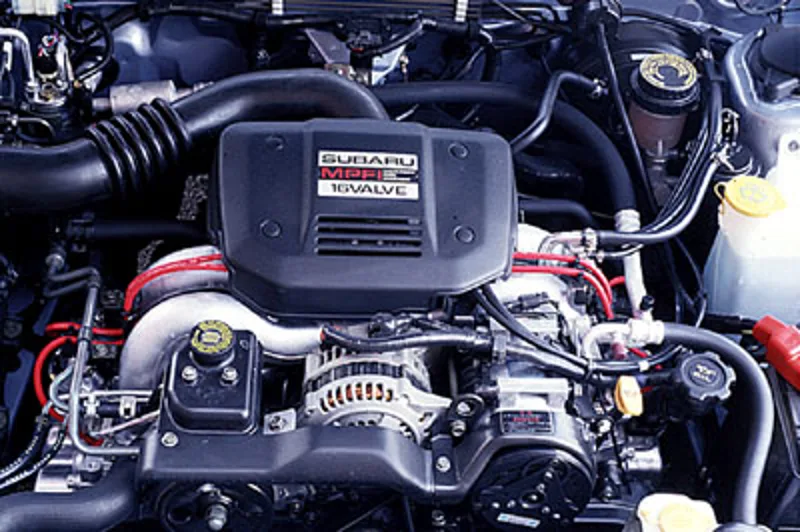
The 1000 used a water-cooled flat-four with overhead valves, and pushrods operated those valves. Subaru engineers had examined designs from Porsche, Renault, DKW and the Chevrolet Corvair before choosing this layout. The main obstacle was the vibration from the universal joints, which was solved with a "double offset joint" developed with the bearing maker Toyo Bearing, now NTN.
Other details set the car apart. It had inboard drum brakes at the front, which reduced unsprung weight and helped the independent front suspension. It also had no heater core, so warmth came directly from the radiator. Subaru kept this unusual brake design into the 1970s.
The suspension combined torsion bars with coil springs, much as the Subaru 360 had done. Modern Subarus still use horizontally opposed engines, although they are much larger and use overhead cams.
How was the Subaru 1000 launched?
The Subaru 1000 was formally introduced on 21 October 1965 at the Hilton Hotel Tokyo, now the Hotel Tokyu Capitol. It appeared at the 12th Tokyo Motor Show later that month, and sales began on 14 May 1966. A national release in Japan followed in October 1966, with the model code A522.
The styling of the A-5 recalled the Citroen Ami, with a reverse-raked notchback rear window like the 1959 Ford Anglia 105E in Britain. Turn signal lamps sat beside that rear window.
Early buyers could order three-point seat belts from October 1966. The two-door sedan, model code A512, arrived on 15 February 1967, and in June 1967 the model codes were unified as A12.
What changed in the 1000 range in 1967 and 1968?
A five-door light van, code A41, arrived on 14 September 1967. It was in reality a station wagon with a folding rear seat, sold as a commercial vehicle to take advantage of Japanese tax rules. Only the lower-powered engine was offered in the van, and it came in Standard or Deluxe trim. The Deluxe was identifiable by a chrome strip along the flanks.
The Sports Sedan followed two months later with the EA-53 engine. The three-door light van arrived in January 1968, when the floor-mounted shifter also became an option on the Deluxe sedans. Sports Sedans gained a dual hydraulic brake circuit as standard. The Super Deluxe, a two- or four-door sedan with a standard floor shift, came in November 1968 with only four months of production left.
How much power did the Subaru 1000 SS make?
The 1000 SS, shown at the 1967 Tokyo Motor Show and offered for 1968, produced 67 PS (49 kW; 66 hp) at 6,600 rpm. Its top speed rose from 135 to 150 km/h (84 to 93 mph). The extra power came from twin SU carburettors and a 10:1 compression ratio.
Stopping and steering improved as well. The SS gained quicker steering, disc brakes at the front, firmer suspension and standard radial tyres. The base 55 PS unit was the EA52 of 977 cc, with a two-barrel carburettor and 9:1 compression, peaking at 6,000 rpm.
What did the FF-1 change in 1969?
The larger and facelifted FF-1 was introduced in Japan on 1 March 1969. It replaced the 1000 in the Japanese line-up and was marketed in the United States as the Star for the 1970 and 1971 model years. Two- or four-door sedans and a five-door station wagon were offered, all with the EA61 engine and a four-speed manual.
The FF-1 was easy to tell from the 1000 by its trim changes, including a revised front grille and interior. A Sports version with a high output EA61 engine appeared in October 1969, and the Super Touring was its four-door sedan. The April 1971 facelift redesigned the taillights and gave the bonnet and boot lid a small lip.
The 1000 had been released before its design was fully complete, so Subaru made many changes during production in response to dealers and owners. The FF-1 carried that development on, and it became a platform of sedans and wagons.
What was the FF-1 1300G?
The FF-1 1300G, code A15, arrived in Japan on 10 July 1970 with the larger 1.3-litre EA62 flat-four. It kept the independent torsion bar suspension, rack and pinion steering, inboard front drum brakes and dual radiators of the 1100. A quicker steering rack went on the sporting models, which were the Sports and the Super Touring.
The EA62 had no cooling fan. Only an electric fan on a small radiator cooled the engine, and the dual radiator arrangement let it warm up quickly and run quietly. The 1300G was also sold as a five-door van in Japan with Deluxe trim, and a floor shifter was an option on that van.
Why did the FF-1 sell well in the United States?
Subaru claimed 29 miles per US gallon (8.1 L/100 km; 35 mpg-imp) for the 1300G. That economy helped the car become a strong-selling import in the United States. In 1972 the same car was sold there as the FF-1 1100.
Subaru was also keen to promote the car's handling in bad weather. Even in 1972 it boasted about the foul-weather handling of its cars, and the cars sold well on that reputation.
The 1972 and 1973 US models mostly used the 1.3-litre EA62 engine. The high compression EA62S added dual exhaust pipes, two twin-barrel Hitachi carburettors and revised camshafts. Its 93 PS (68 kW) output at 7,000 rpm was reserved for the Sports and Super Touring versions.
What was the Tohoku Electric 4WD wagon?
In 1970 the Tohoku Electric Power Company asked a Subaru dealership for an all-weather vehicle with four-wheel drive, because its jeeps were open to the weather and had poor heaters. The company's jeeps were of an old design, and something more modern was wanted. Subaru was asked to convert the 1000 station wagon from front-wheel drive to four-wheel drive, which meant adding a driveshaft, a rear differential and a transfer case.
Two test prototypes ran in March 1971, using a rear differential borrowed from a 510-series Nissan Bluebird. The 4WD wagon was displayed at the 18th Tokyo Motor Show on 29 October 1971, parked on a mirror so visitors could see the drivetrain. It had 20 mm (0.79 in) more ground clearance than the standard car.
Subaru built eight of these wagons. Tohoku Electric bought five, and the other three went to the Village of Hakuba in Nagano Prefecture for agricultural use. In 2008 Subaru located one of the original eight, restored it to its original condition and displayed it at events in Japan.
How many FF-1s were built?
A total of 83,696 FF-1s were built from 1969 until 1972. The 1000 had already reached over 4,000 units a month by March 1969, when it was superseded by the 1100 that the United States knew as the FF-1 Star.
The platform of sedans and wagons was discontinued on 1 September 1972, and sales continued into 1973 alongside the new Leone.
What are the Subaru FF-1 Star specifications?
| Specification | Detail |
|---|---|
| Build years | 1000 from 1966 to 1969; FF-1 from 1969 to 1972 |
| Layout | Front engine, front-wheel drive, water-cooled flat-four |
| 1000 engine | 977 cc EA52, 55 PS (40 kW; 54 hp) |
| 1000 SS engine | EA53, 67 PS (49 kW; 66 hp) at 6,600 rpm |
| 1000 SS top speed | 150 km/h (93 mph), up from 135 km/h (84 mph) |
| FF-1 1100 | 1,088 cc EA61, 62 PS (46 kW) JIS |
| FF-1 1300G | 1,268 cc EA62, 80 PS (59 kW) |
| EA62S | 93 PS (68 kW) at 7,000 rpm, Sports and Super Touring |
| A-4 length | 3,885 mm (153.0 in), wheelbase 2,400 mm (94 in) |
| A-5 length | 3,985 mm (156.9 in), wheelbase 2,470 mm (97 in) |
| US economy (1300G) | 29 miles per US gallon (8.1 L/100 km; 35 mpg-imp) |
| FF-1 output | 83,696 built |