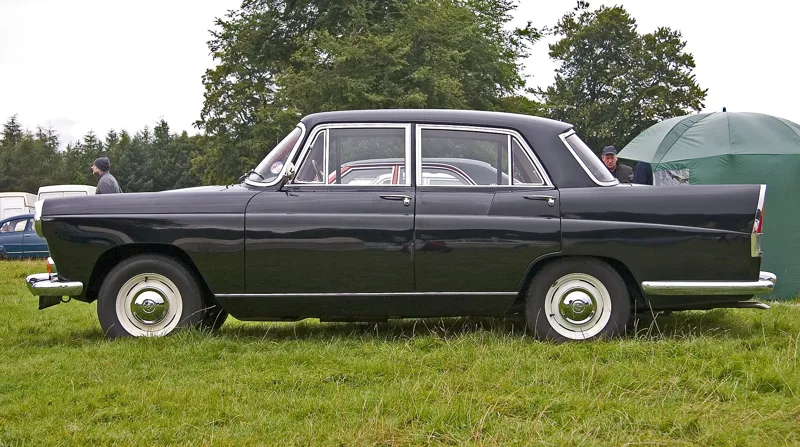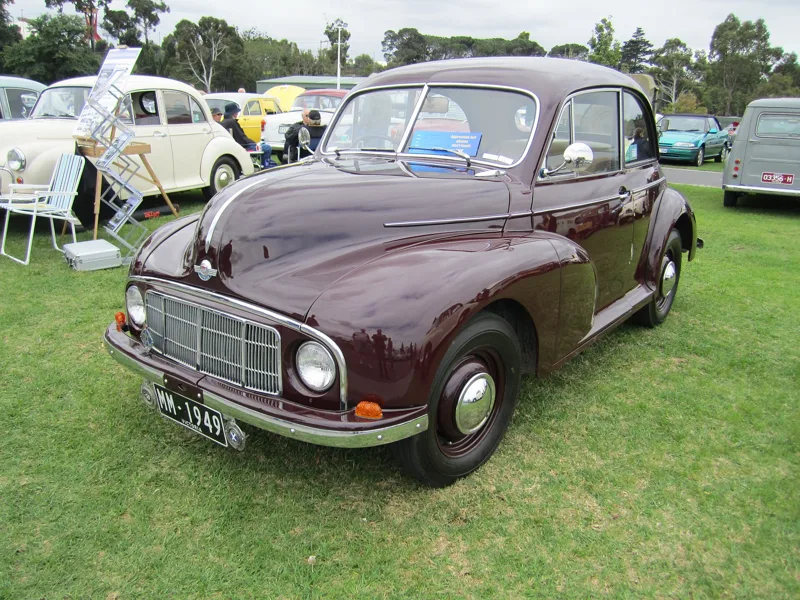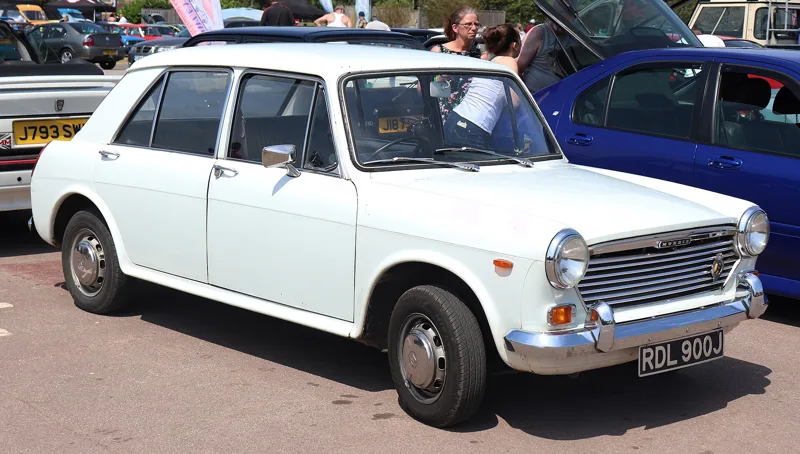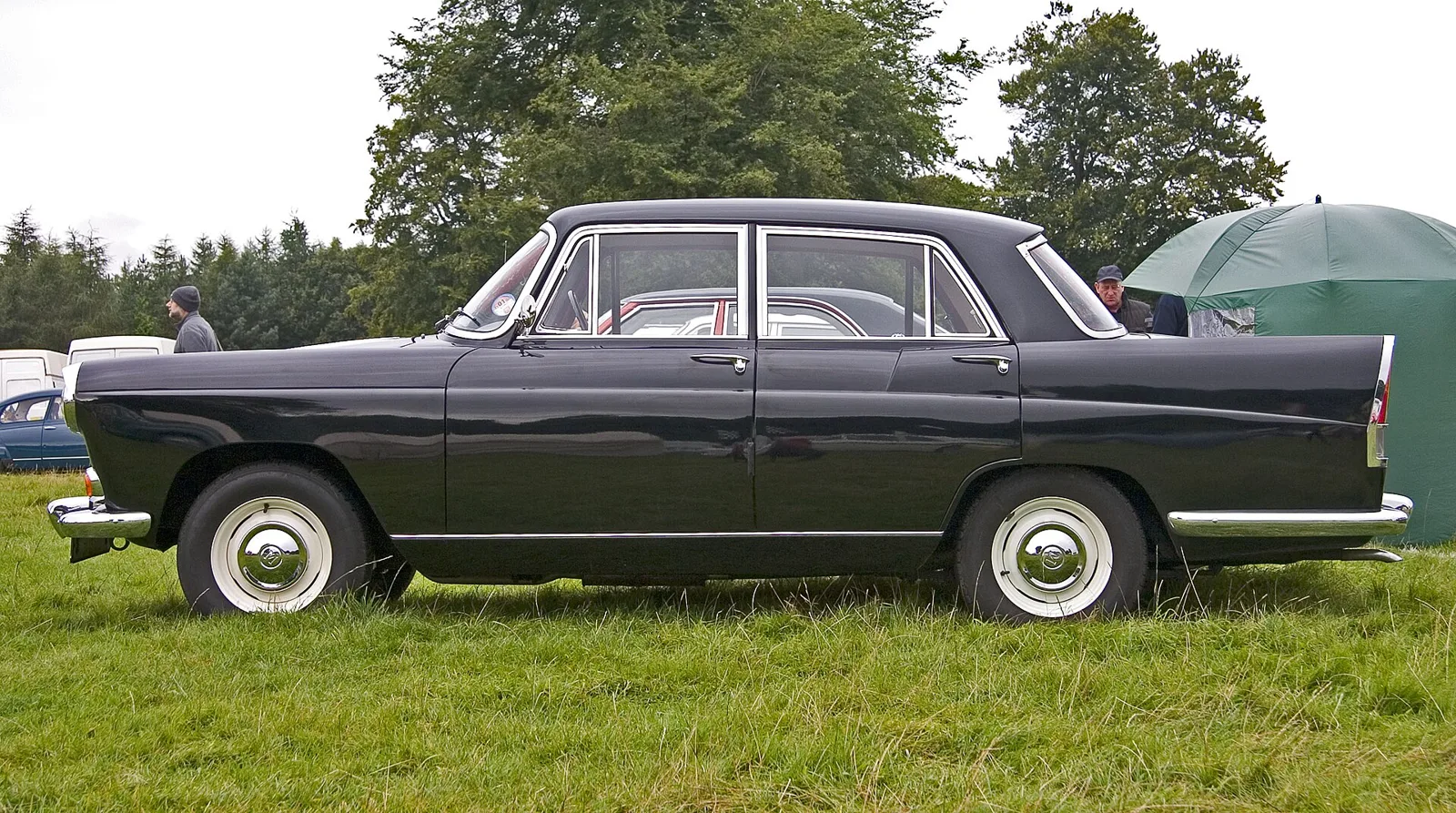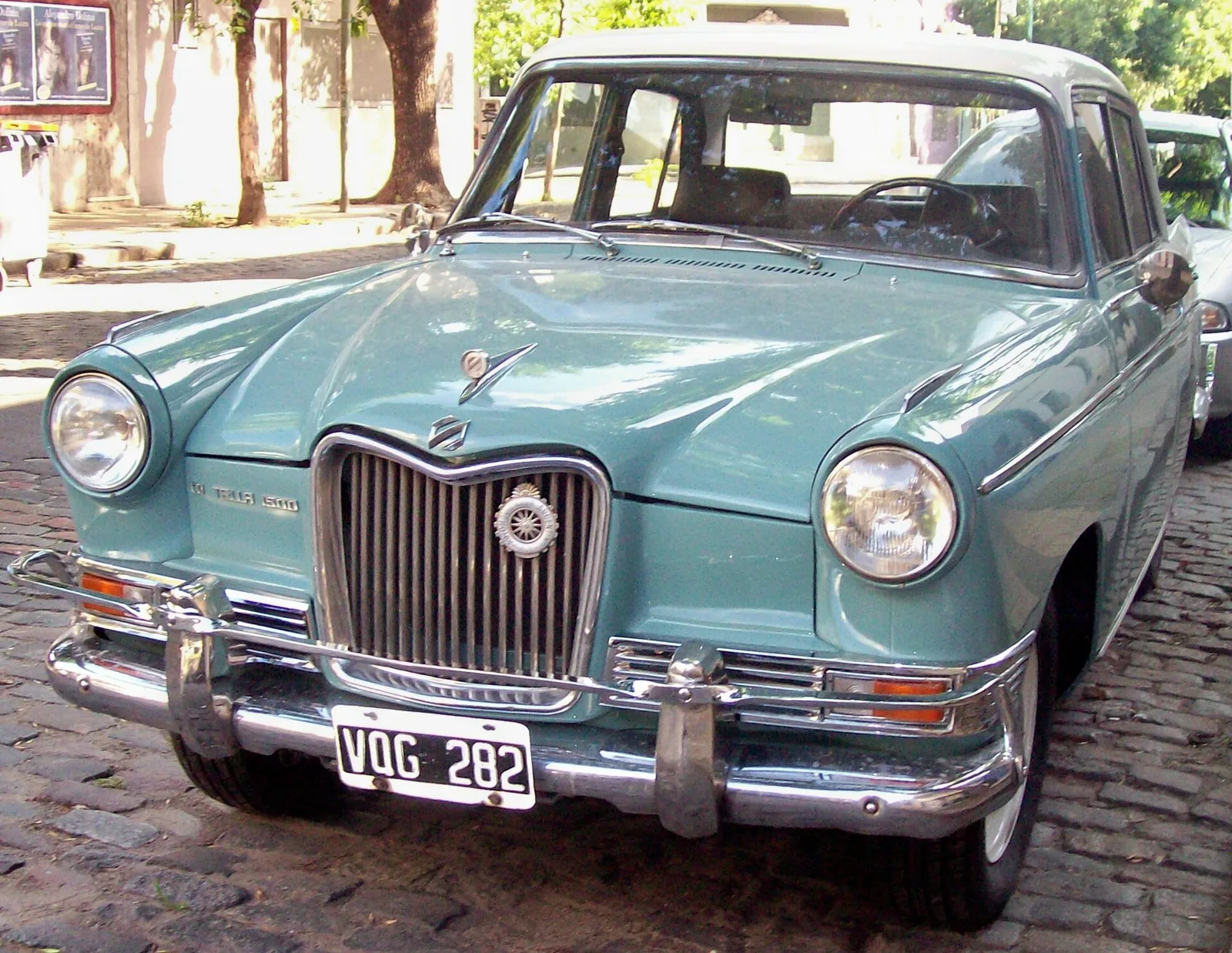
An Argentine-built car on British mechanicals, with Pininfarina styling and a place as an emblematic taxi of Buenos Aires.
The Siam Di Tella 1500 was a segment D saloon built in Argentina under licence from the British Motor Corporation. Its 1,489 cc engine gave 56 HP (42 kW), and it used a Riley front with an Austin rear. Of its first 14,500 cars, 3,870 were used as taxis.
Built in Argentina on British mechanicals, with body lines by the Italian studio Pininfarina, the Siam Di Tella 1500 went on to become an emblematic taxi of Buenos Aires. Its story runs from an appliance maker's car plant to a film and a monument.
What was the Siam Di Tella 1500?
The car was offered as a four-door saloon and as a five-door estate called the Traveller. Its front combined the Riley 4/68 grille and front end, while the rear came from the Austin A-55 Cambridge Mk II. A pick-up for 500 kg, called the Siam Di Tella Argenta, was also developed locally, under the design code ADO-49.
The Siam Di Tella 1500 was classed as segment D. Its five-seat body was built as a self-supporting structure, and BMC was one of the first makers to experiment with that construction method.
Few cars became so closely tied to one city's streets as the Siam Di Tella 1500 did in Buenos Aires.
How did Siam end up building cars?
Siam was a household-appliance company, known for its electric refrigerators, and it later made scooters under licence from the Italian firm Lambretta in the 1950s. Its car business began when the owners decided to take advantage of the car industry promotion scheme that Arturo Frondizi's government had set up in 1959.
Siam Di Tella Automotores SA was formed in 1959 to take advantage of that regime, which allowed it to build models under licence from the British Motors Corporation. The car chosen to start production was the Austin A-60, called the Di Tella 1500 in Argentina, although its grille and front details came from the Riley 4/68.
How quickly was the factory built?
Siam fitted out an empty premises it owned at Monte Chingolo, in the Buenos Aires province. The works on the complex of 50,000 square metres began at the end of October 1959 and took 126 days, and the factory opened on 15 March 1960.
Within a fortnight, on 2 April, the first Siam Di Tella 1500 came off the production line. Demand was strong, and the 1,000th unit was built on 2 September. Line production was supervised by English technicians from BMC, whose main aim was to shorten production times to meet the growing demand. Demand reached 4,000 units in the first year.
The following year the figures roughly tripled, in step with growth in car output and in industry generally. A simple and reliable mechanical package and a competitive price made the car ideal for the middle-class family.
What engine did the Siam Di Tella 1500 use?
The car used a B Series engine of Austin origin, with a cast-iron block, a four-stroke Otto cycle and four cylinders in line. It produced 56 HP (42 kW) at 4,500 rpm, from 1,489 cc (90.9 cu in). The valves sat in the head, operated by pushrods and side tappets, and the cooling circuit used a pump driven by the engine.
Two features were unusual for Argentina in the 1960s. The first was the SU carburettor, the Skinner Union design, which had a variable venturi controlled by a piston and a tapered metering needle. The mixture was regulated by intake vacuum, which reached the carburettor through a rubber hose connected to the valve cover.
The second was the fuel pump. Most cars of the period used mechanical pumps, but the Siam's was an electric diaphragm unit by Joseph Lucas, which delivered a precise amount of fuel and helped economy. Most of the car's electrical equipment also came from Lucas, which was based in Birmingham.
Many people in Argentina believed the engine was related to the Dodge 1500, sold in the United Kingdom as the Hillman Avenger. It was not. The B Series had no kinship with the design developed by the Rootes group for Chrysler. Austin had patented the B Series in 1936, and it was improved on several occasions, becoming one of the longest-running engines in continuous production with hardly any change.
How did the Siam Di Tella 1500 drive?
The four-speed gearbox had synchromesh on every gear except first and reverse, and was operated by a lever beside the steering column. Its gear speeds were 50 km/h (31 mph) in second, 83 km/h (52 mph) in third and 117 km/h (73 mph) in fourth, where transmission vibration could be felt. The first and second ratios were very short, while third was long enough to make town driving relaxed. Above 40 km/h the difference between third and fourth was barely noticeable, thanks to the engine's exceptional flexibility.
The ride was much praised, for a smooth, quiet and soft feel that could still carry heavy loads. The front axle used double wishbones with coil springs and Armstrong Super lever-arm dampers, and the rear was a rigid Hotchkiss-drive axle on longitudinal leaf springs. Girling drum brakes worked on all four wheels, and the handbrake was a cable-operated unit on the rear wheels. For Argentine roads the suspension was modified, with the front end and the rear damper mounts reinforced.
The clutch was a dry-disc unit with hydraulic operation based on a Borg and Beck design. Some drivers complained of a difficult gear change until they became used to the travel, and the long first-gear travel earned the car a nickname. Taxi drivers in particular often fitted an H-pattern gear lever to the floor, which they found more reliable.
How big was the Siam Di Tella 1500?
The Siam 1500 was a spacious segment D car able to carry five people, the driver included. Its body was reinforced by two longitudinal side members with joints, one of which carried the engine and suspension, which made it particularly robust.
| Dimension | Measurement |
|---|---|
| Length | 4,520 mm (178.0 in) |
| Width | 1,620 mm (63.8 in) |
| Height | 1,520 mm (59.8 in) |
| Wheelbase | 2,520 mm (99.2 in) |
| Front track | 1,241 mm (48.9 in) |
| Rear track | 1,267 mm (49.9 in) |
| Ground clearance | 17 mm (0.7 in) |
| Tyres | 5.90-14, 23 lb/sq in front and 25 lb/sq in rear |
| Kerb weight | 1,090 kg (2,403 lb) |
The fuel tank sat over the rear axle in the boot, level with the C-pillars and out of harm's way. It held 46 litres (12.2 US gal), and the Lucas electric pump sat in one of its corners.
How much fuel did the Siam Di Tella 1500 use?
The Siam's urban fuel use was 10.3 L/100 km (27.4 mpg-imp; 22.8 mpg-US). On the open road the figures were 9.3 L/100 km (30.4 mpg-imp; 25.3 mpg-US) when cruising at 80 km/h. At 110 km/h the car used 11.8 L/100 km (23.9 mpg-imp; 19.9 mpg-US), per the owner's handbook.
With a full tank the car could cover 485 km plus the reserve. Its top speed was 117 km/h (73 mph), and the fuel economy of the car was one of the reasons so many were used as rental taxis.
Which other models shared the Siam's platform?
In 1966, because of financial difficulties at Siam Di Tella Automotores, the subsidiary CIDASA, part of Industrias Kaiser Argentina, became the new licensee of BMC. Vehicles from then on were sold under the names Riley, Morris and M.G. (Morris Garages), each with some local peculiarities.
The redesign of these models carried the code ADO-38 and came from the Austin Design Department, under Alec Issigonis, designer of the Mini. Four of the models had no equivalent on the British market, in Australia or in New Zealand, and the Siam's Riley grille on an Austin tail was a case in point.
The Morris 1650 Fordor was a four-door saloon with better equipment in its seats and instrument panel, and with 1,622 cc (99.0 cu in) of capacity. The M.G. 1650 was the most luxurious of the range, with the B Series engine of 1,622 cc and exclusive instrument panel changes, but only a few were built, and only in Argentina.
The estate version of the Morris was the Traveller, which matched the Australian Freeway at the front and rear but not in its engine. The Freeway had a 2.4 six-cylinder engine designed in Australia that was never sold in the United Kingdom.
British Riley 4/68 and 4/72 cars kept one rear light design all along, close to the M.G. Magnette's. Only in Argentina did the Riley 1500 take the newest Cambridge rear light, a more geometric unit with a wraparound bumper, though on smaller dimensions. Unlike the United Kingdom and Australia, the Austin and Wolseley brands were not sold in Argentina.
The M.G. Magnette had an appearance identical to the Siam Di Tella 1,622 cc apart from its badges, and was physically identical to the British car but not mechanically. The M.G. 1650 had a descending tail design with no equivalent under that badge in Britain or any other market.
What else did the Siam carry as standard?
The instruments came from Smiths and included a speedometer, partial and total odometers, and gauges for engine temperature and oil pressure. Because the dynamo charged the battery only above a certain engine speed, owners often added an analogue ammeter or voltmeter, as the car's own red warning light only signalled discharge.
The spare wheel was stored neatly under the boot floor, in a metal cradle lowered by a worm screw turned from inside the boot. That crank could also turn the engine without the starting handle, in case of a fault or a weak battery. These were the last cars made in Argentina with the handle that hooked onto the lower pulley, reached through a slot in the centre of the bumper.
How did the Siam become a taxi and a cultural icon?
The Siam became an ideal car for taxi drivers. Of the first 14,500 cars built, 3,870 were used as taxis. Owners also praised its economy, which was one reason so many were put on the meter. Its robust engine and easy ride suited the job, and it became the emblematic vehicle of the profession in the city.
The car has also appeared in culture. The Siam was chosen as the car for the opening season of the series Rolando Rivas, taxista. Claudio Garcia Satur and Soledad Silveyra were in the cast. An ordinance from the time of the 1978 World Cup forced cars more than ten years old out of taxi service.
The Fuerzabruta theatre company began in 2003 as an independent project from De La Guarda. Its show has been staged in Lisbon, London, Madrid, Barcelona and New York. It was presented in the parade for the Bicentenary of the May Revolution on 25 May 2010, and from July 2011 it was performed every day at the Tecnopolis exhibition.
A monument to the taxi driver by Fernando Pugliese stands at Puerto Madero, in a polymer sculpture imitating bronze, showing a driver with his Siam Di Tella 1500. The car also has a central role in the 2012 film Masterplan, directed by Diego and Pablo Levy.