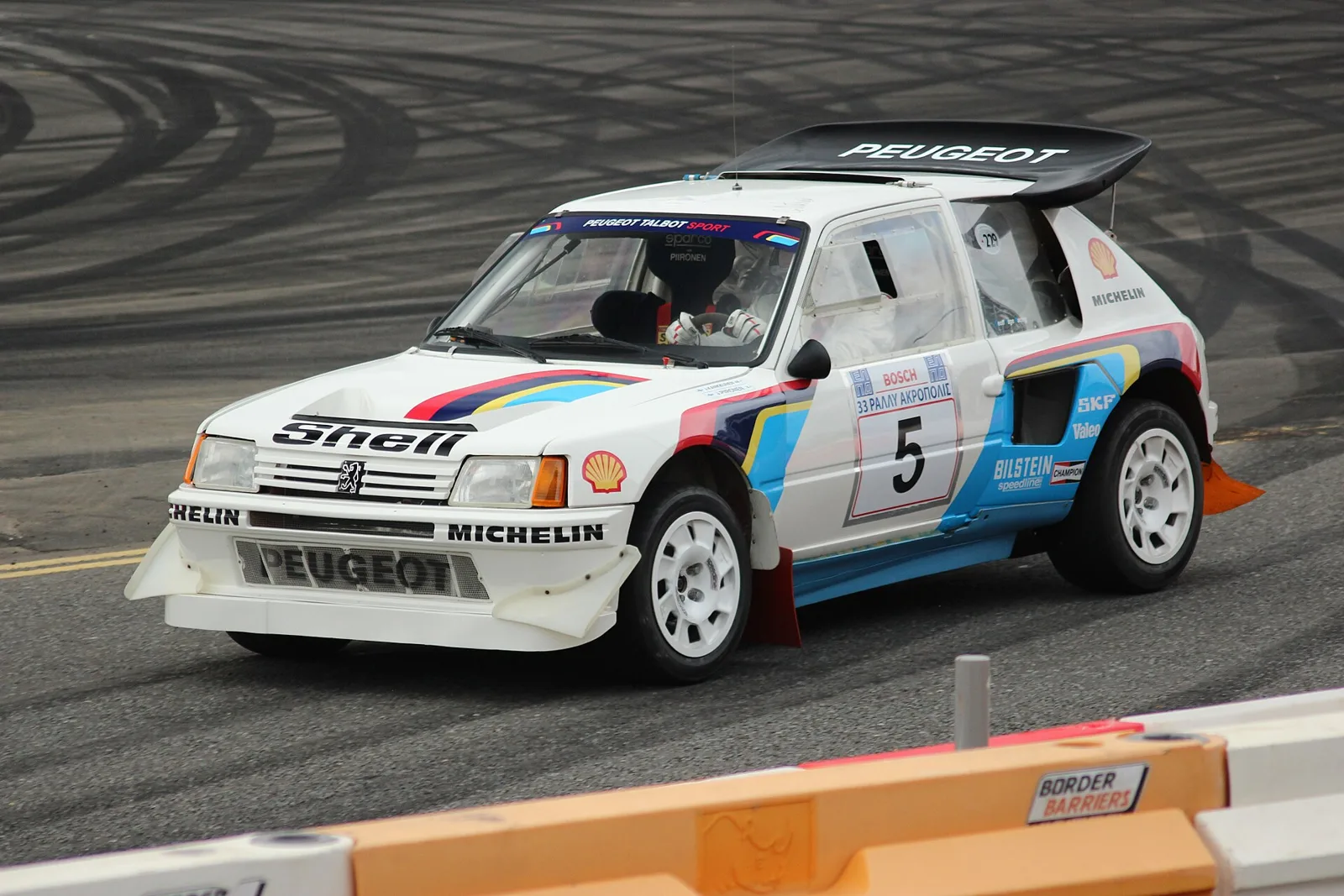
Built to homologate a racing rally car, the 205 Turbo 16 won manufacturers' and drivers' titles for Peugeot in 1985 and 1986 under Jean Todt's programme.
The Peugeot 205 Turbo 16 was a four-wheel-drive rally car homologated in Group B for the World Rally Championship. It debuted at the 1984 Corsica Rally and helped Peugeot win the manufacturers' and drivers' titles in 1985 and 1986. Its Evo 2 version produced 550 PS (542 hp; 405 kW).
The Peugeot 205 Turbo 16 was built to win rallies in Group B, a very open and permissive class. A road version was made to meet the homologation rules, and the competition cars that followed took the manufacturers' and drivers' titles in 1985 and 1986.
How did Group B change rallying?
The World Rally Championship began in 1973, and its early cars came mainly from Groups 2 and 4. In 1982 the international federation introduced Group B, which brought four-wheel drive and turbocharged engines to the sport, with power raised to new limits.
Manufacturers could build cars purely for competition, on condition that they produced only 200 road units for the market.
A road car built to satisfy the rules, and a rally car that pushed rivals to rethink their own designs.
Why did Peugeot enter the World Rally Championship?
Until 1981 Peugeot's rally presence was mostly in African events, where its 404 and 504 cars had done well. Company president Jean Boillot wanted a more dynamic image, and the launch of the 205 supermini offered a chance to commit fully to competition. The brand was in financial trouble after the failed purchase and relaunch of Talbot.
The brand's leadership saw the 205 as a way out of that crisis, pairing an affordable everyday model with a major competition programme.
Who led the programme and built the team?
Jean Todt, a former co-driver, was given control of the programme and a large budget. He was asked for two things: that the new car look as much like the production 205 as possible, and that it be a winner. He surrounded himself with engineers from Formula One, including Andre de Cortanze.
Todt had four World Championship wins as a co-driver. Two of them came with Hannu Mikkola in a Peugeot 504 at the 1975 Morocco Rally and with Guy Frequelin in a Talbot Sunbeam at the 1981 Argentina Rally, a season in which the pair also chased the title against Ari Vatanen.
What did the Turbo 16 borrow from its rivals?
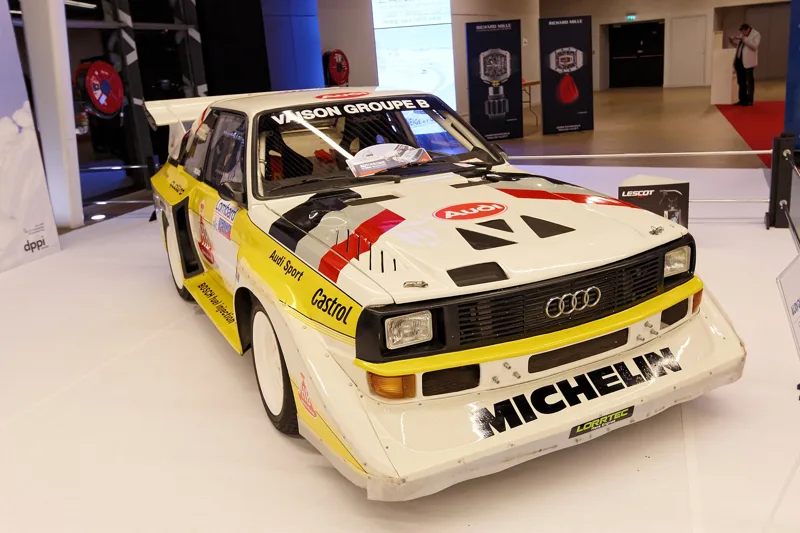
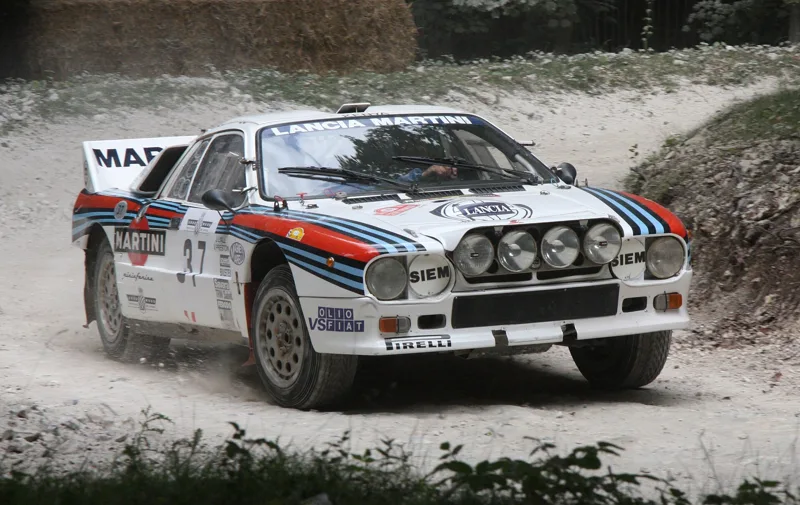
Peugeot combined the lightness and mid-engined layout of the Lancia Rally 037 with the four-wheel drive and turbo supercharging of the Audi Quattro. The result was a compact chassis built around a central monocoque cell, built with aluminium beams and welded panels in a space-frame arrangement.
The engine sat transversely over the rear subframe, and the gearbox and rear axle were housed in the same subframe. A viscous central differential could shift torque between the axles, from 33 to 46 kg-m (324 to 451 N-m; 239 to 333 lb-ft), favouring either axle.
A naturally aspirated V6 had been considered early on, but the turbo four was chosen for its lower weight and mechanical simplicity.
How much power did the early engine make?
The 1,775 cc (108.3 cu in; 1.8 L) turbo four produced 300 PS (296 hp; 221 kW) at first, a figure later passed by the evolutions. Its K26 twin-scroll turbocharger ran at 1.4 bar (19.9 psi; 137.2 kPa), with K-Jetronic injection and four valves per cylinder.
The gearbox was a five-speed manual that Peugeot recovered from the Citroen SM, and the engine used dry-sump lubrication.
How did Peugeot price the road car?
Peugeot sold the 200 road-going 205 Turbo 16 units at a price below cost, and finished them in anthracite to keep costs down.
How was the road car homologated?
FISA inspected the required 200 units on 29 March 1984, and approval followed on 1 April 1984 under homologation number B262. The road car wore anthracite paint to cut costs, and the units were sold below cost.
The road T16 had wider wheel arches, a bonnet outlet, bulging wings and a rear-mounted engine. It weighed 1,210 kg (2,668 lb), and made 200 PS (197 hp; 147 kW) at 6,750 rpm with 26 kg-m (255 N-m; 188 lb-ft) of torque at 4,000 rpm. Sports seats and harnesses gave the cabin a competition feel.
How did the homologation rules shape the 205?
Group B let manufacturers homologate new parts or evolutions by building just twenty more cars.
The rules rewarded makers that could build cars from scratch without mass production, cutting their costs. The 205 was a product of exactly that freedom.
How did the first test go?
The 1983 Mille Pistes test went badly, and the Citroen Visa 4x4 of Jean-Luc Therier beat the Peugeot. Its four-wheel drive did not quite work, the turbo was too slow and then too abrupt, and the car was hard to drive. Engineers fixed these problems over a long process before the 1984 Corsica Rally.
What changed between the first version and the Evo 2?
The first version, the 205 Turbo 16, had 350 PS (345 hp; 257 kW) and weighed 940 kg (2,072 lb), which was 230 kg (507 lb) less than the road car. Its light materials, Kevlar among them, sat on a steel monocoque chassis. The Evo 2 replaced it mid-season at the 1985 Finland Rally.
The Evo 2 gained a tubular rear structure that cut its weight to 910 kg (2,006 lb), two front skirts and a large rear wing. The first car still appeared in later events, usually in the hands of private drivers. Its dampers had temperature control adjusted by the co-driver, and it could reach 100 km/h (62 mph) in two seconds.
Who were the rivals on the stages?
The favourites at the 1984 Corsica Rally were the rear-wheel-drive Lancia Rally 037s of Markku Alen and Miki Biasion, which suited Corsica's narrow roads. The Audi Quattros of Stig Blomqvist and Walter Rohrl and the Toyota Celicas of Juha Kankkunen and Bjorn Waldegard were also among the rivals.
The Renault 5 Maxi Turbo of Jean Ragnotti won the 1985 Corsica Rally, while the Citroen Visa 4x4 had already beaten the Peugeot in the 1983 test. The Lancia Delta S4 of Henri Toivonen debuted with a win at the 1985 RAC Rally, foreshadowing the Lancia against Peugeot duel of the following year.
How did the 1984 season unfold?
The official debut came in May at Corsica, where Vatanen's fastest time came on the second stage, a 22.25 km (13.83 mi) run between Sainte Marie Sicche and Moca. He led until stage nineteen, when he went off the road in the rain and crashed. Jean Pierre Nicolas finished fourth, ahead of Stig Blomqvist, and Markku Alen won, followed by Miki Biasion.
At the Acropolis Rally Vatanen again led the event and set eleven fastest stages, two fewer than the winner Blomqvist, until a mechanical problem ended his run. Nicolas also retired late with brake trouble.
The third event, the 1000 Lakes Rally, gave Vatanen the car's first victory, with thirty-one fastest stages out of fifty-one. He finished two minutes clear of Alen, with Henri Toivonen more than four minutes back, and both drove Lancia Rally 037s. He won at San Remo too, and at the RAC Rally he came through from behind after a rollover. Three wins from five rallies left Peugeot third in the manufacturers' table.
What happened in 1985?
Vatanen won the first two rounds, and at Monte Carlo he recovered from an eight-minute penalty to win by more than five minutes over Walter Rohrl of Audi. Salonen finished on the podium in his first event with the 205, and the team's third driver, Saby, finished fifth.
Salonen won in Portugal on the Arganil stage, and at the Acropolis he began four straight victories that carried him to the top of the standings. Vatanen crashed heavily on the second stage in Argentina and spent two weeks in a coma, which kept him out of competition for two years. Salonen won that round too. He was crowned world champion later, in Finland, with three events remaining.
At Corsica, Peugeot's Evo 2 debuted with Saby second, but the event was overshadowed by the death of Attilio Bettega, who hit a tree in his Lancia Rally 037. The San Remo Rally went to Rohrl in an Audi Sport Quattro S1, with Salonen second, and at the RAC Rally the Lancia Delta S4 of Toivonen won on debut.
In Portugal, Rohrl of Audi and Massimo Biasion of Lancia dominated the event until Salonen came through on the Arganil stage, and a five-minute penalty then cost Rohrl the win. For Argentina Peugeot also entered the Argentine driver Carlos Reutemann, alongside Salonen and Vatanen.
The Evo debuted at Corsica with a rated output of 430 PS (424 hp), and its visible changes were a rear wing and front side deflectors.
Private entrants ran 205s too. Paul Gardere finished the Monte Carlo Rally in twelfth place in a private 205, and Giovanni del Zoppo took seventh at San Remo in another private car.
The Safari Rally ended the events of Vatanen and Saby, the first with a head gasket failure and the second in an accident. Salonen's seventh place was the only finish for a 205, behind Toyota Celicas.
In Greece Salonen led from start to finish, and New Zealand brought the team its best result of that season, with its two drivers on the podium.
Blomqvist won the Acropolis Rally in 1984 and set the pace there, while in Greece in 1985 his Audi troubles left him second behind Salonen. By then Blomqvist, who could not finish in Argentina, still held second place in the standings.
How did the 1986 season and the Evo 2 finish?
The Evo 2 made fifteen official appearances across 1985 and 1986, achieving seven victories and fifteen podiums. The brand also won the manufacturers' and drivers' titles in 1986.
What did the Group B ban mean for the car?
After the Group B ban the 205 was assigned to other competitions, and the cars kept competing, including in events such as Dakar. The 205 won the Rally Dakar in 1987 and 1988, and a longer 405 Turbo 16 added two more Dakar wins.
The 405 Turbo 16 was also used, with some changes, at the Pikes Peak International Hill Climb. Rivals had seen the 205's mechanical structure as a model and in some cases copied it.
What came after the 205?
In 2013 Peugeot developed a competition version of the 208 in the R5 category, and named it the 208 T16 in homage to the 205 Turbo 16. Four-wheel drive comes with the package, along with a 1.6 turbo whose 32 mm (1.3 in) restrictor flange limits airflow, and a five-speed sequential transmission.
Specifications at a glance
| Specification | Value |
|---|---|
| Engine (1984 to 1986) | 1,775 cc (108.3 cu in), turbocharged four |
| Competition power | 350 PS (345 hp; 257 kW) at 8,000 rpm, first version |
| Competition weight | 940 kg (2,072 lb), first version |
| Road car | 1,210 kg (2,668 lb), 200 PS (197 hp; 147 kW) at 6,750 rpm |
| Evo 2 power | 550 PS (542 hp; 405 kW) at 7,600 rpm |
| Evo 2 weight | 910 kg (2,006 lb) |
| Homologation | B262, 1 April 1984 |
| Titles | Manufacturers and drivers, 1985 and 1986 |