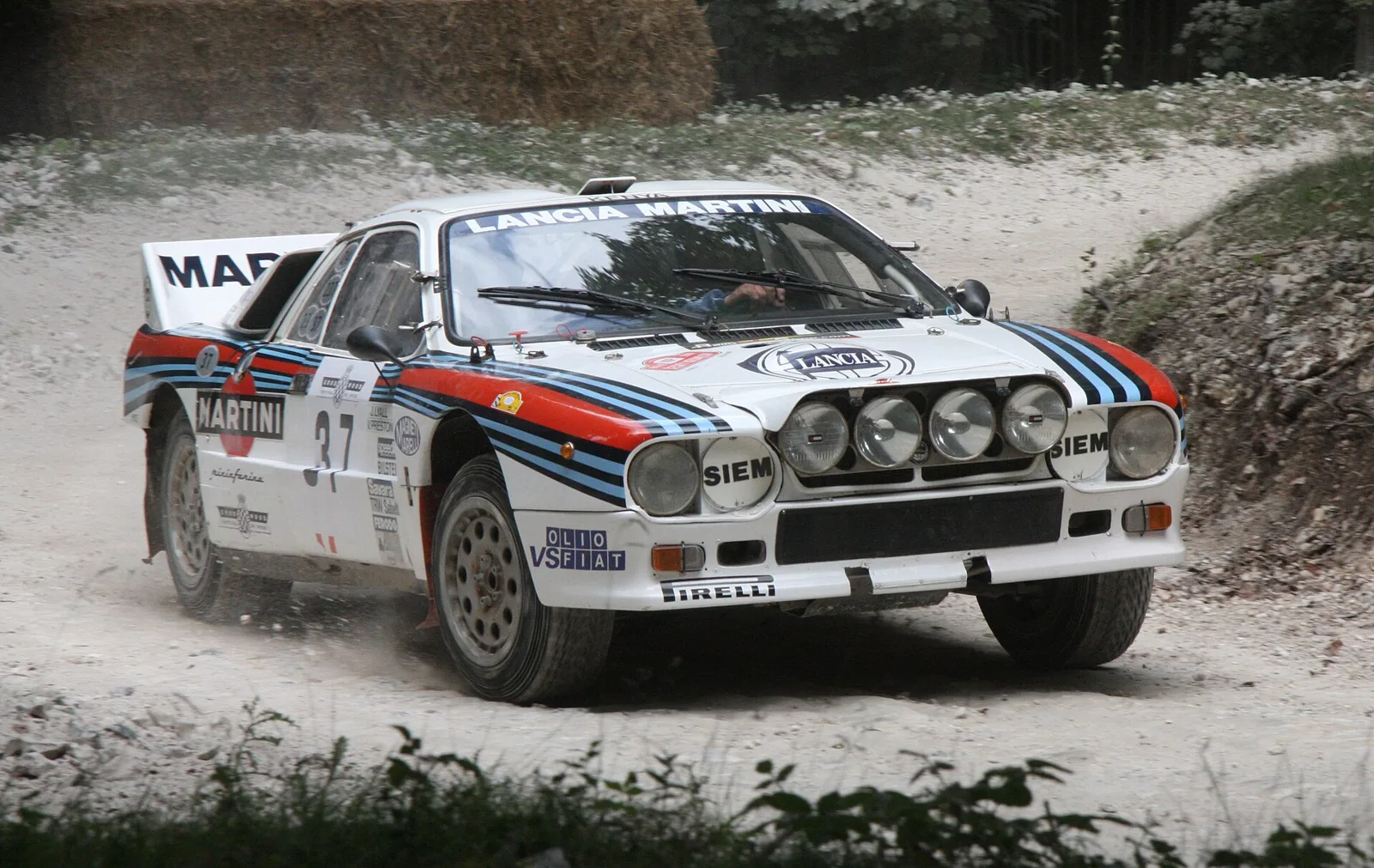
The last rear-wheel-drive WRC champion, six straight Delta titles and a 34-year wait, ended in Croatia in April 2026.
The Lancia Rally 037 won the 1983 WRC manufacturers' title as the last rear-wheel-drive champion. Lancia Corse HF returned in 2026 with the Ypsilon Rally2 HF Integrale, won in Croatia after 34 years and took the WRC2 teams title.
The last rear-wheel-drive car ever to win a World Rally Championship title was a Lancia. The marque's final WRC win before its return came in the 1992 season, 34 years earlier. When Yohan Rossel and Arnaud Dunand won the Croatia Rally on 12 April 2026 in a Lancia Ypsilon Rally2 HF Integrale, a name that had gone quiet after 1992 was back at the front.
The two cars sit at opposite ends of a long story. The Lancia Rally 037 was the machine that held off four-wheel-drive rivals for a season in 1983. The Ypsilon Rally2 HF Integrale, run by the revived Lancia Corse HF, is the car that has carried the badge back into the World Rally Championship.
What was the Lancia Rally 037?
The Lancia Rally, known inside the company as the Tipo 151 and to everyone else as the Lancia 037 or Lancia Rally 037, was a sports car with its engine behind the driver, built in the early 1980s to go rallying in Group B. Its name comes from Abarth's project code, SE037. It came in three main forms: the Evoluzione 1 and Evoluzione 2 rally cars and the Stradale road car.
Markku Alen, Attilio Bettega and Walter Rohrl drove it, and in 1983 it won the manufacturers' world championship for Lancia. It remains the last rear-drive winner of the championship.
Built to the new Group B rules
Lancia began work on the car in 1980 to fit the new Group B regulations, which let manufacturers go racing with relatively few road-going homologation cars. Abarth did most of the design and worked a double-bubble roofline into the shape, a reference to its own race cars of the 1950s and 1960s. Pininfarina, Dallara and project manager Sergio Limone also took part. Lancia built 200 road cars before the 1982 season to satisfy the rules.
The 037 was loosely based on the Lancia Montecarlo, which was sold as the Scorpion in the US and Canada. It shared the centre section, but every body panel and mechanical part was different. Steel subframes ran ahead of and behind that section, and most of the body panels were Kevlar. The car looks like a silhouette racer, yet the road and race versions were built the same way and the 037 was sold as its own model, so it does not strictly qualify as one.
How the 037 worked
The Montecarlo had a mid-mounted engine sitting across the car. For the 037 Lancia kept the position but turned the engine to run front to back. That gave the designers more freedom with the suspension, and moved engine weight forward. A double wishbone layout was used at both ends, and the rear had twin shock absorbers on each side to cope with the pounding of high-speed driving on rough roads.
The engine was a supercharged four-cylinder developed from the one in the Fiat Abarth 131 rally cars, built on a long-stroke Fiat Twin Cam block with the 131's four-valve head. Early cars used a single large Weber carburettor in place of the 131's twin carbs, and later cars switched to fuel injection. A ZF transaxle handled the gears.
Lancia chose a supercharger over a turbocharger to remove turbo lag and sharpen the throttle response. Output was first quoted at 195 kW (265 hp), then raised to 206 kW (280 hp). The final Evolution 2 engine made 239 kW (325 hp) after its displacement grew to 2.1 litres (2,111 cc).
The rear-wheel-drive layout is the part that dates the car. It was the normal arrangement for rally cars before Group B, but almost every successful rally car since has sent power to all four wheels, which makes the 037 the last of its kind to win.
Lancia's last rear-drive champion and its WRC2 comeback car share one badge and 34 years of waiting.
How the Lancia 037 raced in the World Rally Championship
The 037 first competed at Italy's Rally Costa Smeralda in 1982. Two cars started and both retired with gearbox problems. The rest of that first season was full of retirements, although the car did win several rallies, the first of them the Pace Rally in the UK.
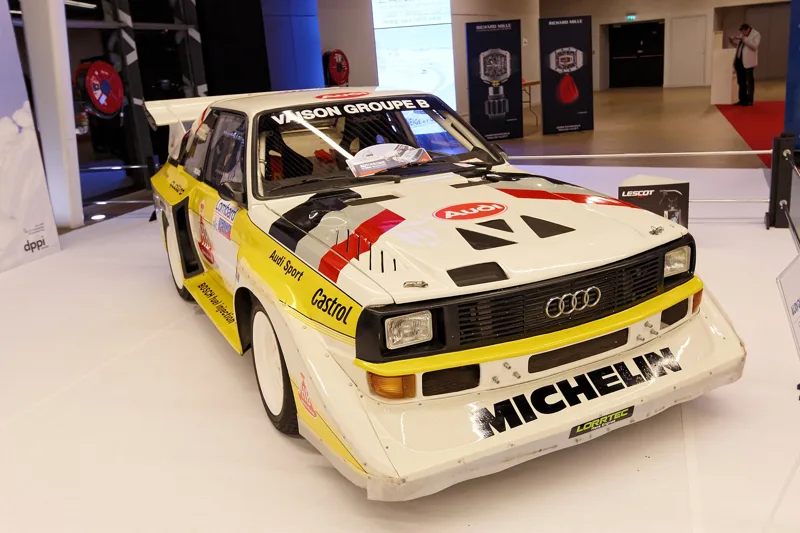
The 1983 season was far better. Lancia took the Constructors' title, with Rohrl of Germany and Alen of Finland as its main drivers, even though it faced the four-wheel-drive Audi Quattro. Neither driver started the final round, and Rohrl kept a mathematical chance of the drivers' title, which went instead to Audi's veteran Hannu Mikkola.
The four-wheel-drive tide
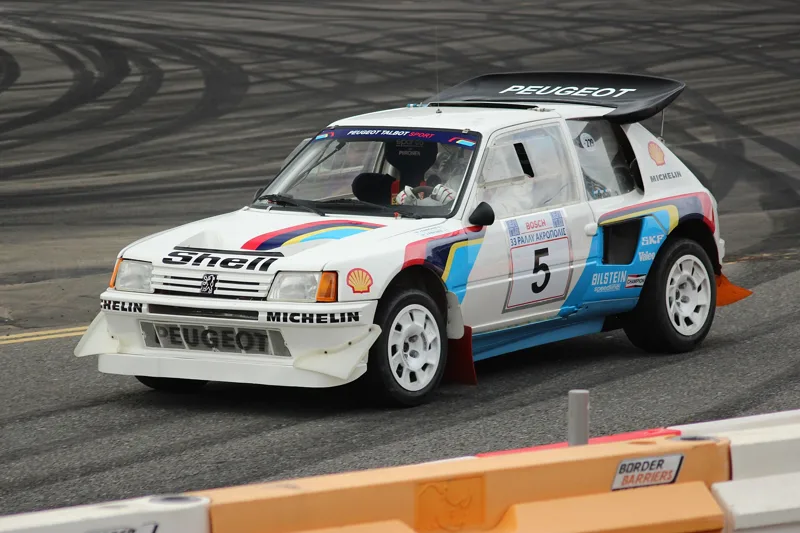
For 1984 Lancia brought out the Evolution 2 with more power, and it was not enough. Audi won both 1984 championships, and the four-wheel-drive Peugeot 205 T16 beat Lancia in the 037's last works season in 1985. Alen took the last 037 win, and the only one for the Evolution 2, on the 1984 Tour de Corse. The 037 was then retired in favour of the Delta S4, a four-wheel-drive car with both a supercharger and a turbocharger, which first appeared at the season-ending RAC Rally in Great Britain.
Attilio Bettega died in an 037 crash in 1985. Antonio Rodrigues won the 1984 Falperra International Hill Climb in one. The 037's final appearance in the world championship came at the 1986 Safari Rally, run by the Martini Lancia team, which used the 037 because it had not had time to develop the S4 for that event.
One later outing is worth knowing. In 1994 ROSS Competition fielded an ex-works 037 at round three of the All Japan GT series. It was massively underpowered against the GT1 class opposition, ran a short-ratio five-speed gearbox, and had an engine never designed to run at high speed for long periods. Naohiro Furuya brought it home 12th overall and ninth in GT1, seven laps behind the Team Taisan Porsche 962C that won overall and three behind the Team Gaikokuya Nissan Skyline that won GT2.
The Lancia 037 Stradale road car
Lancia built the 037 Stradale between 1982 and 1984 as the road-going version of the rally car. Group B required a minimum of 200 verifiable road cars, and 207 examples are known to have been made. Stradale means road-going in Italian.
The Stradale had an Abarth-developed 2.0-litre (1,995 cc) 16-valve four-cylinder engine with two overhead camshafts, fed by an Abarth Volumex Roots-type supercharger. It made 151 kW (205 hp) at 7,000 rpm and 225 N m (166 lb ft) of torque at 5000 rpm. Lancia claimed a top speed of more than 220 km/h (137 mph) and 0-97 km/h (60 mph) in 7.0 seconds. Today it is regarded as one of the most collectible cars Lancia has built.
Lancia Corse HF and what it won
The Scuderia Lancia, which later became Lancia HF Squadra Corse, was created in 1951 by Gianni Lancia, son of the company's founder. It started with sports car racing, where its cars made a name on the Carrera Panamericana, in the Targa Florio and on the Mille Miglia. Lancia entered Formula 1 in 1954 and 1955 without shining. It came back with three world endurance titles between 1979 and 1981.
Rallying was where it became a giant. Lancia won the last International Championship for Manufacturers, with the Fulvia in 1972. In the World Rally Championship it won constructors' titles with the Stratos in 1974, 1975 and 1976, the 037 in 1983 and the Delta six years in a row from 1987 to 1992. That makes Lancia the most statistically successful marque in the championship, and the Delta the most successful single model designation ever to compete in rallying.
| Model | Team championship won |
|---|---|
| Fulvia | 1972 International Championship for Manufacturers |
| Stratos | World Rally Championship for Manufacturers in 1974, 1975 and 1976 |
| 037 | World Rally Championship for Manufacturers in 1983 |
| Delta | World Rally Championship for Manufacturers, six consecutive titles from 1987 to 1992 |
| Ypsilon Rally2 HF Integrale | 2026 WRC2 Championship for Teams, won by Lancia Corse HF |
Drivers, Martini and the cost of Group B
Juha Kankkunen won the drivers' title in 1987 and 1991, and Miki Biasion won it in 1988 and 1989, all with the Delta. Other drivers with several WRC wins for Lancia included Alen, Auriol, Munari, Darniche, Rohrl, Bjorn Waldegard and Henri Toivonen. Lancia's own history counts 11 constructors' and 5 drivers' titles between 1970 and 1992: the ten world constructors' titles plus the 1972 International Championship, and the four world drivers' titles plus Munari's 1977 FIA Cup for Rally Drivers.
Martini Racing signed with the works team in 1982, a year after joining its sports car programme, and sponsored the brand new Group B 037 with Bettega and Alen. The partnership lasted until the end of 1992, one of the longest in the sport, and covered the Delta S4 and the Delta Integrale. In 1993 Martini ran a smaller programme limited to the Italian championship with Dario Cerrato.
The story has a dark side. Bettega died on the 1985 Tour de Corse in a 037, and a year later at the same rally Finnish favourite Toivonen died in a Delta S4. Those deaths eventually ended Group B. Lancia officially stopped racing at the end of 1992.
The Lancia Ypsilon Rally2 HF Integrale and the return to rallying
After more than 30 years, Lancia returned to rallying with two competition cars grown out of the Ypsilon road car: a Rally4 HF built to Rally4 rules in 2024, followed by the Rally2 HF Integrale built to Rally2 rules in 2025. In 2025 the smaller car appeared in both the Italian and the European championships, the Italian one being a single-make series, the Trofeo Lancia Rally.
The Rally2 car has a 1.6-litre turbocharged petrol engine, built on an upgraded version of the engine and gearbox used in the Citroen C3 Rally2. It was in development during 2025 and Stellantis unveiled it during testing in August and September that year. On 27 February 2026 Stellantis said that Andrea Crugnola, a multiple Italian rally champion who helped develop the car, would contest the Italian championship with it.
Lancia Corse HF in the 2026 World Rally Championship 2
In the WRC2 the car runs under the name Lancia Corse HF, with PH Sport operating two factory-backed entries. Yohan Rossel and Nikolay Gryazin signed to drive it. The car made its debut at the 2026 Monte Carlo Rally on 21 January, in what was regarded as one of the toughest editions in years because of the conditions. Drivers from both teams made small errors, but the car proved fast and competitive. It won eight special stages and the shakedown. Gryazin took the shakedown and the first stage, and Rossel won SS6, SS10, SS11, SS14, SS15, SS16 and the final stage, SS17.
The first victory arrived on 12 April at the Croatia Rally, won by Rossel and co-driver Arnaud Dunand. Rossel and Dunand finished fourth overall, and Gryazin and Konstantin Aleksandrov sixth, behind only the Rally1 cars. A second win came on 26 April at the Rally Islas Canarias, again for Rossel and Dunand. On 31 August 2026 Lancia Corse HF clinched the 2026 WRC2 Championship for Teams.
Lancia's other championships in 2026
The same car competes in the European Rally Championship, with Lancia Corse HF entering Andrea Mabellini and Virginia Lenzi, and with Rautio Motorsport entering Tuukka Kauppinen and Topi Luhtinen. In the first round, the 43rd Andalucia Rally on 19 April, Mabellini and Lenzi took sixth place, 51.6 seconds behind the winner.
In Italy, Crugnola and co-driver Luca Beltrame run for E.A. Sport Investment. They won the opening rally, which was Lancia's first win in the Italian championship for more than 30 years. The last had been at the Rally Il Ciocco e Valle del Serchio in 1993, when Gilberto Pianezzola and Loris Roggia won in a Delta Integrale, exactly 33 years earlier. In France, Yoann Bonato and Benjamin Boulloud of Trajectus Motorsport also won the first round of the French championship, making a double of debut wins in Italy and France.
For the lancisti, as Lancia's devoted fans are known, the Croatia win ended a wait of 34 years since the 1992 season.
What has Lancia Corse HF achieved in its first year back?
Lancia Corse HF has won the WRC2 teams title in its first year, the Ypsilon Rally2 HF Integrale is racing in the European, Italian and French championships as well as the WRC2, and Rossel and Gryazin are contracted to the factory team. The project marks Lancia's comeback to the World Rally Championship after decades, with two factory-backed entries for the 2026 season.