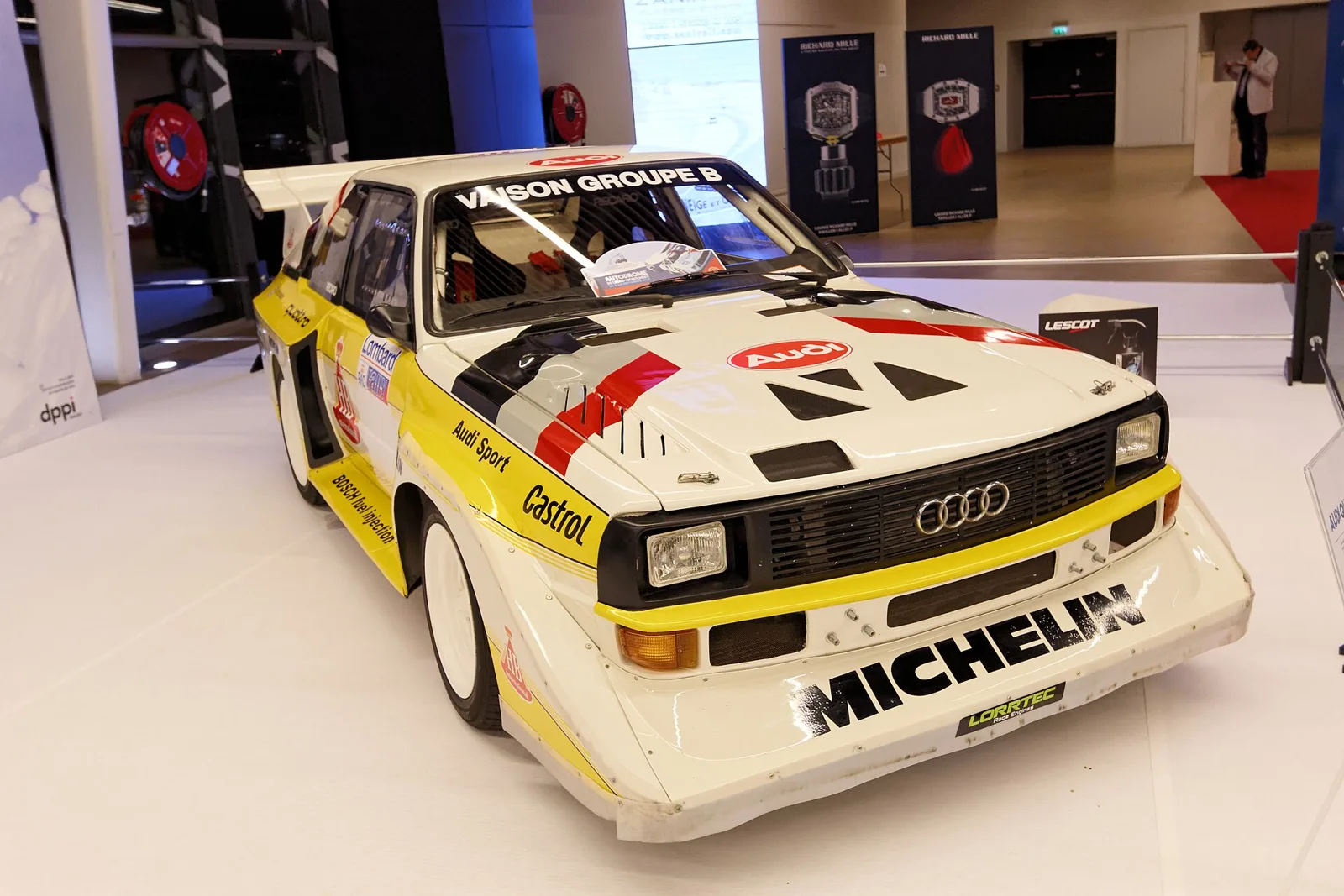
Turbo cars with no boost limit, 200-car homologation and over 500 hp: how the rules built the Audi, Peugeot and Lancia monsters, and what ended them in 1986.
Group B was a 1982 FIA rally category with only 200-car homologation and no boost limit, which pushed top cars from about 250 hp to over 500 hp by 1986. The FIA banned it from 1987 after fatal crashes in Portugal and on the Tour de Corse.
In 1986 the fastest rally cars ever built were banned within weeks of two fatal crashes. One in Portugal killed three spectators, and one on Corsica killed Henri Toivonen and Sergio Cresto. Group B rallying had almost no limit on power.
What was Group B rallying?
Group B was the FIA's 1982 rulebook for grand touring cars, and it served as the top class of the World Rally Championship until 1986. The cars needed only two seats, and the group replaced the older Groups 3, 4 and 5.
The same restructuring created Groups N and A, one for standard production cars and one for modified ones. Those had to have four seats and be built in large numbers, with 5,000 units needed in 12 months, reduced to 2,500 from 1993. Group B was meant for sports cars that could not meet that bar, and it could also run in the GT class of the World Sportscar Championship beside the faster Group C prototypes.
Its era is commonly called the golden age of rallying. The rules produced rally cars among the quickest, strongest and most advanced ever built, and the sport also suffered a run of serious and fatal accidents.
Weight and engine size were thought the only ways to control speed, so there was no limit on boost.
How many cars did a maker have to build?
A manufacturer had to build only 200 road cars to homologate a Group B model, which was 4 per cent of what some groups demanded and half the 400 previously needed in Group 4. The requirement could be extended by building 10 per cent of the initial number each following year, which meant 20 cars in Group B's case against 500 for A and N.
The group also allowed 'evolutions'. A manufacturer could upgrade its competition car and build only 20 of the evolved version, not another 200. The result was a set of homologation specials, extremely rare cars made only to satisfy the quota rather than to sell, if they survived beyond a showing to FIA officials.
The low numbers changed what manufacturers built. Front-wheel drive had gradually replaced rear-wheel drive in production cars, but Group B let them make mid-engined cars with rear or four-wheel drive without building thousands of matching road cars. The Ford RS200 had fibreglass bodywork, and the Peugeot 205 T16 and Lancia Delta S4 were silhouette cars with space frames that shared little with their showroom namesakes.
How did the rules let power explode?
When the groups were drawn up, weight and engine size were thought the only ways to control speed. Cars with forced induction had their capacity treated as 1.4 times its real value, but there was no limit on boost. So engineers took the turbocharger, then new to road cars, and kept turning it up.
The winning cars of 1981 produced about 250 hp (186 kW). By 1986, Group B's last season in rallying, at least two cars made more than 500 hp (373 kW). Peugeot fitted an antilag system derived from Formula One, an early version that did not work very well, and Lancia combined a turbocharger and supercharger on the Delta S4.
There were 15 classes across Groups N, A and B, each with minimum weights and wheel size limits. The 3,000 cc class, equal to 2,142.8 cc with forced induction, carried a 960 kg minimum and held the Audi Quattro and Lancia 037. The 2,500 cc class, or 1,785 cc with forced induction, had a 890 kg minimum and held the Peugeot 205 T16 and Lancia Delta S4. Today turbo power is limited by intake restrictors, and every rally class has a weight to power limit.
How do the old Group B rules compare with Group A?
| Rule | Group B (1982 to 1986) | Group A (top class from 1987) |
|---|---|---|
| Cars needed to homologate | 200 | 5,000 in 12 months, 2,500 from 1993 |
| Minimum seats | Two | Four |
| Boost limit | None | Capped at 300 hp (224 kW) and 2,000 cc |
| Power seen in the top cars | More than 500 hp (373 kW) by 1986 | 300 hp (224 kW) limit |
How did the Audi Quattro change rallying?
The Quattro began as an idea from Audi chassis engineer Jorg Bensinger in 1977, when he saw the Volkswagen Iltis, a military vehicle, beat other cars in snow tests. Audi showed the car at the Geneva Motor Show on 3 March 1980. It was the first rally car to use the newly allowed four-wheel drive, and the first to pair a front engine and four-wheel drive with a turbocharger.
The road car used a 2,144 cc five-cylinder turbo with 147 kW (200 PS) and reached 100 km/h in 7.1 seconds. For rallying, Audi cut the capacity to 2,133 cc so the car would fit the 3,000 cc class once the 1.4 factor was applied. The rally engine made 225 kW (306 PS) at 6,700 rpm. Production lasted until 1991 and totalled 11,452 cars.
Autocar tested a Quattro in May 1981 and praised its traction on wet and slippery surfaces, saying only the Porsche 911 matched it. It priced the car at 14,500 pounds and judged it good value against BMW, Porsche and Jaguar rivals that cost 5,000 pounds more.
Hannu Mikkola took the drivers' title in a Quattro in 1983, and in 1984 Audi beat Lancia to both championships, with Stig Blomqvist as champion. In 1986 the evolved Sport Quattro S1 was credited with more than 600 hp (450 kW) and had a front end like a snowplough.
How did Lancia and Peugeot challenge Audi?
Lancia's 037 was rear-wheel drive, which made it less stable than the Quattro on loose ground, yet it won the 1983 manufacturers' title with a win to spare. Lancia cared little for the drivers' crown, and did not enter a single car in the final RAC Rally even though Walter Rohrl was still in contention. Opel's Manta 400 and Toyota's Celica were also rear-driven, and Toyota won only the 1983 Ivory Coast Rally with Bjorn Waldegard.
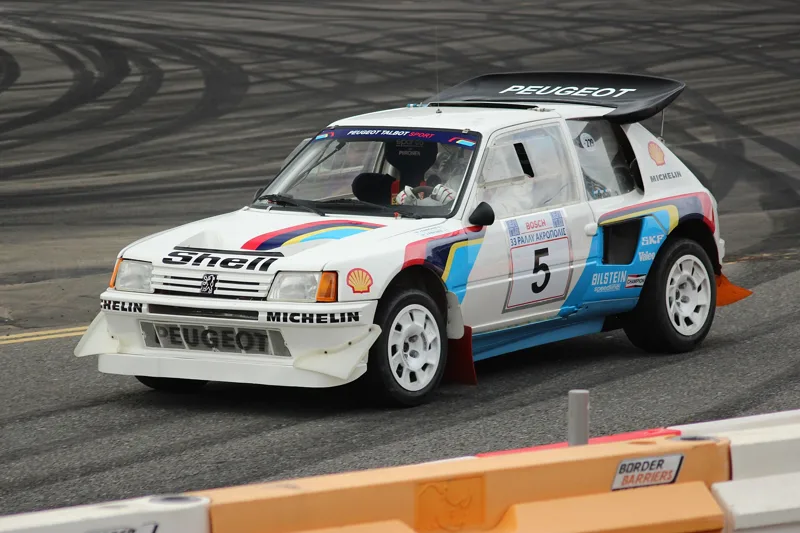
The turn came midway through 1984, when Peugeot joined with the 205 T16. It had four-wheel drive like the Audi but was smaller and lighter. Ari Vatanen, the 1981 champion, drove it, and Jean Todt, later Ferrari's Formula One team manager, ran the programme.
Audi revised the Quattro heavily, shortening the wheelbase among other changes, but Peugeot still dominated 1985. Timo Salonen won the drivers' title with five wins. The season also showed the danger, as Vatanen went off the road in Argentina and was badly hurt after his seat mounts failed in the crash.
More new cars arrived that year. Late in 1985 Lancia replaced its outclassed 037 with the Delta S4, Ford returned with the RS200, and Rover built the Metro 6R4, with its boxy bodywork and large front wing. Citroen's BX 4TC proved too heavy and cumbersome to succeed.
For 1986 Salonen and Juha Kankkunen drove the Evolution 2 version of the 205 T16, with a lightweight space-frame chassis. Lancia's S4 went to the Finnish prodigy Toivonen and Markku Alen, and Ford gave its RS200 to Blomqvist and Kalle Grundel.
What was the Lancia Delta S4?
The Delta S4 was Lancia's Group B car for 1985 and 1986, an evolution of the 037 with a midship engine and four-wheel drive. Only 28 complete chassis were built. Its 1,759 cc four-cylinder engine produced 490 PS (360 kW; 483 hp), and some put it at 500 PS.
It used a tubular space frame, carbon fibre bodywork that could be removed front and back for fast repairs, and Kevlar doors with no handle or window winder. A centre differential sent 60 to 75 per cent of the torque to the rear wheels.
The clever part was twincharging. A turbocharger works like a windmill: it needs exhaust to spin it, so there is almost no boost below a threshold, which was 4,500 rpm on the S4. A supercharger is driven by the crankshaft, like a pump you work by hand, so it gives boost at once but drags on the engine at high revs. Lancia used the supercharger at low revs and handed over to the turbo higher up. Its predecessor engine, with a supercharger alone, made 325 hp (242 kW).
To homologate it Lancia planned 200 road versions, the Stradale, between October 1985 and 1986, though probably fewer than 100 were built. At about 100 million lira, it cost five times the most expensive Delta of the time. It produced 250 PS (184 kW; 247 hp) and Lancia claimed 225 km/h (140 mph).
The S4's first outing was a win, at the 1985 RAC Rally, with Henri Toivonen. In 1986 it won three rallies: Monte Carlo with Toivonen, Argentina with Miki Biasion and the Olympus Rally with Markku Alen. It also won the 1986 European Rally Championship.
What went wrong in 1986?
The appeal of the cars drew bigger crowds, sometimes so large that drivers could barely see the road ahead. Michele Mouton said she could only drive quickly by imagining the spectators were trees, and Vatanen spoke of a human corridor. Other reports said spectators interfered with direction signs and put snow or mud on the road.
In March, on the opening stage of the Rally de Portugal near Sintra, Joaquim Santos turned right to dodge a few spectators. He lost control of his Ford RS200 and slid into another group. Three people were killed and 31 injured. The factory drivers withdrew, and Joaquim Moutinho won the rally.
On the Tour de Corse, Toivonen and co-driver Sergio Cresto left the road in their Lancia, plunged into a ravine and landed on the roof. Trees ruptured the aluminium fuel tank under the driver's seat and it exploded. Both men died, and no witness was close enough to see clearly what happened.
Why did the FIA ban Group B?
Immediately after the Corsica deaths, the FIA banned the group from the World Rally Championship from the following season. FISA president Jean-Marie Balestre froze development of the cars at once. The governing body also dropped its plans for a Group S and made Group A the top class, capped at 300 hp (224 kW) and 2,000 cc.
Audi and Ford withdrew, while others kept their Group B cars through the rest of that year. Peugeot's boss Todt was outraged and took legal action against the federation. Lancia's Group S car, the ECV, never raced, and the company used the production Delta in 1987.
The 1986 championship went to Peugeot's Juha Kankkunen, after the Sanremo Rally results were annulled when Peugeot was disqualified for illegal side skirts and the FIA found the cars legal. Alen had won that rally. It was also the only year the FIA issued a drivers' title for Group A, won by Kenneth Eriksson in a Volkswagen Golf GTI 16V.
What happened to the Group B cars afterwards?
Ex-rally cars carried on in European Rallycross until that series dropped them in 1993. The World Sportscar Championship had left Groups B and C behind by 1991. In 1993 the final Group B cars gained homologation, and the FIA allowed national championships and domestic racing to use them until as late as 2011.
From 1987 the Group A cars were the vehicles used in the main World Rally Championship for drivers.