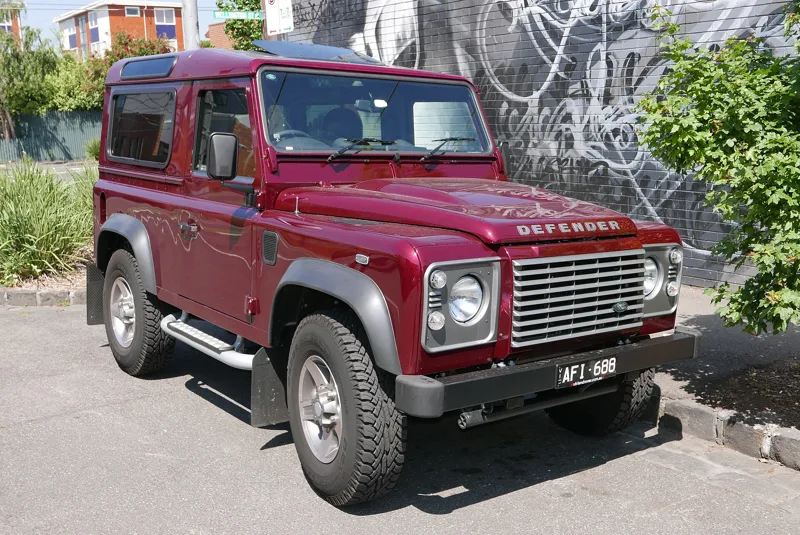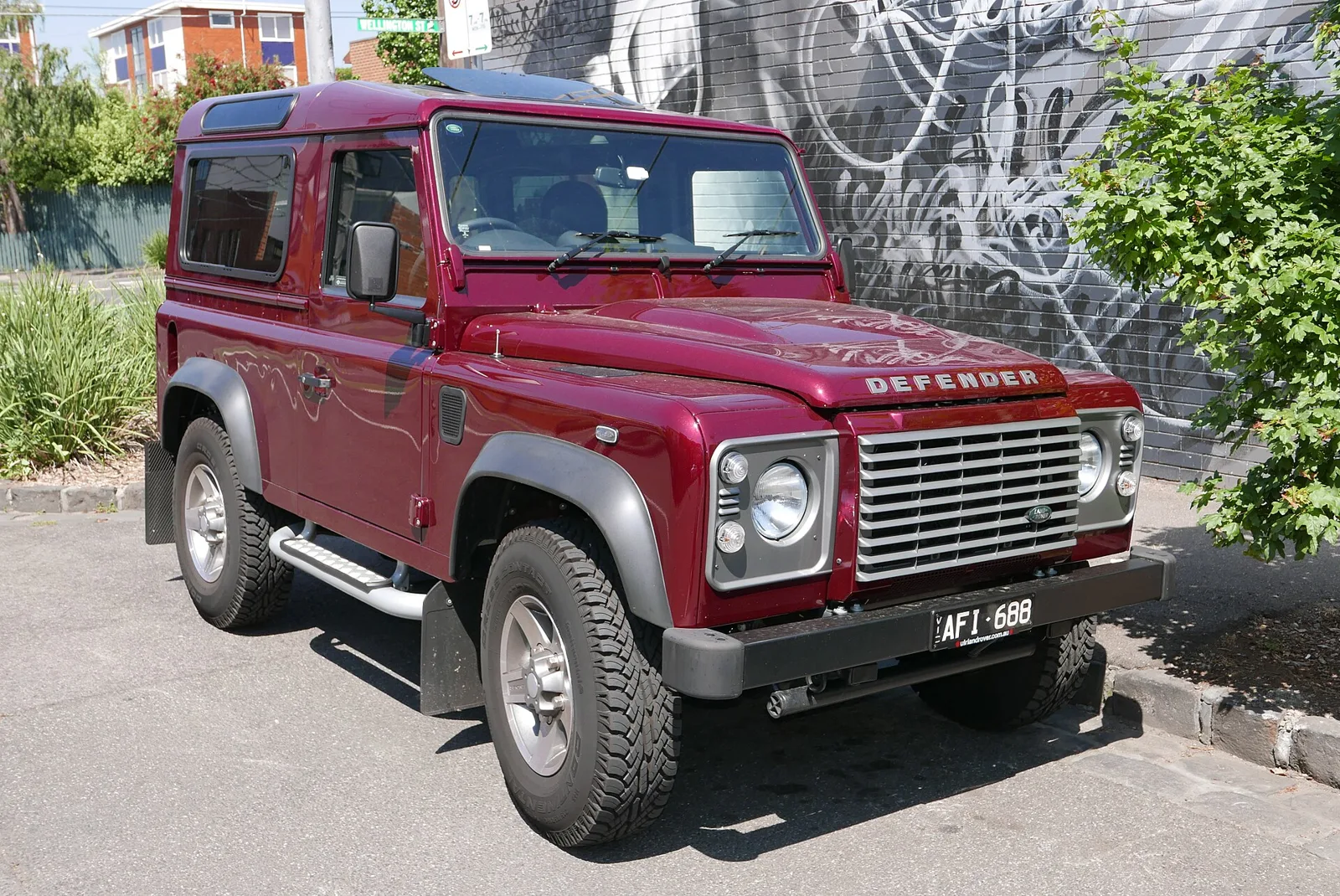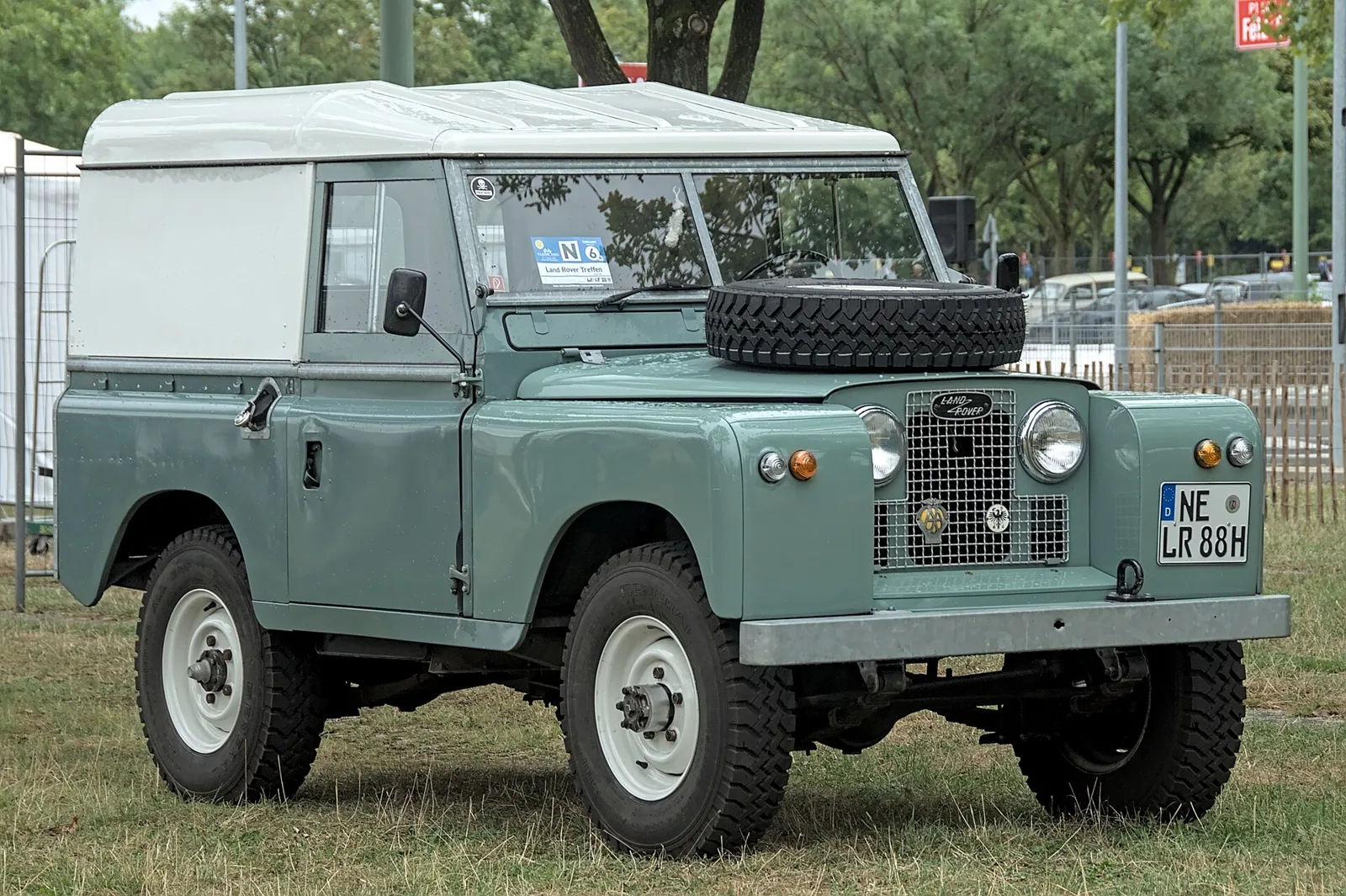
Built from 1948 on a box-section steel frame with aluminium bodies, the Series I, II and III became a mass-market four-wheel-drive icon, sold to farms, armies and tourists worldwide.
The Land Rover Series was a British off-road vehicle built from 1948 by the Rover Company, later British Leyland. Its Series I, II and III models used a box-section steel frame and aluminium bodies, and about 440,000 Series III vehicles were built.
The Land Rover Series, comprising the Series I, II and III, was a compact British off-road vehicle built by the Rover Company from 1948 and later by British Leyland. It was inspired by the World War II jeep, but it differed from its ancestor in its box-welded steel frame and aluminium alloy bodies. It became the first civilian four-wheel-drive car built in volume with doors and an optional hard roof.
What was the Land Rover Series?
The Series models were practical, simple vehicles that Land Rover built in large numbers for farms, utilities, the armed forces and private buyers. Most used leaf springs and could be switched between two- and four-wheel drive, and all could be started with a front hand crank. Front and rear power take-offs drove accessories.
A box-frame off-roader built with rationed materials that outlived its own plan and became a worldwide four-wheel-drive icon.
Why was the Land Rover conceived?
The Land Rover was conceived in 1947, in the years after the Second World War. Before the war Rover had made luxury cars, which sold poorly once peace returned. Raw materials were tightly rationed, and only firms building construction equipment or exporting goods could easily get them.
Rover's original Coventry factory had been bombed during the war, so the company moved into a large shadow factory at Solihull, near Birmingham. Starting car production there from scratch was not financially viable, and a planned small economical car, the M Type, proved too expensive to build.
Who designed the first Land Rover?
Maurice Wilks, Rover's chief designer, proposed a light agricultural and utility vehicle that was similar in concept to the Willys Jeep but aimed at farm work. He drew on his own experience of farming with a surplus Jeep in Anglesey. A power take-off was added because it offered a gap between jeeps and tractors.
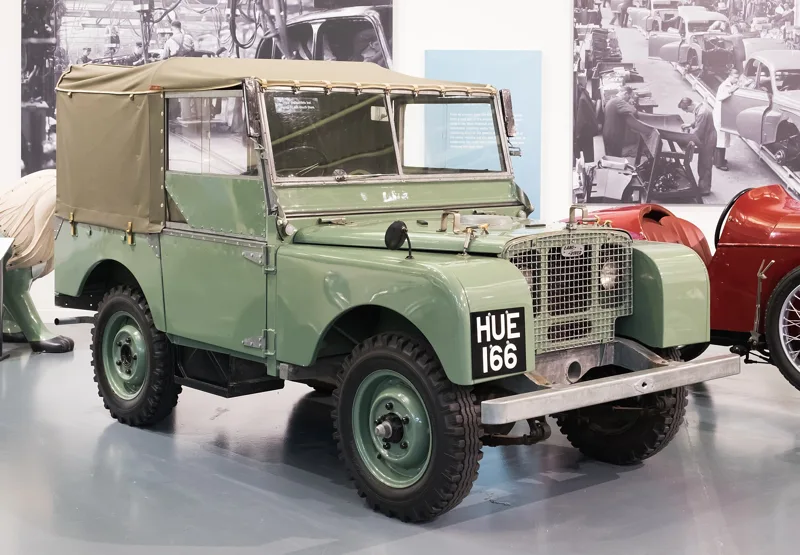
The first prototype had its steering wheel mounted in the centre, which gave it the name centre steer. It used a Jeep chassis and the engine and gearbox from a Rover P3 saloon. Its bodywork was made from a light aluminium-magnesium alloy called Birmabright to save rationed steel. Early vehicles came only in shades of light green, because military surplus supplies of aircraft cockpit paint were used.
How did the prototype change for production?
Tests showed that the prototype could drive farm machinery as a tractor would, and it was tested ploughing. As production approached, however, the tractor role mattered less and the centre steering proved impractical. The steering wheel moved to the normal position, the bodywork was simplified and a larger engine was fitted.
A specially designed transfer gearbox replaced the Jeep unit, so the production car used no Jeep components. It was slightly shorter than its American inspiration, but wider, heavier and faster, and it kept the power take-offs. The Land Rover was intended to run for only two or three years to raise cash and export orders, but it outlasted that plan.
Many of the defining features came from Rover's need to simplify tooling and use the least rationed material. The aluminium alloy body was kept throughout production, despite its higher cost, because it was light and resisted corrosion. The flat body panels with simple curves could be formed by hand, and the box-section ladder chassis used four steel strips welded into a box.
What was the Series I?
Land Rover began production in 1948 with what is now called the Series I, unveiled at the Amsterdam Motor Show. Its brief was farm and light industry work, and it used a steel box-section chassis with an aluminium body. The first cars rode an 80-inch (2.03 m) wheelbase and had a 1.6-litre petrol unit that gave roughly 50 bhp (37 kW; 51 PS).
The four-speed gearbox came from the Rover P3, with a new two-speed transfer box. The drivetrain used a freewheel unit at the front, so that the front axle disengaged on overrun. A ring-pull in the driver's footwell locked the freewheel for conventional four-wheel drive. Doors and a roof, in canvas or metal, were optional extras.
What were the Station Wagons of the Series I?
In 1949 Land Rover introduced a more comfortable body option called the Station Wagon, built by the coachbuilder Tickford. Tickford was known for work on Rolls-Royce and Lagonda cars, and its body was wood-framed with seating for seven. It had leather seats, a heater and a laminated windscreen, but its wooden construction was costly to build.
Because the Tickford was classed as a private car, buyers paid high Purchase Tax, unlike on the basic model, and fewer than 700 were sold. All but 50 were exported. The company's own in-house station wagons, introduced in September 1955, were far more successful.
How did the Series I grow in the 1950s?
A bigger 2.0-litre petrol unit appeared in 1952 and 1953. It had Siamese bores, meaning there were no water passages between the cylinders. Around 1950 its legal standing was settled too. It had been classed as a commercial vehicle, which kept it free of purchase tax but limited it to 30 mph (48 km/h). After an appeal to the Law Lords it was classified as a multi-purpose vehicle.
The 1954 model year brought big changes. The 80-inch wheelbase gave way to an 86-inch (2.18 m) model, and a 107-inch (2.72 m) pick-up was introduced. The extra length sat behind the cab for more load space. The spread bore petrol engine followed in mid-1954, with better cooling between the cylinders.
September 1955 brought a five-door on the 107-inch chassis, seating up to ten. The 86-inch wagon had three doors and seats for seven. These wagons used simple metal panels and bolt-together construction, and they included a Tropical Roof, a second roof skin that kept the cabin cool and reduced condensation.
In mid-1956 the wheelbases grew by 2 inches (51 mm), to 88 inches (2.24 m) and 109 inches (2.77 m). Those dimensions were used on Land Rovers for the next 25 years. In 1957 a new 2.0-litre diesel arrived. It used an overhead valve layout, unlike the petrol engines, and made 52 hp (39 kW) at 4,000 rpm, one of the first high-speed diesels built for road use.
What changed with the Series II?
The Series II was produced from 1958 until the Series IIA arrived in 1961. It came in 88-inch and 109-inch wheelbases, known as SWB and LWB. It was the first Land Rover that Rover's styling department worked on, under chief stylist David Bache. He created the barrel-side waistline, and the body was widened by 5 inches (12.7 cm) to cover the wider track.
The Series II also introduced the 2.25-litre petrol unit that became familiar to owners. The first 1,500 or so SWB models kept the older 52 hp 2.0-litre. The larger unit produced 72 hp (54 kW) and became the standard Land Rover engine until the mid-1980s.
A 12-seat option on the 109-inch station wagon was introduced largely because of UK tax rules, under which a vehicle with 12 or more seats counted as a bus. The twelve-seater was cheaper than the seven-seat 88-inch wagon, and it stayed in the range for decades before being dropped in 2002.
Why is the Series IIA so celebrated?
The Series IIA is widely regarded as the toughest of the Series models. The IIA was hard to tell apart from the II, with only minor cosmetic changes. A 2.25-litre diesel joined the line, and from 1967 long-wheelbase models could take a 2.6-litre inline-six petrol engine with servo-assisted brakes. A small number of North American trucks were built with it too.
From February 1969 the headlamps moved into the wings on home-market models. The Series IIA also appeared in films and television documentaries set in Africa during the 1960s, including Born Free. Its image in the public mind comes largely from that era.
The Rover Company had been absorbed into the Leyland Motor Corporation in 1968 under government pressure. By February 1968, the Land Rover had reached its twentieth birthday with total production just short of 600,000, more than 70% of which had been exported. Sales of utility Land Rovers peaked in 1969-70 at more than 60,000 a year.
In Australia, Land Rover held around 90% of the four-wheel-drive market during the 1960s, a figure matched in many African and Middle Eastern countries.
What was the Forward Control?
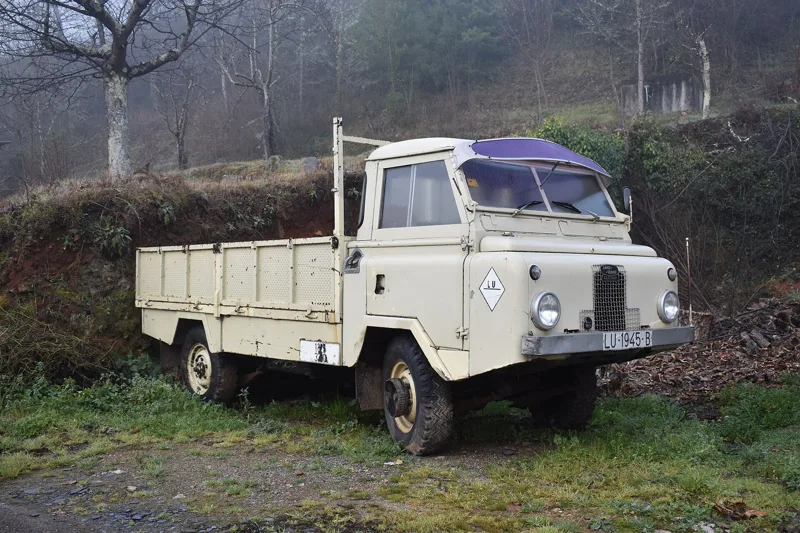
The Series IIA Forward Control, launched in 1962, put the cab over the engine for more load space. It was based on the 109-inch chassis, and export vehicles were the first Land Rovers to use the 2.6-litre petrol engine. Tyres were large 900x16 types on deep-dish rims to spread the weight of the heavy vehicle.
It carried a load of 1.5 long tons, or 1,500 kg, but its engine was underpowered for that capacity. Fewer than 2,500 were built, and most had utility bodies. The Series IIB Forward Control arrived in 1966 with the 2.25-litre diesel as an option, and it added wide-track axles and a front anti-roll bar. Production ended in 1974.
What was the Series III?
The Series III kept the body and engine options of the IIA, including station wagons and the One-Ton versions. About 440,000 were built from 1971 to 1985, which makes it the most common Series vehicle. The traditional metal grille gave way to a plastic one, and the headlights stayed in the wings. Land Rover produced its millionth vehicle in 1976, during the Series III run.
The engine's compression rose from 7:1 to 8:1 on the 2.25-litre unit, which added a little power. The Series III was the first Land Rover with synchromesh on all four gears, and its simple metal dashboard was replaced by a moulded plastic one. The instruments moved to the driver's side.
In 1980 the 2.25-litre engines received five main bearing crankshafts, and the transmission and axles were strengthened. The rear half-shafts had been prone to breaking under heavy use, and overloading by commercial operators made the problem worse. A 1982 redesign raised the driving splines from 10 to 24, which largely solved it.
In April 1982 the County trim arrived on station wagons, with cloth seats from the Leyland T-45 lorry, added insulation, tinted glass and other comfort features. A High Capacity Pick Up on the 109-inch chassis offered 25% more load volume than the standard pick-up, with heavy-duty suspension.
How did the Stage 1 V8 come about?
The first V8 Land Rover prototype was built on the initiative of Bruce McWilliams, boss of Rover's North American arm. He thought the new all-alloy V8 from General Motors would suit the Land Rover. In early 1966 the project passed to Richard F Green, a former service manager and product development engineer based in South San Francisco.
The project was named BOP, for Buick, Oldsmobile and Pontiac, and the car was painted Golden Rod Yellow, which gave it its nickname, Golden Rod. Green designed the engine adapter plate, upgraded the brakes and modified the car at Moeller Bros Body Shop. The completed car was driven to New York, then shipped to Southampton and taken to Solihull.
From 1979 to 1985 the Stage 1 was built with components shared with the Range Rover and the 101 Forward Control, including the LT95 gearbox and the 3.5-litre Rover V8. Output was reduced to 91 hp (68 kW), well below the Range Rover's figure. Toyota Land Cruisers and Nissan Patrols with six-cylinder engines were taking market share, particularly in Australia and Africa, and the Stage 1 was the answer. It had constant four-wheel drive, though it kept the Series III's leaf springs.
Most Stage 1 vehicles were long-wheelbase, although 24 short-wheelbase examples were made. Most went abroad, because UK buyers preferred the economical four-cylinder engine. The New Zealand Army bought 566 V8 Land Rovers between 1982 and 1986 and retired the last in 2006.
What was the One-Ton 109?
Built from late 1968 until 1977 across the late IIA and Series III years, the One-Ton 109 was really a Series IIB forward control on a standard 109-inch body, with a 2.6-litre petrol engine and a lower-ratio transfer box. Its chassis frame was unique to the model, and it used drop-shackle suspension like the military Land Rovers.
Only 170 IIA and 238 Series III One-Tons were built for the home market, which makes it one of the rarest Land Rovers ever made. Twenty-two IIA One-Tons were fitted with a 2.25-litre petrol unit and went to the Ministry of Defence as fire tenders.
How was the Series sold in Australia?
Australia was an important market, especially for utility models. Australia's government bought 80-inch Series I vehicles in the late 1940s for dam and road projects, which brought the vehicle to public notice. Land Rover set up local factories in the 1950s to assemble CKD kits from Solihull.
Sales declined from the middle of the 1970s. Japanese competitors arrived in larger numbers, and British component quality was seen as poor. Leyland Australia tried to revive the range with the GAME, a short-wheelbase Series III aimed at recreation, but sales were limited and it ended in 1979.
Supply problems also hurt. The factory never had the capacity to meet demand, and most vehicles were imported in kit form from Britain. Buyers also found the Land Rover underpowered, poorly rust-proofed and slow, despite its good off-road ability. By 1983, with the One Ten, the Toyota Land Cruiser was Australia's best-selling 4x4. In 1982 a 3.9-litre Isuzu diesel was offered, and it helped slow the decline.
How did South Africa build Land Rovers?
South Africa's relationship with the marque began in 1949, when the first 80-inch Series I vehicles were sold there. Car Distributors Assembly assembled the first CKD Land Rover in Port Elizabeth in August 1950. Local production of fuel tanks and chassis began in August 1963, and local content reached 44% of vehicle weight by 1972.
In 1980 the Series IIIS received locally made petrol and diesel engines. The Blackheath plant in the Cape was named the biggest Land Rover CKD assembly site outside the UK in 1992.
Why did the British Army choose the Land Rover?
The British Army tested the 80-inch Series I almost as soon as it appeared in 1948. The Army was first interested in a purpose-built military 4x4, the Austin Champ, but the Champ proved too complex and unreliable on the battlefield, so the Army turned to the Land Rover. The Ministry of Defence began ordering in batches from late 1949, and by the mid-1950s it was buying 200 vehicles at a time.
Land Rovers served in the Korean War and the Suez Crisis, and they became standard light military vehicles across the Commonwealth. The Fitted For Radio version had 24-volt electrics and a generator to power radios. The Long Range Desert Patrol Vehicle, nicknamed the Pink Panther for its light pink camouflage, was converted by Marshall's of Cambridge and used by the SAS on desert patrol.
By the late 1970s the British Army had about 9,000 Series III vehicles. The air-portable half-ton 88-inch lightweight was used by many armies, including the Dutch and Danish, which chose diesel engines for theirs. The Royal Air Force and Royal Navy also ran smaller fleets.
How did Australia and New Zealand use the Series?
Australian-built Series vehicles, from Series 1 to 3, served widely with the country's army, navy and air force. Variants included long-range patrol vehicles, ambulances and fire tenders. The Land Rover Perentie, introduced in 1987, served in large numbers until 2019.
The New Zealand Army bought 640 Australian-built Series I vehicles from 1951 to 1953, and later Series II and IIA models. It bought 566 Series III 109-inch V8s from 1982 to 1986. The final V8s were retired in 2006 in favour of 321 Pinzgauers.
How did licensed builders spread the Land Rover?
Minerva of Belgium built the Minerva-Land Rover under licence after the Belgian Army sought a lightweight 4x4 in 1951. Rover had been competing with the Willys Jeep for the contract. The deal was agreed in October 1951, and both 80-inch and 86-inch models were built until 1956.
Santana Motor of Linares, Spain, also built Series models under licence from 1958, first from CKD kits shipped from Solihull. From 1968 Santana developed its own versions with new engines, and it later took the name Land Rover Santana. The agreement ended in 1983, but the company continued with vehicles that looked much like the Series and Defender.
What is the Series' legacy?
In 1992 Land Rover said that 70% of the vehicles it had built were still in use. That claim reflects the aluminium body, the rugged box-section frame and the simple mechanicals that made the Series practical for farms, armies and expeditions.