How a 1947 farm vehicle built from rationed aluminium became the Defender, ran for 67 years and gave way to an all-new design.
The Land Rover Defender grew from the Series Land Rover of 1948, appearing as the One Ten in 1983 and renamed Defender after the 1989 Discovery. Production of the old model ended on 29 January 2016. The all-new unibody Defender launched in September 2019 and shares nothing with it.
The last Land Rover Defender left the line on 29 January 2016 wearing the number plate H166 HUE, an echo of HUE 166, the first pre-production Land Rover of 1948. It was the 2,016,933rd Defender and it ended 67 years of continuous production.
How did the Series Land Rover become the Defender?
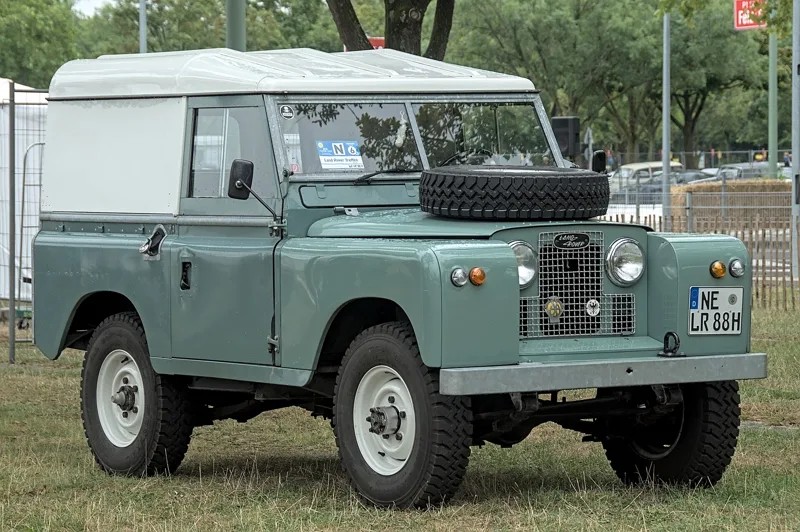
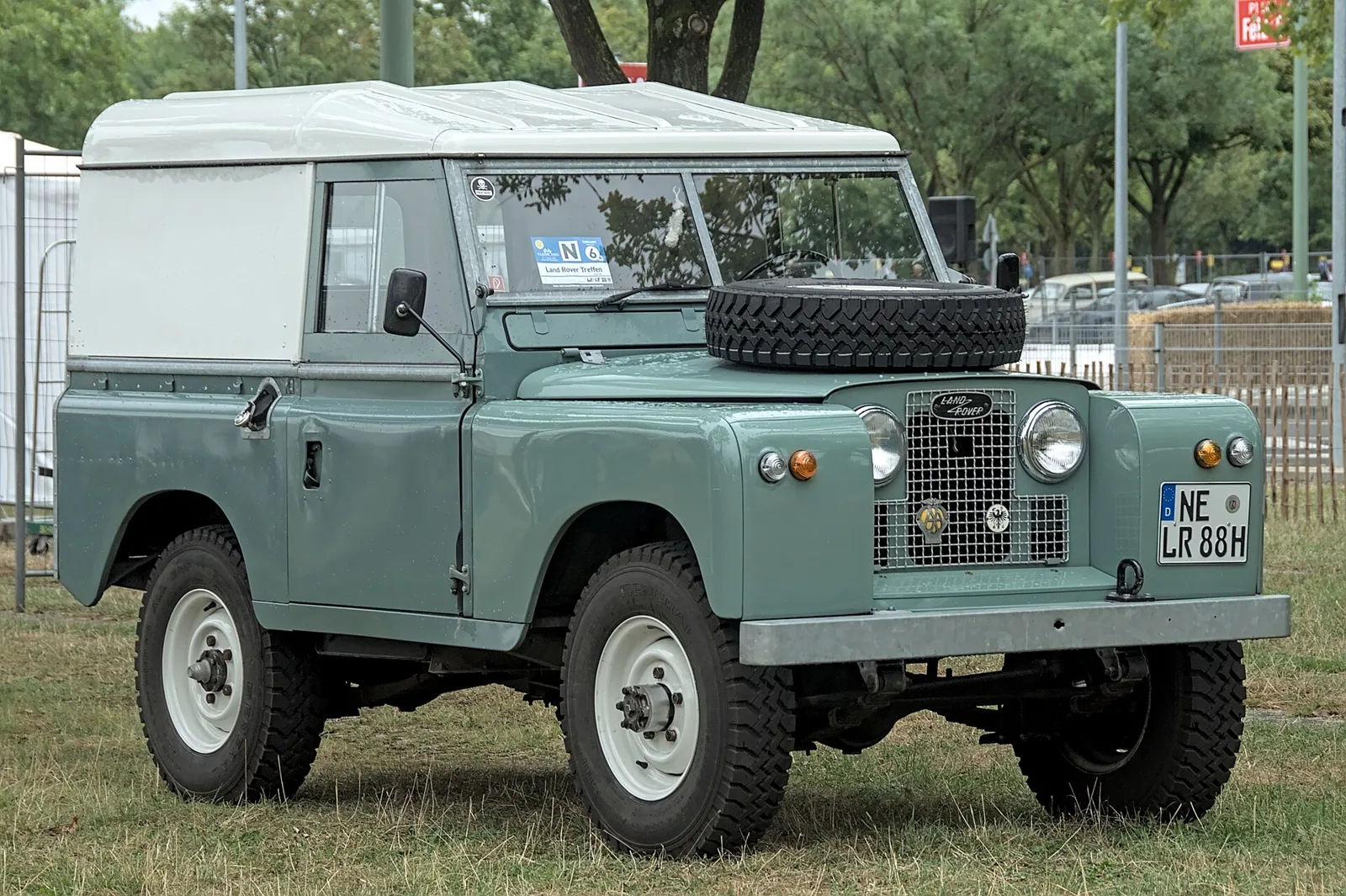
Slowly, and then through a rename. The Defender was never a clean-sheet design. It grew from the Series Land Rover launched at the Amsterdam Motor Show in April 1948, and its first form, the Land Rover One Ten, was a coil-sprung Series with modern running gear. When Land Rover introduced the Discovery in 1989, the name "Land Rover" became a marque rather than a single model, and the older vehicles needed a new name to avoid confusion: Defender.
The vehicle gained a worldwide reputation for ruggedness and versatility. It is often described as the British equivalent of the Willys Jeep of the Second World War. Its steel ladder chassis and aluminium alloy bodywork came straight from the original Land Rover, which at first used detuned versions of Rover engines.
It is all very Defender, but not as we know it.
How did the Land Rover begin in 1947?
With a shortage of steel and a factory that needed work. Rover had made luxury cars before the war, and nobody wanted them in the austere years afterwards. Raw materials were rationed to companies making construction or industrial equipment, or products that could be exported to earn foreign currency. Rover's Coventry factory had been bombed, so the company moved into a vast Solihull "shadow factory" built just before the war to make Bristol Hercules aircraft engines. A small, economical car called the M Type was drawn up, but would have been too expensive to produce.
Maurice Wilks, Rover's chief designer, proposed a light agricultural and utility vehicle in the spirit of the Willys Jeep, with an emphasis on farm work. He may have been inspired by the Ferguson tractor that Standard was building in its own shadow factory, but more likely he drew on his own experience of an army-surplus Jeep on his farm on Anglesey, North Wales. His version added a power take-off, filling a gap between jeeps and tractors.
The first prototype had the steering wheel in the middle, which earned it the name "centre steer". It sat on a Jeep chassis and used the engine and gearbox of a Rover P3 saloon. The hand-made body was Birmabright, an aluminium and magnesium alloy, to save on rationed steel, and the paint was surplus aircraft cockpit green, so early vehicles came only in shades of light green. A team led by engineer Arthur Goddard developed the first pre-production cars in late 1947.
The production version moved the wheel to the side, simplified the body to cut production time and cost, and fitted a larger engine and a purpose-designed transfer gearbox. It did not use a single Jeep component. It was slightly shorter than the American original but wider, heavier and faster, and it kept the power take-off drives.
Rover expected to build it for just two or three years, to bring in cash and export orders before returning to up-market cars. Once car production restarted, however, the off-roader greatly outsold them. Many of its defining features came from the need to simplify tooling and use minimal rationed materials: the aluminium alloy body, flat panels with simple constant-radius curves that could be formed by hand on a basic jig, and a box-section ladder chassis made of four steel strips welded on each side.
What did the Series I, II and III add?
The Series I, in production from 1948, used an 80-inch (2.03 m) wheelbase and a 1.6-litre petrol engine of around 50 bhp (37 kW; 51 PS), with the Rover P3's four-speed gearbox and a new two-speed transfer box. Its four-wheel-drive system included a freewheel that disengaged the front axle on the overrun, and a ring-pull in the footwell locked it for conventional 4WD. In 1950 that system gave way to a simple dog clutch.
Not every buyer wanted a spartan machine. In 1949 a Station Wagon with a wooden-framed body by Tickford, a coachbuilder known for Rolls-Royce and Lagonda work, offered seats for seven, leather, a heater and a one-piece windscreen. It was taxed as a private car and cost so much that fewer than 700 were sold, all but 50 of them exported. A far simpler in-house Station Wagon of September 1955, on the 107-inch chassis, seated up to ten people and was highly popular.
The standard Land Rover had its own tax puzzle. Classed as a commercial vehicle, it avoided purchase tax but was held to 30 mph (48 km/h). After an appeal to the Law Lords, it was reclassified as a "multi-purpose vehicle". A 2.0-litre diesel with 52 hp (39 kW) arrived in 1957, among the earliest high-speed diesels designed for the road.
The Series II of 1958 brought the attention of Rover's styling department. Chief stylist David Bache drew the "barrel side" waistline, a 5 in (12.7 cm) wider body, and the curved side windows and rounded cab roof still used on later Land Rovers. The 2.25-litre petrol engine, at 72 hp (54 kW), became the standard unit until the mid-1980s. The 109-inch Station Wagon added a twelve-seater option, which UK tax law treated as a bus. That made it cheaper than the ten-seater, and the layout stayed on sale until 2002.
In 1992 Land Rover claimed that 70% of all the vehicles it had built were still in use. The Series Land Rover was also the first civilian four-wheel-drive car built in numbers that had proper doors and offered a hard roof.
What changed when the One Ten and Ninety arrived?
The coil-sprung Land Rover, called the One Ten, was introduced in 1983, with the shorter Ninety following in 1984. The numbers represented wheelbases in inches, though the Ninety actually measured 92.9 inches (2,360 mm). Advertising spelled the numbers out in full, while the badges above the grille read "Land Rover 90" or "Land Rover 110". At launch the only other Land Rover in production was the Range Rover.
Superficially there was little to tell them from a Series III, apart from a full-length bonnet, a revised grille and wheel arch extensions covering wider-track axles. Underneath, the changes were deep, many of them borrowed from the Range Rover:
- Coil springs front and rear, for a more compliant ride and better axle articulation.
- Permanent four-wheel drive, with a two-speed transfer gearbox and a lockable centre differential.
- A modernised interior and a taller windscreen in a single piece.
- Stronger engines: one diesel and two petrol.
Engineers briefly offered a part-time 4WD system for the One Ten, but it failed to sell and was dropped by 1984. Wind-up windows arrived that year, replacing the sliding panels of early 110s, along with a 2.5-litre diesel of 68 hp (51 kW). A low-compression version of the Range Rover's 3.5-litre V8 improved performance.
Engines kept improving. In 1985 an 83 hp (62 kW) 2.5-litre petrol arrived, and the 114 hp (85 kW) V8 reached the Ninety, a first for a production Land Rover of short wheelbase. The Diesel Turbo came in September 1986 with 85 hp (63 kW), a 13% power increase, and torque up 31.5% to 150 lb ft (203 N m) at 1,800 rpm. Early turbo diesels gained a reputation for poor reliability, with bottom-end failures and cracked pistons. Land Rover fitted a revised block and improved big end bearings in 1988 and a redesigned breather system in 1989. The V8 rose to 134 hp (100 kW) at the same time.
What do Defender 90, 110 and 130 mean?
They are wheelbases in inches, roughly. The One Ten had a 110-inch wheelbase, and the Ninety measured 92.9 inches (2,360 mm). The third model, the One Two Seven, rode on a 127-inch (3,226 mm) wheelbase, became the Defender 130 after the rename, and kept the same dimensions.
The One Two Seven was designed for utility companies and military users. In standard form it was a four-door, six-seater, joining the front section of a One Ten 4x4 to the back of a One Ten high-capacity pick-up, so that a work crew and its kit could travel together. Its payload was up to 1.4 tonnes, compared with 1.03 tonnes for the One Ten and 0.6 tonnes for the Ninety.
Land Rover built them on a special line. Each began as a One Ten 4x4 chassis, was cut in two, and had 17 inches (432 mm) of chassis welded in before the halves were reunited. They became a common base for mobile workshops, ambulances, fire engines and flatbeds, and the South African assembly plant offered a 15-seater. By 1990 only the 134 hp (100 kW) V8 and the 85 hp (63 kW) turbo diesel were available.
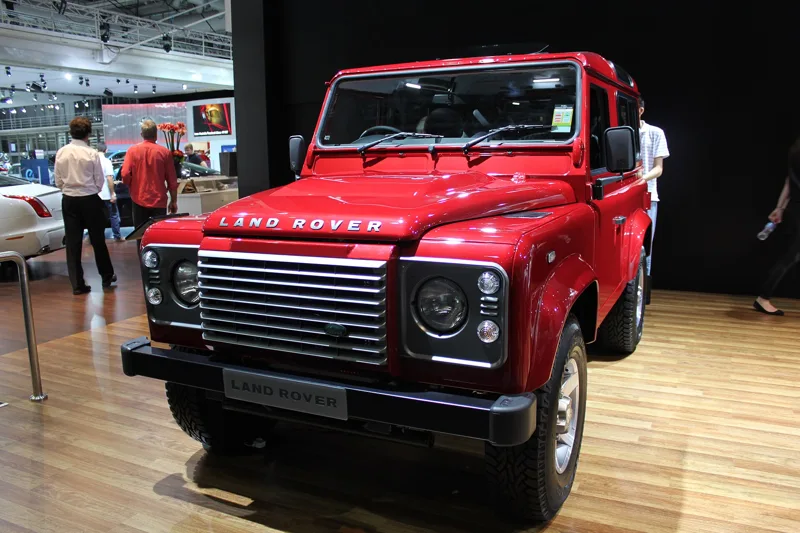
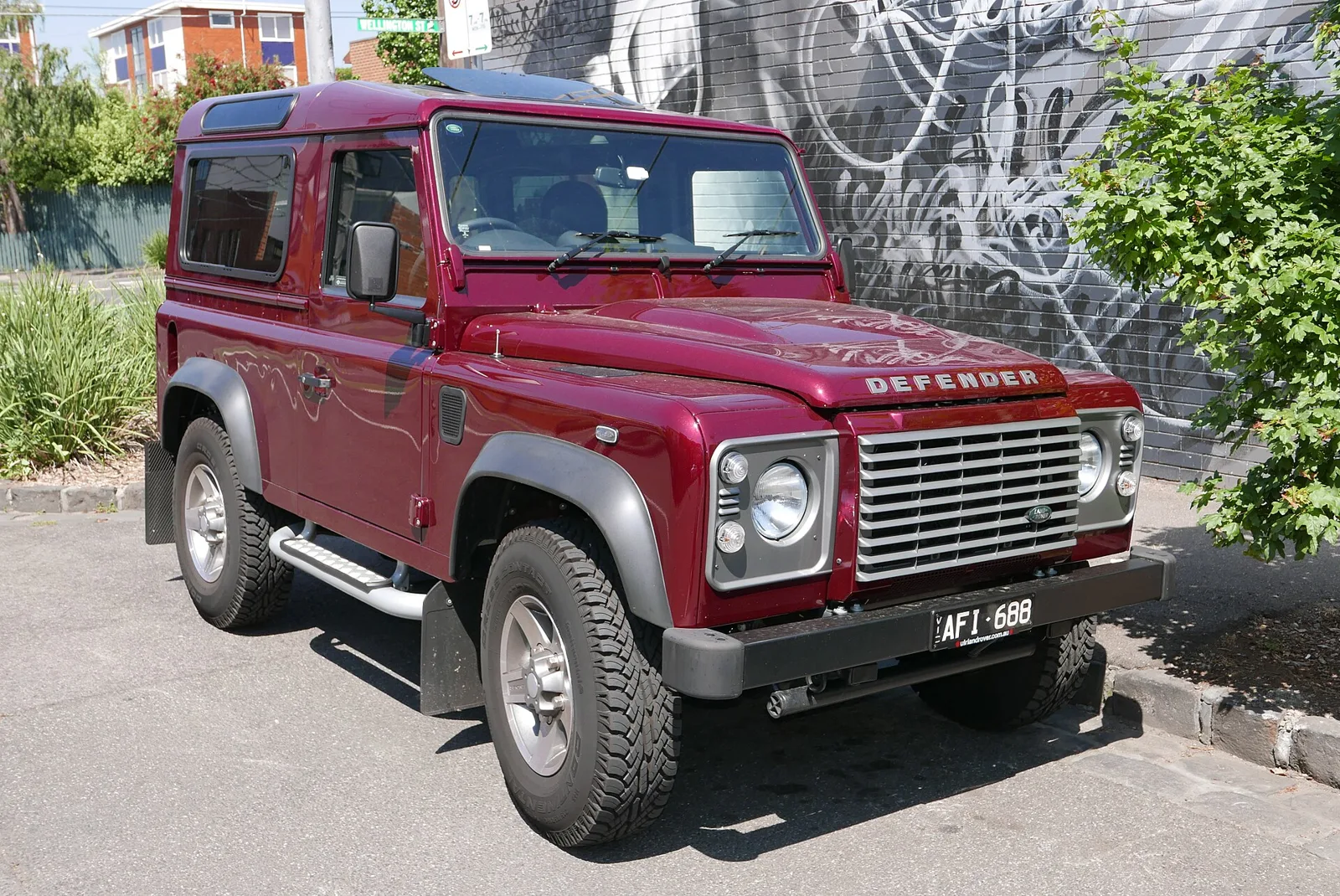
The Defender name arrived in the 1991 model year, after the Discovery of 1989 had become a third model built alongside the two. The cars carried a "Defender" badge at the front and "Defender 90" or "Defender 110" at the rear. From 2007 to 2016 the L316 had a blank badge space above the grille, "Land Rover" in raised letters across the bonnet, and no wheelbase badges at all.
How did the Defender become a family car?
From the 1987 model year to 2006 the Defender was designated L315, a period in which Land Rover began to market the utility vehicle as a private recreational one. The basic pick-up, 4x4 and van were still workhorses, but the County models were sold as multi-purpose family cars with better trim and more comfortable seats.
Land Rover began making yearly detail changes to the County to attract new buyers and persuade existing owners to trade up, a long-standing practice in the car industry. The changes brought new graphics and colours, radio-cassette players, air-conditioning, Rostyle wheels and headlamp wash-wipe systems, plus accessories such as surfboard carriers and bike racks.
North American cars carried a cast plaque on the rear with a limited-edition production run number. The Defender 110 was sold there for the 1993 model year, and the Defender 90 from 1994 to 1997. After 1997 the Defender was not sold there again until 2020, because of low sales and the changes needed to meet updated safety rules.
What happened when Defender production ended?
After a continuous run of 67 years, production ended on 29 January 2016, with just over two million Series and Defender vehicles built. The two millionth was assembled by a special team in May 2015 and auctioned later that year for the International Federation of Red Cross and Red Crescent Societies. Counting only the 90, 110 and Defender models, the 33-year run was ranked the sixteenth longest of any single-generation car in history in 2020.
A final special edition, the Defender Works V8 with 400 bhp (298 kW), had been announced in January 2018.
How does the new Defender differ from the old one?
Almost completely. The new Land Rover Defender (L663) made its global debut in September 2019 and was launched on 10 September 2019 at the Frankfurt Motor Show. It shares no components or technology with its predecessor and is the first all-new version, breaking the engineering link to the Series Land Rovers of 1948. It is also aimed at a more upmarket buyer.
| Feature | Old Defender (1983-2016) | New Defender (L663, 2020) |
|---|---|---|
| Construction | Steel ladder chassis, aluminium alloy body | Aluminium monocoque (unibody) |
| Suspension | Live rigid axles, coil springs | Independent all round; air suspension standard on the 110 |
| Four-wheel drive | Permanent, lockable centre differential | Permanent, locking centre and rear differentials, two-speed transfer case |
| Body styles | 90, 110, 130 | 90 (3-door), 110 (5-door), 130 (5-door, three rows) |
| Engines | 2.5-litre diesel and turbo diesel, 3.5-litre V8 petrol | Ingenium turbodiesels and turbo petrols, mild hybrid, plug-in hybrid |
| Transmission | Five-speed manual with transfer gearbox | ZF 8-speed automatic with two-speed transfer case |
The 90 can have coil springs or air suspension, with ground clearance of 226 mm (8.9 in) on coils and a maximum of 291 mm (11.5 in) on air. The 110 is 5,018 mm (197.6 in) long including the rear-mounted spare and has a wheelbase of 3,022 mm (119.0 in). Deliveries of the 5-door 110 began in early 2020, and the 3-door 90 followed in late 2020. The 4,536 kg (10,000 lb) winch is officially supported, unusual for a unibody vehicle.
Engines at launch were Ingenium units: the 196 bhp (146 kW) D200 and 237 bhp (177 kW) D240 turbodiesels, the 296 bhp (221 kW) P300 turbo petrol, the 395 bhp (295 kW) P400 mild hybrid six and the 398 bhp (297 kW) P400e. The motoring press generally welcomed it. The Evening Standard wrote that it was "all very Defender - but not as we know it", while TFL Car was critical of build quality.
Performance and special editions
The Defender V8 uses the supercharged 5.0-litre V8 and makes 386 kW (518 hp), reaching 100 km/h in about 5.2 to 5.4 seconds. The OCTA tops the range as a 110 only, with a BMW V8 of 635 PS (467 kW; 626 hp) and 750 N m (553 lb ft), and a claimed 0 to 60 mph in 3.8 seconds. Special editions include the 2021 Bond Edition, three hundred cars made for the film No Time to Die, and the 75th Anniversary Edition in Grasmere green, recalling the original HUE 166.