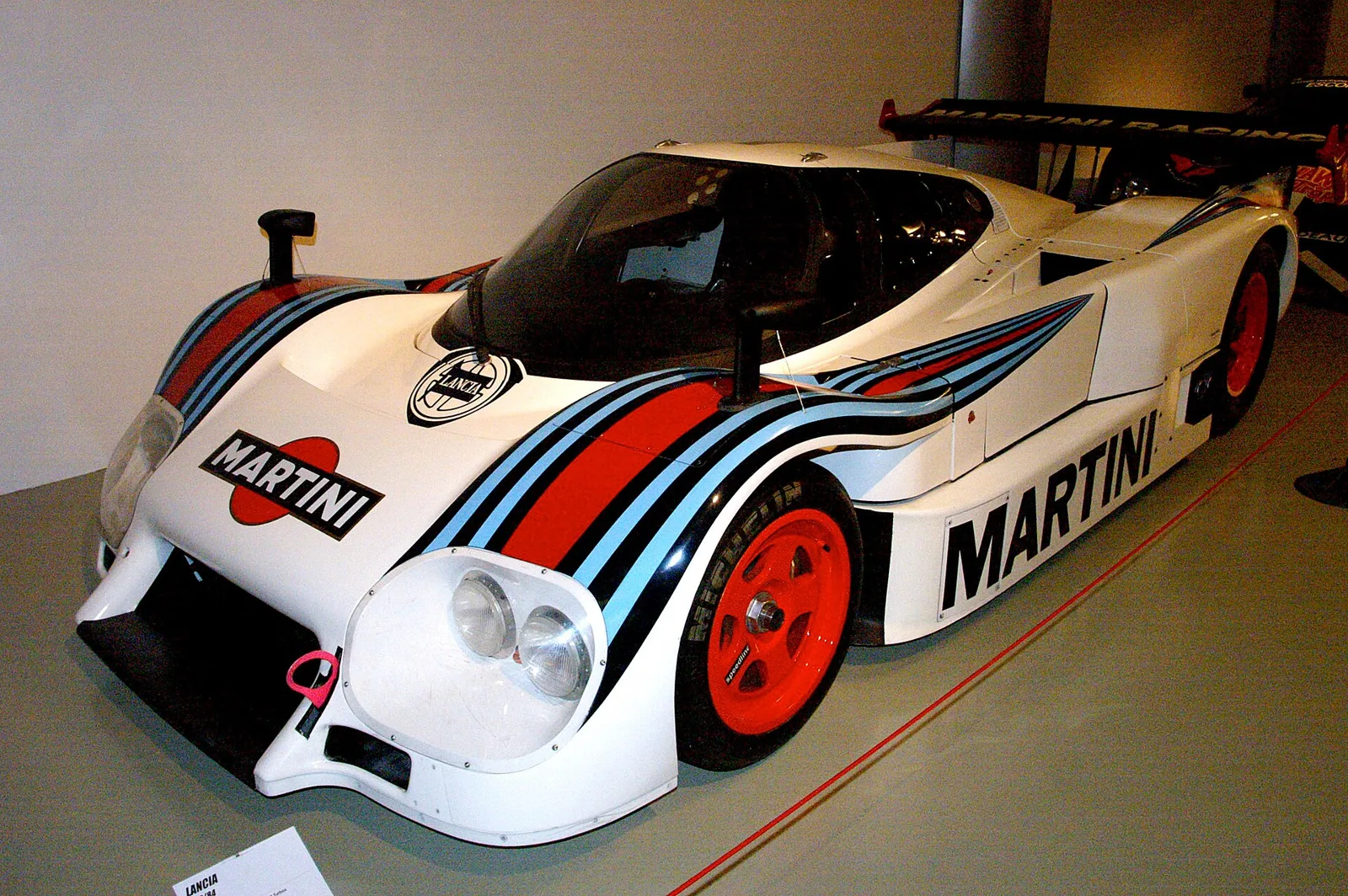
A turbocharged Ferrari V8 gave Lancia pole positions and a handful of wins in the World Sportscar Championship, until reliability and fuel use ended the factory programme.
The Lancia LC2 was a Group C sports prototype built by Lancia and powered by a Ferrari-derived V8. Lancia ran it in the World Sportscar Championship from 1983 to 1986, and it secured three race wins before the factory programme ended, though privateers used it until 1991.
The Lancia LC2 was built to win in the World Sportscar Championship, and at times it came close. The story is one of promise, with pole positions and a handful of victories, set against persistent weaknesses in fuel use and reliability. Its turbocharged Ferrari-derived V8 gave it more power than the Porsche 956s it faced, but fuel consumption and reliability problems kept it from the victories its speed suggested.
Why did Lancia need a new racing car?
The Group C rules introduced to the World Championship in 1982 required coupe-style cars that met a fuel economy standard of 100 km for every 60 litres (16 US gal). The earlier Lancia LC1 followed the older Group 6 rules and used an open cockpit, and its turbocharged straight-four could not reach the new fuel figure.
Cesare Fiorio ran the effort to replace the LC1. With no road engine big enough to serve as a base, the company looked to the Fiat Group, of which it was part, and to Ferrari, another Fiat company.
A Ferrari-derived turbo V8 in a Lancia body, built to beat Porsche and often beaten by its own reliability.
How was the Ferrari engine built?
Ferrari allowed Lancia to adapt its new naturally aspirated 3.0-litre four-valve V8, first seen in the 308 GTBi QV road car in 1982. Enzo Ferrari handed the development work to Nicola Materazzi, then head engineer for racing.
The racing unit was developed in parallel with the F114B engine that powered the GTO, and both were built with heavy use in mind. The GTO engine was to use IHI turbochargers for the road, while the racing engine was heavily modified for the track.
| Feature | Detail |
|---|---|
| Original racing capacity | 2.6 litres (159 cu in), reduced from the 3.0-litre road V8 |
| Revised capacity | 3.0 litres (183 cu in) from 1984 |
| Induction | Two KKK turbochargers, running at 3.0 bar boost |
| Power, 1984 engine | Just under 840 HP at 9000 rpm |
| Torque, 1984 engine | 800 lb-ft at 4800 rpm |
| Gearbox | Hewland five-speed manual, later swapped for an Abarth-cased unit in 1984 |
| Chassis | Aluminium monocoque built by Dallara, with Kevlar and carbon fibre bodywork |
| Cars built | Seven under Lancia, plus two for Gianni Mussato |
The displacement was chosen partly so the engine could also be used in the North American CART series. The first version was reduced to 2.6 litres, but the Ferrari V8 went back to 3.0 litres in 1984 in an attempt to improve reliability and horsepower.
Magneti Marelli supplied improved engine electronics for the larger unit, which allowed it to use no more fuel than the previous version. The turbos started pulling from 3,000 rpm.
How was the LC2 chassis designed?
Two Italian specialists, Abarth and Dallara, shared the chassis work. Dallara's own factory produced an aluminium monocoque, plus Kevlar and carbon-fibre bodywork.
The LC2 kept a large radiator intake in the centre of its nose, as the LC1 had. The Porsche 956s, by contrast, took their air from the rear flanks and sides of the cockpit. Air for the turbo intercoolers was ducted through the side bodywork, and brake cooling inlets sat just behind the doors.
At the back, pontoon-style bodywork joined the wings and carried a large wing across the pontoons, with the diffusers exiting between them and beneath the wing. The cars were changed almost every season, including new brake duct inlets beneath the headlights.
How did the LC2 start in 1983?
The LC2 made its debut in 1983 with Martini Racing livery in Martini and Rossi colours. It initially used Italian Pirelli radial tyres. The first round was the 1000 km of Monza, Lancia's home event, where the LC2 claimed pole, almost a second clear of Joest Racing's 956.
Tyre trouble then took the leading Lancia out of contention, while the sister car ended twelve laps down on the winning 956. The Pirelli tyres were later replaced with British Dunlop crossply tyres, though the suspension had been tuned for the Italian product, and the cars struggled to finish for months.
Neither car completed a race until round five, the 1000 km of Spa. There both Martini cars finished alongside the privateer Mirabella LC2, but only after a series of setbacks had dropped them out of contention. The team's first reliable run came at the European Endurance race in Brands Hatch, where Alboreto and Patrese took fourth.
Lancia skipped the World Sportscar event in Japan and ran the European Endurance race at Imola instead. Teo Fabi and Hans Heyer won there, earning the car its first win, with no factory Porsche entered. The season ended with second places at Mugello and Kyalami, and Lancia took second in the World Constructors Championship with 32 points to Porsche's 100.
What happened to the LC2 in 1984?
The revised LC2s appeared at the 1000 km of Monza with suspension reworked for the Dunlop tyres, and they opened the season with a podium. A pole at Silverstone was followed by a fourth-place finish in the 1000 km race there.
At Le Mans both cars lined up on the front row, as the Rothmans Porsche squad stayed away. Wollek's pole effort of 3:17.11 was about 11 seconds faster than the fastest Joest Racing 956, which started on the second row. At mid-race Wollek and Nannini were ahead, having fought off Vern Schuppan's Kremer Porsche, the reigning winner, and Alan Jones.
Gearbox problems on both cars then cost the lead. Wollek and Nannini still finished eighth, completing the full distance and showing the car could be reliable, with Nannini setting the fastest lap at 3:28.90. A privateer LC2 also ran for Pierluigi Martini, Xavier Lapeyre and Beppe Gabbiani, which crashed heavily in qualifying. The Automobile Club de l'Ouest ruled out a new chassis, so the car was repaired in time to race, and rumours persisted that a new chassis had been used anyway.
After Brands Hatch the team took a short break, then returned at Imola, where both cars crashed out. At Kyalami, Patrese and Nannini led a 1-2 finish, the LC2's second victory, although none of the leading Porsche teams attended in protest at the country's apartheid laws. Lancia then skipped the final round at Sandown Park in Melbourne. Autocourse concluded that the team had too many different problems, and that poor preparation must be the cause.
How did the LC2 perform in 1985?
In 1985 Martini Racing had to show that the LC2 could win, because Lancia needed justification for funding the project. The cars were revised again and ran on Michelin radials. Mugello opened the year with an LC2 on pole, 1.7 seconds clear of the factory Porsche, but that car's engine failed and the other team car finished fourth.
At Monza the LC2s were nearly four seconds faster in qualifying and led the early laps, but a tree fell across the track and stopped the race. At Silverstone one LC2 led until a wheel bearing failed in the closing laps, forcing Nannini to pit and surrender the lead. At Le Mans the cars were in the lead early on, but reliability problems dropped them back to sixth and seventh. A fuel pump failure ended the Hockenheimring race.
At Spa the LC2s of Wollek, Patrese and Mauro Baldi led the factory Porsche before the organisers ended the race early as a mark of respect for Stefan Bellof, who had died in a crash earlier that day. The result was Lancia's first win against the Rothmans factory Porsche squad. At Brands Hatch the LC2s were leading when they collided with one another, and they finished third and fourth.
Lancia skipped the last two rounds yet still ended second in the Teams Championship, narrowly ahead of a privateer Joest Porsche.
Why did the factory LC2 programme end?
Lancia kept the project alive for 1986 as a single-car operation. Monza's sprint race started the season, and the LC2 finished second, under a minute adrift of the winning Rothmans car. The first endurance race at Silverstone brought back the old reliability problems, and the car failed to finish.
According to Autosport magazine, the car had run out of fuel after delays, softer tyres and qualifying boost used for a lap record. Lancia concluded the cars still lacked the reliability and fuel economy to take on the developed Porsche 962C, so Martini Racing withdrew from the championship. The company then focused its effort on the World Rally Championship. Over three seasons the LC2 had shown speed in qualifying, but it had rarely turned that speed into finishes.
Who kept racing the LC2 after Lancia left?
Privateer teams tried to carry on with the older LC2 chassis. Gianni Mussato ran two races in 1986 and then quit the championship. He reappeared for single outings in 1987 and 1988. His car then moved to Dollop Racing late in 1988, where it again failed to finish any race that season.
In 1989 Mussato came back with a new LC2, though it too struggled to finish. His team made one final attempt in 1990, running only the 24 Hours of Le Mans, with the same result. In 1991 Veneto Equipe tried the LC2 in the World Sportscar Championship, but the car failed to qualify for some races and never finished one. The factory cars had at least won pole positions, a mark the privateers rarely came close to matching.
What became of the Abarth LC2 and the V10 project?
After the factory programme ended, Abarth acquired one LC2 and fitted it with the Alfa Romeo Tipo 1035 V10, a 3.5-litre unit. The V10 came from the Alfa Romeo 164 Procar, and the project was developed under the name SE047.
That car was an early step towards the Alfa Romeo SE 048SP of 1988. Its engine did not make it into the final phase of the SE 048SP work.