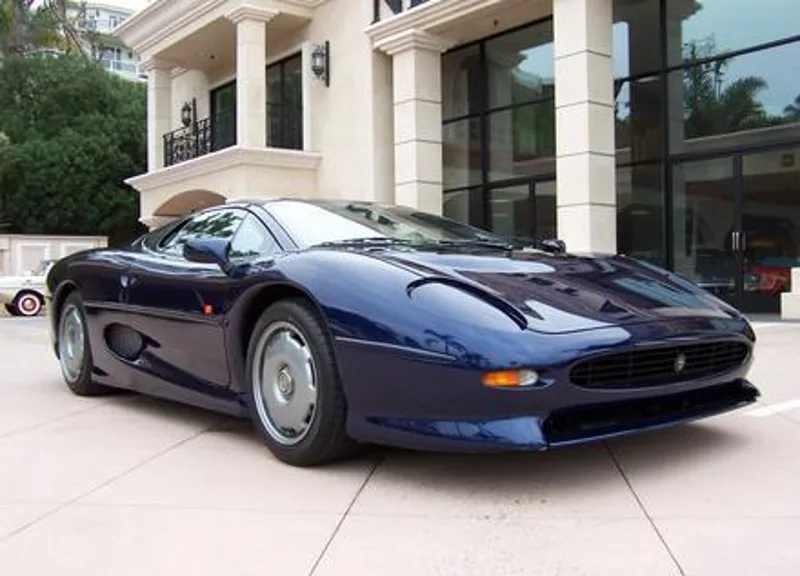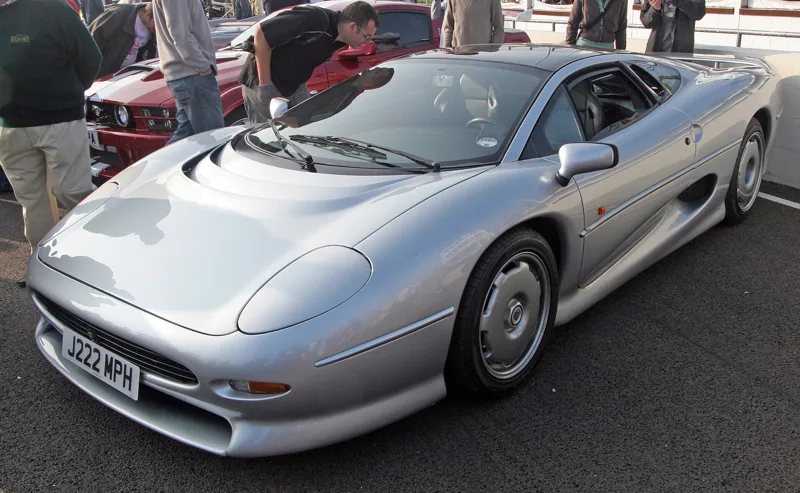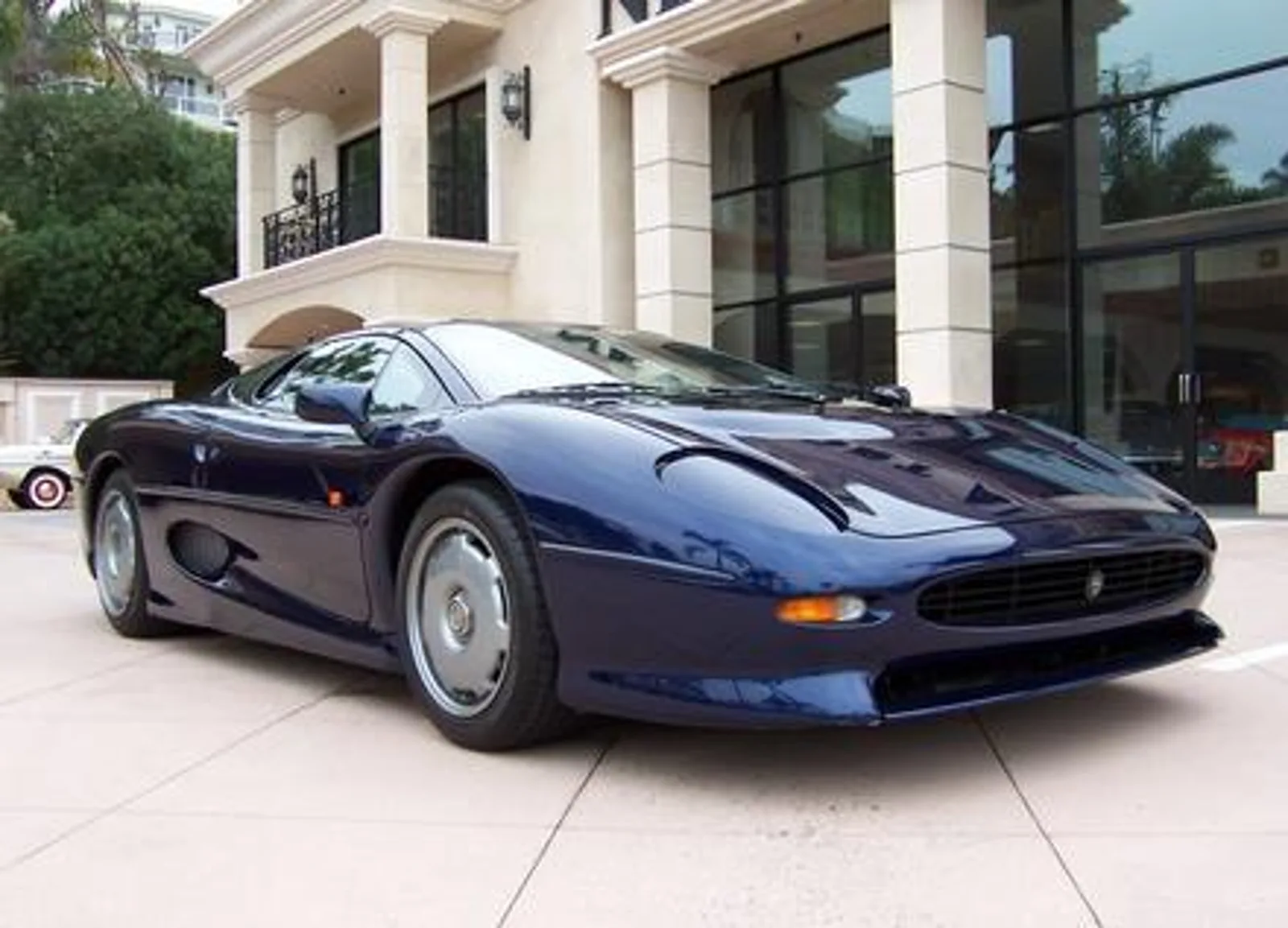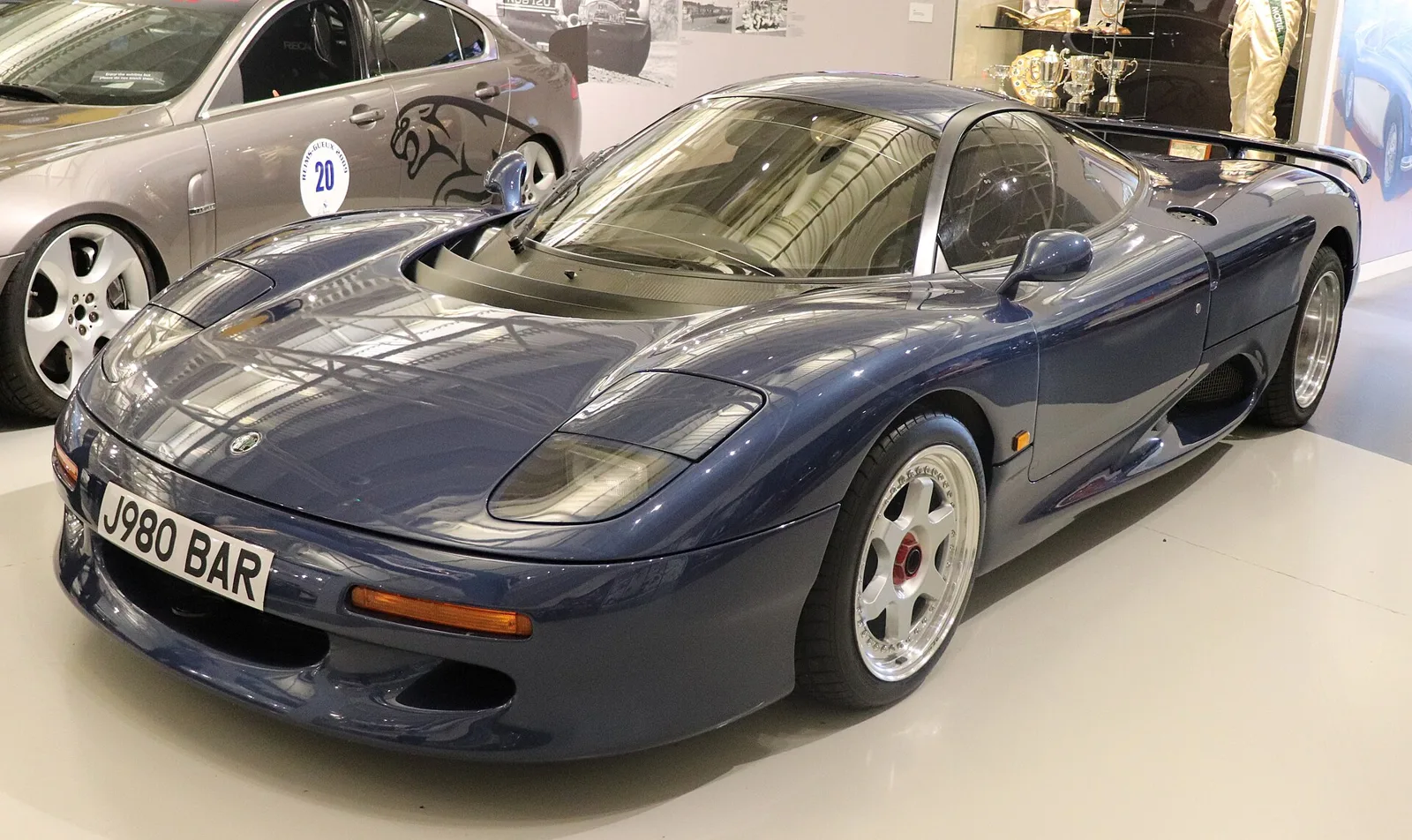
A 450 hp V12 two-seater built by JaguarSport and TWR from 1990 to 1992, based on the XJR-9 that won at Le Mans and made from carbon fibre throughout.
Built between 1990 and 1992 by JaguarSport, the XJR-15 was a two-seat road car based on the XJR-9 that won Le Mans. Its 450 hp V12 sat in a chassis and body made entirely of carbon fibre and Kevlar composites.
The Jaguar XJR-15 was a two-seat road car built by JaguarSport, a joint venture of Jaguar Cars and Tom Walkinshaw Racing, between 1990 and 1992. It used a 6.0-litre naturally aspirated V12 producing 450 hp (336 kW), and its carbon-fibre and Kevlar structure made it the first road-going car built entirely from those composites. A total of 53 were made, each at a price of about 500,000 pounds sterling.
What was the Jaguar XJR-15?
The Jaguar XJR-15 was a limited-production sports car designed to be driven on public roads and to race in a single-make series. Only 50 were planned, although 53 chassis were eventually built, and each one was sold for 500,000 pounds sterling. Its construction, engine and handling all came from Jaguar's racing programme rather than a standard road model.
Although it carried the Jaguar name, the car had no official involvement from Jaguar itself. JaguarSport built it at Bloxham in Oxfordshire, England, and the company was owned jointly by Jaguar Cars and TWR, the racing firm run by Tom Walkinshaw.
A carbon-fibre two-seater built from a Le Mans winner, with a 450 hp V12 and a race-bred chassis.
Where did the XJR-15 come from?
The XJR-15 grew out of Tom Walkinshaw's idea from 1988, after he saw the XJ220 concept at the British Motor Show. Jaguar had just won Le Mans with the XJR-9, and wealthy racing enthusiasts pressed Walkinshaw to build a road-going version of that car. The project was originally intended as a better alternative to the XJ220.
Walkinshaw asked Peter Stevens to develop the road car, which was first designated the R-9R. Stevens made the cockpit 75 mm (3.0 in) wider and lifted the roof 40 mm (1.6 in) for extra headroom. The scale model was ready by Easter 1989, the clay model was finished by October that year, and the first prototype was ready for Walkinshaw to drive in July 1990.
TWR modelled the car on the Jaguar C and D types, the Ford GT40 and the Ferrari 250 GTO. It met British construction and use rules, so owners could register it for the road in the UK, though its small run meant it was never type-approved. Production was announced on 15 November 1990, and the car was launched at Silverstone early in 1991.
Early buyers included racers such as Derek Warwick and Bob Wollek, along with the Sultan of Brunei.
How was the XJR-15 built?
The XJR-15 used a monocoque chassis and bodywork made from carbon fibre and Kevlar, a pairing that set a milestone for road cars. The McLaren F1 later used similar techniques, arriving in 1992. The car measured 480 cm long, 190 cm wide and 110 cm tall, and its final weight was 1,050 kg (2,315 lb).
The underside was flat, in line with Group C racing practice, and it used ground-effect venturi channels towards the rear. The engine was a stressed member of the rear frame, carrying part of the suspension loads. The drag coefficient was 0.30, and the car was built with a 48 percent front and 52 percent rear weight distribution.
The road car's ride height was set higher than the XJR-9 racer needed, to suit public roads. Its suspension was also softer than the racer's.
What powered the XJR-15?
The XJR-15 was powered by a 5,993 cc (6.0 L) naturally aspirated 24-valve V12. It produced 450 hp (336 kW) at 6,250 rpm and 569 N-m (420 lb-ft) of torque at 4,500 rpm, with an electronically managed fuel injection system and a fly-by-wire throttle that was advanced for its time.
The standard gearbox was a TWR unsynchronised six-speed manual, and a five-speed synchromesh unit was available as an extra. The engine weighed 299 kg (659 lb) with its clutch and accessories. The bodywork used 17-inch OZ forged alloy wheels with Pirelli P Zero tyres.
How fast was the XJR-15?
Contemporary tests put the XJR-15 at 3.9 seconds from 0-60 mph (0-97 km/h), and its gearing limited the top speed to 191 mph (307 km/h). The brakes were steel discs with AP four-piston callipers, and the suspension used Bilstein shock absorbers with wide wishbones and pushrods.
The car's power-to-weight ratio was strong, and the lightweight composite body helped its acceleration. The brakes were described by testers as among the car's strongest features, although softer pads were fitted for road use.
How did the XJR-15 handle?
The XJR-15 handled differently on road and track, and the first impressions were mixed. Tiff Needell road-tested a development car at Silverstone in early 1991 and found the car oversteered, but he later described a very rapid change of direction through the tight chicane.
Problems with the tyres added to the difficulty on track. Tom Walkinshaw had switched to Bridgestone just before the race series began, and team members later said the company had no moulds for the rear tyres and used F40 moulds instead. Drivers found the rears went off quickly and that it was hard to judge how hard to push.
For road use the suspension was set up more softly, and on the right rubber reviewers were won over. Ian Kuah, writing in World Sports Cars in 1992, said the ride quality was better at low speeds than that of a Ferrari 348, and he described the grip as far beyond what most drivers would use. Ron Grable, writing in Motor Trend in May 1992, said the car struck a balance between a race car and a road car.
Was the XJR-15 practical?
The XJR-15 offered very little in the way of practicality. The sill was wide, so the driver stepped onto the seat to get in, and the gear lever sat on the right of the driver. Both seats were set close together and close to the centre of the car.
There was no storage space because of the car's racing origins. Sound insulation was minimal, so the car carried an in-car headset system. Even so, the interior was widely praised in the car press, with its carbon fibre and yellow Kevlar trim, detailed analogue instruments and a shift lever that sat close to the small steering wheel.
Which race series did the XJR-15 compete in?
A limited number of XJR-15s were built for the 1991 Jaguar Sport Intercontinental Challenge, a three-race series held alongside the Formula One Grand Prix weekends at Monaco, Silverstone and Spa-Francorchamps. Sixteen racing-specification cars were entered for each round, and the winner of the final race at Spa received a cash prize of US$1 million.
Most owners who wanted to race did not drive their cars themselves. Instead they hired professional drivers, and Jaguar Sport included preparation and maintenance in the price of each race car. Nearly US$1 million was spent on each car, which made the series expensive for owners.
What happened in the Intercontinental Challenge races?
Derek Warwick took pole at Monaco and led the early laps, but Armin Hahne and Warwick touched several times in the first corners. Warwick emerged in front and finished seven tenths of a second ahead of David Brabham after 16 laps of hard racing.
At Silverstone, Warwick started from pole again, but a puncture and a collision with Brabham ended his challenge. Juan Manuel Fangio II won the race, precisely 45 years after his uncle's last victory at the same circuit. By the flag, 11 of the 16 starters had been damaged in one way or another.
The final race at Spa carried the US$1 million winner's prize, and Jaguar Sport kept the length of the race undisclosed to counter speculation about race fixing. Hahne took the lead when Cor Euser went wide on the eighth lap, and he won by a clear margin after 11 laps. Hahne later named the win as the highlight of his career.
What became of the XJR-15 after Jaguar left racing?
Once Jaguar had left sports car racing in 1994, Nissan turned to TWR to build the R390. The R390 borrowed the central tub of the XJR-15, meaning the cockpit and glasshouse, but it had new front and rear ends, a broader chassis and a Nissan engine instead of a Jaguar unit.
The R390 went well at Le Mans, and in 1998 all four cars finished in the top 10, placing third, fifth, sixth and tenth. Meanwhile the XJR-15 found a second life in historic racing. On 6 June 1999 the Aston Martin Owners Club staged a historic Group C invitation event at Donington Park. Bryan Wingfield's XJR-15 finished fourth overall and first in class.
The Aston Martin Owners Club Group C Challenge continued in 2000, with Wingfield's car driven by the journalist Paul Chudecki in several rounds. Results included a seventh-place finish at Spa-Francorchamps, a win in class at Donington Park and further class podiums at Silverstone and Brands Hatch.
What was the XJR-15 LM?
At the end of the production run, TWR built a small number of more powerful cars with the British firm XK Engineering, designated XJR-15 LM, for a Japanese customer. These cars used the 7.0-litre V12 shared with the XJR-9 and produced more than 710 PS (522 kW; 700 hp).
The LM also had a larger rear wing, an extra front splitter with vents, a modified engine cover with extra cooling vents and a roof air intake to feed the bigger engine. Records of the variant are sparse. Photographs suggest at least five cars were built, and a blue example bought by a UK collector after 2013 was the first LM known to exist outside Japan.
Jaguar XJR-15 specifications
| Specification | Detail |
|---|---|
| Built | 1990 to 1992, JaguarSport, Bloxham, Oxfordshire |
| Production | 50 planned; 53 chassis made |
| Price | 500,000 pounds sterling |
| Engine | 5,993 cc naturally aspirated 24-valve V12 |
| Bore x stroke | 90 mm x 78.5 mm |
| Compression ratio | 11.0:1 |
| Power | 450 hp (336 kW) at 6,250 rpm |
| Torque | 569 N-m (420 lb-ft) at 4,500 rpm |
| Transmission | TWR six-speed unsynchronised manual; five-speed synchromesh optional |
| Chassis and body | Carbon fibre and Kevlar monocoque |
| Dimensions | 480 cm long, 190 cm wide, 110 cm tall |
| Weight | 1,050 kg (2,315 lb) |
| Weight distribution | 48 percent front, 52 percent rear |
| Drag coefficient | 0.30 |
| 0-60 mph | 3.9 seconds in contemporary tests |
| Top speed | 191 mph (307 km/h), gearing limited |
| LM variant | 7.0-litre V12, more than 710 PS (522 kW; 700 hp) |