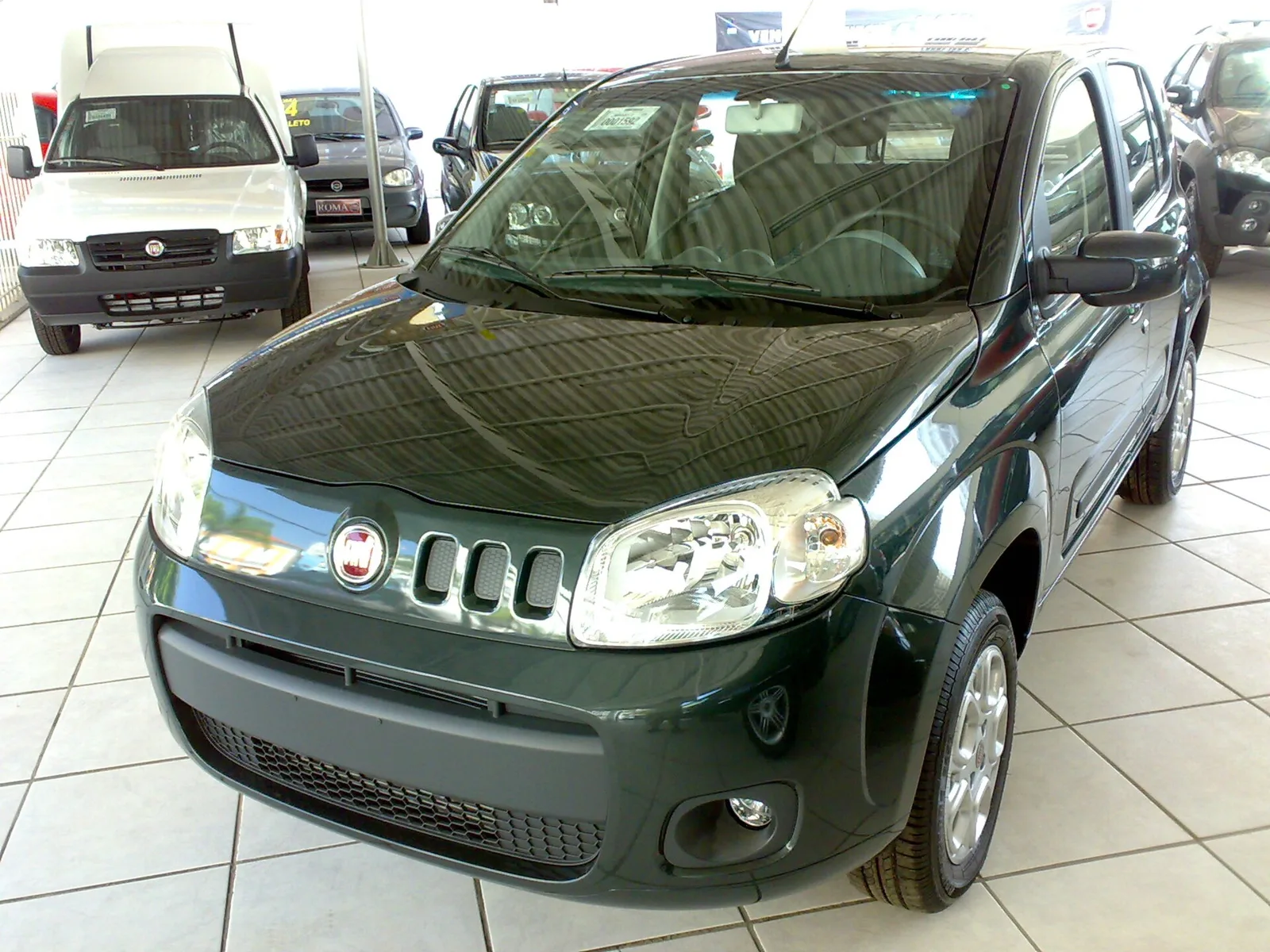
The Brazilian-built Novo Uno revived a name that began with a 1983 supermini, a car that sold more than 8,800,000 times across its platform.
Novo Uno, project Type 327, is a South American car built in Brazil. It uses 1.0 and 1.4 litre Fire Evo engines that run on ethanol or petrol, and production finished at the end of 2021, after which it was never sold in Europe.
The 2010 Fiat Uno is the second generation of a name first used for a 1983 supermini. Its modern form was built in Brazil, where it went on sale as the Novo Uno and was sold in South America rather than Europe. Production ran until the end of 2021, and the model shared its name with one of the most widely built small cars in Fiat's history.
What is the 2010 Fiat Uno?
The 2010 Fiat Uno is the Brazilian-built Novo Uno, project Type 327, which revived the Uno name for South American buyers. Engineering was done in Brazil, with styling input from Fiat's Centro Stile studio in Turin. Brazil and a number of other South American markets took it, though it never reached Europe.
Its styling sits between two Fiat families. It is a more urban interpretation of the Fiat Panda look, built on a Fiat Palio base, and it is larger and roomier than the first Uno while costing less and being smaller than the second generation.
A name that began in 1983 came back in 2010 as a Brazilian car, sized between the generations and built for South American roads.
Where did the Uno name come from?
The original Uno was a supermini designed by Giorgetto Giugiaro of Italdesign and launched in January 1983 to replace the Fiat 127. Its project name was Tipo Uno, meaning Type 1, because it followed the Tipo Zero, the Panda. The Uno's tall, square body echoed Giugiaro's 1978 Lancia Megagamma concept, though in a smaller package.
Over 8,800,000 Unos were built across all generations, which placed the platform eighth in the list of the most produced automobile platforms in history. The name was revived in 2010 for the South American car, linking the newer model back to that long production run.
How did the first Uno sell in Europe?
The first Uno went on sale about a month after the Peugeot 205, which was its main rival. It was offered in three-door and five-door hatchback forms, and it arrived just after General Motors had introduced the Opel Corsa, sold as the Vauxhall Nova in the UK. UK sales began in June 1983.
Britain took the car in large numbers. More than 20,000 were sold in the first full year, and sales peaked at more than 40,000 in 1988. The Uno won the 1984 European Car of the Year title in December 1983, edging out the Peugeot 205 by a narrow margin.
What engines did the first Uno use?
Launch engines were a 0.9 litre (903 cc) 100-series OHV unit carried over from the 127, as well as 1.1 litre (1116 cc) and 1.3 litre (1301 cc) units from the 128 family, both with single overhead cams. Fiat badges of the period gave the output in metric horsepower rather than the engine size, rounded to the nearest five, so the range carried badges of 45, 55, 60, 70 and 75.
From 1985 the 1.0 litre (999 cc) SOHC FIRE engine replaced the 0.9 litre. The name stood for Fully Integrated Robotised Engine. It was lighter, used fewer parts and offered better performance and economy than its predecessor. The top trim, the single-point injected 75 SX i.e., had remote locking, built-in front foglamps and an oval exhaust tip shared with the Turbo.
The Uno used MacPherson strut independent front suspension and a twist-beam rear with telescopic dampers and coil springs. Its controls were grouped in ergonomic clusters either side of the instrument binnacle, so the driver could operate them with hands on the wheel, and a single column stalk handled the turn signals and horn. That broke with the three-stalk layout Fiat had used since the late 1960s.
How did the Turbo i.e. differ from the ordinary Uno?
The Uno Turbo i.e. arrived in April 1985 as a three-door-only hot hatch. Its 1.3 engine, shared with the Ritmo and Strada, had Bosch multi-point injection and Magneti Marelli ignition, while an IHI turbo with an intercooler cooled the intake air. It made 105 PS (77 kW; 104 hp) and reached 205 km/h (127 mph), which put it among the fastest hot hatches of the 1980s.
The capacity was first given as 1299 cc, but it was changed early in production to 1301 cc. Italy's motorway system set a higher speed limit for cars above 1300 cc, which explains the change. Owners later reported that the larger engine felt more responsive and had more torque than the earlier unit.
Cars built from 1985 to late 1987 used a five-speed gearbox derived from the Ritmo and Strada. It was replaced by a newly developed C510 five-speed with a stronger differential and a better gearchange linkage, although the ratios stayed the same.
Visually the Turbo i.e. had black plastic sill trims, arch extensions, a fibreglass tailgate with a spoiler, tinted glass and side decals. It was lowered, stiffened and fitted with 13-inch alloy wheels and Pirelli P6 tyres. Vented front discs and solid rear discs replaced the standard brakes. Inside were sports seats, red carpet and an extended centre console, while later cars had red seatbelts.
Optional extras ran from polished Cromodora alloys and power windows to a manual sunroof and a digital dashboard. That panel showed fuel level, coolant temperature and boost pressure as bar graphs, along with a digital speed readout that could switch between km/h and mph. Later first-series Turbo i.e. cars could be fitted with a basic ABS system that worked only on the front wheels.
Why did the diesel versions matter?
Diesel Unos arrived in mid-1983, using a 1.3 litre engine already seen in the Fiorino and the 147. It was first offered only in Italy and was built in Brazil from 124-series engines. It reached other European markets from early 1984, and daily output in mid-1983 was 280 cars out of a total of 2000.
The diesel was sold as the Uno D with three doors and the Uno DS, or Super, with five. Apart from that badge, the only outward clue was an extra oil pressure gauge inside. The engine made 45 PS (33 kW), the same as the smallest petrol unit, but with much more torque. Because of extra sound insulation and heavier parts, the diesel weighed 121 kg (267 lb) against 79 kg (174 lb) for the 903 petrol car.
In 1986 a 1.7 litre naturally aspirated diesel arrived in the 60DS, together with the Uno Selecta, which used a continuously variable transmission. The Selecta was the only diesel Uno sold in the UK. Its CVT was developed with Dutch firm Van Doorne and Ford, and Fiat then held a 24% stake in Van Doorne.
A 1.4 litre turbodiesel, the Uno Turbo D, made 72 PS (53 kW). It was quick for a small diesel of its time and out-accelerated the 70 SX petrol car, while using roughly a third less fuel. Its suspension was firmer to cope with the heavier engine, and an oil temperature gauge came as standard.
How did the 1989 facelift change the Uno?
The Uno was facelifted in September 1989 at the Frankfurt Motor Show. The front styling and tailgate were revised, and the tailgate change improved the drag coefficient to Cd 0.30. The dashboard was redesigned to replace the pod-style switchgear with conventional stalks on the steering column.
Engine changes followed. The 1.1 litre gave way to a FIRE unit, and a 1.4 litre (1,372 cc) engine derived from the Fiat Tipo replaced the 1.3 litre in both normally aspirated and turbo forms. A 1.4 litre Uno Turbo was claimed to reach 204 km/h (127 mph), while the 1.0 version managed 140-145 km/h (87-90 mph) depending on the gearbox. The Turbo i.e. also gained a Garrett T2 turbine, Bosch LH Jetronic injection and better aerodynamics.
Which countries built the Uno?
The Uno was built in many countries after its European production finished. Italian factories built 6,032,911 cars before output ended in 1995, and the platform went on in other places for much longer. Brazil made the car until 1 January 2014, and the country's total across the Uno and Mille models reached 3.6 million in a 30-year run.
Poland built 173,382 units from June 1995 to October 2002, first at Bielsko-Biala and then at Tychy. In Argentina Sevel produced 179,767 cars from March 1989 to 2000, and the sedan version, called the Duna, was made from 1988 to 2001. More than a quarter of a million Duna units were built at Fiat's Cordoba plant.
Other assembly sites included South Africa, where 110,000 units were built between 1990 and 2002. Morocco assembled cars until 2003, and Turkey built the Uno from 1994 to 2000. A Yugoslav-built Uno 45R was made in Kragujevac from 1988 to 1994, and 2,620 examples were produced. India began with a poor start in 1996 when only 617 cars were delivered out of 30,000 ordered, before a 50-50 joint venture with Tata Motors began in January 1997.
How was the 2010 Novo Uno engineered?
The new car was designed for Latin American conditions. It had two engine choices, a 1.0 Fire Evo with 74 hp and a 1.4 Fire Evo with 87 hp. Both could run on ethanol, petrol or any mixture of the two, which suited Brazil's fuel market.
Its size was a deliberate middle ground. It was roomier than the first Uno, yet it sat below the second generation in size and price. Earlier Brazilian Unos kept the spare tyre in the engine bay, as the Fiat 147 had done, which left more room for luggage in the boot.
What changed in the Novo Uno's later years?
Fiat launched the Uno-based Fiorino panel van in December 2013. In September 2014 the Uno received a facelift and gained the Start and Stop system on the 1.4 Fire engine. A further facelift came in 2016, when the Firefly engine arrived in 1.0 and 1.3 litre forms.
In 2018 Fiat removed the Way and Sporting trims, along with their GSR semi-automatic versions. The new Drive version became the entry model, and the Attractive remained, both only with the 1.0 Firefly engine. The Way returned in mid-2018 with both the 1.0 and 1.3 engines.
By 2021 the Firefly engine had been dropped, and the car reverted to the older 1.0 73/75 PS Fire Evo. Only the Attractive stayed in the range, because the Way, Sporting and Drive versions had been discontinued. Production closed at the close of 2021, and the final run was the Uno Ciao special, limited to 250 units.
How did the Novo Uno perform in safety tests?
A Brazilian Uno was tested by Latin NCAP in 2011 and rated as highly unsafe. The crash score was a single star for the adults inside, with two stars for child occupants. A later test in 2013 rated it zero stars.
What was the Uno Cabrio concept?
At the Sao Paulo International Motor Show in October 2010, Fiat presented the Uno Cabrio concept. The prototype had two seats and a body kit, and it used the 1.4 Fire T-Jet 16V engine that produced 152 HP. It was a showcase car rather than a production model.
What are the Fiat Uno 2010 specifications?
| Specification | Detail |
|---|---|
| Project code | Type 327, Brazilian-built Novo Uno |
| Sold in | Brazil and other South American countries; not exported to Europe |
| Engine (base) | 1.0 Fire Evo, 74 hp; from 2021 at 73/75 PS |
| Engine (larger) | 1.4 Fire Evo, 87 hp |
| Fuel | Ethanol, petrol or any mixture |
| Panel van | Fiorino, launched December 2013 |
| Firefly engines | 1.0 or 1.3 litre, introduced in 2016 |
| Final production | Uno Ciao limited edition, 250 units, end of 2021 |
| Brazilian total, all generations | 4,379,356 Unos at Betim |
| Latin NCAP 2011 | One star adults, two stars children |
| Uno Cabrio concept | 1.4 Fire T-Jet 16V, 152 HP, Sao Paulo, October 2010 |