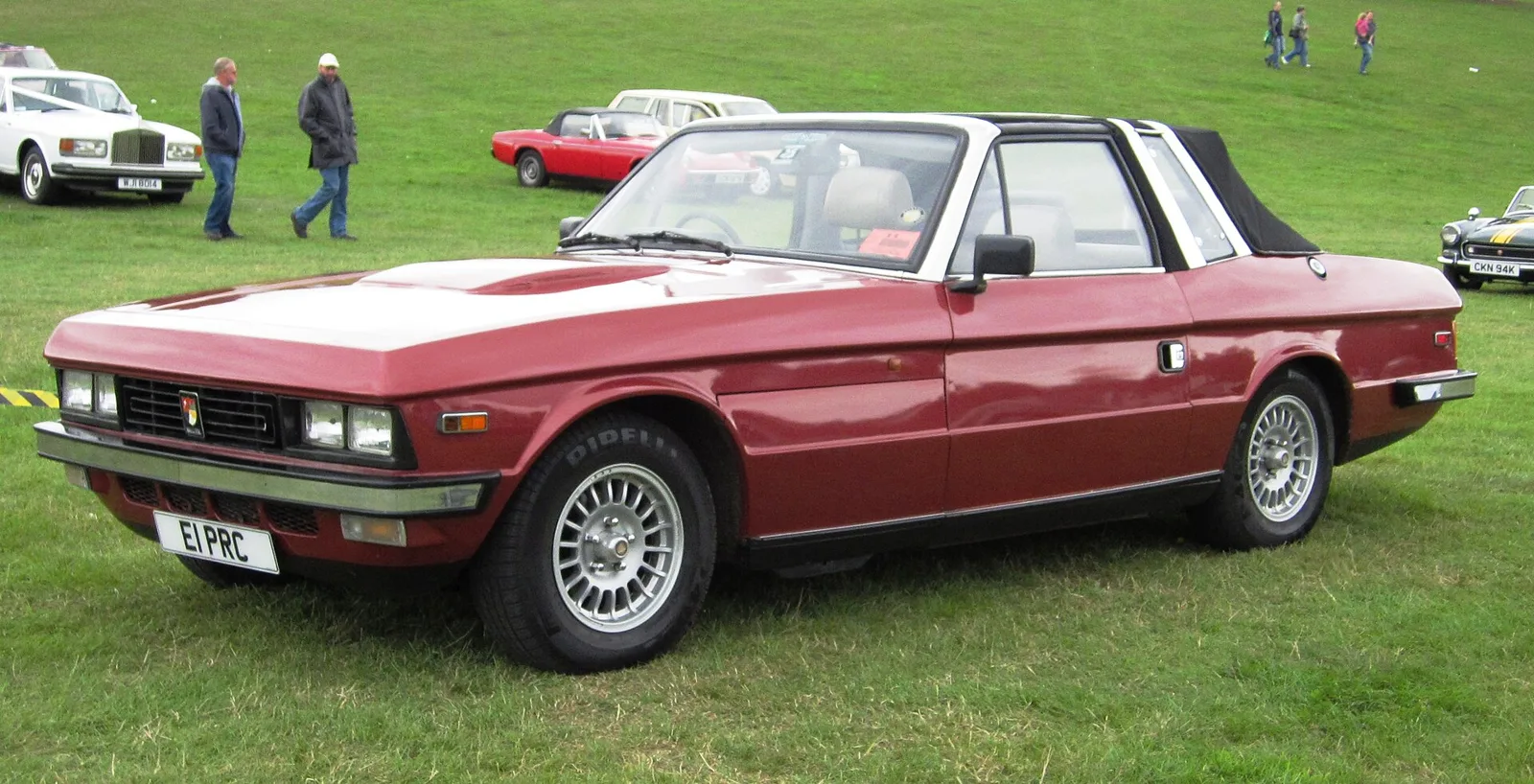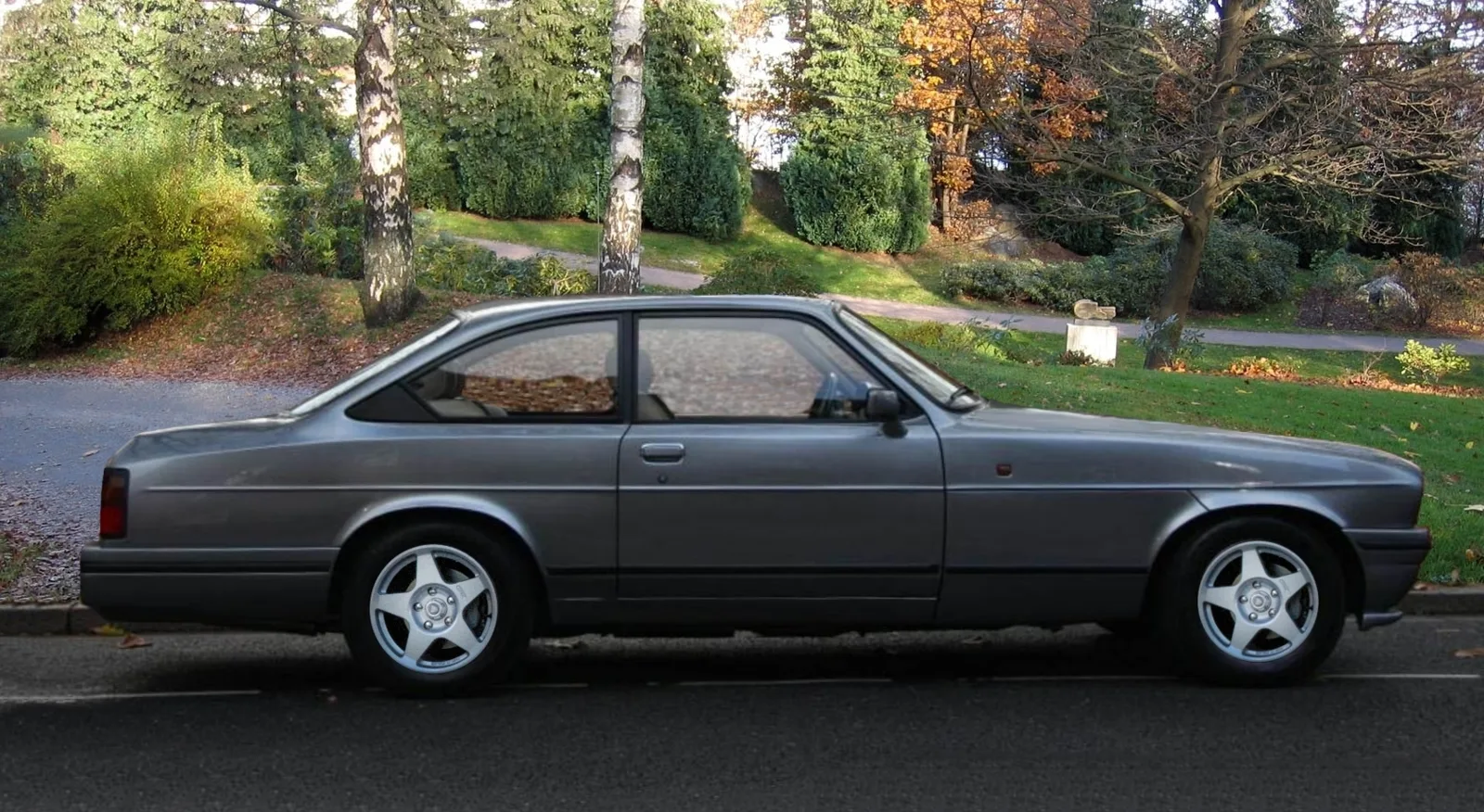
Hand-built from 1993 until summer 2008, the four-seat Blenheim paired a BMW-derived chassis with a Chrysler eight-cylinder engine and a roofline made for tall passengers.
The Bristol Blenheim was a four-seat coupe made by Bristol Cars from 1993 to 2008 in three series. It combined a BMW-derived chassis with a Chrysler 5.9-litre eight-cylinder engine and was built largely by hand, with fewer than 50 examples estimated.
The Bristol Blenheim was a four-seat upper-class coupe from the British maker Bristol, built largely by hand in three series. The car married a BMW-derived chassis, first engineered before the war, to a Chrysler eight-cylinder engine of up to 294 kW (400 PS; 395 hp). Exact production numbers are not known, and estimates put the total at fewer than 50 cars.
Where did the Blenheim come from?
The Blenheim grew out of the 603 and Britannia, the coupes Bristol had built since the 1970s and 1980s. Tony Crook, then sole owner of Bristol Cars, first considered a replacement for the closed four-seater, but chose to develop the saloon further so that an updated car could appear quickly. The result was shown to the public in September 1993.
Bristol Cars, based in Gloucestershire, had started as an aircraft maker. The Bristol Aeroplane Company was founded in Bristol in 1910, and when orders for new aircraft fell after the Second World War, it moved into the car business, as Saab had done. Bristol took the chassis of the BMW 326 almost unchanged and used it for every later model.
Until 1961 Bristol used a six-cylinder engine based on a BMW development. The 407 brought Chrysler eight-cylinder engines, and the brand's character shifted from sportiness towards comfort and understatement.
The 603 of 1976 marked a turning point. It came with smaller engines and, for the first time in 18 years, a completely new body that the factory built itself. The Britannia of 1982 and its turbocharged twin, the Brigand, were outwardly revised 603s. Critics had found the original not particularly beautiful, and the Britannia and Brigand stayed in production for eleven years, although their carburettor engines looked dated under stricter exhaust rules.
When the range needed renewing at the start of the 1990s, Crook considered a shortened, updated version of the open Beaufighter, which had a Zagato-designed body. The death of development chief Dennis Sevier and the company's financial difficulties ended that plan, and the existing saloon was developed instead.
A car built on a prewar BMW chassis, with a Chrysler eight-cylinder engine and a roofline made for tall passengers.
Why was the Blenheim named after an aircraft?
The name refers to the Blenheim fighter aircraft of the Bristol Aeroplane Company, not to Blenheim Palace, as some publications have claimed. Only one airworthy example of that aircraft still exists. Bristol had named its cars after historic aircraft since the Beaufighter of 1980, which gave each car an identity of its own.
The name also let Bristol avoid a numbered model designation. Continuing the 603 numbering would have produced 603 S4 or 604, and that risked a legal dispute with Peugeot, which had protected three-digit type names with a zero in the middle.
Chassis, suspension and brakes
Like its predecessors, the Blenheim sat on a separate box frame with longitudinal members and cross members. Bristol regarded the separate chassis as a contribution to passive safety. Keeping a structure more than 50 years old produced dimensions that were unusual for the 1990s.
The engine sat behind the front axle, as it had on the Bristol 400 of the immediate postwar years. Bristol described the Blenheim as a front mid-engined car and credited the engine position with better weight distribution. The car was also very narrow: nearly 20 cm (7.9 in) slimmer than a Bentley Continental R, and 5 cm (2 in) slimmer than a Ford Mondeo.
The front suspension used double wishbones with coil springs. At the rear, a rigid axle was located by a Watt linkage and torsion bars. Dampers could be set at the factory to the customer's taste, but there was no electronically controlled suspension.
Power steering came from ZF and the disc brakes from Girling. Neither anti-lock brakes nor airbags were available at any point during production.
What power did the Chrysler engine produce?
The 5.9-litre (360 cu in) Chrysler eight-cylinder produced between about 166 kW (225 PS; 222 hp) in the first series and 294 kW (400 PS; 395 hp) in the 3S. The factory never published exact figures, so these are estimates from the literature. The engine was used in every series, with its output raised over the years.
The unit was a small-block from Chrysler's LA family, introduced in 1964 and built in Canada. Chrysler had used it in some mid-size models between 1971 and 1980, and from the mid-1970s makers including Bristol, Monteverdi and Jensen took it for small-series cars.
From 1992 to 2002 the engine went into large off-road vehicles such as the Jeep Grand Cherokee, and after that it was built exclusively for Bristol. Bristol's engines were assembled by hand in a department that dealt mainly with warranty work, and they were of a higher grade than the production-line versions fitted to the SUVs.
Unlike the engines of the 603 and Britannia, the Blenheim's unit had electronic multi-point injection. Turbocharging, which the Brigand had offered until 1993, was no longer available. Over the predecessor, the novelty was a Chrysler four-speed automatic with electronic control, and the car had four catalytic converters as standard.
Body, roofline and interior
The body was a steel framework welded to the box chassis and covered in aluminium, and the bumpers and trim, including the radiator surround, were also aluminium. The body type is classified inconsistently. Bristol called the Blenheim a saloon, while German and French publications mostly listed it as a coupe.
The shape carried over from the 603 and Britannia, whose design came from Dudley Hobbs. Keeping a 17-year-old basic design again came down to money: at the start of the 1990s the company could not afford new press tools, so the existing parts were reused.
The roof was the most unusual part of the design. Bristol wanted two adults to fit comfortably on the rear seats, and it had a long-standing aim of letting four passengers of 1.80 metres (5 ft 11 in) travel in comfort. That needed a high roofline above the back seats. Very thin B and C pillars improved visibility, and their design took its cue from the Ford Escort II of 1975. Test reports praised the car's visibility.
The spare wheel lived in an outside compartment between the front wheel and the A-pillar, a feature every Bristol had carried since the 404 sports coupe of 1953. The battery sat in a matching compartment on the other side, which enlarged the boot and helped centralise the weight.
The front and rear styling were new. After the wide-band headlamps of the predecessors, the front again carried four round lamps, whose design varied across the series. The rear was raised to add boot volume and was never restyled. Inside, the Blenheim kept the predecessors' character, with real walnut dashboard trim, an oval leather-covered instrument unit and made-to-measure seats. Connolly supplied the leather until 2000.
How many were built, and how long did production last?
Exact production numbers are not known, but estimates suggest fewer than 50 cars were built. The three series were listed as 1993 to 1997, 1998 to 1999 and 1999 to 2011, but the last Blenheim was completed in summer 2008, which makes the production period 15 years.
The car was listed for 18 years, yet the last one was finished in 2008. In early 2011, shortly before Bristol Cars became insolvent, the company website still described the Blenheim as available.
Production stretched on mainly because of Toby Silverton, who had owned the company since 1997. Tony Crook had seen the Blenheim as a stopgap until a newly developed successor called the Buccaneer was ready. Silverton instead changed the Blenheim step by step, and his attention went to the Fighter, a gull-wing sports car.
The three series at a glance
| Version | Production | Output (estimate) | Notes |
|---|---|---|---|
| Blenheim, first series | Autumn 1993 to December 1997 | About 166 kW (225 PS; 222 hp) | Top speed 225 km/h (140 mph) |
| Blenheim 2 | Presented January 1998, built about one and a half years | About 191 kW (260 PS; 256 hp) | Turning circle 11.9 metres |
| Blenheim 3 | Presented October 1999, listed to 2011 | About 265 kW (360 PS; 355 hp) | 139,825 pounds at presentation |
| Blenheim 3S | Presented summer 2002 | About 294 kW (400 PS; 395 hp) | 10,000 pounds more than the basic model |
| Blenheim 3G | From 2002 | LPG-run version of the Blenheim 3 | Exempt from the London Congestion Charge |
The first series
The prototype, a silver car with red leather, was shown in September 1993. It had started life as a Britannia from 1983 and was Crook's personal car for some years. The first series had a large front panel with four small xenon headlamps, and a shield-shaped grille that Autocar took for a copy of a Lancia design.
Crook placed the Blenheim between the Bentley Continental R and the Aston Martin Virage. Both had more power and cost more, and against them the Bristol was the slowest car. Bristol emphasised economy instead, saying the engine turned only 1,700 rpm at 100 km/h. Holding 110 km/h steadily, the car burned 12.5 litres per 100 km (22.6 mpg-imp; 18.8 mpg-US).
Blenheim 2
The second series arrived in January 1998. According to Silverton it was developed in seven months and brought more than 700 detail changes. Larger round headlamps, a chromed cross bar in the radiator opening, a wider track and a turning circle reduced to 11.9 metres followed. Output rose to about 191 kW (260 PS; 256 hp), and a top speed of about 240 km/h (150 mph) became possible.
Blenheim 3 and 3S
Presented in October 1999, the third series focused on sportiness. Output was increased significantly, with different levels reached over the years. The front wings gained a rounded profile, the bonnet's leading edge became wavy, and the overall length shrank by 40 mm (1.6 in). The Town Coupe version let the passenger seat fold forward to give the rear passenger almost unlimited legroom.
The sportier 3S, presented in summer 2002, had about 294 kW (400 PS; 395 hp), a rear track 60 mm (2.4 in) wider and firmer suspension. It cost 10,000 pounds more than the basic model.
Blenheim 3G
From 2002 Bristol offered an LPG version alongside the Blenheim 3. It revived a tradition from 25 years earlier, when the 412 and 603 could already run on gas. The factory said gas was cleaner and cheaper to run.
Blenheim 4, the one-off
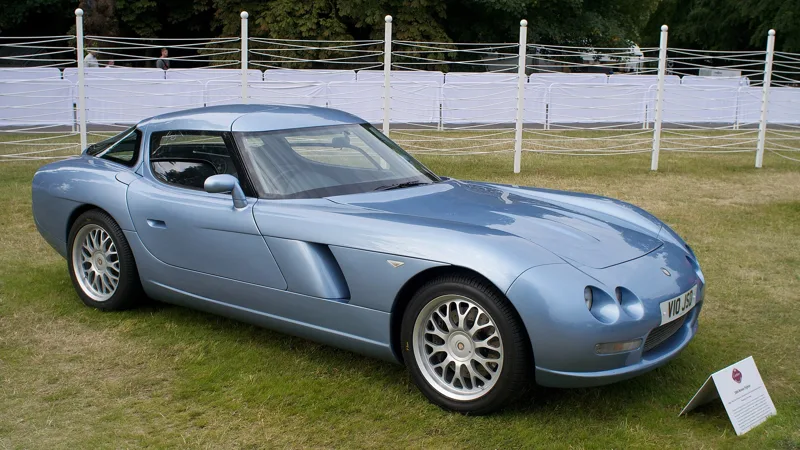
In spring 2009 Bristol built a specially bodied car for a customer, usually called the Blenheim 4. Painted light blue, it kept the familiar semi-fastback shape but had rear lights from the Audi A4 Avant of 2000 to 2004, rounded mirrors and new bar-type door handles. Its engine matched the 3S but was fitted for LPG. It remained a one-off, shown at exhibitions and offered for sale from April 2012.
Did the Blenheim make money?
The Blenheim did not pay its way. Low volumes and complicated production meant regular losses for Bristol Cars. In the 1990s those losses were at first covered by profits from restoring older Bristols and selling used cars.
From 2000 onward the owner, Silverton, also had to provide subsidies more than once. He acknowledged that the model was not profitable and framed it as an investment: each new Blenheim would be a car that Bristol Services could later service and restore for profit.