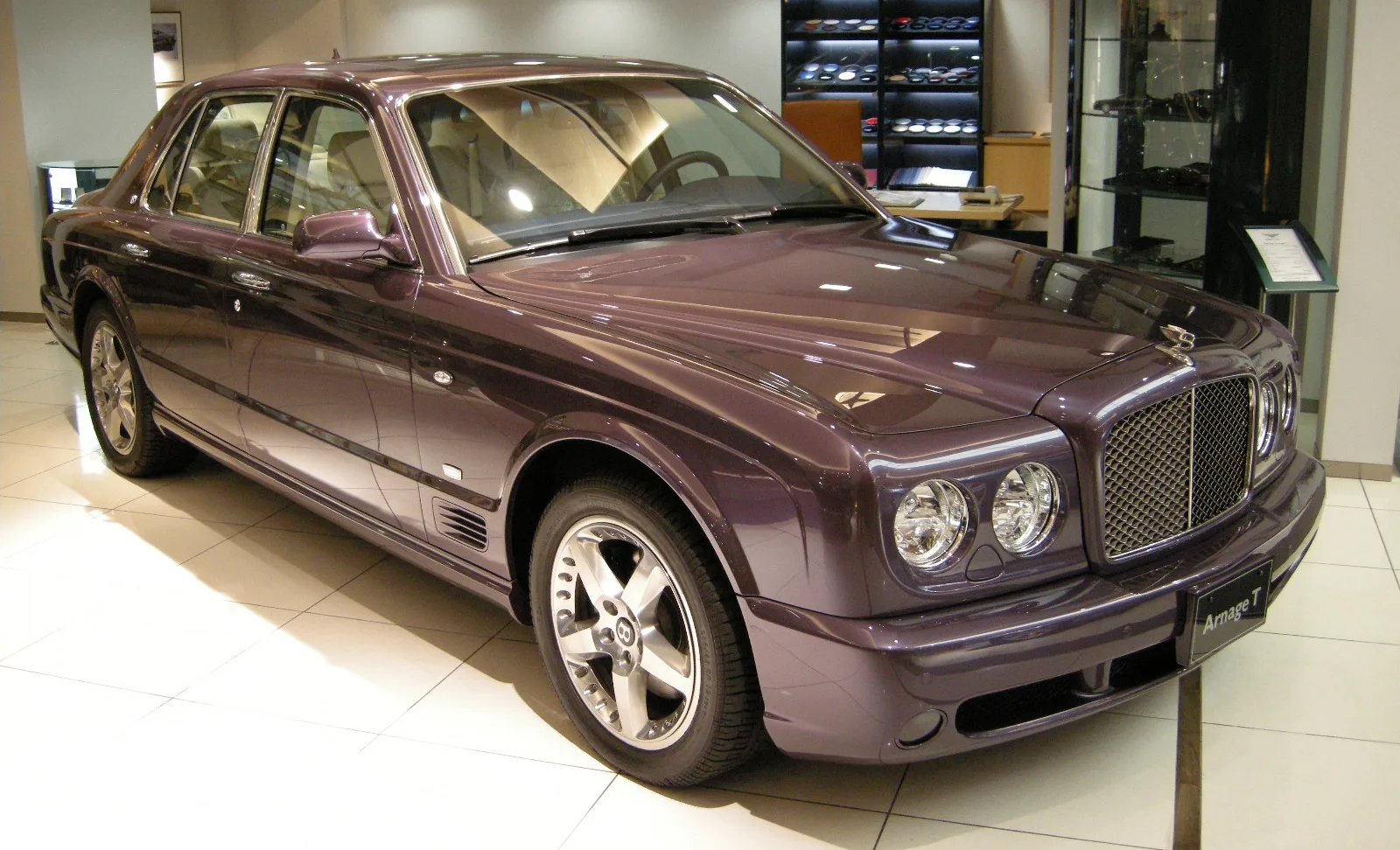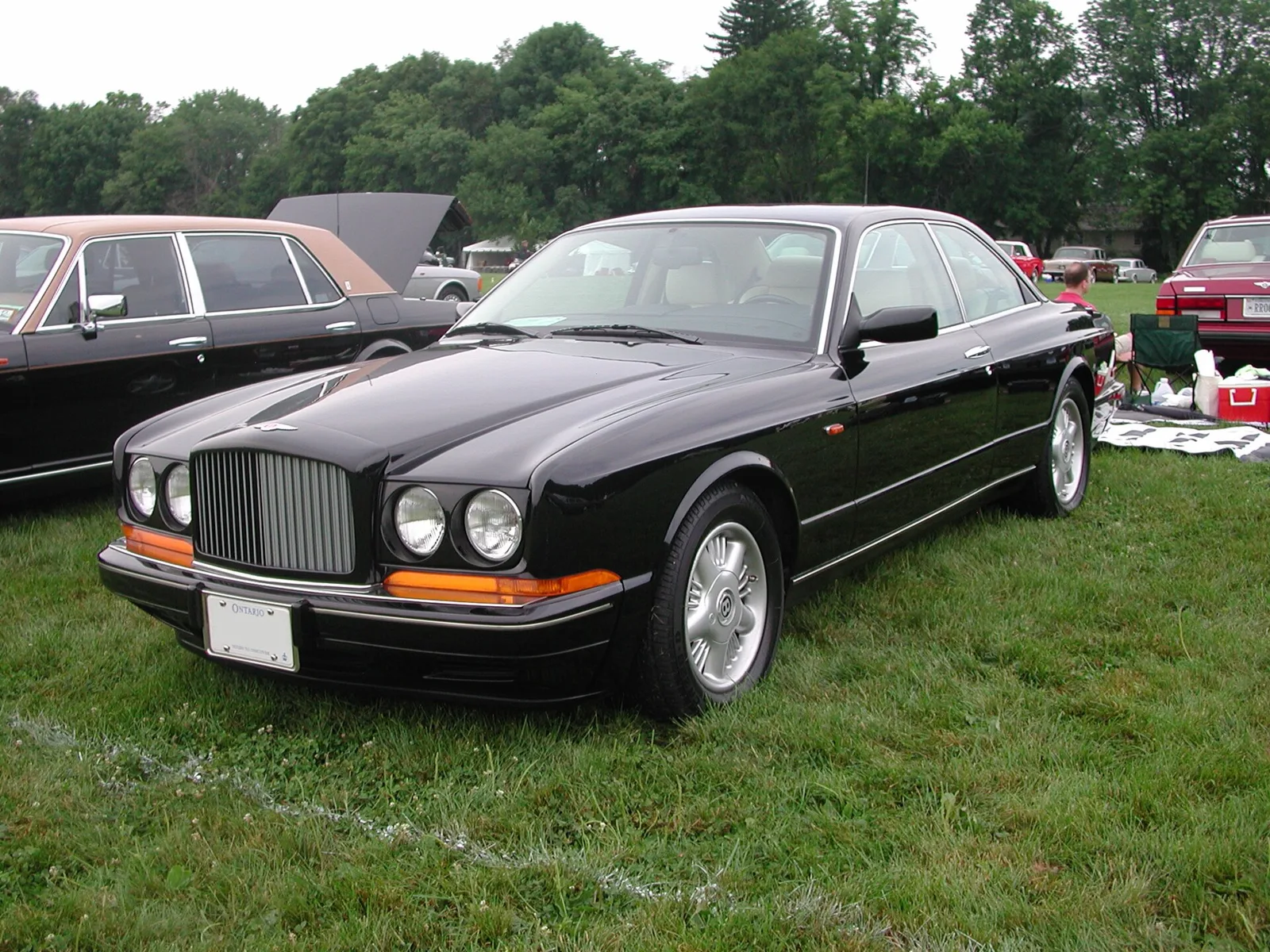
Built from 1991 to 2003 on the Rolls-Royce SZ platform, the Continental R was the fastest and most powerful Bentley of its day and helped save the brand.
Bentley's Continental R, a two-door luxury coupe, ran from 1991 to 2003 on the Rolls-Royce SZ platform. It used a turbocharged V8, rose from 325 hp to 420 hp across its life and is credited with helping revive the Bentley marque.
The Bentley Continental R was a luxury two-door coupe built by Bentley Motors from 1991 to 2003. It was the first Bentley with a body not shared with a Rolls-Royce since the 1965 S3 Continental, and it held the title of the quickest, dearest and strongest Bentley of its day. A convertible derivative, the Bentley Azure, followed in 1995.
How did the Continental R come about?
David Plastow, managing director of Rolls-Royce Motor Cars in the early 1980s, could see the potential in a brand that had been neglected for 15 years. The first step was the Bentley Mulsanne Turbo of 1982, a turbocharged version of the standard four-door saloon.
Peter Ward, the marketing director, wanted a more sporting identity that moved Bentley away from being a re-badged Rolls-Royce. Designers John Heffernan and Ken Greenley were asked for a distinctive coupe, and a fibreglass mock-up appeared at the 1985 Geneva Motor Show as the Project 90 concept.
Project 90 was largely shelved as the company worked on a replacement for the Rolls-Royce Corniche. Graham Hull, chief designer in house at Rolls-Royce, suggested the Corniche designs would suit a Bentley coupe better, and in 1986 he produced a rendering that became the Continental R.
A two-door Bentley that helped save Rolls-Royce Motor Cars and ran as the fastest Bentley of its day.
Who designed the Continental R's body?
Heffernan and Greenley were kept on to finish the design, having led the Royal College of Art's automotive design course. International Automotive Design in Worthing, Southern England, produced the first prototypes and bought a machine tool solely to cut the clay for them.
Graham Hull and the in-house Rolls-Royce styling group handled the interior. The body was far removed from the somewhat slab-sided four-door SZ cars of the time, and it reached a drag coefficient of Cd=0.37.
The Continental R also had roof-cut door frames, which made access easier on a lower roofline than its four-door contemporaries. A subtle spoiler effect at the rear completed the look, and the finished car disguised its huge dimensions well. It was around 4 inches longer than a 2013 long-wheelbase Mercedes S-Class.
How did the Continental R's name come about?
The Continental name recalled the post-war Bentley Continental. The letter R nodded to the 1950s R Type cars and to the 1980s and 1990s Turbo R, where it denoted roadholding.
The car was built on the Rolls-Royce SZ platform, an evolution of the SY platform, with an aerodynamically shaped two-door body. Its success later proved important to the wider group, as the revival helped save Rolls-Royce Motor Cars.
How did the Continental R launch in 1991?
A pre-production car, developed under the codename Nepal, was taken secretly to Switzerland for a surprise launch at the 1991 Geneva Motor Show, where it emerged from behind a wall on the Rolls-Royce stand, earlier than the 1992 date that had been expected.
Handel's Zadok the Priest, written for King George II's coronation in 1727, was chosen as the launch music. The Sultan of Brunei was so impressed that he bought the show car for over 2 million pounds, and the unexpected vermilion coupe overshadowed the new Mercedes-Benz W140 that launched at the same show.
What engine did the Continental R use?
The car used the 6.75-litre Garrett-turbocharged V8 from the Turbo R. Early cars from 1991 to 1993 produced 325 hp (242 kW; 330 PS) at 4,000 rpm and 610 Nm (450 lb ft) at 2,000 rpm, although Rolls-Royce did not publish official figures and described power simply as sufficient.
The 1994 model year brought revised cylinder heads, with work by Cosworth, a sister company in the Vickers group. Power rose to an estimated 360 hp (268 kW; 365 PS) at 4,000 rpm, with 678 Nm (500 lb ft) at 2,000 rpm, and the alloy wheels grew to 17 inches in a new seven-spoke design.
The 1996 model year was the biggest step. A liquid-cooled chargecooler became standard, along with a Zytek EMS3 engine management system and a digitally controlled turbo over-boost. Output reached 385 hp (287 kW; 390 PS) and 746 Nm (550 lb ft), available from 2,000 rpm, and it was the first time Rolls-Royce officially released performance figures.
Autocar, testing the 1996 car in August 1995, suggested the gearbox would have been destroyed by the low-down torque. Rolls-Royce quoted the 0-60 mph time as sub 6 seconds and the top speed as 155 mph (249 km/h).
In 1998 the electronic traction assistance system became standard. Power and torque stayed the same, but 0-97 km/h acceleration was quoted at 6 seconds.
How did the chassis and gearbox work?
The car used the 4-speed GM 4L80-E automatic, which Rolls-Royce had tested over more than 1,609,344 km (1,000,000 miles) and modified for refinement. Self-levelling hydraulic suspension with adaptive ride control was fitted, along with ventilated front discs with twin calipers.
Every car had a centre-console electronic gear selector, the first time Rolls-Royce had moved the selector off the steering column. A Sport button adjusted the gearbox mapping and stiffened the suspension, and road testers repeatedly praised its high-speed handling for such a large, heavy car.
Engine management came from MK-Motronic digital fuel injection with fully mapped ignition. The launch top speed was 145 mph (233 km/h), with 0-60 mph in 6.6 seconds.
What did the Continental R cost?
At launch the price was US$271,780 in 1992, or 178,000 pounds in Britain. UK prices rose to 180,120 pounds in the 1994 model year and reached 187,354 pounds by 1996. At its introduction the car had been the most expensive production car in the world.
What was the Continental S?
The Continental S, a limited edition, appeared in 1994 and 1995 and added a liquid-cooled chargecooler to the performance package. Only 37 were produced, and they were offered to established Bentley customers, one of whom was the late Alan Clark MP.
Its engine was estimated at 385 hp (287 kW; 390 PS), and 0-60 mph acceleration improved to 6.1 seconds.
How did the Continental T differ?
Launched in 1996, the Continental T was a short-wheelbase version of the R that offered more power and responsive handling at the cost of rear legroom. Its wheelbase was 102 mm (4 in) shorter, with extended wheel arches and a more athletic outward look.
At launch the T offered 400 hp (298 kW) and 800 Nm (590 lb ft). For 1998 the output rose to 420 hp (313 kW; 426 PS) and 881 Nm (650 lb ft) at only 2,200 rpm. The T had larger brake discs, full front brake calipers and ABS.
The interior used turned-metal dashboard trim with chrome instruments instead of the R's wood, and the T weighed 200 lb (91 kg) less. Its 0-60 mph time was 6.2 seconds, and its quarter-mile took 14.5 seconds at 98.3 mph (158.2 km/h). The Environmental Protection Agency classified it as a subcompact car.
The T carried a premium of at least 21 percent over the R, and it cost 7 percent more than the Azure convertible. The T Mulliner, introduced in 1999, added modified shock absorbers and stiffer torsion bars, raising front stiffness by 40% and rear by 20%.
What was the Continental R Mulliner?
Mulliner versions, sold from March 1999, debuted at Geneva and used the Continental T's 420 hp unit in the longer R body. Customers who wanted the T's power in the longer wheelbase were the reason it existed.
With that engine the Mulliner was estimated at 170 mph (274 km/h) and reached 0-60 mph in 5.6 seconds.
What other special versions were built?
The Continental R California Edition was a limited run of six wide-body coupes in 1998, and the sixth car had the full-spec T engine. A 1999 Continental Sedanca Coupe had a removable roof panel over the front seats, and 79 were built.
Between 1999 and 2003 Bentley's Personal Commission programme produced customised cars, and 194 Continental R cars had the 420-horsepower engine, some of them in wide-body form. The R 420 and Le Mans editions followed in the same period.
Were there bespoke Blackpool cars?
Throughout the 1990s, Rolls-Royce built special cars for wealthy customers under the code name Blackpool cars. These were bespoke vehicles, generally based on the Continental R but with unique body shells that cost several million pounds to tool up, so only a handful were made.
The best-known customer was the Sultan of Brunei, who reportedly placed orders worth tens of millions of pounds during this period.
How did the Continental R end?
Production ceased in 2003, and the Continental R was the last car still based on the SZ Silver Spirit platform. Four-door cars on that platform had already been superseded in 1998 by the Bentley Arnage and Rolls-Royce Silver Seraph.
The final Series comprised the last eleven cars, six of them left-hand drive, all under the 2003 model year. Some features unique to the company disappeared on later cars, including pedals mounted in the floor, low sills and mineral-oil suspension and brakes.
How many Continental Rs were built?
Production totalled 1,504 Continental R and S cars, of which 1,236 were Continental R models built from 1991 to 2002. The Continental T total was 350, with 322 built from 1996 to 2002, and 131 Continental R Mulliners were made from 1999 to 2003.
Other counts include 38 Continental R 420s from 2000 to 2003 and 46 Le Mans cars in 2001. Only 37 Continental S cars were built in 1994 and 1995, and the Sedanca Coupe reached 73 units in 1999.
What are the Continental R specifications?
| Specification | Detail |
|---|---|
| Production | 1991 to 2003 |
| Engine | 6.75-litre Garrett-turbocharged V8 |
| Power, 1991 to 1993 | 325 hp (242 kW; 330 PS) at 4,000 rpm |
| Power, 1994 | 360 hp (268 kW; 365 PS) at 4,000 rpm |
| Power, 1996 | 385 hp (287 kW; 390 PS) |
| Power, Continental T and R 420 from 1998 | 420 hp (313 kW; 426 PS) |
| Torque, 1991 to 1993 | 610 Nm (450 lb ft) at 2,000 rpm |
| Torque, 1998 Continental T | 881 Nm (650 lb ft) at 2,200 rpm |
| Gearbox | 4-speed GM 4L80-E automatic |
| Top speed at launch | 145 mph (233 km/h) |
| 0-60 mph, launch | 6.6 seconds |
| 0-60 mph, Continental T | 6.2 seconds |
| 0-60 mph, Mulliner | 5.6 seconds |
| Launch price | US$271,780 in 1992; 178,000 pounds in the UK |
| Continental T wheelbase | 102 mm (4 in) shorter than the R |
| Continental R/S production | 1,504 built |