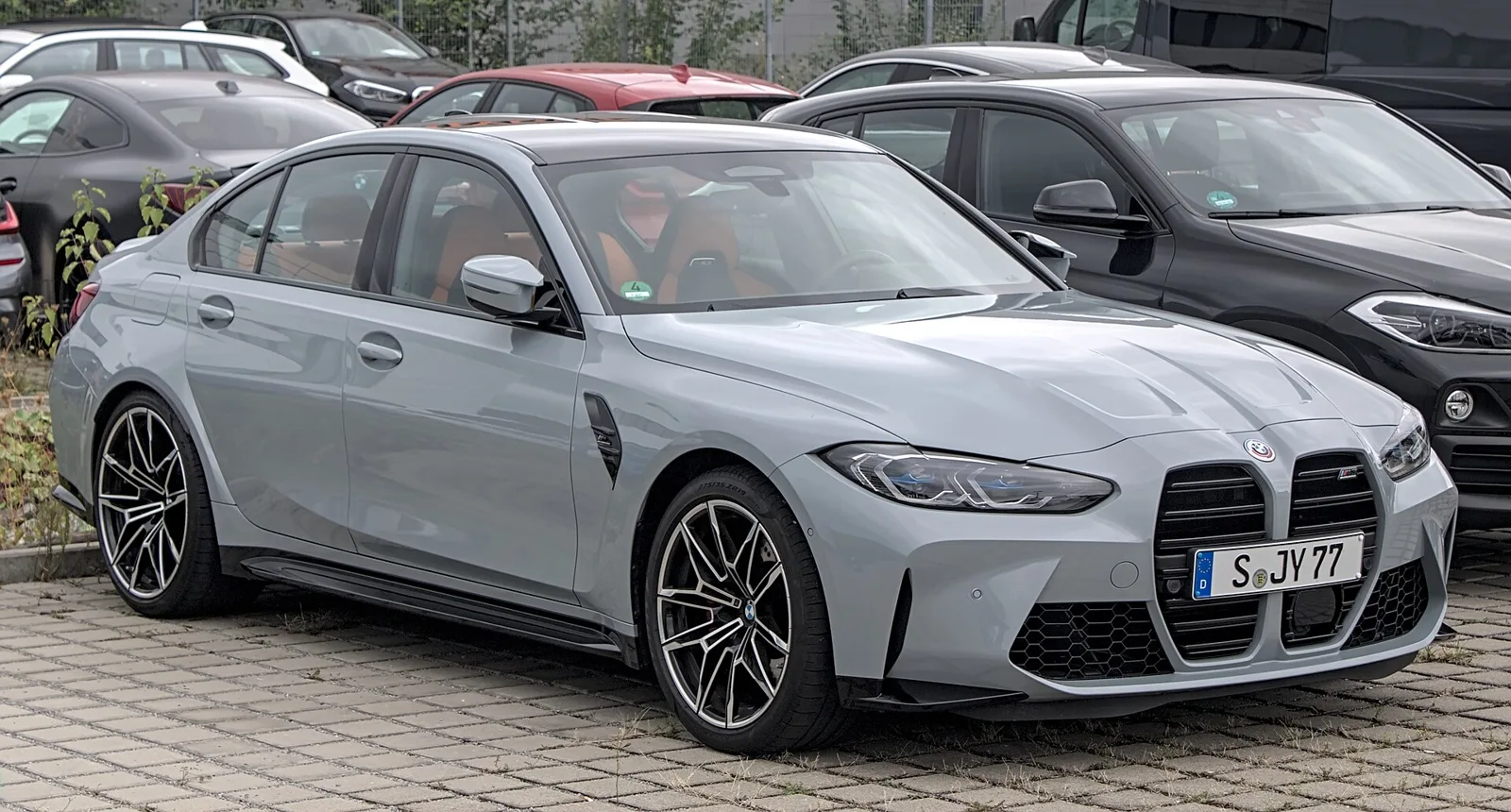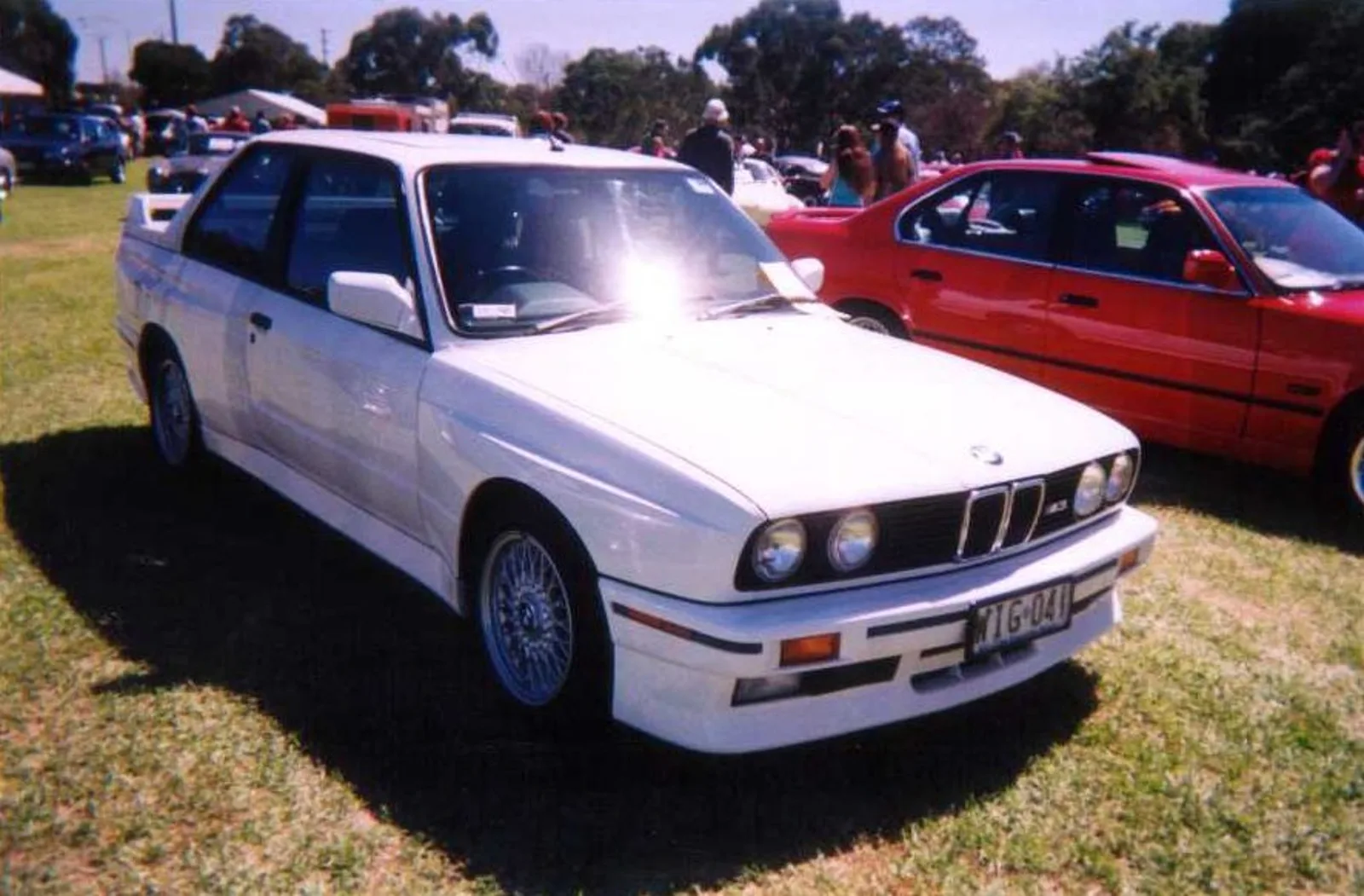
A Group A homologation car built on the E30 3 Series, with a four-cylinder engine derived from the inline six, rally and DTM programmes, and a Japanese price of 6.58 million yen.
The BMW M3 (E30) was a Group A homologation sports car built from 1986 to 1991 on the 3 Series. It was the first model of the M3 line, with a 2.3 litre four-cylinder engine and a record of touring car success.
The BMW M3 (E30) was the first M3, a sports car that BMW built from 1986 to 1991 on the E30 generation of its 3 Series. It was a Group A homologation car, which meant the race car had to keep the engine type, suspension, brakes and appearance of the production car. It won titles in three touring car series in its debut year, 1987.
Why did BMW build the M3?
Mercedes-Benz entered the small saloon market in 1982 with its 190 series. In 1983 it announced the 190E 2.3-16, whose engine tuning had been entrusted to Cosworth, and it began promoting itself through motorsport. BMW, which had withdrawn from Formula One, answered with the M3, a Group A car based on the 3 Series.
BMW had found success in the small saloon market since the 1960s with the 02 series and the first 3 Series. It introduced the E30, the second generation of the 3 Series, in 1982, so the M3 was built on a car that was already established. From 1987 BMW took on Mercedes directly in touring car racing.
A four-cylinder engine, a Group A rulebook and a row over a 60,000 dollar registration fee marked the first M3's debut year.
How did the M3 differ from the 3 Series?
The M3 kept the two-door E30 body, but Group A rules fixed the type of engine, suspension and brakes, and the car had to keep its production appearance. Its aerodynamics and performance therefore had to be built in at the production stage, not added afterwards.
Front and rear spoilers and side skirts increased downforce, and the shape from the C-pillar to the boot was changed to reduce drag. Plastic was used for the front bumper, the rear window surround, the rear spoiler and the boot lid, all to save weight. Through these changes the drag coefficient improved from 0.38 for the 3 Series to 0.33.
What engine and chassis did the M3 use?
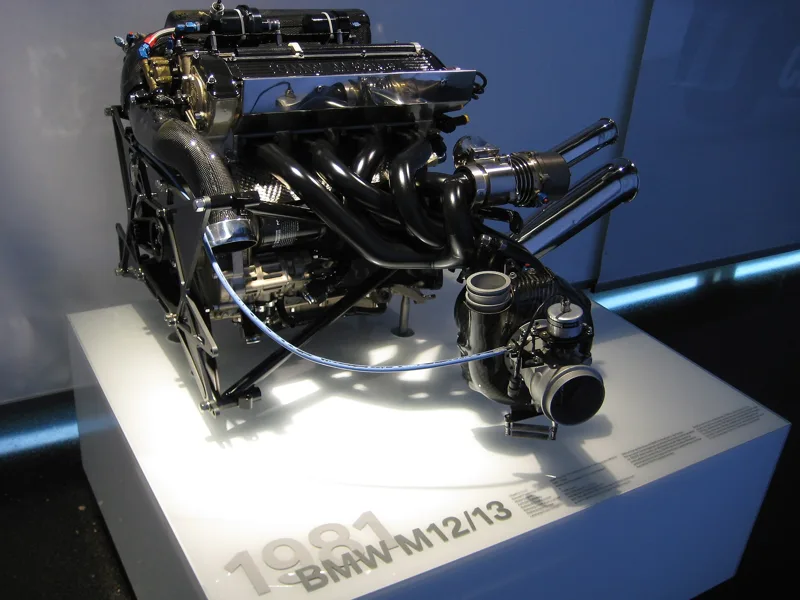
The engine was the S14B23, a four-cylinder version of the inline six M88 used in the M1 and 635CSi. Its displacement was 2,302 cc, which placed it in Division 2 of Group A. Fuel was metered by Bosch Motronic, and the gearbox was a five-speed manual.
Earlier touring cars such as the 635CSi and 325i used inline sixes. For the M3, BMW wanted a further gain in cornering performance, so the six was turned into a four.
Both axles had ventilated discs, and ABS was part of the road-car specification. Blister fenders widened the track to take 10-inch-wide rim wheels and 15-inch wheels. The front brake calipers and wheel bearings were shared with the 5 Series (E28 type), and the caster angle was set at three times the standard 3 Series figure. Because of that, the wheels changed from the standard four-hole, PCD 100 pattern to five holes on PCD 120.
The evolution models followed quickly, with the M3 Evolution in 1987 and the M3 Evolution 2 in 1988.
Specifications at a glance
| Item | Figure |
|---|---|
| Engine | 2.3 litre inline four, DOHC, 4 valves |
| Output | 195 PS (143 kW; 192 hp), 23.4 kgf-m of torque |
| Gearbox | Five-speed manual |
| Length | 4,360 mm (171.7 in) |
| Width | 1,675 mm (65.9 in) |
| Weight | 1,200 kg (2,646 lb) |
| Height | 1,365 mm (53.7 in) |
| Wheelbase | 2,562 mm (100.9 in) |
| Drag coefficient | 0.33, from 0.38 on the 3 Series |
| Brakes | Ventilated discs front and rear, ABS on the production car |
| Japan price | 6.58 million yen |
The standard car is listed for 1985 to 1990. In Europe an uncatalysed version rated at 200 PS stayed on sale alongside it until 1989, and when that version was dropped the engine was improved to the 215 PS unit of the Cecotto model.
BMW Japan imported only the E30 M3 with this engine officially, and the new car sale price there was 6.58 million yen.
Which M3 variants were built?
The range ran from the standard M3 and the Cabriolet to the Europameister, Evolution, Evolution II, the Cecotto and Ravaglia editions and the Sport Evolution. Production ran from 25 units for the Ravaglia to 786 for the Cabriolet, while the Sport Evolution reached 601 and the Europameister 148.
The M3 Cabriolet, built from 1988 to 1991, used the boot lid of the E30 3 Series convertible to make room for the folding soft top, so it had no rear spoiler. As a luxury version it came with all-leather upholstery and a hydraulic electric soft top, and 786 were built.
The Europameister of 1988 commemorated the winning of the European Touring Car Championship. It had leather trim and a plate bearing the signature of Roberto Ravaglia, and 148 were made.
The 1987 M3 Evolution had a larger front spoiler and a lip spoiler under the rear wing, and its engine produced 210 PS. Of that model 505 were built. The Evolution II of 1988 was tuned to 220 PS and given a special crystal paint on a white base with three coloured M stripes, and 500 were made.
Limited models named after the BMW touring car racers Johnny Cecotto and Roberto Ravaglia came in 1989. They had the 215 PS engine, special body colours and signed commemorative plates. The Cecotto model numbered 505 units, while the Ravaglia was basically identical but only 25 units were sold, all in the United Kingdom.
The Sport Evolution of 1989 and 1990 was homologated to match a DTM rule change that raised the permitted displacement from 2.3 litres to 2.5 litres. The engine block was modified, and the front and rear spoilers were special parts. Production was 601 units, of which 600 were two-door saloons and one a cabriolet.
How did the M3 perform on track?
The race M3 was competitive from its debut in 1987, when it won titles in the World, European and German touring car championships and also won in the World Rally Championship. Its race engine produced 294 PS against 200 PS in the production car, and teams valued its simple race setup and maintenance-free engine.
Before the 1987 season BMW Motorsport had shipped 40 Group A M3s. Schnitzer, Linder and Prodrive also built and sold competition cars, and Prodrive's founder David Richards said the company alone built 56 M3s. Former Formula One champion Niki Lauda took part in the development tests of the race car.
The cost of racing one was high. A Group A kit cost about 13 million yen in 1987, and the Group A version of the Sport Evolution cost about 28 million yen new in 1990. Upgrading an existing car with a conversion kit cost about 10 million yen.
What happened in the 1987 World Touring Car Championship?
The first World Touring Car Championship in 1987 was thrown into confusion when FISA demanded a registration fee of 60,000 dollars per car just before the opening round. Only 15 cars paid, and at Monza only four M3s entered, all from Schnitzer and Linder.
Problems carried on during the race. Officials judged that the M3's carbon-fibre boot lid broke the rules, and seven of the eight entered cars were excluded. The Sibiem car of Johnny Cecotto and Riccardo Patrese, which had finished first, also lost its result.
The M3 then won the second round at Jarama and the third at Dijon, while Ford's Sierra took the fourth round at the Nurburgring. The fifth round, the 24 Hours of Spa-Francorchamps, went to a Sibiem entry of Eric van de Pol, Jean-Michel Martin and Didier Theys, and M3s took the first three places. That showed how reliable the car was.
At Brno in round six, Ford introduced the evolution Sierra RS500 and took places one to four in qualifying. In the race Eggenberger scored a one-two finish and took a debut win. The drivers' title in the season went to BMW's Ravaglia, while the teams' title went to Ford's Eggenberger.
How did the M3 fare in Europe and Germany?
In the European Touring Car Championship, Winfried Vogt of Linder won the 1987 title, and Ravaglia took the championship in 1988 even though the Ford Sierra had the better machine. BMW won only three of 11 rounds that year, so its plan to get Ravaglia the title worked by putting him in the cars running near the front.
The Evolution 2 debuted at the seventh round at the Nurburgring. A six-speed gearbox was offered for the S14 engine as well, but the drivers did not rate it. In 1988 the Asia Pacific Touring Car Championship, held in four rounds, went to Trevor Crowe, who drove an M3.
In the German Touring Car Championship, Eric van de Pol of Zakspeed won the drivers' title in the M3's first year, and Ravaglia of Schnitzer won again in 1989. The Sport Evolution with its 2.5 litre engine arrived in 1990 with 330 PS in DTM specification, 15 PS more than the 2.3 litre car, and adjustable spoilers. Audi's four-wheel-drive V8 quattro then dominated, and Hans-Joachim Stuck took the drivers' title. The best BMW result was second for Johnny Cecotto.
In 1991 Zakspeed moved to the Mercedes camp, and BMW ran Schnitzer, Bigazzi and Linder as works teams. Output rose to 340 PS, and only the works cars had ABS. In 1992 BMW brought in Ravaglia, who had been racing mainly in the Italian touring car championship, for Schnitzer, and the DTM M3 gained about 360 PS. It was still well behind the Mercedes, and BMW won seven of 24 races before deciding to leave the DTM after that season.
How did the M3 do in national championships?
In the British Touring Car Championship, Sytner won the Class B title in 1988 driving a Prodrive M3, and James Weaver took that class in 1989. The series ran two classes in 1990, an A class above 3 litres and a B class for naturally aspirated 2-litre cars. Sytner took the class title that year, and Will Hoy of Vic Lee Motorsport became the first champion under the full Class 2 rules in 1991.
In the French Touring Car Championship, Fabien Giroix of Garage du Pack won the 1987 drivers' title. Jean-Pierre Marche then took the title in 1988, 1989 and 1990, a run of three in a row.
In the Italian Supertourismo series, Michele de Gioia won in 1987, Johnny Cecotto in 1989, and Roberto Ravaglia in 1990 and 1991. In 1992 the Alfa Romeo 155 GTA won 17 of 20 races, and the M3 won only three. The series moved to Class 2 in 1993, which ended the M3's run.
Did the M3 win endurance races?
The M3 won the classic 24 Hours of Spa-Francorchamps, and at the Nurburgring 24 Hours it won four times in a row. In the 1990 Spa race, the car of Johnny Cecotto, Fabien Giroix and Markus Oestreich beat a Group A Sierra in a close finish. Dieter Quester, Marc Duez and Christian Danner finished second, and Schnitzer took a one-two result.
Bigazzi also finished fourth at that race, and Linder fifth. In 1992 Bigazzi won, with Jean-Michel Martin, Steve Soper and Christian Danner, and M3s took the podium places.
At the Nurburgring the M3 won in Group A specification in 1989 and 1990, and in DTM specification in 1991 and 1992.
How did the M3 race in Macau?
The Gear Race at the Macau Grand Prix drew strong teams from Europe and Japan. BMW had taken part with the 635CSi, and from 1987 it entered the M3. That year Schnitzer swept the top three places, with Ravaglia first, Quester second and Giroix third.
Schnitzer repeated its one-two in 1988 with Alfred Hoeger and Markus Oestreich. In 1989 the Sierra cars beat it badly, and the best BMW result was 10th for local driver Kevin Wong. In 1990 Masahiro Hasemi won in a Nissan Skyline GT-R, with Schnitzer's Emanuele Pirro second and Joachim Winkelhock third.
From 1991 DTM cars could enter, and Pirro of Schnitzer won Macau for the first time. He won again in 1992, with Winkelhock and Ravaglia second and third. By 1993 BMW's racing had moved to Class 2 touring cars, and a local driver, Charles Khan, won in a 1992 specification DTM M3.
What was the M3's record in Japan?
The M3 entered the All Japan Touring Car Championship from 1987. In the fourth round at Sugo, an Autobureck Autotech M3 driven by Will Hoy and Haruhito Yanagida debuted in Division 2, finished on the same lap as the winning Toyota Supra, and took second overall and the class win. Autobureck took two Division 2 wins that year and the class title.
BMW Japan considered backing a works team in the series but dropped the idea, and the programme passed to private teams. In 1988 more M3s were entered, and Division 2 became a near one-make field.
In 1989 the Tomei Sports Advan Alpha M3 was dominant. At the Nishi-Nihon opener its qualifying lap beat the course record by 0.7 seconds, and the car claimed pole by over a second. It won easily, lapping the other M3s, and it went on to five wins for Kenji Takahashi's first championship.
In 1990 Stella, formerly Autobureck, won two races and regained its position, with Roland Ratzenberger and Takamasa Nakagawa taking the title. The M3 Sport Evolution, with about 300 PS, spread through the series that year. The JTC ended after 1993, when Stella won five of nine rounds to take its fifth title.
How did BMW enter the rally world?
The rally programme began when David Richards of Prodrive proposed it to BMW. The head office gave little support, but dealers in France and Belgium helped set up a project centred on the national championships. In its first year Prodrive made only one World Rally Championship start, the Tour de Corse.
There Bernard Began won, beating the Lancia drivers Yves Loube and Miki Biasion. It was the first WRC win for both Began and Prodrive. For BMW it ended a 14-year wait, the previous win having come on the 1973 Austrian Alpine, with Achim Warmbold and Jean Todt in a 2002Tii.
The rally car developed step by step. The first cars used touring car engines, but later in the 1987 season BMW built a rally engine. In 1988 Prodrive built a six-speed gearbox of its own, and Ari Vatanen's car at the 1000 Lakes Rally carried the first traction control system used in the WRC.
In 1989 Prodrive and Marc Duez, backed by FINA, planned five events: Monte Carlo, Portugal, Tour de Corse, the 1000 Lakes and San Remo. They finished eighth at Monte Carlo and fifth in Portugal. At the Tour de Corse Chatriot was second, Began fifth and Duez sixth, and Duez finished seventh at San Remo to end the drivers' standings 13th.
Engine output had been 275 PS at the WRC debut and passed 300 PS by 1989.
Where did the M3 win in rallies outside the WRC?
The first European Rally Championship win came in October 1987 at the Rally d'Antibes, when Bernard Began of Prodrive beat Didier Auriol in a Sierra. In 1988 Chatriot won the Rally de Garrigou, and in August Patrick Snijers won the Madeira rally. Chatriot won the Rally de Garrigou again in 1990.
In March 1995 Jose Maria Ponce took the El Corte Ingles rally in the Canary Islands, five years after the car's previous win.
National titles followed. Snijers won the Belgian championship for the fourth time in an M3 in 1988, and Duez took the Belgian title in 1989. Chatriot won the French championship in 1989 and 1990, and Jose Barcas took Spain in 1989, with Ponce following in 1991.
In 1987 Enrico Gugliari, entering for the Italian team Pro Motorsport, finished ninth in the Hong Kong to Beijing rally. In 1988 Prodrive ran a Group A M3 in the Giro d'Italia Auto in November. Andrea Zanussi and Johnny Cecotto finished fourth, behind three Alfa Romeo 75 Turbo IMSA cars, and Marc Duez and Pierre Timoniere finished fifth.
Who won the 1987 drivers' title?
Roberto Ravaglia took the 1987 World Touring Car Championship drivers' title for BMW, but the teams' title went to Ford's Eggenberger. Seven of the eight entered cars had been excluded at the opening round, and the Cecotto and Patrese result was also cancelled.