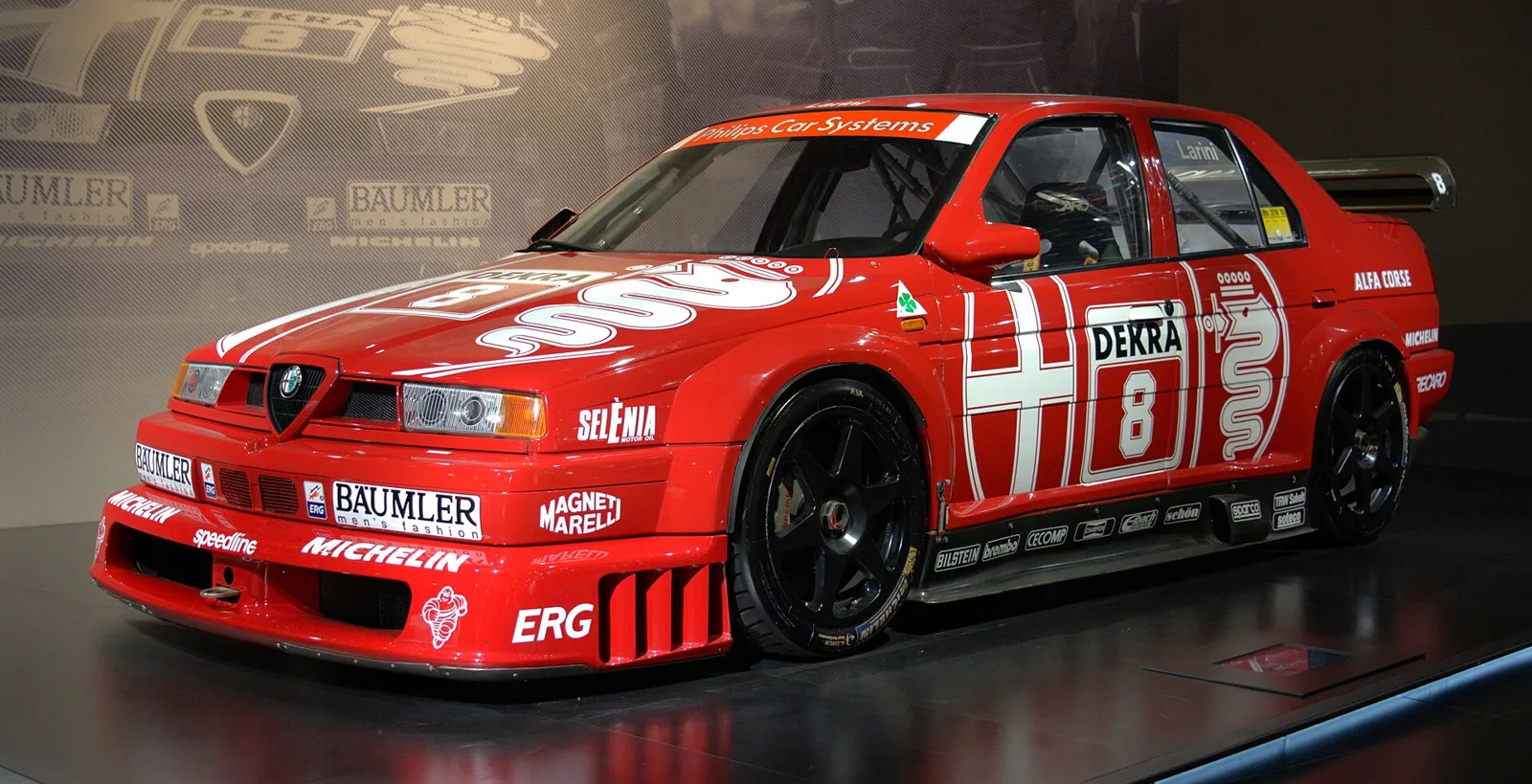
A road saloon rebuilt for the DTM, with a V6 that grew from 420 PS to 490 PS and a run of 38 wins from 1993 to 1996.
The Alfa Romeo 155 V6 TI was a racing version of the 155 saloon, built for the German DTM touring car championship. Its V6 made 420 PS in 1993 and reached 490 PS in 1996, and the car won 38 races across the DTM and ITC.
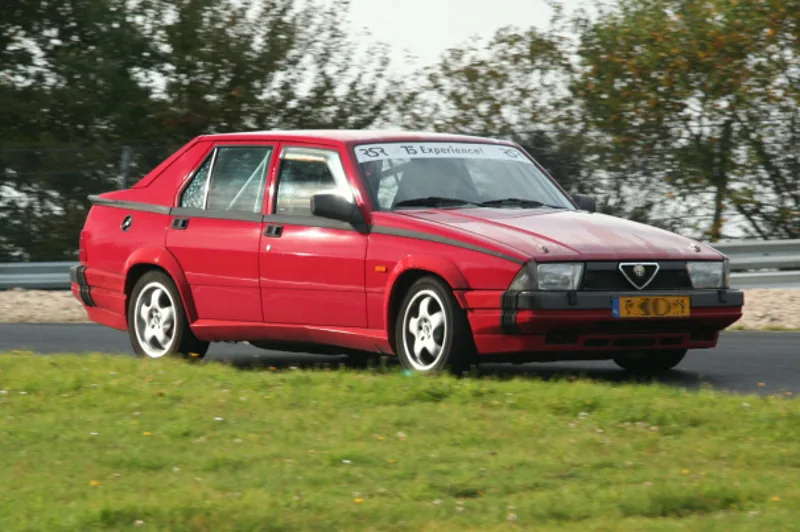
From outside, the Alfa Romeo 155 V6 TI looked almost identical to the road 155. Beneath its body it was a true prototype, and in the DTM and ITC it recorded 38 victories.
Why did Alfa Romeo choose the German championship?
Alfa Corse, the racing team led by Giorgio Pianta, who ran the competition department at Fiat Auto, picked the DTM in 1993. Germany alone had adopted FIA Class 1 (D1) regulations, which allowed engines of up to 2.5 litres with at most six cylinders, while the other leading European touring car series ran 2-litre saloons.
Those rules were generous. A racer could be altered extensively as long as its outline stayed faithful to the road model, and no special or boosted road version had to be homologated. The base model only had to have been built in 25,000 examples.
Rivals fell away. BMW, Audi and Opel, all regulars in the series until 1992, declined to follow the new formula, which left Mercedes-Benz, the reigning champion, to meet the newcomer with its rear-wheel-drive 190 DTM. Opel did return for the final rounds of the year, fielding its freshly debuted Calibra V6.
The 190 produced 375 PS (276 kW; 370 hp). The Alfa, with its all-wheel-drive layout and a 420 PS (309 kW; 414 hp) engine, soon proved both quicker and more dependable. Nicola Larini and Alessandro Nannini were the drivers who made the difference, and Larini prevailed over the field that season, taking three pole positions and the title.
At the Nurburgring Nordschleife, a circuit about 21 km long, the Tuscan Larini won both heats. That brought the Milan company back to victory on that circuit fifty-eight years after Tazio Nuvolari had done so.
A road saloon rebuilt as a prototype touring car that collected 38 wins.
What was under the bodywork?
The chassis was a lattice of steel tubes, with the engine mounted longitudinally at the front. The body reproduced the road car's lines in carbon fibre. The racer's width followed that of the homologated production car, and the regulations allowed the track to be widened by 10 cm, so the production 155 itself had to be modified to suit.
Air could pass beneath an imaginary line joining the lower halves of the wheels, through intakes, vents and free appendages. A flat floor limited ground effect, which still produced around 800 kg of downforce at top speed, helped by a rear wing above the boot and a spoiler near the ground on the front bumper.
Suspension at both ends used push-rod layouts, with wishbones that could flex and angled struts. The engine itself formed a load-bearing part of the front suspension. Braking combined a sophisticated Bosch ABS system with Brembo calipers that borrowed Formula One solutions, and the discs were self-ventilating steel.
How much power did the 155 V6 TI make?
In 1993 the engine delivered 420 PS (309 kW; 414 hp). By 1995 and 1996 the figure had reached 450-460 PS (331-338 kW; 444-454 hp), with revs between 11,500 and 11,800 rpm and a 12,000 rpm ceiling imposed by the regulations.
The mechanical package was built to the Formula One standards of its day. Cosworth produced the crankcase and cylinder heads in die-cast aluminium alloy. Every cylinder had double ignition, the valves returned pneumatically, and the engine ran a dry sump.
The original 60-degree V6 descended from the Busso 2.5-litre, and the rules required only the bank angle and cylinder spacing to match a production unit. Its best output was 470 PS (346 kW; 464 hp), with 31 kgm of torque, and it weighed 106 kg.
Was the 90-degree V6 a Montreal engine?
Engineer Sergio Limone later said that it was not. The 90-degree unit had cylinders too close together for pistons of adequate bore, so it came from the PRV V6 first installed in the Lancia Thema V6. The Montreal engine, homologated in any case, served as a marketing screen.
The Alfa-Lancia link explains how this was possible. In the second half of the eighties, immediately after Alfa Romeo went into the Fiat Group, the Arese firm briefly ceased to be a financially separate business, merged with Lancia as Alfa-Lancia Industriale. The Milan company therefore also built some Lancia cars and could draw freely on Chivasso's technology. Fiat's leaders kept quiet about it.
In mid-1996 the 155 received this more powerful 90-degree V6, aimed at winning back competitiveness and, ideally, the title. The older 60-degree unit had peaked at 470 PS, so the new engine was a clear step up. Its crankshaft was simpler, because two connecting rods sat side by side on each crankpin. That made the shaft 7 cm shorter and lighter, with fewer torsional stresses.
Output reached 490 PS (360 kW; 483 hp) while weight fell to 96 kg, and the gains helped the car string together six consecutive victories.
How did the car get its grip?
Drive passed through a six-speed electro-hydraulic sequential gearbox, changed with paddles behind the steering wheel, and then into a permanent four-wheel drive system. The central differential was electronically controlled, and the front and rear differentials were self-locking. Depending on the layout of the track, torque went 35-40% to the front axle and 65-60% to the rear.
The electronics were the most advanced and most expensive component. They represented half the value of the car, which was then put at 900 million lire, and three main control units coordinated the engine, transmission and ABS.
The minimum weight was 1,060 kg (2,337 lb) and the top speed 265 km/h (165 mph). Thanks to the all-wheel drive, the 0 to 100 km/h run took 3.7 seconds.
Specifications
| Specification | Detail |
|---|---|
| Class | FIA Class 1 (D1) touring car |
| Engine | 2.5-litre V6, maximum 2,500 cc |
| Power in 1993 | 420 PS (309 kW; 414 hp) |
| Power in 1995-1996 | 450-460 PS (331-338 kW; 444-454 hp) |
| Revs | 11,500-11,800 rpm, limit 12,000 rpm |
| Torque | 32.4 kgm |
| Minimum weight | 1,060 kg (2,337 lb) |
| Top speed | 265 km/h (165 mph) |
| 0-100 km/h | 3.7 seconds |
| Gearbox | 6-speed sequential, paddle-operated |
| Drive | Permanent four-wheel drive |
| Brakes | Bosch ABS, Brembo calipers, steel discs |
How many races did the 155 win?
The car won 38 DTM and ITC races, plus three in exhibition events that did not count towards the championship. Seven drivers scored those wins, and Larini and Nannini together took the great majority of them. Larini had 17 and Nannini 13, each with one more in exhibitions.
Stefano Modena, Christian Danner and Michael Bartels each collected two wins, while Kris Nissen and Gabriele Tarquini had one apiece. Danner added an exhibition victory of his own.
Season by season, the 155 took 12 of the 20 heats in 1993, more than any other car in the championship. In 1994 it won 11 of 20, again the most, with Larini and Nannini each taking four. Even so, its performance stayed ahead of its rivals, but reliability problems linked to the new electronics cost it the title on several occasions.
Two exhibition rounds at Donington did not count towards the title. Danner and Larini won there in 1993, and Nannini took the 1994 event, which accounts for the three exhibition wins in the total.
1995 was thinner, with 5 wins from 23 heats. Bartels and Danner took two each, and Larini one. The 1996 season produced 10 wins from 26 heats, seven of them for Nannini, two for Larini and one for Tarquini.
What happened after the ITC ended?
When the ITC was disbanded, several 155 V6 TIs passed to private teams. Some were later raced in the Italian Speed Mountain Championship, known as CIVM, where they still compete. The main results listed are Antonino La Vecchia in the Group A Supersalita in 1996 and 1997.
The 155's DTM years lasted until 1995, and in 1996 the series became the ITC.
Later listed hill-climb results include Marco Gramenzi in 2003, 2012 and 2015, and Fabrizio Pandolfi in 2008 and 2009.