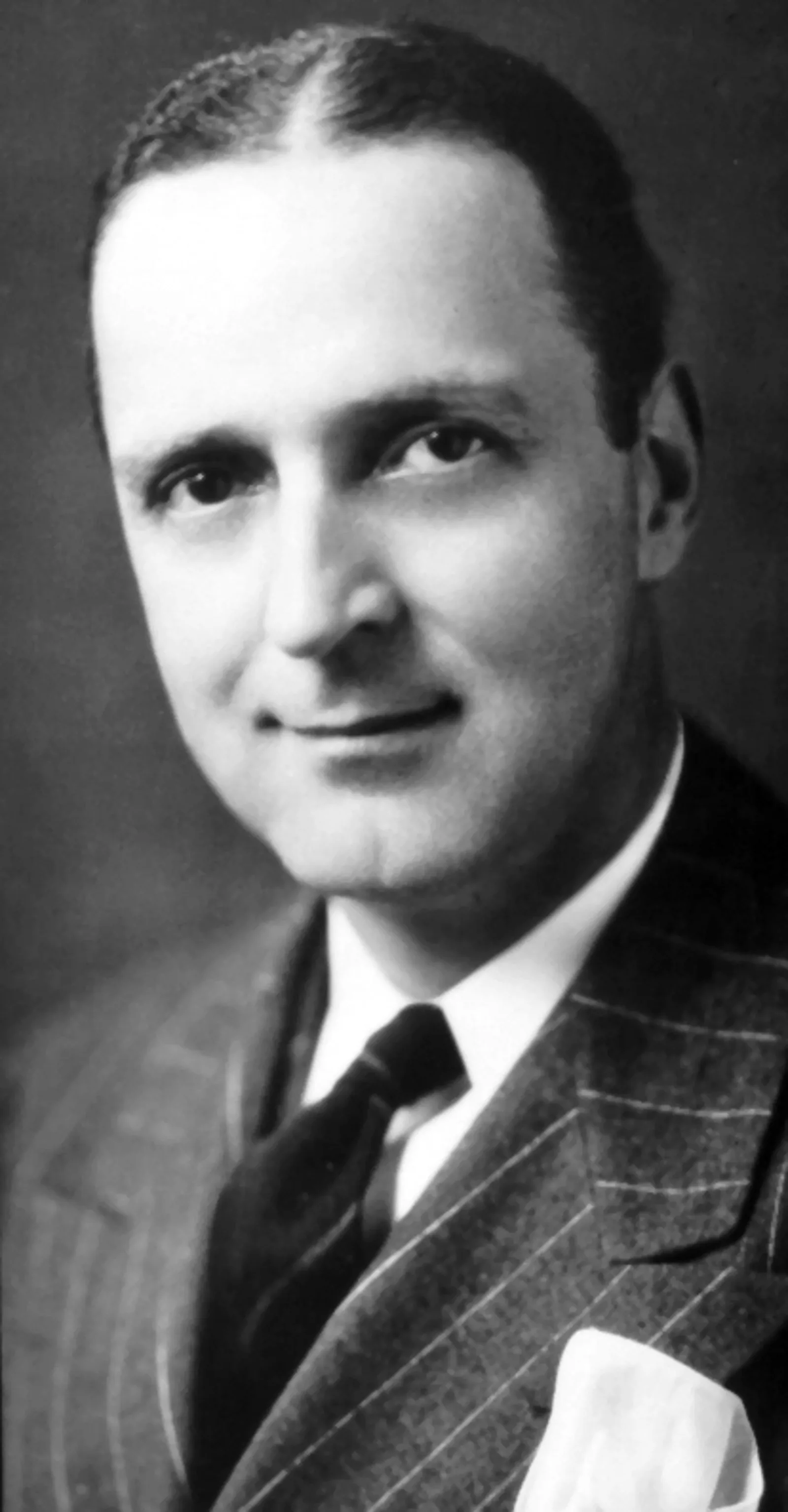
The Michigan entrepreneur behind the Tucker 48, a rear-engined sedan with features that later became common, and the 1949 trial that ended his company.
Preston Tucker developed the Tucker 48 sedan, a rear-engined car whose safety features anticipated later designs. The company collapsed after stock fraud accusations in 1949, but Tucker was acquitted on all counts in 1950, and he died in 1956 aged 53.
Preston Tucker was an American automobile entrepreneur who developed the Tucker 48 sedan, a car that introduced many features now common in modern vehicles. Production was halted in 1949 amid accusations of stock fraud, and Tucker was later acquitted on every count. The 1988 film Tucker: The Man and His Dream is loosely based on his car and the saga surrounding its production.
Who was Preston Tucker?
Preston Thomas Tucker was born on 21 September 1903 on a peppermint farm near Capac, Michigan. He grew up outside Detroit in the suburb of Lincoln Park, where his mother, a teacher, raised him after his father died when Preston was three or four years old. He was obsessed with cars from an early age and was driving before he was a teenager.
He is remembered as an inventor, car salesman and promoter as much as an engineer. His success depended on his ability to sell an idea, and the Tucker 48 became the best-known product of that talent. He died on 26 December 1956, aged 53, and he is buried at Michigan Memorial Park in Flat Rock.
A car built around safety ideas decades ahead of the rules, and a company that ended in a courtroom rather than a showroom.
How did Tucker's early career lead to car making?
At 16 Tucker began buying late-model automobiles, repairing them and selling them at a profit. He worked as an office boy for the Cadillac Motor Company, joined the Lincoln Park Police Department in 1922 against his mother's wishes, and married Vera in 1923. The couple ran a gas station near Lincoln Park while he worked on the Ford assembly line.
His sales career followed. He sold Studebakers on the side and then took a job as a car salesman in Detroit with Michael Dulian, who later became sales manager at the Tucker Corporation. In Memphis he managed Chrysler sales, and by 1933 he was regional sales manager for Pierce-Arrow in Buffalo, New York. He later returned to Detroit as a Dodge salesman.
His real route into engineering was Indianapolis. During the early 1930s he made annual trips to the Indianapolis Motor Speedway and met Harry Miller, the engine maker responsible for many Indianapolis 500 winners. In 1935 Tucker and Miller formed Miller and Tucker, Inc., which built 10 souped-up Ford V-8 racers for Henry Ford. The company's steering boxes overheated and locked up in the race, a setback that taught Tucker how hard it was to move a design from concept to finished product.
The partnership ran until Miller's death in 1943. Through it Tucker met the Chevrolet brothers and the engineer John Eddie Offutt, who later helped build the first Tucker 48 prototype. By 1939 his outgoing personality and his involvement at Indianapolis had made him well known in the automotive industry.
What were the Tucker Tiger and the Tucker Turret?
In 1939 Tucker moved his family back to Michigan and set up the Ypsilanti Machine and Tool Company in a remodelled barn. A Dutch government request for a combat vehicle suited to muddy terrain gave him a project. He designed the Tucker Tiger, a short-wheelbase armoured car powered by a Miller-modified Packard V-12 engine.
The Dutch deal collapsed when Germany invaded the Netherlands in the spring of 1940. Tucker finished the prototypes and tried to sell the vehicle to the United States armed forces. The Combat Car was said to reach 100 mph (161 km/h), well beyond the specification, but the military rejected it as too fast and already committed to other vehicles. Its power-operated gun turret attracted the interest of the United States Navy.
The turret was soon in production, first at the Ypsilanti shop. Although it is often said to have been used widely on bombers such as the B-17 and B-29, it was in fact developed for the Douglas B-18 Bolo, and no Tucker turrets were fitted to bombers. Tucker's patent and royalty rights were later taken over by the United States, and he spent years in litigation trying to recover royalties.
How was the Tucker 48 designed?
The design began with a 1946 article in Science Illustrated magazine, which showed a futuristic car with a hydraulic drive system designed by George Lawson, alongside a photograph of a 1/8 scale model enlarged to look full size. The first sketch was called the Torpedo on Wheels. Tucker later renamed the car the Tucker 48 to avoid evoking the horrors of the war.
To finish the prototype design, Tucker hired the stylist Alex Tremulis, formerly of Auburn, Cord and Duesenberg, on 24 December 1946. He gave Tremulis six days to finalise the design, and Tucker approved the preliminary result on 31 December 1946. A full-page advertisement in March 1947 claimed the car was the product of 15 years of testing, and the copy described many innovations, some of which did not reach the production car.
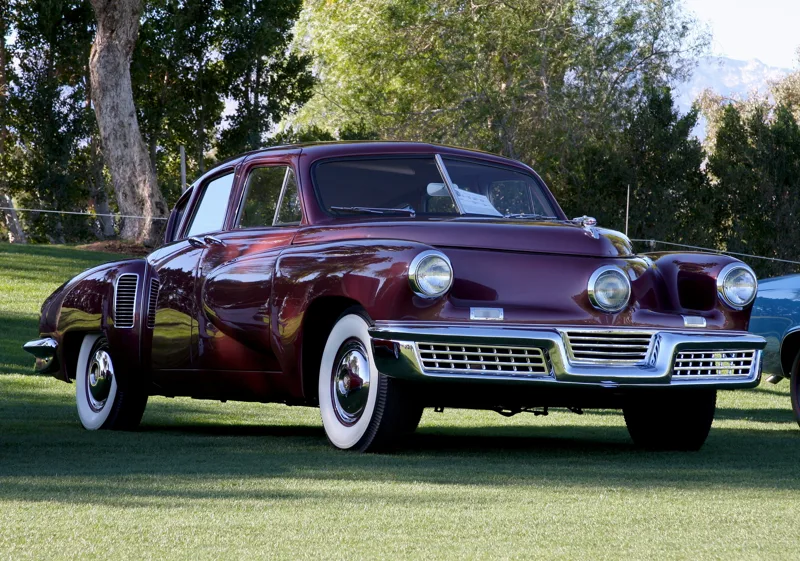
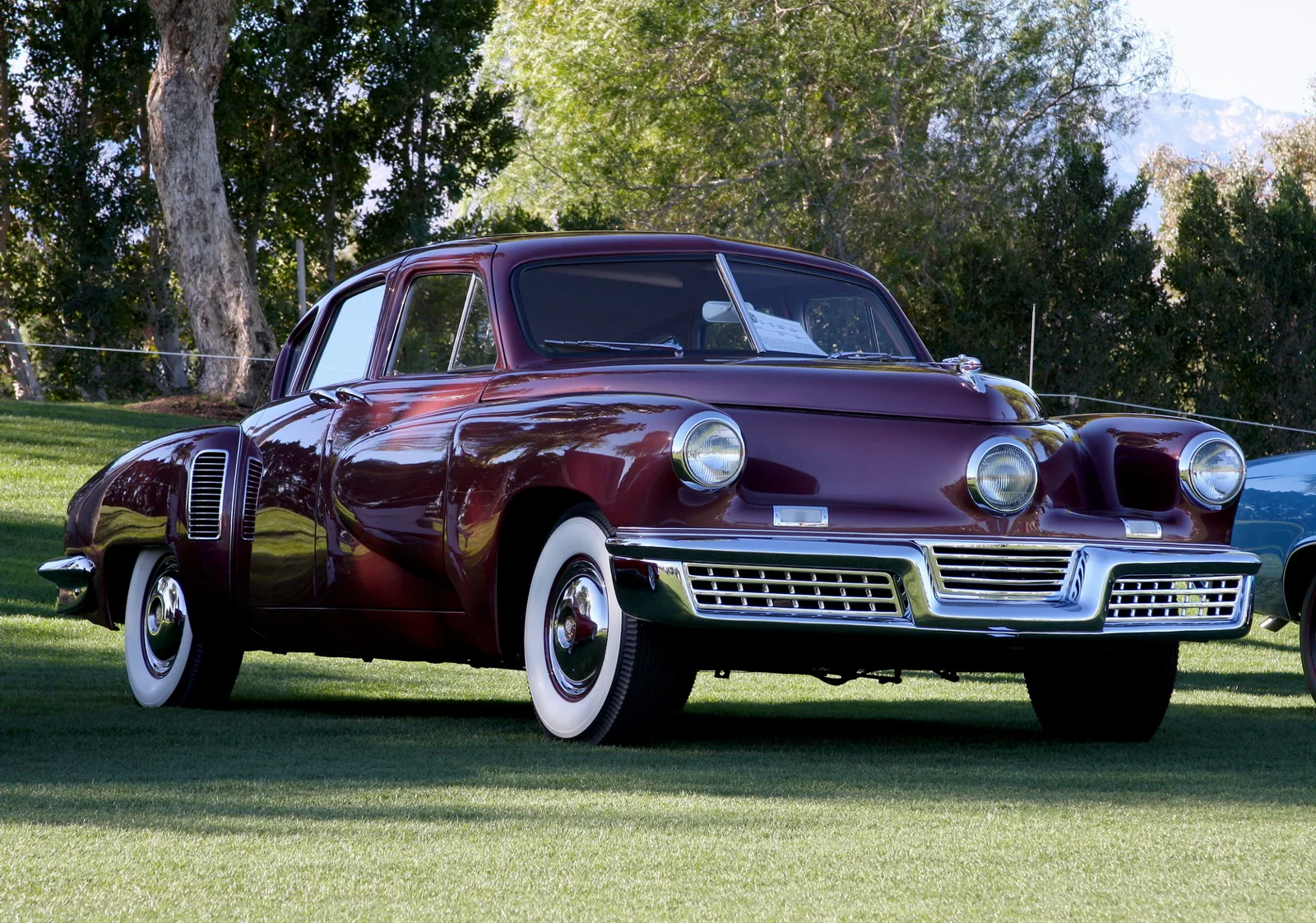
The specification called for a rear engine, a low-revving 589 cubic inch unit with hydraulic valves, fuel injection, torque converters on each rear wheel, disc brakes and a laminated windscreen designed to pop out in an accident. A centre headlight, the cyclops light, was designed to turn with the steering to light corners at night. The padded dashboard, self-sealing tyres and a roll bar within the roof were all part of the safety focus.
Many of those ideas were dropped. The 589 cubic inch engine, the individual torque converters, the mechanical fuel injection and the disc brakes did not survive the testing and development phase. Tucker settled on a modified 334 cubic inch (5.5 L) Franklin O-335 aircraft engine, and he bought its manufacturer, Aircooled Motors in New York, for US$1.8 million in 1947 to secure the supply.
How did Tucker finance a factory and dealer network?
Tucker signed a lease in July 1946 on the Dodge Chicago Aircraft Engine Plant, a 475 acre (1.92 km2) site that had built Wright R-3350 engines for B-29 bombers. The lease was conditional on raising $15 million by March 1947. He sold dealership rights and floated a $20 million stock issue through the Chicago brokerage firm of Floyd D. Cerf, and by 1947 the company held more than $17 million in the bank.
The company planned for 60,000 cars a year, with 140 a day in the first four months and 300 a day afterwards. Its accessories programme sold items in advance and gave buyers a place on a dealer waiting list, and by the time of the trial it had sold more than 2,000 dealerships at prices from $7,500 to nearly $30,000 each. Tucker moved into the Chicago plant only in September 1947, after disputes with the Lustron Corporation delayed him almost a year.
| Date | Event | Detail |
|---|---|---|
| July 1946 | Plant lease signed | Dodge Chicago plant, 475 acres (1.92 km2) |
| 24 December 1946 | Tremulis hired | Six days to finalise the design |
| March 1947 | Funding deadline | $15 million to be raised for the lease |
| September 1947 | Factory occupied | Company moves into the Chicago plant |
| 26 September 1947 | Chairman resigns | Harry Toulmin leaves the board |
| 3 March 1949 | Control changed | Two managers take over the company |
| 4 October 1949 | Trial begins | Factory closes with 37 cars built, 50 in total |
| 22 January 1950 | Verdict | Not guilty on all counts after 28 hours |
Why did the Tucker Corporation run into trouble?
The Securities and Exchange Commission had watched small automakers closely since the grants given to Kaiser-Frazer. Tucker took no federal money, but his accessories programme and dealership sales drew the SEC's attention. In September 1947 the chairman, Harry Toulmin, resigned and wrote to the SEC that he was leaving because of how Tucker was using public money. Tucker replied that Toulmin had been asked to step aside for a more prominent man.
Later that year the radio commentator Drew Pearson criticised the car on air and called it the tin goose, a reference to Howard Hughes's Spruce Goose. The first prototype had no reverse gear at its unveiling, and the criticism spread through the press. Dealers began filing lawsuits to recover their money, and the company's stock value fell sharply.
Federal prosecutors indicted Tucker and six colleagues on 10 June 1949 on 25 counts of mail fraud, five counts of violating SEC regulations and one count of conspiracy. The trial opened on 4 October 1949 under Judge Walter J. LaBuy, and the factory closed the same day. Only 37 cars had been built at that point, and a loyal workforce returned, some without pay, to finish 13 more.
The government's case relied on former employees who described rudimentary development methods, and on an SEC accountant who testified that more than $28 million had been taken in while under one-seventh was spent on research and development. Under cross-examination, the accountant could not show that the money had been taken fraudulently. The defence presented no witnesses, and the jury returned not guilty verdicts on 22 January 1950 after 28 hours of deliberation.
Did Tucker intend to build the car?
Speculation has continued about whether Tucker meant to produce a car at all. Collectors in the Tucker Automobile Club of America have amassed more than 400,000 drawings, blueprints, corporate documents and letters that they believe show a company developing a manufacturing process. The company had hired more than 1,900 employees, including engineers and machinists.
At the trial the vice president Lee Treese testified that the Chicago plant was 90% ready with industrial machinery to mass-produce the vehicle. Tucker later said that even Henry Ford had failed the first time out. Whether or not the enterprise was sound, the car itself is historically significant for the ideas it introduced.
What happened to Tucker after the trial?
The Tucker Corporation's assets were auctioned in Chicago after the trial, and Tucker kept one of the remaining Tucker 48 cars, with another going to his mother. In the early 1950s he worked with Brazilian investors and the designer Alexis de Sakhnoffsky on a sports car called the Carioca. The project never reached production, and the Tucker name rights had been bought by Peter Dun of Dun and Bradstreet.
His health declined after travel to Brazil. He was diagnosed with lung cancer and died of pneumonia as a complication of it on 26 December 1956, aged 53. A 1954 attempt to revive the company, led by George A. Schmidt of the Tucker Dealers Association, produced sketches for a two-door convertible but failed to attract enough investment.