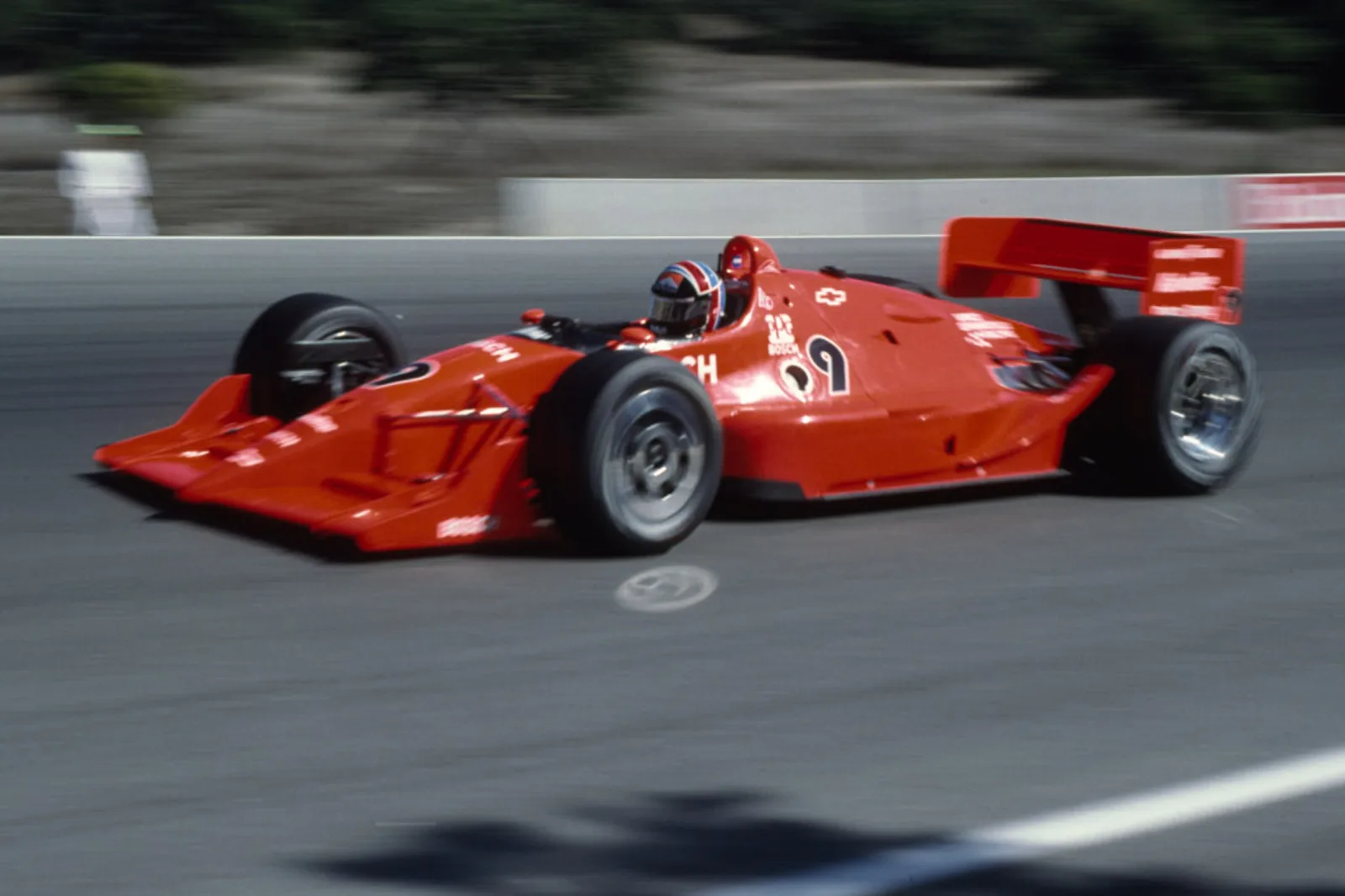
The dayglow red CART team of the late 1980s won races with Roberto Guerrero in 1987 and Arie Luyendyk in 1991, then closed when its funding dried up.
Vince Granatelli Racing was a CART team from 1987 to 1991 whose cars were painted dayglow red. Its drivers won two races in each of its first and final seasons, and the team closed after 1991 for lack of funding.
Vince Granatelli Racing was an American open-wheel team that raced in CART from 1987 to 1991. Its best results came in its first and final seasons, when its drivers each won two races. The cars were painted in a dayglow red livery, a tribute to the STP-sponsored Indy cars run by Andy Granatelli, Vince's father.
Who was Vince Granatelli and what was his background?
Vince Granatelli was the son of Andy Granatelli, whose cars had won the Indianapolis 500 in 1969 with Mario Andretti and in 1973 with Gordon Johncock. In 1973 Vince was crew chief for teammate Graham McRae's car. He began as a car owner after Team Cotter, owned by Dan Cotter of True Value hardware stores.
Granatelli died of pneumonia and complications from COVID-19 on 22 January 2022, at the age of 79.
A dayglow red CART team that won two races in its first season and two more in its last, then closed for lack of funding.
How did the team's first season go in 1987?
The team debuted in 1987 with Roberto Guerrero, who had driven for Cotter, in the No. 4 True Value/STP March. At the season opener in Long Beach he qualified second but finished 12th after an engine fire on lap 88 of 95.
At the Checker 200 at Phoenix International Raceway, Guerrero started last after his car was found 2.5 pounds underweight. He took the lead on lap 87 and led 96 of the 200 laps on his way to his first win. Later that season he won the Escort Radar Warning 200 at Mid-Ohio after qualifying first. Afterwards he was third in the standings, 40 points behind the leader, Bobby Rahal.
What happened at the 1987 Indianapolis 500?
Guerrero qualified fifth for the Indianapolis 500 and ran at the front for most of the race. On lap 130 a wheel from Tony Bettenhausen Jr.'s car was punted into the air by Guerrero's car, and it landed in the grandstands, killing a spectator. Guerrero took the lead late on, but a stall and a damaged clutch cost him time, and Al Unser won his record-tying fourth Indianapolis 500.
Guerrero's season was cut short four days after Mid-Ohio. While testing at Indianapolis Motor Speedway, his suspension failed on the last lap and he hit the turn 2 wall, and the right front tire struck him. He missed the rest of the season. Al Unser, Raul Boesel and others filled in, and Guerrero still finished fourth in the standings with 106 points.
How did Guerrero's 1988 season go?
Guerrero returned in 1988 in the No. 2 STP Lola. In his first CART race back he finished second at Phoenix. The team then took on sponsorship from Dianetics, after the sponsorship was turned down by Team Penske. Guerrero's results declined, and an engine failure at Long Beach left him 19th.
At Indianapolis the team entered a second car for Gordon Johncock, who failed to qualify. Guerrero qualified 12th, but he was involved in a first-lap crash and finished 32nd. He crashed in practice for the Milwaukee race, and the team withdrew. Granatelli ended the sponsorship that year.
Guerrero's best result for the rest of the season was third at the Quaker State 500 at Pocono. He finished 12th in points with 40, and he then left for Morales Motorsports. Granatelli also threatened to withdraw from CART after the series cut Cosworth boost levels from 48 inches to 45 inches.
What was the team's record in 1989 and 1990?
For 1989 the team fielded the No. 9 STP Lola-Buick with Tom Sneva as the regular driver. Sneva crashed in practice for the season opener at Phoenix and failed to qualify. At Long Beach an older March was used, and Sneva finished 10th, five laps down.
At Indianapolis the team ran a second car for John Andretti, and the cars were numbered 7 and 70 because USAC sanctioned the race. Andretti finished 25th after an engine failure, and Sneva finished 27th after a pit fire. The team had considered a third car for Guerrero, but his contract ruled it out.
Didier Theys took over the main car later in the year, finishing 11th at both Mid-Ohio and Road America. Theys finished 21st in points with nine, Sneva 28th with three, and Andretti 31st with one.
In 1990 Theys drove the No. 9 in a part-time season, and he finished 11th at Long Beach. At Indianapolis Sneva, Kevin Cogan and Theys drove three Penske-built cars. Cogan finished ninth, Theys 11th and Sneva 30th, after a CV joint failure. Theys's best result that year was seventh at the Molson Indy Toronto, and he finished 18th in points.
Granatelli admitted that the team's recent fortunes were hard to take. It was no fun, he said, to run for 10th place every race with no hope of finishing much higher.
How did Arie Luyendyk's 1991 season unfold?
Before 1991 Granatelli combined his operation with a team that had been bought by Bob Tezak, the founder of International Games. The combined team competed as Uno/Granatelli Racing. Arie Luyendyk drove the No. 9 Uno Lola-Chevrolet, but the team was effectively unsponsored because the Uno brand came from International Games.
Luyendyk finished ninth at the Gold Coast Indy race in Surfers Paradise and fifth at Long Beach. He then won the Valvoline 200 at Phoenix after leading 129 of 200 laps, the first of his two wins that season.
At the Indianapolis 500 Luyendyk's car became the No. 1, as the defending winner. He qualified third fastest, but he started 14th because he was a second-day qualifier, and he finished third, one lap down. The team had sponsorship from RCA for the race. It had planned a second car for Al Unser, but it chose not to split its focus from Luyendyk.
Afterwards the team struggled for money. Tezak stopped paying his share of the prize money, and Luyendyk sued him and won. After Portland, Tezak pulled his funding, and Granatelli began paying for the car himself. At the Meadowlands Luyendyk finished 18th with gearbox trouble, even though he was sixth in points.
At Michigan, Tezak tried to stop the team from competing because the Uno sponsorship had been withdrawn. Granatelli obtained an injunction, and Luyendyk qualified seventh fastest, but he started 20th of 21 cars because of the day he qualified. He led 52 of 250 laps and finished second, despite a stop-and-go penalty for passing under caution.
Luyendyk then won the Bosch Spark Plugs Grand Prix at Pennsylvania International Raceway, his second win of the year. He finished sixth in the championship with 134 points. Granatelli ended the operation after the season, when the money ran out.
What was the team's legacy?
The team's best seasons came at the start and the end of its five years, with two wins for Guerrero in 1987 and two for Luyendyk in 1991, which bookended its run. The team never won a championship, but its drivers gave the red cars a presence in the CART field.
The sponsorship problems that ended the team in 1991 show how hard it was to fund an independent CART effort.