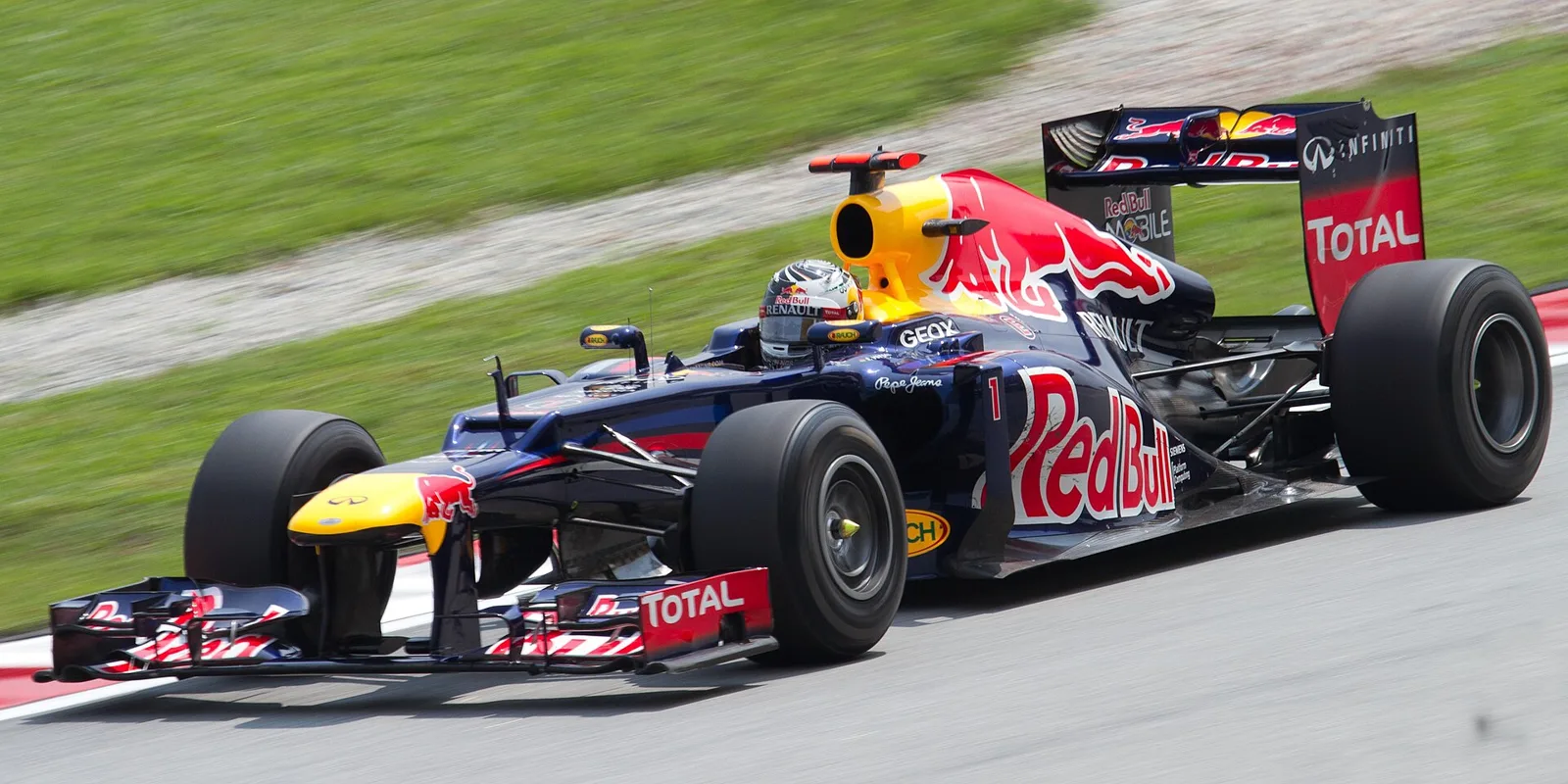
A stepped-nose car that gave Sebastian Vettel five wins, drew three rule disputes and lived on in demonstration runs.
The Red Bull RB8 was Red Bull Racing's Formula One car for 2012, driven by Sebastian Vettel and Mark Webber. It won five races with Vettel, took the Constructors' lead and became the centre of three rule disputes during the season.
The Red Bull RB8 was the Formula One car Red Bull Racing ran in 2012, the season in which Sebastian Vettel defended his title and won five races. The car was unveiled online on 6 February, and its first on-track outing came at Jerez in pre-season testing. Its stepped nose, a run of rule disputes and a close fight for the championship defined the year.
What was the Red Bull RB8?
The RB8 was designed by Red Bull Racing for the 2012 Formula One season. Vettel was the reigning World Drivers' Champion and drove it alongside Mark Webber, with Sebastien Buemi as test driver. The car went online on 6 February before its first running at Jerez.
Like most cars built to the 2012 rules, the RB8 used a stepped nose intended to protect drivers in a collision with another car. Red Bull held back from copying the reactive ride-height system that Lotus had developed, a system the FIA later banned, because the team preferred to make its components work together as a package.
The RB8 gave Sebastian Vettel five wins, and it spent the season as much in the stewards' office as on the track.
How did the RB8's design work?
The nose carried a slot cut into its step. Adrian Newey said the slot served no purpose beyond cooling the driver. Christian Horner argued that the components had to function as one package rather than as separate parts that rivals could copy one at a time.
Vettel, who names his racing cars, called his RB8 Abbey. The name had no connection to his favourite band's album or to the famous Silverstone corner that shares the word. Vettel's own explanation was simply that it was a cool name.
Why did the RB8 face so many legality disputes?
Three disputes followed the RB8 through 2012. Rivals challenged a hole in its rear floor before Monaco, the FIA rewrote the rules to outlaw it before Canada, and a throttle map and ride-height adjustments drew further complaints. Red Bull was cleared over the throttle map, yet further rule changes still forced it to adapt the car before Hungary.
The floor issue came first. Several teams complained about a slot in the rear floor before Monaco. Red Bull's position was that the part had first appeared at Bahrain and had cleared every scrutineering session since, so it was within the regulations. The FIA disagreed and changed the rules before the Canadian round.
The throttle dispute came at the German Grand Prix. Jo Bauer, the FIA technical delegate, sent the matter to the race stewards because of a throttle map he believed was illegal. The 2012 rules required a linear relationship between throttle opening and torque, and Bauer felt the RB8 exploited medium-speed corners to gain downforce, an effect he thought could work as a rough form of traction control.
The ride-height dispute followed the Canadian round. The rules said height could be changed only with a tool, but the FIA had asked the team to modify a part so that the front height could be adjusted by hand. Horner admitted the team had been asked to change that part, but he denied that the height had been altered illegally while the car was under parc ferme conditions.
How did the RB8 start the 2012 season?
The RB8 reached the opening round in Australia after three pre-season tests, one at Jerez and two at Barcelona. Webber and Vettel qualified fifth and sixth, and during the race their pace improved against the rest of the field. Vettel finished second and Webber fourth, a strong start that suggested the car had real pace.
Malaysia brought wet weather, and Vettel was running fourth with a few laps to go when a collision left him with a puncture. Webber inherited fourth place. China was harder in qualifying, with Webber seventh and Vettel eleventh, but Webber got past Vettel on the final lap to claim fourth and leave Vettel fifth.
Bahrain was the breakthrough. Vettel took the first pole and first victory of the RB8's career, leading every lap apart from the pit-stop phases. Pressure from the two Lotus cars failed to shift him, and Webber, who had qualified third, finished fourth again. The win moved Vettel to the top of the Drivers' Championship and gave Red Bull the Constructors' lead for the first time that season.
What were the key results?
| Round | Vettel grid | Vettel finish | Webber grid | Webber finish |
|---|---|---|---|---|
| Australia | 6th | 2nd | 5th | 4th |
| Bahrain | Pole | 1st | 3rd | 4th |
| China | 11th | 5th | 7th | 4th |
| Spain | 7th | 6th | 11th | 11th |
| Monaco | 9th | 4th | Pole | 1st |
| Canada | Pole | 4th | 4th | 7th |
| Britain | 4th | 3rd | 2nd | Led late after passing Alonso |
| Hungary | 3rd | 4th | 11th | 8th |
How did the middle of the season play out?
The middle rounds were a mix of high points and frustrations for the RB8. Monaco was the best weekend, with Webber winning from pole. Vettel's alternator failure at Europe and his penalty in Germany cost him ground, and the team's lead over its rivals was tested again and again. The rounds that followed showed how thin the margins had become.
Spain came straight after the only in-season test allowed, at Mugello, and the weekend was less kind. Webber started and finished eleventh, while Vettel moved from seventh to sixth after both cars pitted to replace front wings that had developed a fault. Two weeks later Monaco reversed the mood.
At Monaco Webber took pole after Michael Schumacher was penalised, and he won, giving the team its third successive win in the principality. Vettel deliberately skipped the final part of qualifying, started ninth and climbed to fourth, finishing 1.3 seconds behind the winner. Webber had become the sixth driver to win in the opening six rounds, and the RB8 was the only car with more than one victory.
Rivals were beginning to come into view. McLaren, Ferrari, Mercedes and Lotus all sat close to the RB8 at the top of the Constructors' table. Williams and Sauber had shown flashes of good form but did not look like title contenders.
After the floor hole was ruled out, Red Bull arrived in Canada with a slightly altered car. Vettel took pole and fought Lewis Hamilton and Fernando Alonso for most of the race before finishing fourth after an extra stop for poor tyre degradation. Hamilton won, becoming the seventh winner in seven races and taking the Drivers' lead.
At the European Grand Prix Vettel qualified on pole, three tenths faster than Hamilton, and he led until lap 33, when an alternator failure ended his race. Webber, who had qualified 19th, fought back to finish fourth. The alternator fault became a recurring problem for Renault engines and hit the RB8 more than once.
At a wet Silverstone, Alonso claimed pole for the first time this year, with Webber second and Vettel fourth. Webber overtook Alonso for the lead with a handful of laps remaining. Vettel lost ground at the start, recovered to third and crossed the line five seconds back.
At Hockenheim, Alonso won from pole, with Vettel and Webber qualifying second and third. Webber dropped to eighth during the race. Vettel was running third near the end when he went around the outside of Jenson Button for second, but he was penalised because his car had been completely off the track during the move, and he was dropped to fifth.
The Hungarian Grand Prix was the last round before the summer break. Hamilton took pole and the win, Vettel started third and finished fourth, and Webber started 11th and finished eighth. Webber and Vettel now sat second and third in the standings, two points apart and forty points behind Alonso.
How did the title fight develop after the summer break?
After the break the championship moved quickly. Red Bull still led the Constructors' table, but McLaren and Ferrari had improved, and every race from Belgium onward carried the threat of a rival winning. The RB8 had to hold its lead against rivals who were gaining pace.
Belgium showed the new balance. Button took pole and the win, which suggested McLaren's pace had improved. Vettel had missed out on Q3 and qualified eleventh, but he started tenth and moved up to second after a large collision at the start. Webber, who had taken eighth on the grid, finished sixth.
Italy went less well. Hamilton won in Italy, giving the McLaren its third straight win. Vettel qualified sixth and Webber eleventh, and both Red Bulls retired, a double failure not seen since the 2010 Korean Grand Prix. Vettel's alternator failed again, and Webber went off violently at the Ascari chicane, where tyre damage from the spin ended his race.
Singapore brought a new device. Red Bull arrived with a double-DRS system, which Mercedes had used near the start of the season with an effect similar to the F-duct, a system banned after the 2010 season. All teams agreed to outlaw double-DRS for 2013 following Hungary, yet Lotus had built its own version and tried it first.
The race itself was a stroke of luck for Red Bull. Vettel qualified third and Webber seventh. Hamilton led from pole until his gearbox failed, and Vettel inherited the win. Webber took a time penalty, lost his tenth-place finish and was classified eleventh.
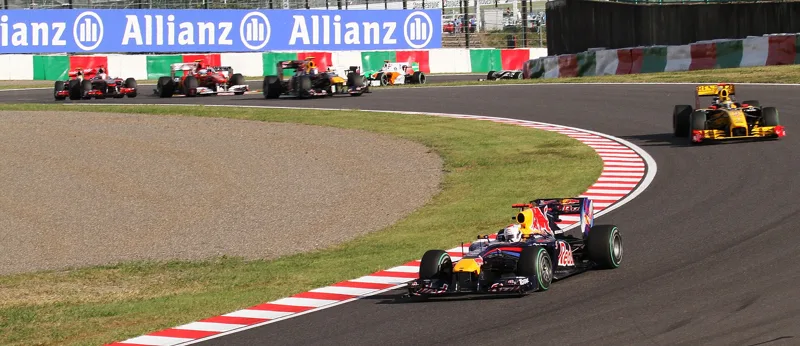
Suzuka was the RB8's best venue of the year. Vettel took pole, Webber qualified second and the team secured its first front-row pairing of the year. Vettel led every lap and set the fastest lap, becoming the first driver to win consecutive races in 2012. Webber lost a place at the first corner and was spun by Romain Grosjean, then fought back through the field to finish ninth.
Alonso retired at the start in Japan, which cut Vettel's deficit to the Ferrari driver from 29 points to just 4 with five races remaining. Webber stayed in contention behind Raikkonen and Hamilton, and Red Bull kept a comfortable lead over McLaren and Ferrari in the Constructors' standings.
How did the season end?
Korea produced another front row lock-out, this time with the cars reversed, Webber taking pole. Vettel got ahead at the opening corner and went on to win, which gave him a 6-point championship lead, while Webber completed a 1-2 finish. Alonso ended third for Ferrari, whose pace had improved, yet Red Bull and McLaren were still quicker.
India marked the team's third consecutive front row lock-out, with Vettel on pole and Webber second. Red Bull had never done this before, and nobody had managed it since 2007. Vettel led from start to finish, collecting his fourth win in a row and fifth of the year. Webber held second until a KERS problem let Alonso past, and then he held off Hamilton over the final two laps to stay on the podium.
How was the car presented to fans?
The RB8 kept the colour scheme of the previous championship. Its bodywork was blue with yellow inserts and stripes in light blue, yellow and grey. The Red Bull emblem, for the team's main sponsor, was prominent, and the French oil company Total had red inserts on the wing strips. Infiniti's sponsorship was more visible than in earlier cars.
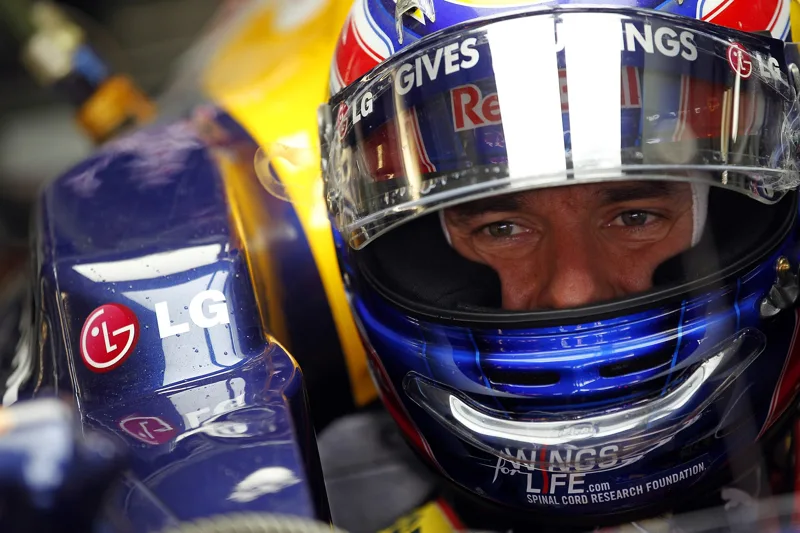
For the British round, fans supplied 25,000 images that appeared on the car in support of the Wings For Life Foundation. The idea turned one of the season's races into a charity showcase as well as a sporting event.
What happened to the RB8 after 2012?
After the season the RB8 was used in demonstrations and rewrapped in other liveries, just as its predecessor had been. Marc Marquez and Dani Pedrosa, both MotoGP figures, drove it in 2018 at the Red Bull Ring, wearing the Toro Rosso STR13 colours.
On 5 March 2020 Max Verstappen took the RB8 out at Zandvoort in the RB16 livery, at a circuit that had recently been renovated. The car was also used briefly in a drag race against other vehicles presented by Carwow, which kept its public profile alive long after its racing career ended.
What is the RB8's legacy?
The RB8 is remembered as a strong car in a close season, one whose legal disputes were as memorable as its results. Vettel's five wins, Webber's podium finishes and the team's constructors' lead showed what a well-run package could achieve when the rules were under constant scrutiny.
The disputes over its floor and throttle map show how closely the rules were policed in 2012, and the rule changes that followed show how quickly the sport moved to close the gaps. Its later life as a demonstration machine has kept the car visible to fans long after the title race was over.