A 2018 Formula One car built around a new engine, a switch that exposed chassis weaknesses and a season that began with a surprise points haul and ended in a difficult midfield fight.
Alonso and Vandoorne raced the 2018 MCL33 on Renault power, a car that scored points early on. Qualifying was a weak point, and the team's constructors' finish was sixth after Force India's points were removed from the table, a result that reflected a difficult first year with the new engine.
The McLaren MCL33 was the Formula One car McLaren raced in the 2018 championship, the first built around a customer Renault engine after the team ended its partnership with Honda. Driven by Fernando Alonso and Stoffel Vandoorne, it made its competitive debut at the Australian Grand Prix. The car exposed chassis weaknesses that the switch had brought out, and the season ended with McLaren sixth in the constructors' standings.
What was the McLaren MCL33?
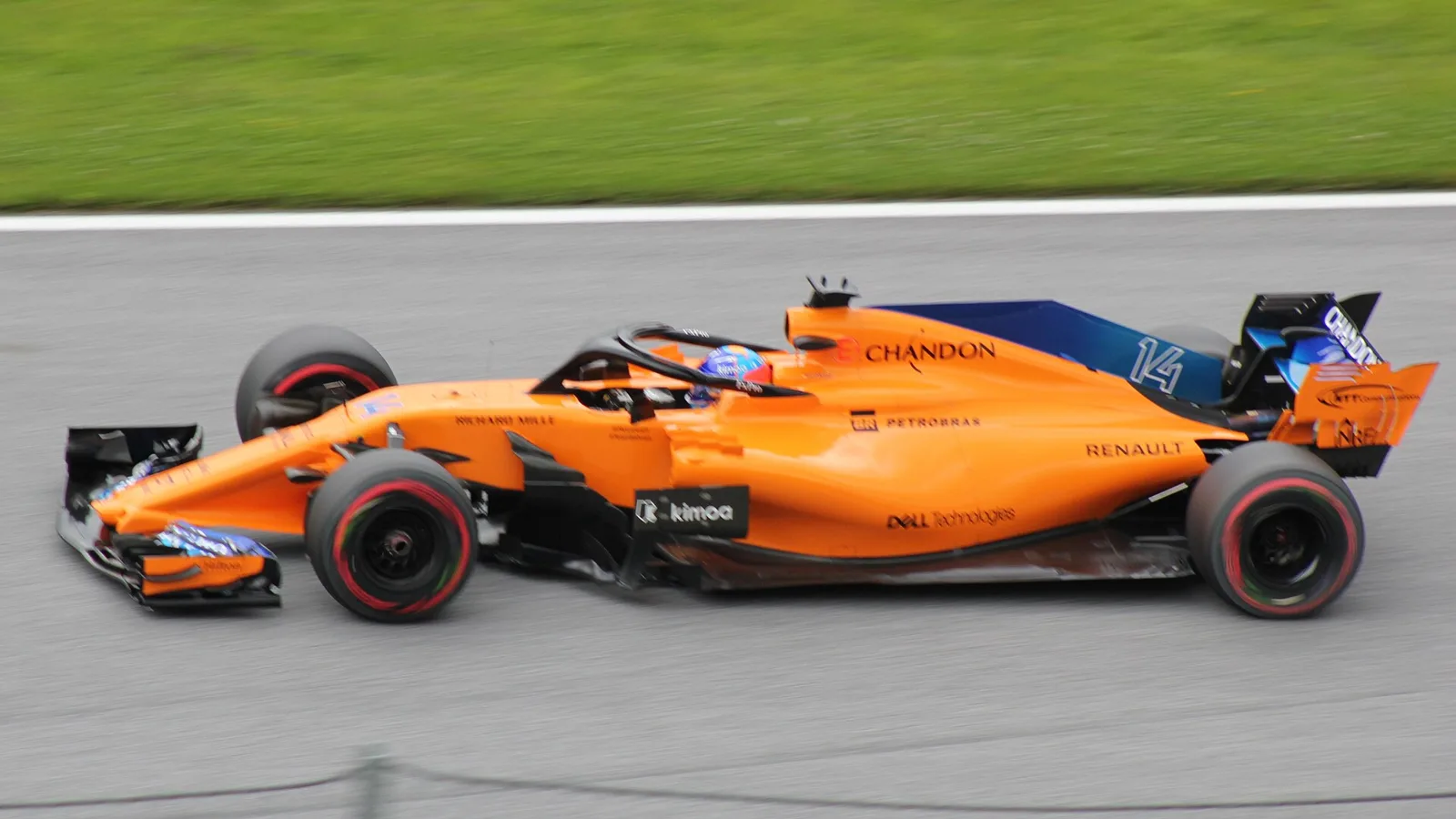
The MCL33 was McLaren's Formula One car for 2018. Its drivers were two-time world champion Fernando Alonso and Stoffel Vandoorne, and it was powered by the Renault R.E.18 engine. The car was launched in an orange and blue livery that paid tribute to some of the team's earliest cars.
Testing and development work on the car also involved Lando Norris, who later became the 2025 Formula One World Champion, together with McLaren's regular test driver Oliver Turvey. The MCL33 was the first McLaren to use a customer Renault engine, and the first to run a French-licensed engine since the Peugeot-powered MP4/9 of 1994.
A car that carried McLaren through a difficult switch to Renault and left it sixth, with a chassis still searching for its best setup.
Why did McLaren switch to Renault engines?
McLaren ended its full-works partnership with Honda in September 2017 after three years, citing Honda's repeated failure to supply a reliable and competitive power unit. Renault could not supply McLaren while meeting its commitments to Red Bull Racing and Toro Rosso, so Toro Rosso took full-works Honda engines and freed up the Renault supply chain for McLaren.
The new arrangement gave McLaren Renault's R.E.18, a power unit that was an evolution of the established R.E.17. The switch was not seamless, though. After criticising its engine supplier in the previous seasons, the team found that the switch exposed issues with the McLaren chassis itself, and its drivers struggled to get the most from the package.
How was the MCL33 designed around the Renault engine?
The design team, led by technical director Tim Goss, had to rethink the car's rear end. Unlike the Honda, the R.E.18 carried its turbo, compressor and MGU-H all at the rear, so McLaren had to redevelop the engine bay, the gearbox and the rear suspension geometry.
The Renault layout gave the team more flexibility over the size and position of the fuel cell, and it allowed the engine to sit closer to the driver. The turbo, however, protruded into the space the gearbox housing occupied, so the gearbox was redesigned and the rear suspension mounting points were overhauled to fit the engine.
The changes also allowed McLaren to develop a more radical rear suspension geometry. The upper elements of the suspension were combined into a single piece, which reduced the bodywork in a key area of the chassis. That cut drag and gave the team more control over the air flowing over the rear diffuser.
Pre-season testing revealed a cooling problem. Burn marks appeared on the rear of the engine cowling because the packaging was tight and cooling was insufficient for peak engine temperatures. A temporary cooling package was used for the test, and the team later said the reliability issues had been resolved.
What rules shaped the MCL33's design?
The sport's technical regulations required the halo, a titanium cockpit protection frame mounted above and around the driver's head. The halo weighed several kilograms and forced teams to modify their chassis extensively, because the reinforced structure had to withstand the weight of a London bus in the mandatory crash tests.
Two other features were removed or banned. The shark fin, a carbon fibre panel extending back from the engine cowling, was written out of the technical regulations after McLaren lobbied the FIA. The launch version had a fin of its own, running across the cowling between the airbox and the exhaust. The t-wing, a slim horizontal element in front of and above the rear wing, was banned for the 2018 championship.
How did pre-season testing go for the MCL33?
Pre-season testing was a difficult start. Electrical and hydraulic faults limited the car's running, and the MCL33 covered 2,788 km (1,732.4 mi), less than any other car. Alonso was positive about the R.E.18 after the first day, but McLaren admitted it was underprepared for the season.
Mercedes covered 4,481 km (2,784.4 mi) across the eight days of testing, the most of any team. McLaren had to defend its design when it was suggested that the reliability problems came from a flaw in the chassis, because the Toro Rosso STR13, which ran on the Honda engines McLaren had dropped, had gone through testing without interruption.
How did McLaren's early development plans unfold?
McLaren planned an extensive aerodynamic update for the opening round in Australia. Reliability problems in testing pushed the upgrades back to Bahrain, and the revised front wing and bargeboards were aimed at steadying the airflow over the car. Staff changes followed before the Azerbaijan Grand Prix.
The bargeboard and turning-vane design was modelled on a concept pioneered by Red Bull Racing and Ferrari in 2017. Team principal Eric Boullier said the upgrade timetable meant the proper version of the car would only arrive at the Spanish Grand Prix. Director of chassis development Tim Goss left the team ahead of Azerbaijan.
How did the MCL33 perform in the opening rounds?
Alonso and Vandoorne qualified eleventh and twelfth in Australia, which became tenth and eleventh after penalties elsewhere. Alonso finished fifth and Vandoorne ninth, scoring twelve points between them. That result was more than the Honda-powered MCL32 had scored in any race in 2017, and it matched the best the team had managed with Honda in the past three seasons.
Alonso had predicted that Australia would be the hardest race of the championship for McLaren. The team was careful about the haul. Circumstances, including the twin retirements of the Haas cars ahead of the McLarens, had helped as much as the MCL33's pace. McLaren believed there was more to come from the chassis and engine package, but the result was in line with its expectations for the race.
Bahrain began with qualifying thirteenth and fourteenth, as the team struggled with a lack of grip. Alonso and Vandoorne then finished seventh and eighth, adding ten points. The result lifted McLaren to third in the constructors' standings ahead of Red Bull Racing. China was harder, as the team struggled with excess drag on the long back straight, and Alonso finished seventh after a late pass on Sebastian Vettel.
In Azerbaijan Alonso was involved in a first-lap incident with Nico Hulkenberg and Sergey Sirotkin that heavily damaged his car. He still finished seventh in a race of attrition, while Vandoorne struggled with tyre temperatures in the cool conditions and finished ninth after several pit stops under the safety car.
What went wrong for the MCL33 in mid-season?
The car's form fell away from Spain onwards. Its first major update arrived there, but Monaco brought the first failure to score of the year, when Alonso retired with a gearbox failure. Canada and France added to the problems, and the team began to suspect a fault in the aerodynamics that it could not find in the wind tunnel.
Alonso qualified eighth in Spain, his first appearance in Q3 that year, and finished eighth in the race. Vandoorne retired with a gearbox failure. The Monaco weekend was the first time McLaren failed to score, and Vandoorne finished outside the points in fourteenth after qualifying twelfth.
In Canada the cars qualified fourteenth and fifteenth, and Alonso retired from the race with a gearbox failure, his second retirement in a row for that reason. Vandoorne finished sixteenth. In France both cars were eliminated in the first part of qualifying, which Alonso described as a disaster. Vandoorne finished twelfth, one lap off the lead, while Alonso retired with a suspension failure and was classified sixteenth after completing ninety percent of the winner's distance.
Alonso returned to the points in Austria, despite starting from the pit lane after the team broke parc ferme rules to replace his front wing. He used a race of attrition to finish eighth. Vandoorne retired on the penultimate lap with collision damage but was classified, having completed ninety percent of the winner's distance.
How did the 2018 season finish for McLaren?
McLaren's year ended with a mixed record. Sixth in the constructors' table was the result once Force India's points from the first twelve races were excluded. Reliability was better than in 2017, and McLaren gained from rivals' problems early on. Alonso retired from Formula One at the end of the season. Vandoorne could not match his 2017 points tally and also left the sport.
The British Grand Prix week brought a change at the top of the team, as Eric Boullier resigned as team principal. His role was split, with Andrea Stella becoming Performance Director and Gil de Ferran Sporting Director. On track Alonso finished eighth and Vandoorne eleventh, which dropped McLaren to seventh in the constructors' standings, one point behind Force India.
The late-season races brought more retirements. Alonso retired late in Germany with exhaust issues, while Vandoorne finished thirteenth. In Hungary Alonso secured eighth after retirements ahead of him, and Vandoorne retired on lap 49 with a gearbox failure.
What were the MCL33's key results?
| Event | Alonso | Vandoorne |
|---|---|---|
| Australia | 5th | 9th |
| Bahrain | 7th | 8th |
| China | 7th | 13th |
| Azerbaijan | 7th | 9th |
| Spain | 8th | Retired, gearbox |
| Monaco | Retired, gearbox | 14th |
| Canada | Retired, gearbox | 16th |
| France | 16th, classified | 12th |
| Austria | 8th | Classified after retiring |
| Britain | 8th | 11th |
| Germany | Retired, exhaust | 13th |
| Hungary | 8th | Retired, gearbox |