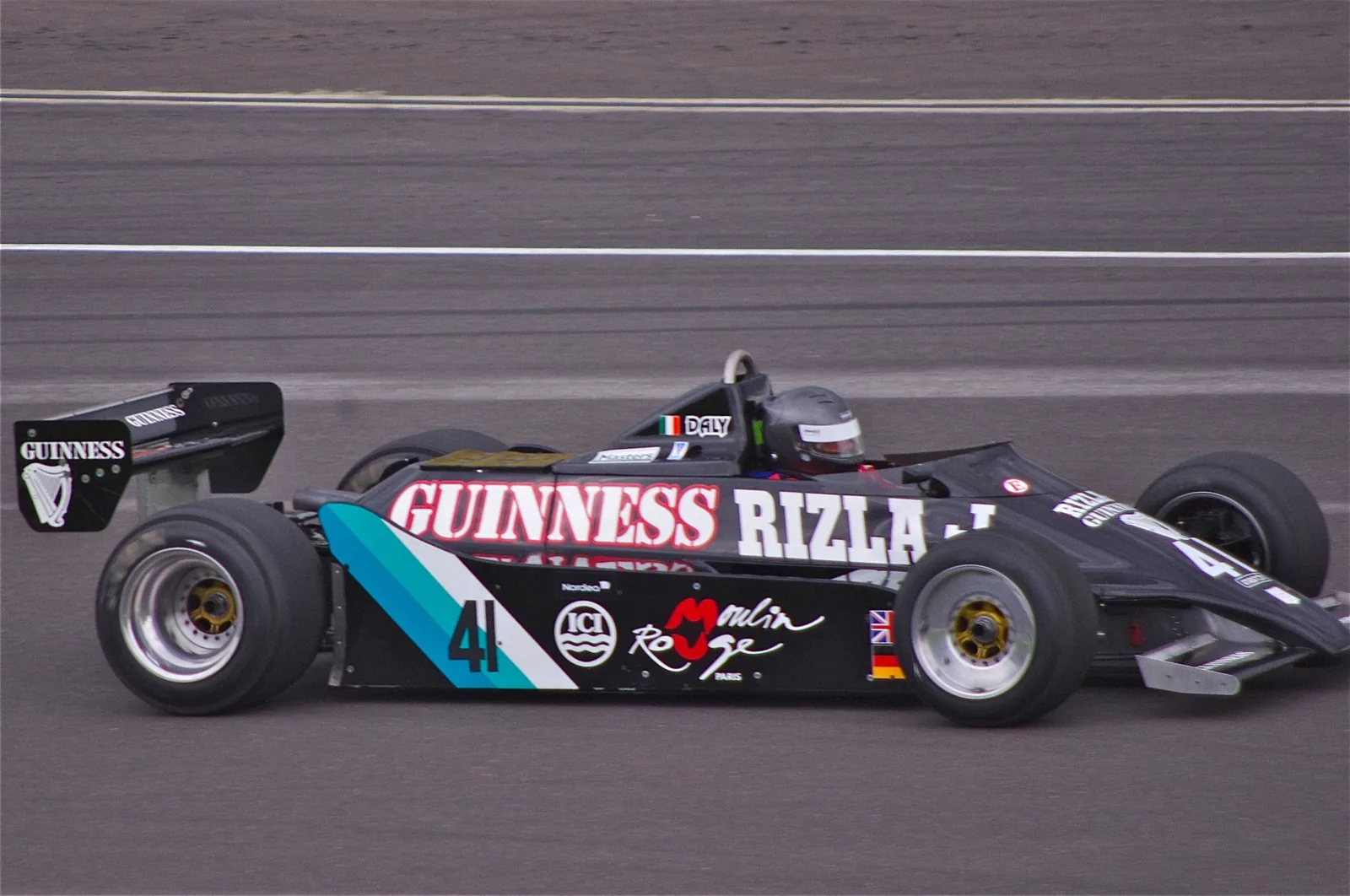
A customer-built car for RAM Racing that borrowed heavily from the Williams FW07, flexed badly and failed to score a single point in 1981.
Built for RAM Racing's 1981 Formula One campaign, the 811 used a Ford-Cosworth DFV engine and a chassis modelled on the Williams FW07. It never scored a championship point, and its chassis later found work with Colin Bennett Racing and Gordon Lightfoot Racing.
The March 811 was a 1981 Formula One car built for RAM Racing, a British team that had been racing since 1975. It was powered by the Ford-Cosworth DFV V8 that most teams relied on in those years, and it was the first March Formula One car since 1977. It was conceived as a copy of a Williams, and it struggled from start to finish, failing to score a single championship point.
Why did RAM Racing need a new car?
RAM had won the Aurora AFX Formula One Series title in 1980, having used it as a route into bigger races. In the World Championship it had appeared only occasionally, borrowing or renting cars from Brabham, March and Williams for a few races in 1976, 1977 and 1980. For 1981 team manager John Macdonald wanted to race full-time, and that meant building a car of its own.
The team had a problem. Its own resources were not enough to design and build a Formula One car in time, and it had no workshop for the job. Robin Herd, a founder of March Engineering who still held a stake in it, had the expertise, so the two sides set up March Grand Prix in late 1980. It was legally and organisationally separate from March Engineering, and no technology passed between the two companies.
A copy of a Williams, built on a budget and flexing on the track, the March 811 never scored a single championship point.
How was the March 811 designed?
The 811 was conceived as a copy of the Williams FW07, which RAM had raced in 1980. Paul Brown, a former Chevron designer, produced the basic design, with managing input from Herd. The FW07 as first built had pioneered carbon fibre reinforced plastic parts, but Herd had them swapped for cheaper steel, aluminium and fibreglass.
Brown objected that the changes would make the car heavy and stiff in the wrong places. When Herd went into the workshop and told the fabricators to use a cheaper honeycomb aluminium than Brown had specified, the disagreement became serious. The first three chassis weighed 632 kg, well above the minimum weight of 580 kg. Brown's predictions were borne out, and Herd then called in Gordon Coppuck, who came from March Engineering, to improve the car.
Coppuck experimented with thinner aluminium on chassis 04 and 05, which only made the flexing worse. At the 1981 Belgian Grand Prix the team added a second aluminium skin to stiffen the chassis, which did little to solve the flex and added more weight to an already heavy car.
Adrian Reynard was brought in later in the year to put things right. He shortened the wheelbase and made some small changes, but his report amounted to building the car Brown had designed in the first place. The resulting Mk3 chassis was the first 811 to reach the 580 kg minimum. Brown and Reynard got on well, and they worked together on and off for the next thirty years.
What were the car's basic components?
Springing came from internal torsion bars at both ends. Its engine was the naturally aspirated Cosworth DFV, connected to a five-speed Hewland FGA gearbox. The brakes came from AP, and the tyres were Michelin at first, switching to Avon from the French Grand Prix onwards.
The design was built from a conventional base, so the car's problems came from materials and construction rather than from any single engineering idea. The sum of cheaper parts and changed specifications produced a machine that was both heavier and more flexible than its predecessor.
How many March 811s were built?
March Engines built six examples between January and June 1981. The first, RM01, was the prototype and also the heaviest chassis built. It was not intended for racing, but Derek Daly used it for two races when RM02, the car first intended, was badly damaged at the Brazilian Grand Prix.
RM02 went on to serve Daly in the first two world championship rounds. RM03 was an identical car and became the first emergency vehicle for Eliseo Salazar, the team's other driver. RM04 replaced it and was lighter but far more flexible. RM05 was similar and was used twice by Daly before it replaced Salazar's RM04 for the Spanish Grand Prix.
RM06 was the final car in the series. It was based on Reynard's revisions, lighter than its predecessors and easier to drive. It appeared at the British Grand Prix and stayed with Daly until the end of the season. RM05 and RM06 both went to Colin Bennett Racing in 1982.
How did the 811 earn its reputation?
The car's reputation was poor from the outset. John Macdonald, RAM's boss and the car's client, was disappointed in it, arguing that a copy was never as good as the original. Herd, in turn, was accused of cutting corners and using inferior materials instead of the ones Williams had used. Outside observers felt that the car was poorly designed and poorly assembled.
The low point came at the Brazilian Grand Prix, when suspension parts fell off the car. Macdonald's public verdict on the car was harsh. Derek Daly called it a sleeper and cited weak build quality as the main reason he would switch to Theodore the following year.
How did the 1981 season go for RAM?
The team ran in black, with white sponsor lettering and sponsorship from the Irish brewer Guinness for most of the year. Herd had wanted Teo Fabi to drive the second car, which Fabi had tested at Goodwood in late November 1980, but John Macdonald chose Daly instead, and Macdonald later publicly regretted that decision.
The team debuted in South Africa, at a race outside the championship. Only the FOCA teams took part, which kept Ferrari, Alfa Romeo, Osella and Renault away. In a field of 18 drivers Daly finished 11th and last, while Salazar retired after 18 laps with a gearbox failure.
A little over a month on, the championship opened at the United States West Grand Prix. Salazar was listed for the opening six championship rounds, but he qualified only for San Marino. At Imola he retired after 38 laps with an engine defect. After two more failures to qualify he left the team, joining the rival Ensign outfit along with his sponsor. The second March was never reassigned, and the team ran one car for the rest of the season.
Daly contested every race. At first he drove RM01, RM02 and RM03 without qualifying. He first qualified when he took over RM04 from Salazar for the Spanish Grand Prix, where he ended 16th, five laps adrift. From the British Grand Prix he had access to the Reynard-revised RM06, fitted with Avon tyres, and he qualified regularly with it, except at the final race in Las Vegas.
Silverstone gave him his best grid slot, 17th, and also the team's finest result of the year, seventh. The car remained unreliable, and four retirements came from technical defects. RAM Racing scored no championship points with the March 811.
What happened to the 811 in 1982?
Colin Bennett Racing entered RM05 in the British Formula One Championship in the first half of 1982, with the Italian-British driver Valentino Musetti. The championship had five races, seven teams and 10 drivers. Musetti failed at Oulton Park, but he finished third in the Caribbean Airways Trophy at Brands Hatch, where only six drivers competed, and then second at Thruxton in the Rivet Supply Trophy. He missed the last two rounds.
In the summer Colin Bennett Racing moved to the North American Can-Am series, which allowed 5.0-litre engines derived from standard units alongside Formula One cars with 3.0-litre engines. The team entered RM05 for Musetti and RM06 for Arnold Glass. Musetti qualified ninth at Elkhart Lake, the best 3-litre car, but his transmission broke on lap nine. Glass started 28th and finished 17th. At Trois-Rivieres Glass failed to qualify and Musetti was 12th on the grid, but he did not finish. The team then left the series.
RM05 was sold after that to Gordon Lightfoot Racing in Canada, which ran it in the final four Can-Am races with John Graham driving. Graham finished every race, and his best result was eighth in the final round at Laguna Seca.
What is the March 811's legacy?
The March 811 is remembered as a car built to a budget and to a copy of someone else's design, and it never found the speed that its team hoped for. Its story shows how a customer team's ambitions can outrun the engineering that backs them up.
The 811 is sometimes described as a March that was no March at all. Its name followed the company's convention, but it sits outside the traditional March family, and it stands as a cautionary tale about building a Formula One car in a hurry.