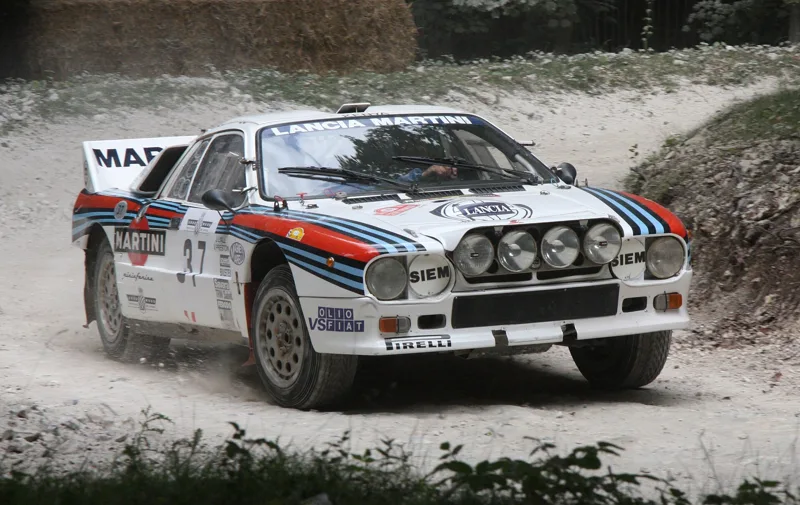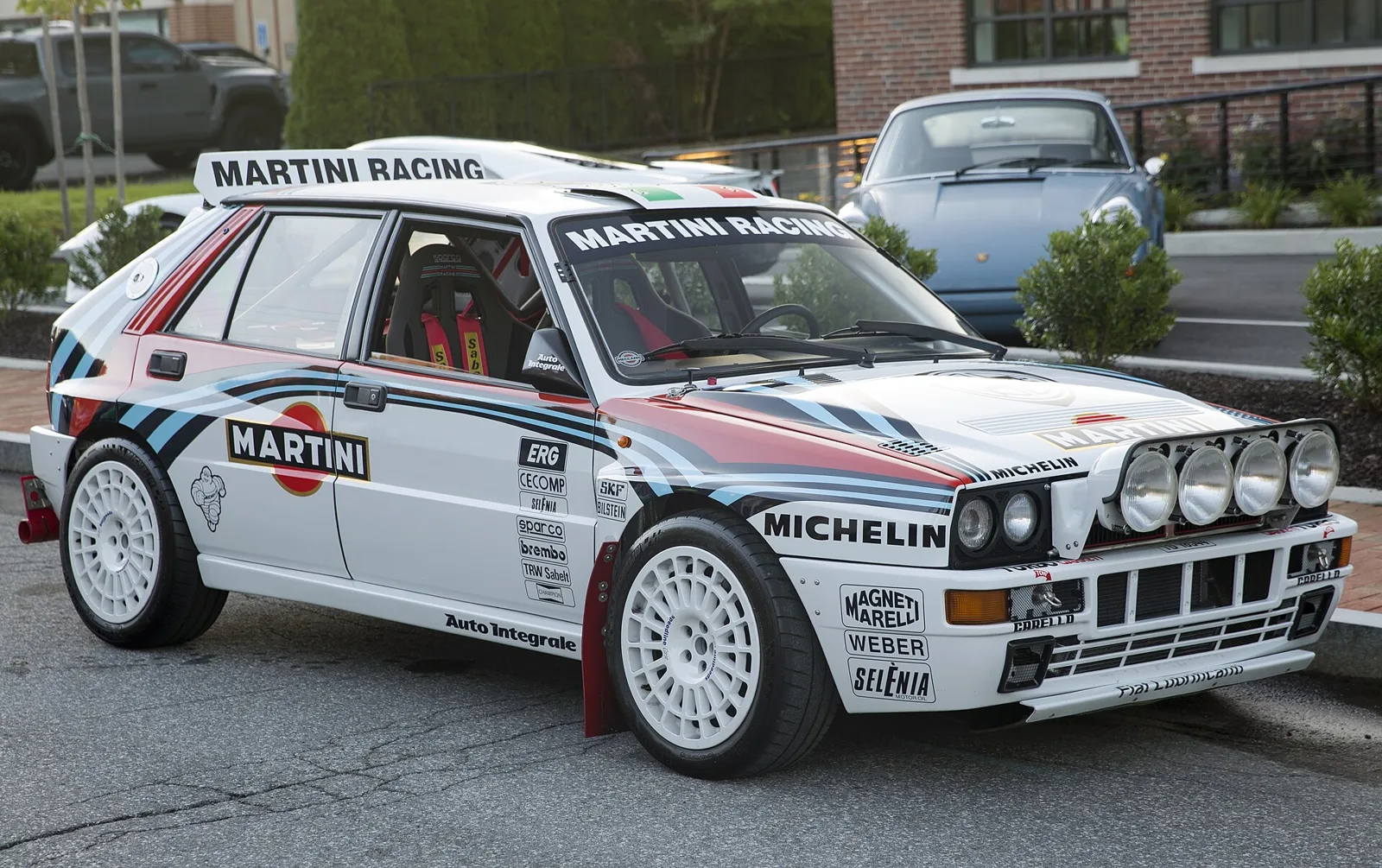
A front-mounted, four-wheel-drive turbo rally car that carried the Martini Lancia team to 46 World Championship rally wins from 1987 to 1992.
Lancia's Delta HF, a Group A rally car, replaced the Delta S4 and debuted in the 1987 World Rally Championship. Its four-wheel-drive turbo layout won 46 rallies across four evolutions and six straight constructors' titles.
The Lancia Delta HF was a Group A rally car built for the Martini Lancia team to compete in the World Rally Championship. It replaced the Delta S4 and was introduced for the 1987 season, when the car began a run of six straight manufacturers' titles.
Based on the Lancia Delta road car, the HF went on to win 46 World Championship rallies across four evolutions. Its drivers' titles went to Juha Kankkunen in 1987 and 1991 and to Miki Biasion in 1988 and 1989, and few rally cars have matched that record.
Why did Lancia build the Delta HF for Group A?
Group B was abolished after the 1986 season, which left Group A as the top rally formula from 1987 onwards. Lancia's answer was the Delta HF 4WD, carrying Abarth code SE043, with a front-mounted two-litre turbocharged engine and four-wheel drive that set it apart from its rivals.
Before Group A, Lancia had built the rear-drive 037 and then the Delta S4 for Group B. The HF was the car that replaced the S4 once the rules changed.
The HF was not without flaws. Its wheel arches were restrictive, the wheels and brakes were too small, and suspension travel was limited. Servicing was also awkward because the compact, transverse-engined layout restricted access to key components.
Rivals included the Mazda 323, the Ford Sierra XR4x4, the Ford Sierra RS Cosworth, the BMW M3, the Opel Kadett GSi and the Renault 11 Turbo. Four-wheel drive gave the Delta an advantage over most of them, and many observers expected Lancia to win the title before the season began.
A rally car with restrictive arches and awkward servicing still won 46 World Championship rallies and six straight manufacturers' titles.
How did the Delta HF perform in 1987?
Massimo Biasion won the Monte Carlo Rally to open the season, then added Argentina and Sanremo. Juha Kankkunen collected four podiums, won the Olympus Rally and the RAC Rally, and clinched the title ahead of Markku Alen. Lancia won seven of the eleven rounds that counted towards the manufacturers' championship.
Alen's title hopes ended on the RAC Rally, where a string of accidents included a rollover on a short spectator stage on the opening day, in view of the television cameras. His challenge was over before the final round had finished.
Kankkunen left the team at the end of the season and rejoined Toyota. His departure meant that Lancia had to rebuild its driver line-up for 1988, and it did so around Biasion, who would become the champion that year.
How did the integrale evolutions change the car?
The Delta line moved through three integrale versions: the 8v, the 16v and the Evoluzione. Each kept the basic layout of the original car while adding wider wheels, bigger brakes, revised suspension and more power, so the design stayed competitive as rivals improved.
The HF integrale 8v, coded Abarth SE044, appeared at the third round of 1988 in Portugal. Team boss Cesare Fiorio said before that event that its larger wheels, bigger brakes and improved suspension would help on asphalt, although the gain on gravel was small.
The Integrale 16v made its debut on the 1989 Rallye Sanremo, the only time the car ran in Italian racing red. Its later evolution, the Evoluzione, was coded Abarth SE050 and was nicknamed the Deltona or Super Delta.
The Evoluzione was said to be 5-6% faster than the 16v car under most conditions. Its changes ran through the whole car, from the body and arches to the wheels, brakes, suspension and aerodynamics, and the engine was more powerful as well.
Did Lancia keep winning in 1988 and 1989?
Yes. Lancia dominated 1988, winning ten of the eleven manufacturers' rounds, and Biasion clinched the drivers' title on the penultimate round. Markku Alen finished the year with a win on the RAC Rally, a first for the Finn.
The 1988 season began with two wins for the original car. Bruno Saby took Monte Carlo and Alen won in Sweden, before the 8v arrived. Didier Auriol was the only driver to beat a Lancia in a straight fight that year, winning on the dry asphalt of Corsica in a Ford Sierra RS Cosworth.
In 1989 the challenge grew. The Toyota Celica GT-Four ST165 was a serious rival, and the Integrale 8v had won its first twelve World Championship events before Mikael Ericsson took Rally Argentina as a guest driver. Ericsson later won the 1000 Lakes Rally for Mitsubishi.
Kankkunen then gave Toyota its maiden victory in Australia, but Lancia still took the manufacturers' and drivers' titles again. The team then chose not to contest the RAC Rally, leaving the season's last round without its cars.
Why did Lancia's run of titles come to an end?
The run began to weaken in 1990. Alen left the team after nearly fifteen years, Kankkunen rejoined, and Auriol won the Monte Carlo Rally, Tour de Corse and Sanremo. Lancia took six wins and its fourth manufacturers' title, but the drivers' title went to Carlos Sainz in a Toyota Celica GT-Four.
That season was the first since 1986 in which Lancia did not claim both the drivers' and manufacturers' championships. The result showed how quickly Toyota had closed the gap, and it set up a closer fight for 1991.
In 1991 Sainz won the opening round at Monte Carlo, but Kankkunen won in Kenya, Argentina, Finland and Australia. Auriol added Sanremo, and the team secured a record fifth manufacturers' title.
In Australia Sainz crashed out, and an electrical failure in Catalunya ended his race there, which kept Kankkunen in contention. On the RAC Rally a head gasket failure on Sainz's Toyota gave Kankkunen his third drivers' title.
How did the Evoluzione and the last seasons unfold?
The Evoluzione debuted at the 1992 Monte Carlo Rally. Lancia had officially withdrawn from rallying at the end of 1991, so the car was run by the semi-private Jolly Club team for 1992 and 1993, although the factory gave initial support.
Toyota had an all-new Celica for 1992, and that raised fears that the Delta would be outclassed. In practice Auriol dominated the early season, taking a record six wins and opening a large championship lead.
Lancia took the manufacturers' title for a sixth consecutive year. Sainz struggled at first with the new car, then fought back late in the season to take an unexpected second drivers' title after Auriol's engine failed and Kankkunen went off the road.
For 1993 Auriol and Kankkunen moved to Toyota, and Sainz joined Jolly Club, where the cars ran in the colours of his sponsor, the oil firm Repsol. The Delta was outclassed by the latest Toyota and the Ford Escort RS Cosworth by mid-season, and its best result was second on the Acropolis Rally.
The Jolly Club team was disqualified after a second place at Sanremo for fuel irregularities. It then withdrew from the final round of the series, which brought the Delta's top-line career and Lancia's own WRC involvement to a close.
What were the Delta HF specifications?
| Specification | Detail |
|---|---|
| Class | Group A rally car |
| Built for | Martini Lancia team, World Rally Championship |
| Based on | Lancia Delta road car |
| Replaced | Lancia Delta S4 |
| Engine | Front-mounted two-litre turbocharged engine |
| Drive | Four-wheel drive |
| Abarth codes | SE043 (HF 4WD), SE044 (integrale 8v), SE050 (Evoluzione) |
| Debut season | 1987 World Rally Championship |
| WRC victories | 46 across four evolutions |
| Constructors' titles | Six in a row, 1987 to 1992 |
| Drivers' titles | Juha Kankkunen (1987, 1991); Miki Biasion (1988, 1989) |
| Evoluzione | 5-6% faster than the 16v car |
The record is easier to read in this form. The HF 4WD opened the Group A era, the 8v and 16v carried the car through 1988 to 1990, and the Evoluzione closed the factory story in 1992.
How did privateers keep the Delta competitive?
Privately run Deltas carried on after the factory left. Teams including Jolly Club, Astra Motorsport and HF Grifone ran the car, and privateer Deltas won the European title in every year from 1987 to 1991 as well as in 1993.
Several private teams ran Deltas outside the World Championship, and the factory's support for them varied. Jolly Club was the steadiest of these entrants, eventually replacing the works squad for the 1992 and 1993 seasons.
Astra kept racing the car in 1994, mostly on European rounds and a few World Championship events. Its best result was fourth place for Alessandro Fiorio on the Acropolis Rally, and Deltas also took many national titles across continental Europe.