A 1990 Formula One entry built from an older chassis, a V12 engine that never arrived and a season of pre-qualifying defeats.
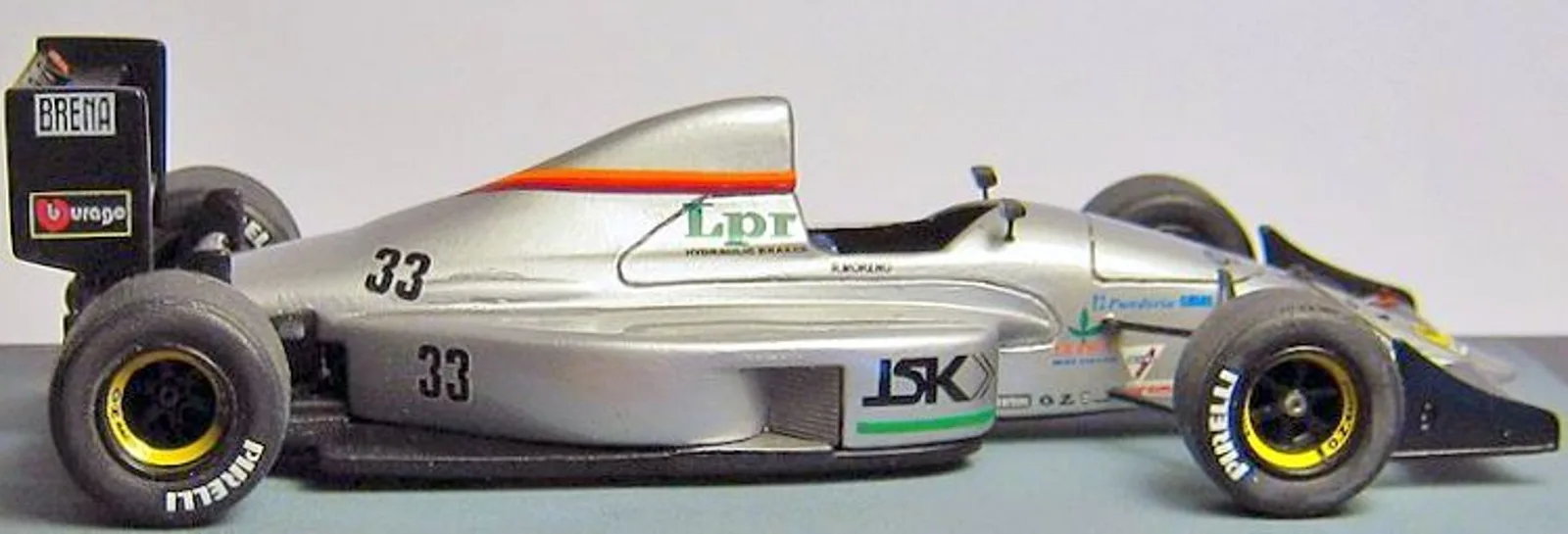
A 1990 Formula One entry from EuroBrun Racing, the ER189B was a modified 1989 car driven by Roberto Moreno and Claudio Langes. It was entered fourteen times, qualified only twice, and marked the end of the team's Formula One career.
The EuroBrun ER189B was the last Formula One single-seater that EuroBrun Racing entered, and it appeared in the 1990 World Championship before the team withdrew for good. Built around a modified version of the 1989 ER189, it was driven by Roberto Moreno and Claudio Langes and entered fourteen times, qualifying on only two of those occasions.
The car is best understood as the product of a team running out of money. Its planned successor never reached a circuit, its promised engine never arrived, and its season ended with forfeit fines that Walter Brun could not avoid. What remains is a car that scraped onto the grid at Phoenix and then spent most of the year trying to get through pre-qualifying.
Where did the EuroBrun ER189B come from?
The ER189B grew out of a team that had struggled badly in 1989. EuroBrun Racing never managed to pre-qualify or qualify for a Grand Prix that year, either with the transitional ER188 or with the ER189 that George Ryton had designed. Before the season ended, the financial partners had left, and the team's co-founder, Giampaolo Pavanello, sold his shares to Walter Brun.
Formula One observers expected Brun to step back from the sport and concentrate on the World Sports Car Championship. Instead, in February 1990 the team applied for two single-seaters for 1990, with Roberto Moreno and Enrico Bertaggia named as the drivers, and Brun said he was in talks about a new engine that could be fitted by the Italian Grand Prix.
The team's first plan was a fresh car, the ER190. Ryton was commissioned to design its chassis, but he had only sketched the design before leaving for Tyrrell. Roberto Ori, who had been assisting him, gave up on the ER190 for lack of time and instead modified the old ER189, which became the ER189B.
A car built to carry a V12 that never arrived, and raced by a team that spent most of its season trying to get onto the grid.
Why was the Neotech V12 never fitted?
The engine plan was the heart of Brun's ambitions. He had signed with Austrian developers of a 12-cylinder unit from Rolf-Peter Marlow, who had worked at Porsche and BMW. The Neotech weighed 137 kg. Its 12 cylinders sat in a 70 degree vee with forty-eight valves, and output was 640 hp at 12,400 rpm. Brun saw it as a power source for his Formula One cars and his Group C machines alike.
Mass production was the sticking point. Some fifty million francs were needed to build the engine in quantity, and only three prototypes existed. Brun announced sponsors in the United Arab Emirates who would invest 45 million Swiss francs for 1990 and 1991, enough to order twenty Neotech engines. When the money faltered, the engine project stalled with it.
By March 1990 the entry list showed EuroBrun with two cars listed for a Neotech engine, although the cars were in fact on the older Judd V8 from 1989. Brun's Emirates contacts later dropped out, and the Neotech coordinator said Brun had not met his financial commitments. Brun confirmed that his cars would stay on the Judd V8 for the season.
How was the ER189B designed?
The ER189B was an update rather than a new car, and the changes were modest. The most notable was the pushrod front suspension, its front handsets relocated up to the cowl. That layout was directly inspired by the Ferrari 640, and Ryton reportedly took the shape of the bodywork's hood from the McLaren MP4/5.
Kees van der Grint replaced Ori as the team's engineer and tried to lighten a chassis that was heavy compared with its rivals. He reworked the in-house gearbox to shed weight and bulk, and he also turned to the rear suspension. A monoshock front suspension, in which one spring-damper package serves both suspension arms, was planned for later in the season.
Three chassis were used during the year. The ER189B/01 was an old ER189 reconfigured for Langes, the ER189B/02 was built in 1990 for Moreno, and the ER189B/03 was completed in the spring for Moreno, who then handed the ER189B/02 to Langes.
Who drove the ER189B?
Roberto Moreno was the lead driver. He had made his Formula One debut with AGS in 1987, starting two Grands Prix, and in 1989 he had qualified four times with Coloni without finishing a race. His earlier career was rich in junior honours: a Brazilian karting title in 1976, a British Formula Ford crown in 1980 and a third place in International Formula 3000 in 1987.
Claudio Langes had a far more modest record. He finished fourth in European Formula 3 in 1984 and raced in Formula 3000 from 1985 to 1989, with a best world ranking of twelfth in 1989. He had a Formula One seat largely because he brought money with him, which was of real interest to Brun.
Gregor Foitek had been the team's pay driver in 1989 until he left before the Italian Grand Prix, after his father, who had helped fund the team, lost patience with the results. Enrico Bertaggia was also originally named for 1990 but was short of funds and went to race in Japanese Formula 3000 instead.
How did the season start with the V8?
The ER189B made its debut at the inaugural Phoenix Grand Prix in a new metallic-grey livery, the fifth colour scheme the team had carried in three years. Thirty-five drivers were competing for twenty-seven places, so both EuroBruns had to pass pre-qualifying first. Only the four fastest pre-qualifiers progressed to qualifying, while the three slowest were eliminated.
Moreno set the fastest pre-qualifying time, 1 min 32 s 292, and then improved in the first qualifying session. Rain arrived before the second session, and Moreno set the second-fastest time of the wet session ahead of Alain Prost, Nigel Mansell and Ayrton Senna. That gave him sixteenth on the grid, less than three seconds off the time that gave Gerhard Berger pole, and a EuroBrun was once again on a starting grid after a long gap.
The race was a struggle. Moreno left his electric fuel pump switched on, which forced a rushed stop on lap two to swap a flat battery. He made a second stop for tyres and came home thirteenth, five laps down on Ayrton Senna. It was the first time a EuroBrun had crossed the line in nineteen races.
Why did the team struggle so badly to pre-qualify?
After Phoenix the story turned quickly. At Brazil Langes missed pre-qualifying, and Moreno's engine cut out on the circuit, so he borrowed his team-mate's car and also failed to get through. At Imola Langes failed again, while Moreno set the 24th-fastest time in qualifying. In the race he was caught in a first-lap accident, and dust and debris blocked his throttle slides before he could complete the lap.
Monaco brought more of the same. Langes failed to pre-qualify, while Moreno had the fourth-fastest pre-qualifying time, but he could not qualify after the mechanics tried new suspension settings that did not work. Van der Grint had already headed back to the factory when the changes were made, and the team could not reach him to revert them.
Canada was the low point for the team's finances. Langes no longer had enough budget to race, and after the Middle East partners walked away, the team depended almost entirely on his payments. Brun allowed him two laps in pre-qualifying to avoid a forfeit that would have cost them a 200,000 dollar fine. Moreno was almost twenty seconds quicker than his team-mate in the wet pre-qualifying session, but in qualifying on a dry track he missed out by a margin of six hundredths, posting 1 min 25 s 172 while Alex Caffi's Arrows managed 1 min 25 s 113.
Mexico followed the same pattern. Langes was present only to keep the team out of the 200,000 dollar fine, and Moreno set the third-fastest pre-qualifying time before reaching the grid. After spinning and stalling, he restarted his engine and drove back onto the track, and he was excluded for accepting outside help. That rule was later revised so that it applied only to races, not qualifying.
In France neither car made the start list, since the drivers managed only sixth and seventh in pre-qualifying. At Silverstone Brun sounded out Marco Greco, a Brazilian racer in Formula 3000, as a possible replacement for Langes, but Langes provided fresh funding at the last minute, and no EuroBrun passed pre-qualifying. In Germany the team tested the monoshock suspension on Langes's car, but it was not ready, and neither driver progressed.
| Grand Prix | EuroBrun result |
|---|---|
| United States (Phoenix) | Moreno sixteenth on the grid, finished thirteenth |
| Brazil | Langes failed to pre-qualify; Moreno failed to get through |
| San Marino (Imola) | Moreno 24th-fastest in qualifying; retired on the first lap |
| Monaco | Moreno failed to qualify; Langes failed to pre-qualify |
| Canada | Moreno missed qualifying by six hundredths of a second |
| Mexico | Moreno excluded after receiving outside help |
| France | Both cars too slow in pre-qualifying |
| Britain | No EuroBrun passed pre-qualifying |
| Germany | Neither car passed pre-qualifying |
| Hungary | No EuroBrun pre-qualified |
How did EuroBrun leave Formula One?
In Hungary no EuroBrun pre-qualified, and from Belgium onwards the AGS and Coloni cars were consistently ahead of the EuroBruns. The team did, however, edge ahead of Bruno Giacomelli's Life Racing Engines in several races, a car that often sat at the back of the grid.
At the end of the European season, Brun told his drivers that he wanted to focus on running his three cars in the sports car series instead. The remaining flyaway races in Japan and Australia would be dropped from his schedule. FIA Vice-President Bernie Ecclestone confirmed a fine of 200,000 dollars per forfeit, with the penalty running to the final round, and warned that any team failing to pay would be refused entry for 1991. Brun was fined 400,000 dollars for his two forfeits, and EuroBrun left Formula One for good.
What was the car's last appearance?
The ER189B made one final appearance at the Trofeo Indoor di Formula 1 on 8 and 9 December 1990, an exhibition held alongside the Bologna Motor Show. The event ran on a track of about 1,300 metres outside the show halls, and it was the third edition of a competition aimed at Italian teams.
The field was small and entirely Italian. Scuderia Minardi entered an M190 for Gianni Morbidelli, Osella fielded an FA1M-E for Olivier Grouillard, and Scuderia Italia ran Jyrki Jarvilehto in a Dallara 190. EuroBrun called on two drivers who had never raced in Formula One, Andrea Montermini and Domenico Schiattarella. Montermini did not take part, while Schiattarella retired after the first lap with a suspension problem against Morbidelli.
Why does the ER189B matter?
The ER189B matters because it shows what happens when a team's engineering plans depend on money that never arrives. The car was a cut-down update of a 1989 design, built to carry a V12 that the team never got to power its single-seaters. Its story is a case study in how a privately funded team can be squeezed out of the sport.
It also illustrates the cost of pre-qualifying. Under the rules of the period, a team that had not finished well the year before had to fight through a separate session before even reaching qualifying. For EuroBrun, that hurdle proved too high, and the team never recovered from it in 1990.