A Montmelo circuit built in 1991 that became the best-known test track in Formula One and hosted some of the sport's most memorable debuts.
This Montmelo venue measures 4.657 km (2.894 mi) and opened in 1991 as a major Formula One testing ground. It hosted the Spanish Grand Prix from its first year, and its Formula One future runs through 2032 on an alternating arrangement with the Belgian race. Motorcycle racing has been part of its calendar since 1992.
Montmelo, just outside Barcelona, is home to a 4.657 km (2.894 mi) motorsport circuit that carries the city's name in its title. With long straights and a varied mix of corners, it is seen as an all-round circuit. The stands seat 140,700 people, and the track holds an FIA Grade 1 licence.
The circuit is best known as the place where Formula One teams do most of their pre-season and mid-season testing. That familiarity has drawn criticism that it reduces the surprises of a race weekend, a debate that has followed the venue for years.
How did the circuit begin?
The venue went up in 1991, and its first Formula One race, the Spanish Grand Prix, followed in the same year. The build also overlapped the 1992 Olympic and Paralympic Games, for which the site hosted cycling time trials.
Do not confuse it with Montjuic, the earlier venue that staged four Spanish Grands Prix from 1969 to 1975. Montjuic lies inside the city of Barcelona itself, while the modern venue sits in Montmelo outside the city. Before 2013 the venue carried the simpler Circuit de Catalunya title.
The Barcelona City Council sponsorship put the city's name into the title in 2013.
A circuit built for testing and tested for decades, where a single chicane or a single wind change can rewrite a season.
Which races made the circuit famous?
The circuit has produced some memorable races. The 1991 race featured Senna and Mansell battling wheel to wheel down the front straight for second, and Mansell came out on top.
Schumacher's 1994 second place came even though he ran more than half the race with just fifth gear. In 1996 he claimed his first Ferrari victory after dominating in a downpour, and in 2001 Mika Hakkinen suffered a clutch failure on the last lap, handing Schumacher the win.
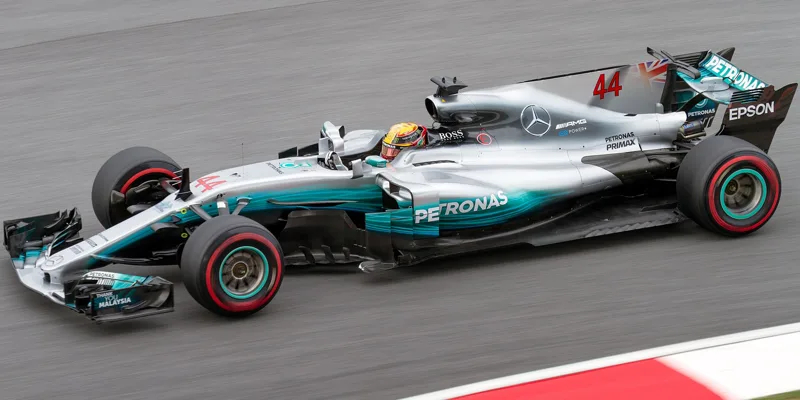
In 2006 Fernando Alonso became the first Spaniard to win the Spanish race at home. A decade later, in 2016, a crash at turn four took out Mercedes drivers Lewis Hamilton and Nico Rosberg, allowing Max Verstappen to win on his first race for Red Bull.
Verstappen's debut win set age records: he was the youngest race winner, the youngest podium finisher and the youngest lap leader, and he was also the first Dutchman to win a Formula One race. Pastor Maldonado scored his only Grand Prix victory and podium here in 2012.
Not every big moment was a victory. In 2008 Heikki Kovalainen lost a wheel rim at speed and left the track at 240 km/h (150 mph) at turn nine. He scrubbed off speed to 130 km/h (81 mph) before the tyre barrier and suffered a minor concussion.
What are the corners like?
The track demands aerodynamic efficiency and careful setup. The wind can change direction during the day, so a car that understeers in the morning may oversteer in the afternoon on the same part of the circuit, and tyre compounds that work in testing can behave differently weeks later.
| Turn | Feature | Detail |
|---|---|---|
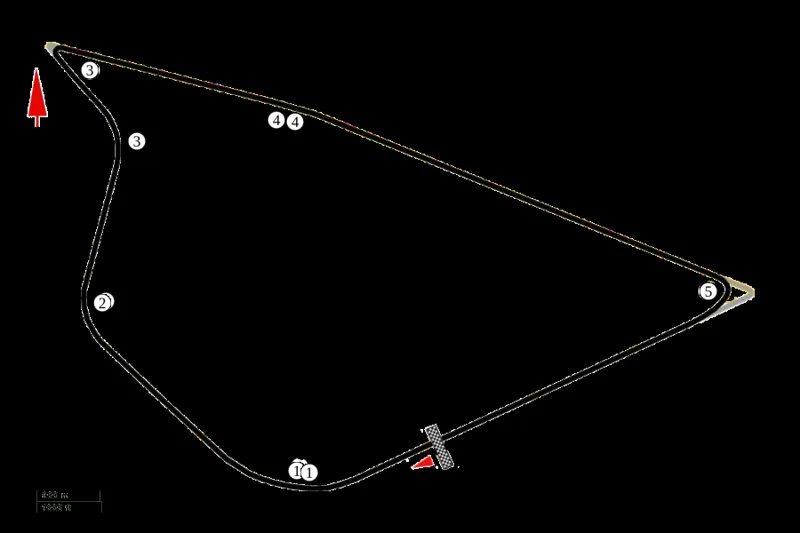
| Turn 1 | Braking zone after a long DRS straight | The main overtaking point; the pit straight runs 1,047 m (1,145 yd) |
| Turn 3 (Renault) | Long, flat-out right-hander | Around four g of lateral force |
| Turn 5 (Seat) | Slow left-hander | Taken in second gear before a rapid downhill |
| Turn 9 (Campsa Corner) | Very fast, blind sixth-gear right-hander | Steep uphill, with a downhill exit that can run wide |
| Turn 10 (La Caixa) | Third-gear left-hander | Reached at the end of the long back straight |
| Turns 13 and 14 | Fast, sixth-gear double right-hander | Carries cars across the start-finish line |
Drivers who hold the outside line through the first corner can take the inside line for turn two, and braking for turn one is left late before a downshift to second gear. Turn four is similar in character to the Parabolica at Monza, where drivers brake and take an early apex in third gear to carry speed out of the corner.
Turn 1 is arguably the most popular place for overtaking. Earlier drivers tucked in behind one another through the final corners and used the slipstream down the long straight. As aerodynamic balance grew more critical in the 2000s and 2010s, that method declined, because cars could no longer follow each other closely through the fast final corner.
Motorcycle riders are known to overtake at several points, including turns one and two, four, five, ten and fourteen. Turn 1 is the main point for cars, but the motorcycle layout has been tuned repeatedly for safety.
How has the layout changed over time?
The final corners have been adjusted several times. In 2007 one of the two final sweepers was swapped for a slow chicane, aimed at cutting speeds through the last corner and improving overtaking. Critics said it did little for overtaking and created congestion in qualifying, and from the 2023 Spanish Grand Prix Formula One reverted to the fast sweeping configuration.
Motorcycle racing has also changed. A new La Caixa turn was built in 2004 for the bikes, while the cars kept the older layout. Luis Salom died of his injuries in 2016 after a crash in turn 12 during Moto2 free practice, and the layout was then switched to the Formula One version for qualifying and the race.
A further motorcycle change came in December 2016, when the FIM announced a new chicane ahead of the car chicane to stop riders cutting the pit lane entrance. Riders judged the new chicane dangerous because of a change in surface, so the car chicane was used during the 2017 race instead.
Further changes followed. In 2017 seating at turn 12 was cleared away to give more run-off, and the La Caixa hairpin was remodelled again in 2021, slower than the original but faster than the Formula One version. The track was resurfaced in 2018 after MotoGP riders asked for more grip, and an earlier resurfacing had taken place in 2004.
Motorcycle racing has produced its own drama. In 2009 teammates Valentino Rossi and Jorge Lorenzo fought all race long, and Rossi won with an overtake on the final corner, an event that riders and pundits called historic.
Why does the circuit matter for testing?
Formula One teams test so much at Barcelona-Catalunya that drivers and mechanics are unusually familiar with it. That familiarity is one reason critics say the circuit reduces the on-track action at race weekends, because the teams already know the answers before the cars arrive.
The wind has also caused problems. Fernando Alonso's testing accident in 2015 was partly blamed on the severity of the wind, which can change drastically through the day and make a tyre compound work well in one test and poorly in another.
Why has the Formula One deal been so uncertain?
For the 2020 season Liberty Media expected a calendar of twenty-one Grands Prix, with any new races coming at the expense of existing ones. The Dutch Grand Prix at Zandvoort was expected to replace the Spanish race, but a later agreement with the teams allowed up to twenty-two races and saved the Spanish Grand Prix.
The November 2021 agreement ran to 2026, which made 2025 the final Spanish race at the venue. For 2026 the race moved to a new circuit around the IFEMA exhibition centre in Madrid, and the Barcelona-Catalunya Grand Prix was held in its place.
A later agreement secured Formula One visits in 2028, 2030 and 2032, alternating with the Belgian race. The deal shows how much the circuit's future depends on its race calendar.
Can the circuit pay its way?
The circuit has struggled financially. Public attendance at the Spanish and Catalan Grands Prix has fallen significantly since 2007, and losses ran into tens of millions of euros between 2009 and 2018. Regional and provincial public bodies have covered the shortfall, keeping the venue afloat.
Some officials have considered removing Formula One from the circuit, and the Barcelona City Council cancelled its economic grant after an audit detected irregularities. Some of those irregularities were later also detected by the Generalitat, which adds to the pressure on the venue.
Noise is another issue. The circuit sits on elevated ground without protective measures against the sound of cars, motorcycles and other vehicles, so racing and testing can be heard for many kilometres, particularly in the nearby municipalities.
The venue has pursued environmental recognition as well. It holds three-star FIA Environmental Accreditation and ISO 14001 certification, and a 2021 report ranked it second among the most sustainable racetracks in the world, level with Circuit Paul Ricard and behind Mugello.
What events take place at the circuit today?
The circuit hosts a wide programme of racing, from winter series in February and March to the Ferrari Challenge finals in November. The Formula One weekend is joined by Formula 2, Formula 3 and Porsche Supercup races. Motorcycle Grands Prix have been held here since 1992, and the Catalan motorcycle Grand Prix took place in May 2026. In 2024 the circuit also hosted a one-off Solidarity motorcycle Grand Prix, which took the place of the Valencia round after flooding in that area.
Endurance racing is a regular feature, with the European Le Mans Series 4 Hours of Barcelona in April, the 24 Hours of Barcelona in September and the FIA World Endurance Championship 6 Hours of Barcelona in October. GT World Challenge Europe and the Lamborghini Super Trofeo Europe also appear on the calendar.
The 2026 Catalan motorcycle Grand Prix was red-flagged after a crash at turn nine scattered debris across the track, and a later restart saw further crashes at turn one. Such events show how the circuit's fast sections and braking zones test riders as well as cars.
The 24h BiCircuit Festival has offered ultra-distance cycling since 2016, with solo and relay options of 24, 12 and 6 hours, and relay teams of up to eight riders.