Sitges, Lasarte, Pedralbes, Montjuic, Jarama, Jerez and Catalunya before Madrid: where the Spanish Grand Prix has been run and what each venue gave the race.
The Spanish Grand Prix began in 1913 at Guadarrama and has visited Sitges, Lasarte, Pedralbes, Montjuic, Jarama, Jerez and Barcelona-Catalunya. Jarama hosted it from 1968 to 1981 and Jerez from 1986 to 1990. In 2026 it moved to the Madring in Madrid, with a contract running to 2035.
In 2026 the Spanish Grand Prix left its home at Circuit de Barcelona-Catalunya, moving to September and to the Madring, a newly built street circuit in Madrid. Kimi Antonelli won the first edition for Mercedes. The Catalan track, meanwhile, keeps Grands Prix of its own in even-numbered years under the title Barcelona-Catalunya Grand Prix.
The move is the latest chapter in a race first run in 1913 that has been staged on road circuits, a short oval, a street track, a permanent circuit north of Madrid and a sherry-country circuit in the south. Jarama and Jerez are the venues that fill the gap between Barcelona's street races and its modern purpose-built track.
When was the first Spanish Grand Prix?
The first race generally considered a Spanish Grand Prix took place in 1913. It was not run to the Grand Prix formula of the day. It was a touring car race, run on public roads at Guadarrama over a 300-kilometre course close to Madrid, on the way towards Valladolid. Its official name, the RACE Grand Prix, honoured the Royal Automobile Club of Spain, and Carlos de Salamanca won it in a Rolls-Royce.
Racing in Spain was already established by then. The Catalan Cup ran annually from 1908 to 1910 on roads around Sitges, near Barcelona. Giosue Giuppone won the first in a Lion-Peugeot, and Jules Goux won the next two in the same make. The enthusiasm led to a plan for a permanent track at Sitges, a 2-kilometre (1.2 mi) oval called Sitges-Terramar. In 1923 it staged the first race formally called the Spanish Grand Prix, and Albert Divo won it in a Sunbeam.
The race has been one of the world's oldest still being contested, and it celebrated its centenary in 2013. The First World War meant a decade's wait for the second running. The race then counted towards the World Manufacturers' Championship in 1927, and in 1935 it stepped up to the European Championship, just before the Spanish Civil War stopped racing. It was revived in 1967 and has been part of the Formula One World Championship since 1968, apart from 1982 to 1985.
Lasarte and the lean years
Money problems hit the Sitges track after that first race. In 1926 the organisers shifted the event to Circuito Lasarte, a 17.749 km (11.029 mi) course in the north near Bilbao, which was where Spain's main race of the 1920s, the San Sebastian Grand Prix, took place. The 1927 race counted for the AIACR World Manufacturers' Championship, yet the event was still not settled, and in 1928 and 1929 it was run to sports car regulations. The 1930 race, scheduled for 27 July, was cancelled after the Wall Street crash of October 1929 and the poor economy, and the 1931 and 1932 races were announced and then cancelled amid political and economic difficulties. Government backing revived the race at Lasarte in 1933. After 1935 Spain slid into civil war and racing stopped. In 1946 the Penya Rhin Grand Prix brought it back at the Pedralbes street circuit in Barcelona.
The wide, pedestrian-lined street track at Pedralbes was never used for motor racing again.
What happened at Pedralbes?
Spain rejoined the international calendar in 1951 when the Formula One championship came to the very wide Pedralbes street circuit in Barcelona. That race gave Juan Manuel Fangio his first world championship, in an Alfa Romeo, helped by tyre problems on the works Ferrari. The races of 1952 and 1953 did not take place because of a lack of money, and in 1954 Mike Hawthorn, a Briton, ended Mercedes' dominance by winning in a Ferrari.
The 1955 race was scheduled, but the disaster at the 24 Hours of Le Mans, with a death toll above 80, brought in new rules for spectator safety, and the race was cancelled along with many others. It was cancelled for the next two years too, partly owing to money problems. The wide, pedestrian-lined street track at Pedralbes was never used for motor racing again.
| Venue | Place | Spanish Grand Prix years |
|---|---|---|
| Guadarrama | Near Madrid | 1913 |
| Sitges-Terramar | Near Barcelona | 1923 |
| Lasarte | Near Bilbao | 1926 to 1935, with gaps |
| Pedralbes | Barcelona | 1951 and 1954 in Formula One |
| Jarama | North of Madrid | 1968 to 1981, with gaps |
| Montjuic | Barcelona | 1969 to 1975, odd years |
| Jerez | Near Seville | 1986 to 1990 |
| Barcelona-Catalunya | Montmelo | From 1991 |
| Madring | Madrid | From 2026, contract to 2035 |
What did Jarama and Montjuic contribute?
Spain bid to rejoin international racing in the 1960s. The national automobile club had a permanent circuit built at Jarama, just north of Madrid, while the government gave Barcelona's Montjuic Circuit a set of safety upgrades. Jim Clark won a non-championship Grand Prix at Jarama in 1967 in a Lotus. In 1968 Jarama hosted the Spanish Grand Prix, near the start of the Formula One season.
The sides then agreed to swap the race between two very different tracks: Jarama, tight and slow, and Montjuic, which was fast and sweeping. Montjuic held its first Formula One race in 1969, won by Jackie Stewart. Jarama would take even-numbered years and Montjuic odd ones. In 1970 Jacky Ickx and Jackie Oliver were involved in a fiery accident and escaped with burns, and Stewart won, then won again in 1971 while holding off three more powerful 12-cylinder cars. Niki Lauda took the first of his 25 victories in 1974.
1975 at Montjuic
The 1975 race was marked by tragedy. Drivers had raised concerns about safety in practice because the Armco barriers around the city streets of Montjuic had not been fastened properly, and a number of protests followed. The drivers refused to race. The organisers panicked and threatened to impound the cars inside the stadium. The teams relented, but Emerson Fittipaldi, a double winner, retired in protest after one lap. On the 26th lap Rolf Stommelen's car crashed when its rear wing broke off, and four spectators were killed. The race was stopped on the 29th lap and won by Jochen Mass, with only half the points awarded. After that the race was confined to Jarama.
Why was Jarama so hard to pass on?
Jarama is a 3.850 km (2.392 mi) circuit in San Sebastian de los Reyes, 32 km (20 mi) north of Madrid. John Hugenholtz, who also created Suzuka, designed it, and Alessandro Rocci built it in 1967 on arid scrub land. It had a short main straight and tight, twisty corners, which made overtaking extremely difficult.
That was what made the 1981 race famous. Gilles Villeneuve, in a turbocharged Ferrari 126CK that was fast on the straights but did not make the most of ground-effect aerodynamics, held off four potentially faster cars for the whole race: Jacques Laffite in a V12 Ligier-Matra, John Watson in a McLaren-Ford, Carlos Reutemann in a Williams-Ford and Elio de Angelis in a Lotus-Ford. The win is considered one of the greatest drives in motorsport, and it was Villeneuve's last.
Earlier races at Jarama had their own stories. In 1976 James Hunt benefited from Lauda's broken ribs, the result of a tractor accident, and was then disqualified because his McLaren measured 1.8 inches over the width limit; an appeal by McLaren succeeded and the points came back. Mario Andretti dominated 1977 and 1978 in his ground-effect Lotus 78. The 1980 weekend turned on a Friday-morning announcement by FISA president Jean-Marie Balestre that the race would not count for the championship. Ferrari, Renault and Alfa Romeo stayed away, only the FOCA independents raced, and Alan Jones won in a Williams.
The end of Formula One at Jarama
Jarama hosted its last Formula One race in 1981 because it was deemed too narrow for modern racing. The Spanish Grand Prix was cancelled in 1982. The organisers appeared to care more about a golf course next to the circuit, and the narrow track, hot late-June weather and small crowd of that year also counted against it. The track was lengthened in 1991 and upgraded in 2015, and since February 2022 it has been called the Circuito de Madrid Jarama - RACE. It staged the Spanish Grand Prix in 1968, 1970, 1972, 1974 and 1976 to 1981, and the Spanish motorcycle Grand Prix on 15 occasions from 1969 to 1988.
In 1987 Jarama staged the 4 Hours, round two of the first World Touring Car Championship for Group A cars. Roberto Ravaglia and Emanuele Pirro won in a Schnitzer BMW M3, from a pole by Klaus Ludwig's Ford Sierra RS Cosworth in 1:31.434, and Andy Rouse set the fastest lap in a Sierra Cosworth with a 1:33.710. Today the circuit stages the Formula E Madrid ePrix in March, Drift Masters in May, the Spanish F4 championship in August and truck racing in October.
How did Jerez become a Grand Prix venue?
A plan to bring the race back on a street circuit at the resort town of Fuengirola for 1984 and 1985 fell through. In 1985, though, the Mayor of Jerez ordered a new circuit for his town as a way to promote tourism and its sherries. Manuel Medina Lara led the project from a preliminary idea by Alessandro Rocci, and the track opened on 8 December 1985. It is 4.428 km (2.751 mi) around, set beside Jerez de la Frontera, which lies 90 km (56 mi) south of Seville in sherry country.
Its first international motorcycle meeting in Spain came in March 1986, and the Grand Prix followed in April with one of Formula One's closest finishes. Ayrton Senna and Nigel Mansell battled furiously and crossed the line side by side, with Senna winning by 0.014 seconds. Mansell won in his Williams in 1987, and in 1989 Senna drove a hard race to win from Gerhard Berger's Ferrari and his fierce rival and McLaren team-mate Alain Prost.
Donnelly's crash and the last race
The 1990 Spanish Grand Prix was the last at Jerez. In practice a violent high-speed crash destroyed Martin Donnelly's Lotus and threw the Briton out of it. His injuries were severe, though he lived, and Formula One never saw him race again. Ferrari took a one-two in the race itself, Prost leading Mansell home. The circuit was popular with the Formula One community, but its remote location did not help crowds, which was one reason the race moved to Barcelona after 1990, even though up to 125,000 spectators can be accommodated.
Jerez returned for the European Grand Prix in 1994 and 1997. Ahead of the 1994 race a new chicane, named the Senna curve, was built at the corner where Donnelly had crashed. The 1997 race was the title decider, and Michael Schumacher and Jacques Villeneuve collided in it. At the podium celebrations, Mayor Pedro Pacheco disrupted the ceremony by presenting a trophy that should have been given by a Daimler-Benz dignitary, and the result was a ban on the track ever hosting a Grand Prix again. Jerez was still used for winter testing until 2015.
The circuit was resurfaced in 2005 and was expected to host Champ Car in 2008, until the series was cancelled. Its last corner was renamed for Jorge Lorenzo on 2 May 2013, the circuit took the name of the late Angel Nieto on 3 May 2018 and the sixth corner was renamed after Dani Pedrosa on 3 May 2019. Pedro de la Rosa holds the outright track record, 1:15.651, from Formula One testing in a McLaren MP4-20 in April 2005.
Who has won at Barcelona-Catalunya?
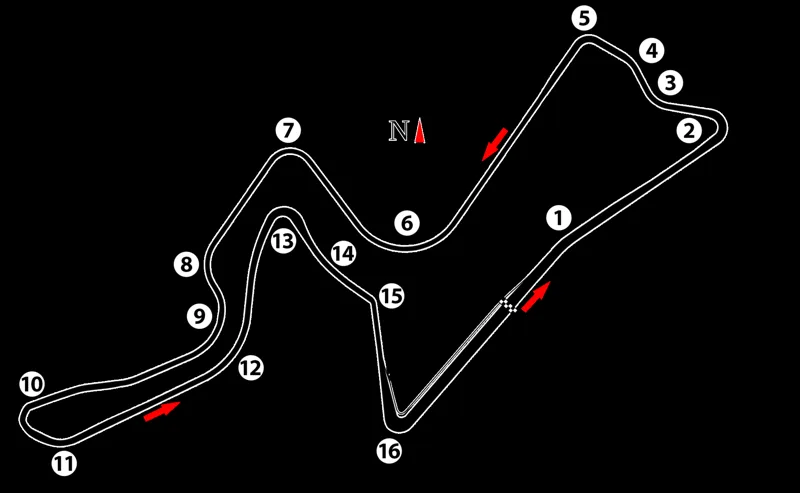
Work on the Circuit de Barcelona-Catalunya at Montmelo, a few kilometres from Barcelona, was supported by the Spanish government, and the race moved there in 1991. Organisers promoted the 1992 race as the Grand Prix of the Olympic Games. From then on it was usually held in late April or early May. Williams won everything at the new track until 1994. Michael Schumacher won six times, including a 1996 victory in heavy rain that was his first for Ferrari. Mika Hakkinen won three times and looked set for a fourth in 2001 until his car failed on the final lap.
Crowds grew from 2003 thanks to Fernando Alonso. He was second in 2003 and 2005, won from pole in 2006, was third in 2007, and finished second in 2010 and 2012. In 2012 Pastor Maldonado won from pole in a Williams, the first win and pole for a Venezuelan driver, Williams's first victory since the 2004 Brazilian Grand Prix and its first Spanish Grand Prix win and pole since 1997. Alonso won again in 2013. Two Spanish drivers have won the race, Carlos de Salamanca in 1913 and Alonso, with the Spanish-speaking Fangio and Maldonado also among the winners.
From 2013 the race was due to alternate between Catalunya and the Valencia Street Circuit, but Valencia dropped out for financial reasons and Catalunya kept the race. Only four of the 19 races at the track from 2001 to 2019 were won by someone other than the pole-sitter. The COVID-19 pandemic pushed the 2020 race back from May to August, and in 2021 Lewis Hamilton won after passing Max Verstappen following an additional pit stop. The layout changed in 2023 to the one MotoGP has used since 2021.
Where is the Spanish Grand Prix held now?
Madrid took over as the Spanish Grand Prix host in 2026, on a contract lasting to 2035. The Madring is a street circuit around the IFEMA Exhibition Centre, and Antonelli won the first edition. Barcelona's Circuit de Barcelona-Catalunya, for its part, holds Grands Prix in even-numbered years between 2026 and 2032 under the name Barcelona-Catalunya Grand Prix.