Gordon Murray built the BT49 in six weeks, and Nelson Piquet used it to win the 1981 world championship by a single point.
Gordon Murray designed the BT49 for Brabham, and it raced from 1979 to 1982 with the Ford Cosworth DFV engine. Nelson Piquet used it to take the 1981 world championship by one point. Seventeen were built, and several survive today.
The Brabham BT49 was a Formula One car designed by Gordon Murray for the British Brabham team. It raced from 1979 to 1982, and in 1981 it carried Nelson Piquet to his first world championship. Built around the Ford Cosworth DFV engine, it was arguably the fastest Cosworth-powered car of its time.
Why was the BT49 designed in only six weeks?
Brabham dropped its Alfa Romeo engine partnership in 1979 after the BT48 disappointed, so Murray needed a replacement car at short notice. He reused the Cosworth DFV, built three cars in six weeks, and had them ready for the Canadian Grand Prix on 30 September 1979.
The move followed a poor year for the BT48. Alfa Romeo had entered its own cars that summer, and Bernie Ecclestone did not want his team to finish behind an Alfa works operation. The author Alan Henry adds that Alfa's design team was drawing on Brabham know-how.
Engine power had lost its primacy. The Alfa engines were strong but unreliable, while ground effect, which Lotus had brought to the sport with the 78 two years earlier, had become the decisive factor. Brabham therefore returned to the Ford Cosworth DFV, which it had last used in 1975.
Three BT49s were built for that Canadian round. Two were converted BT48 chassis and one was new, and the design reused parts of the BT48 wherever it could.
Six weeks of design, one Cosworth engine and a title won by a single point.
How did the BT49 chassis and aerodynamics work?
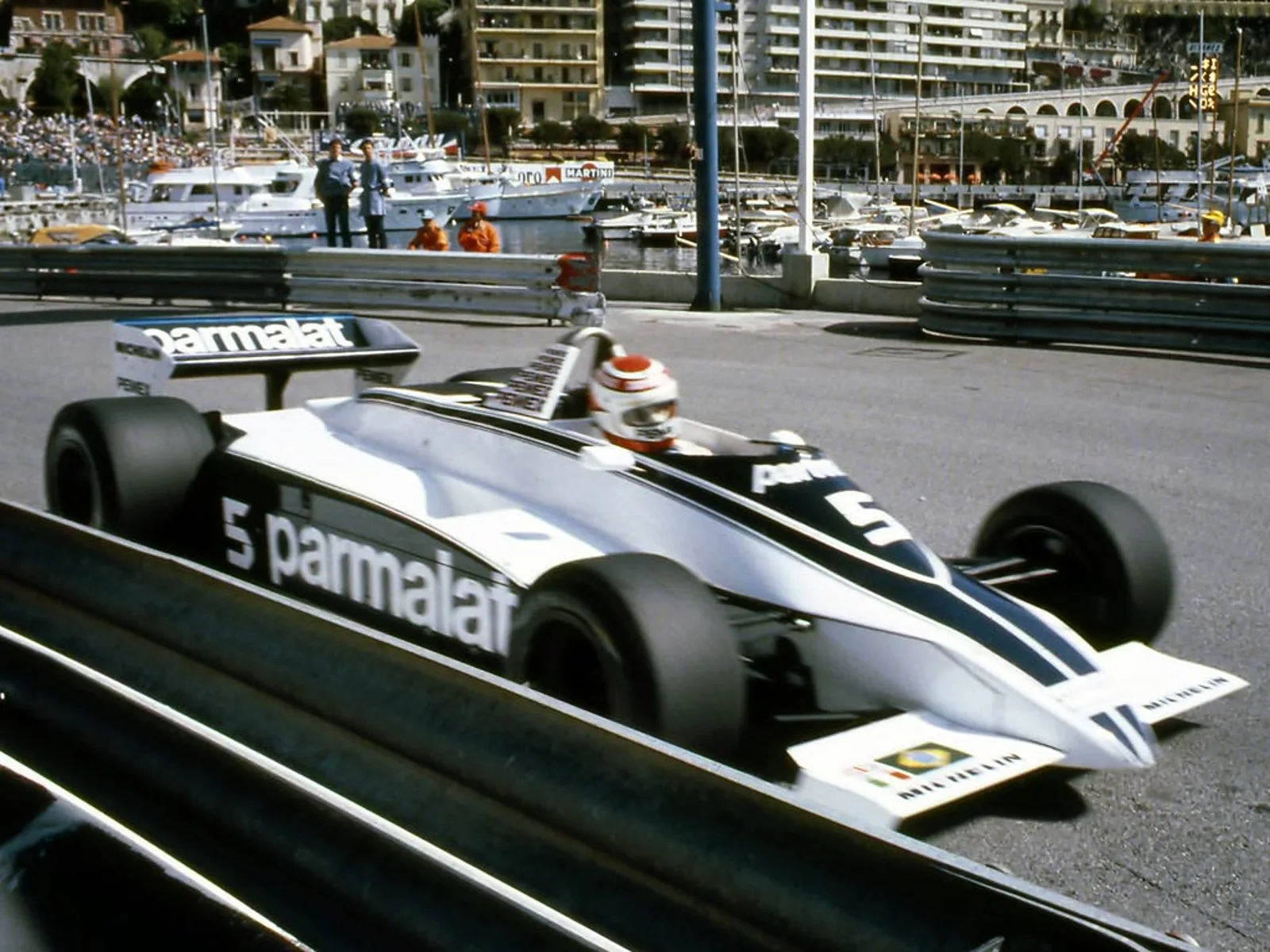
The BT49 used an aluminium alloy monocoque reinforced with carbon fibre composite panels, one of the first Formula One chassis to use the material structurally. Its underside was shaped to create ground effect, pulling the tyres down onto the track and giving more grip with less drag than a conventional wing.
The chassis was slightly longer than the BT48's and new from the cockpit back. Its structural fuel tank was trimmed from 45 imperial gallons to 38 (205 to 173 L) to suit the DFV's lower fuel consumption. Dry weight fell by 35 lb (15.9 kg) against the BT48, and the saving was 95 lb (43.1 kg) when fuelled.
Murray later said the car had more downforce than any rival, and that it all came from ground effect. The team ran it without any front wing and with barely any at the rear, which left the aerodynamics doing almost all of the work.
In its original form the area under the car was sealed by sliding skirts that rose and fell with the car, so that no air could leak in. The suspension used double wishbones at both ends, with springs and dampers mounted on the chassis and operated by pullrods, plus anti-roll bars front and rear.
The wheels were 13 inches in diameter, although 15-inch fronts were sometimes used. The car first ran on Goodyear tyres, but the team had to adapt it to Michelin's radial tyres for part of 1981, when Goodyear temporarily withdrew from Formula One.
What engine did the BT49 use?
The BT49 used the Ford Cosworth DFV, a 2,993 cc V8 that had raced in Formula One since 1967. It produced around 500 bhp (373 kW) at about 11,000 rpm, and it was a stressed part of the chassis that bolted to the fuel tank at the front and to the suspension at the rear.
Murray found the switch back to the DFV a welcome break from the troublesome Alfa engines. Piquet, after his first test session, was also struck by how smooth and willing the DFV felt compared with the Alfa V12s, which he had found less pleasant to drive.
In 1979 all but three teams used the DFV. The strongest rival option, Alfa Romeo's V12, made 525 bhp (391 kW). Later BMW, Ferrari and Hart joined Renault with turbocharged engines, and Ferrari's turbocharged V6 reached around 580 bhp (433 kW) while the DFV stayed near 500 bhp.
Cosworth also supplied Brabham with special evolution DFVs for 1980, producing around 500 to 510 BHP at over 11,000 RPM. Over the 1980 and 1981 seasons Brabham became the favoured team for Cosworth's development engines, which in turn made Piquet the favoured works driver for the supplier.
Brakes were another area of change. For most of its career the BT49 ran conventional steel brakes. Lighter reinforced carbon-carbon discs and pads, a technology Brabham had introduced to Formula One in 1976, were used in 1981 and 1982.
Williams had decided from the 1980 French Grand Prix to have John Judd modify the DFVs used by Alan Jones and Carlos Reutemann. That left Brabham as the leading beneficiary of Cosworth's own development work, a position that carried through most of 1980 and the whole of 1981.
Who won the 1981 title in a BT49?
Nelson Piquet won the 1981 Drivers' title in the BT49C, finishing fifth at the final round, the Caesars Palace Grand Prix, and taking the championship from Carlos Reutemann by one point. It was a title built on consistency rather than outright speed.
The title race was close, and the BT49C's mechanical systems were demanding. The team revised its hydropneumatic suspension continuously, and the car still took pole at two Grands Prix and won two more. Piquet's cars also benefited from a steady run of finishes, which mattered as much as the wins themselves.
Variants of the BT49
The BT49B appeared early in 1980 with a new transverse gearbox designed by the American specialist Pete Weismann. It could take five or six gears and was tall and narrow, which allowed cleaner airflow to the rear. The unit proved hard to make reliable and was put aside after the Dutch Grand Prix.
The BT49T was a test car for BMW's early turbocharged Formula One engine, a 1,499 cc inline four with a single turbocharger in the left sidepod. The first version was said to produce 557 bhp (415 kW).
The BT49C of 1981 used more carbon composite material for a lighter chassis, and it introduced hydropneumatic suspension. The rules set a minimum ride height of 60 millimetres (2.4 in) that year and banned sliding skirts, so fixed skirts had to be sealed by very stiff suspension. By the end of the season total suspension movement was only 1.5 inches (38 mm).
The BT49D of 1982 was built as three new chassis with a lighter structure and one-piece bodywork. It used carbon-carbon brakes as standard and carried large water tanks, which were dumped early in the race so the cars could run as much as 50 kg (110 lb) under the weight limit.
| Variant | Year | Main change | Cars built |
|---|---|---|---|
| BT49 | 1979 | Original DFV car with ground effect | Three, including two converted BT48 chassis |
| BT49B | 1980 | Weismann transverse gearbox | Limited use on a spare chassis |
| BT49T | 1980 to 1981 | BMW turbo test car | One |
| BT49C | 1981 | Lighter chassis, hydropneumatic suspension | Five, plus two converted |
| BT49D | 1982 | One-piece bodywork, carbon-carbon brakes | Three new |
Race record from 1979 to 1982
The car's racing debut was unsettled: Niki Lauda walked away after ten practice laps at the 1979 Canadian Grand Prix. The car soon showed promise, as Piquet ran third before a broken gearbox ended his race. Ricardo Zunino, an Argentine novice, took seventh in a race where only nine cars were classified.
At the season finale at Watkins Glen, Piquet set the fastest lap in wet conditions before a driveshaft failed. The car then faced a more competitive 1980 season, when Piquet scored early points behind Alan Jones and the Williams FW07.
At Long Beach, the fourth round of 1980, Piquet took pole by over a second and led from start to finish. BT49s scored in seven of the ten remaining rounds, and Piquet won at Zandvoort after Jones destroyed his skirts on the kerbs. He also won the Italian Grand Prix, which gave him a one-point lead over Jones. Late in the season the suspension was reworked for the Dutch round, lengthening the wheelbase by three inches so the car could run in a lower-drag set-up.
Piquet lost the title at the penultimate round in Canada, where a development engine failed while he was leading. Rebaque's sixth place there was the team's other points finish, and Brabham finished third in the constructors' championship behind Williams and Ligier.
In December 1980 the IndyCar driver Rick Mears tested the BT49. He was half a second slower than Piquet at Paul Ricard, but faster at Riverside, and he declined a contract for 1981 to stay with Team Penske.
The 1981 season opened with the BT49C at the United States Grand Prix West. The hydropneumatic system repeatedly jammed, and the team revised it over the next races. Piquet took pole at the Brazilian and Argentine Grands Prix, and he won the Argentine and San Marino races. Frank Williams led a protest against the flexible skirts in Argentina, and at the next race the scrutineers rejected them.
Piquet's BT49Cs finished 10 of 15 races, with only one mechanical failure. That consistency carried him to the title.
In 1982 Brabham's BMW-powered BT50 debuted at Kyalami. Piquet won in a BT49D at Brazil, but was disqualified after a protest over the water tanks. Most DFV teams boycotted the fourth race. Patrese won Monaco in a BT49 while Piquet drove a BMW-powered BT50, and Patrese finished second in Canada, the BT49's final Formula One race.
Is a BT49 still raced today?
Yes. BT49s have raced in the FIA Historic Formula One Championship since 1995, in a class for post-1971 ground-effect cars. Christian Glaesel won the 2005 title in a BT49D, and Joaquin Folch won the 2012 title in a BT49C.
Historic rules limit the cars. Engines are restricted to 10,500 rpm, hydropneumatic suspension is not allowed, and carbon-carbon brakes are banned. Cars must keep 40 mm of clearance beneath them, which removes much of the ground-effect advantage, and they run Avon slick tyres.
In 1999 Motor Sport magazine tested a BT49D from the series, which produced 530 bhp (395 kW) at 11,200 rpm before the rev limit was introduced.